
Table of Contents
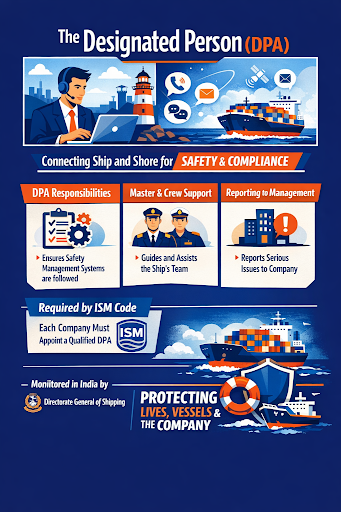
In maritime operations, safety and compliance are always critical. One important role that connects ships at sea with the company on shore is the Designated Person Ashore, commonly known as the DPA. This person ensures that safety management systems are followed and that communication between ship and shore remains clear at all times.
Think of the DPA as the main contact for the ship when serious matters arise. They support the master, guide the crew, and report issues to management. Under the International Safety Management Code, every company holding a Document of Compliance must appoint a qualified DPA. In India, this requirement is monitored by the Directorate General of Shipping.
Choosing the right person for this role is not optional. It protects lives, vessels, and the company itself.
Why DPA Qualifications Are Important
The International Safety Management Code (ISM) Code has been in force since 1998. It requires shipping companies to maintain a structured safety management system. The DPA plays a central role in this system. They monitor safety practices, ensure audits are completed, and help manage emergencies.
In India, DGS Engineering Circular No. 106 of 2009 clarified who can be appointed as a DPA. The intent was simple. Companies should not be limited to only foreign-going masters. Experienced professionals from coastal shipping, offshore vessels, and classification societies were also considered suitable.
This widened talent pool helps companies find DPAs with real operational knowledge. It also improves safety standards across different vessel types. If a company fails to appoint a qualified DPA, the consequences can be serious. DOC suspension, operational delays, and safety incidents may follow.
A qualified DPA is not just a regulatory requirement. It is a practical safeguard.
Minimum Qualification Categories Explained
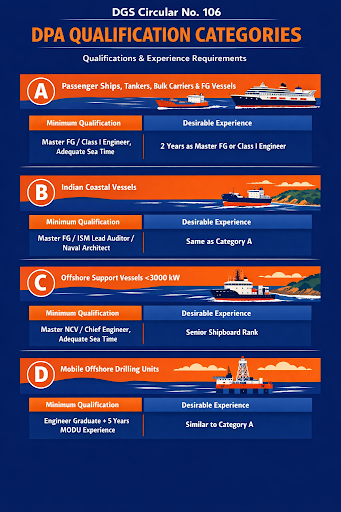
DGS Circular No. 106 groups DPA qualifications into four categories. These categories depend on ship type and area of operation. Adequate sailing experience generally means sufficient sea time to understand shipboard operations and emergency response.
| Category | Vessel Type / Operation | Minimum Qualification | Desirable Experience |
| A | Passenger ships, oil tankers, gas carriers, bulk carriers, cargo ships, and all foreign-going vessels | Certificate of Competency as Master Foreign Going or Class I Engineer, adequate sailing experience, and a responsible shore-based position | Two years of experience sailing as Master FG or Class I Engineer |
| B | Same vessel types as Category A but operating only in Indian coastal waters | Same as Category A, or Naval Architect with minimum five years as ISM Lead Auditor with a classification society, plus vessel-specific operational and managerial experience and a responsible shore position | Same as Category A |
| C | Offshore Support Vessels operating on the Indian coast with engines below 3000 kW, and other coastal cargo ships below 3000 kW | Certificate of Competency as Master or Chief Engineer (Near Coastal Voyage), adequate sea experience, and a responsible shore position, or Naval Architect with minimum two years ISM Lead Auditor experience | Experience equivalent to senior shipboard rank |
| D | Mobile Offshore Drilling Units operating on the Indian coast | Graduate in Mechanical, Electrical, or Petroleum Engineering with minimum five years experience on MODUs and a responsible shore position, or qualification as per Category A | Experience similar to Category A standards |
Responsibilities Beyond Basic Qualifications
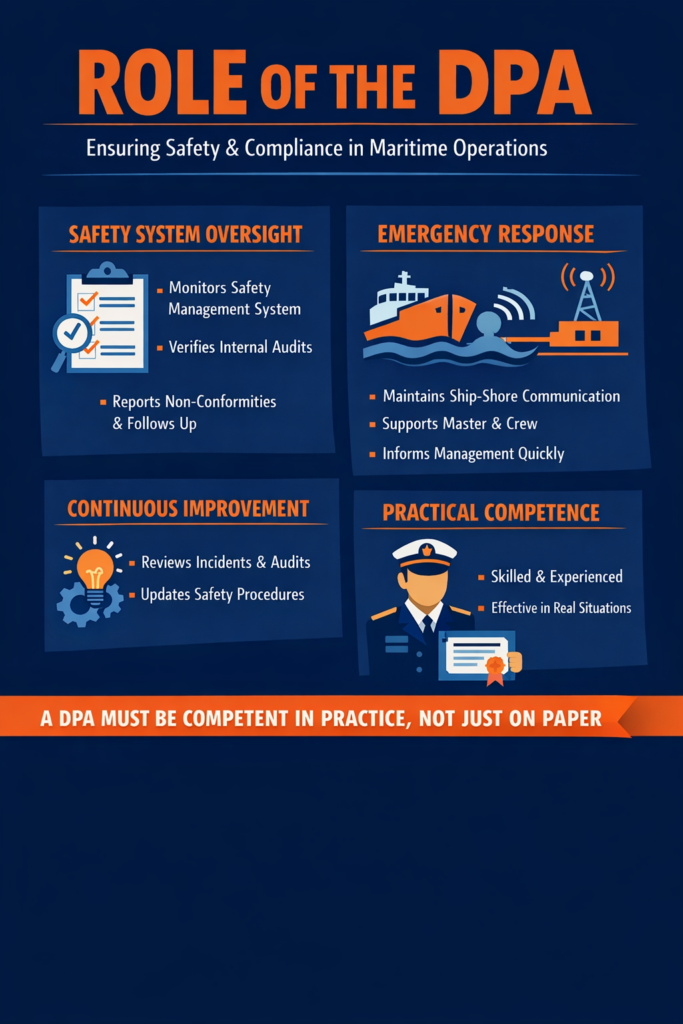
Meeting qualification criteria is only the first step. The actual responsibilities of a DPA are defined in DGS Engineering Circular No. 101 of 2008.
The DPA monitors the implementation of the Safety Management System. Internal audits are verified. Non-conformities are reported. Corrective actions are followed up.
During emergencies, the DPA ensures communication between ship and shore remains active. Support is provided to the master and crew. Management is informed without delay.
The DPA also plays a role in continuous improvement. Lessons from incidents and audits are reviewed. Safety procedures are updated when needed.
Companies must ensure their DPA is competent in practice, not only on paper.
Updates and Compliance Considerations for 2026
It is important to note that Engineering Circular No. 106 of 2009 has been superseded by M.S. Notice 09 of 2014. While the core principles remain similar, refinements may exist. Shipping and RPSL Companies should always verify the latest requirements on the DGS website.
In recent years, more attention has been placed on digital safety systems and cybersecurity. DPAs are expected to understand these areas as part of modern safety management.
Practical Steps for Shipping Companies
Start by reviewing your current DPA against applicable qualification categories. Identify gaps early.
Ensure experience is well documented. Sea service records, audit reports, and appointment letters should be available.
Training is important. ISM Lead Auditor courses offered by recognized organizations add value.
For offshore and coastal operations, professionals from classification societies often bring strong compliance knowledge.
Proactive reviews help avoid inspections issues and operational delays.
Final Thoughts
The role of the DPA is not just about regulations. It is about people, safety, and responsibility. A capable DPA helps create trust between ship and shore. They support crews during difficult situations and guide companies toward safer operations.
Choosing the right DPA strengthens your safety culture. It also protects your business in the long run.
For the latest updates, always refer to official DGS publications. Professional advice should be taken where required.
Frequently Asked Questions Designated Person Ashore
1. Is appointing a Designated Person Ashore mandatory in India?
Yes. Every shipping company holding a valid Document of Compliance must appoint a Designated Person Ashore. This is required under the ISM Code and enforced by the Directorate General of Shipping. Without a qualified DPA, a company may face non-compliance issues during audits.
2. Can a Naval Architect be appointed as a DPA?
Yes, in certain cases. A Naval Architect can be appointed as a DPA if they meet the experience requirements mentioned in the relevant DGS category. This usually includes ISM Lead Auditor experience with a classification society and holding a responsible shore-based position.
3. Does the DPA need recent sailing experience?
Recent sailing experience is preferred but not always mandatory. What matters is adequate and relevant sea experience for the vessel type operated by the company. The DGS focuses more on competence, understanding of operations, and safety management knowledge.
4. Can one DPA handle multiple vessel types?
Yes, a single DPA can oversee multiple vessel types if they meet the highest qualification category applicable. The company must ensure the DPA has sufficient knowledge and experience to manage safety systems across all operations.
5. What happens if a company appoints an unqualified DPA?
If a DPA does not meet DGS requirements, the company may receive audit non-conformities. In serious cases, the Document of Compliance can be suspended or withdrawn. This can lead to operational delays and commercial losses.