
The Directorate General of Shipping (DGS), under the Ministry of Ports, Shipping and Waterways, operates a centralized Grievance Redressal – Support Unit (GR–SU) to handle a wide range of seafarer issues. This guide breaks down the official seafarer grievance and crisis management process. Following these protocols is essential to ensure that all complaints are addressed promptly, fairly, and transparently, in line with the Merchant Shipping Act, 1958 and the Maritime Labour Convention (MLC), 2006.
How Does DG Shipping’s System for Seafarer Grievance and Crisis Management Work?
This section covers the scope, submission channels, and timelines of the official seafarer grievance and crisis management system.
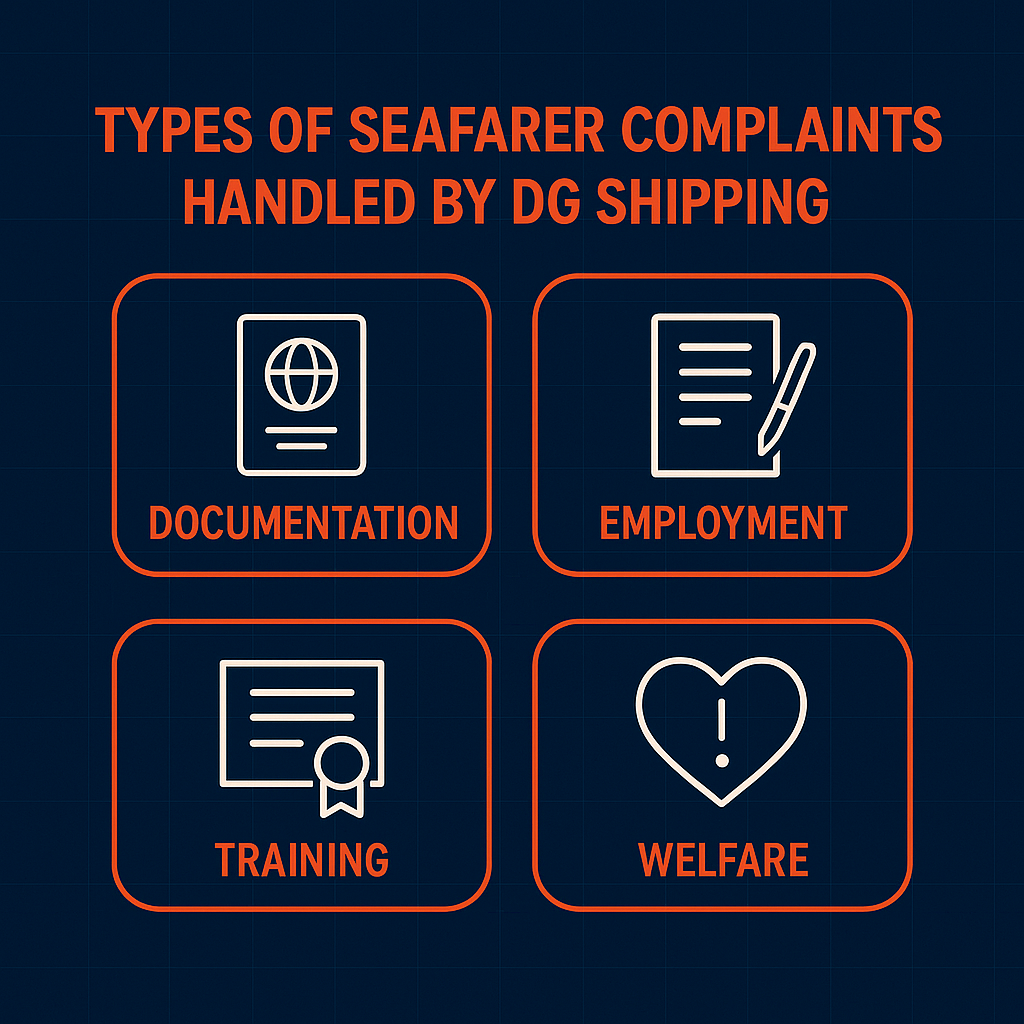
What Types of Complaints Are Covered?
The system, which complements broader frameworks for Standard Operating Procedures (SOPs) for safe legal migration, is designed to handle a comprehensive list of grievances that a seafarer might face during their career.
- Documentation Issues: Yes, the system covers grievances related to your core documents, including your Indian National Database of Seafarers (INDOS) registration, Passport issues, Continuous Discharge Certificate (CDC), and Biometric Seafarers Identity Document (BSID). It also handles requests for corrections to your main seafarer profile.
- Employment & Contractual Disputes: Yes, the system is the primary channel for complaints against Recruitment and Placement Service Licence (RPSL) agencies, cases of monetary or employment-related cheating, fraudulent certifications, and issues with placement before joining a vessel. It also handles critical disputes that occur after joining, such as unpaid wages, poor onboard conditions, repatriation, or contractual disputes after joining.
- Certification & Training: Yes, issues related to your professional certifications are covered. This includes grievances concerning your Certificate of Competency (CoC) and Certificate of Proficiency (CoP) for both Nautical and Engineering streams, as well as your Cookery CoC. Problems with assessments, exams, and training institutes can also be addressed.
- Welfare & Emergencies: Yes, the scope of seafarer grievance and crisis management extends to the most serious situations. This includes issues with death compensation, procedures for a missing seafarer, incidents of piracy and hijacking, and disciplinary actions related to misconduct or alcohol. It also covers disputes related to the Seafarers’ Welfare Fund Society (SWFS) and the Seafarers’ Provident Fund Organisation (SPFO).
How Can a Seafarer Submit a Grievance?
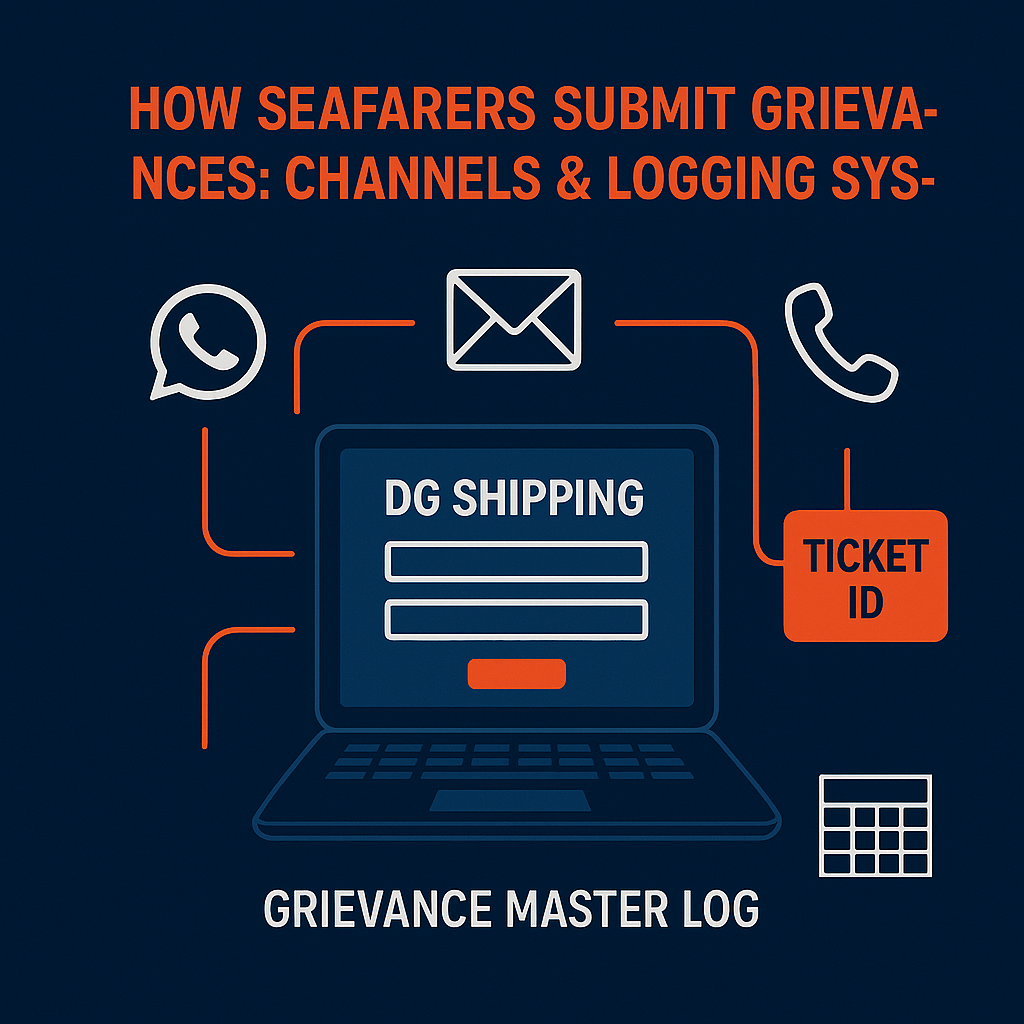
DG Shipping provides multiple channels to ensure grievances can be submitted easily and are formally logged.
- Offline Channels: Yes, you can submit complaints through direct, offline channels. This includes sending a message via WhatsApp, a formal email, making a direct phone call, or even leaving a missed call which will be returned by the support unit.
- Logging Process: When a grievance is received through an offline channel, it is promptly recorded in a “Grievance Master Excel Sheet”. This log includes the date of receipt, complainant’s name, INDOS number, contact details, a detailed description of the issue, and the department it has been assigned to for action.
- Online Portal: For most grievances, you can log a complaint directly through the DG Shipping e-Governance Portal. This is the first step in the formal seafarer grievance and crisis management system, which generates a ticket ID for tracking.
What Are the Official Timelines for Handling Complaints?
The process is governed by a strict Standard Operating Procedure (SOP) to ensure timely action.
- Acknowledgment & Entry: A grievance must be formally acknowledged to the complainant within 1 hour of receipt during working hours. It must also be entered into the Grievance Master Excel Sheet within 1 hour of receipt.
- Follow-Up & Review: The support unit conducts the first follow-up with the assigned department on Day 2 after the grievance was received. A comprehensive review of all open grievances is conducted every Monday to prioritize cases and monitor progress.
- Escalation: If a grievance remains unresolved for more than 7 days from the date of receipt, it is formally escalated to a higher authority, the DDG (Crew), for intervention. The SOP for seafarer grievance and crisis management is time-bound.
What Are the Step-by-Step Procedures for Seafarer Grievance and Crisis Management?
This section details the formal, structured processes for resolving complaints both on the ship and ashore, as part of the official seafarer grievance and crisis management framework.
What is the Onboard Grievance Handling Procedure?
In compliance with the MLC, 2006, Indian flag vessels must follow a set procedure for handling complaints directly on board.
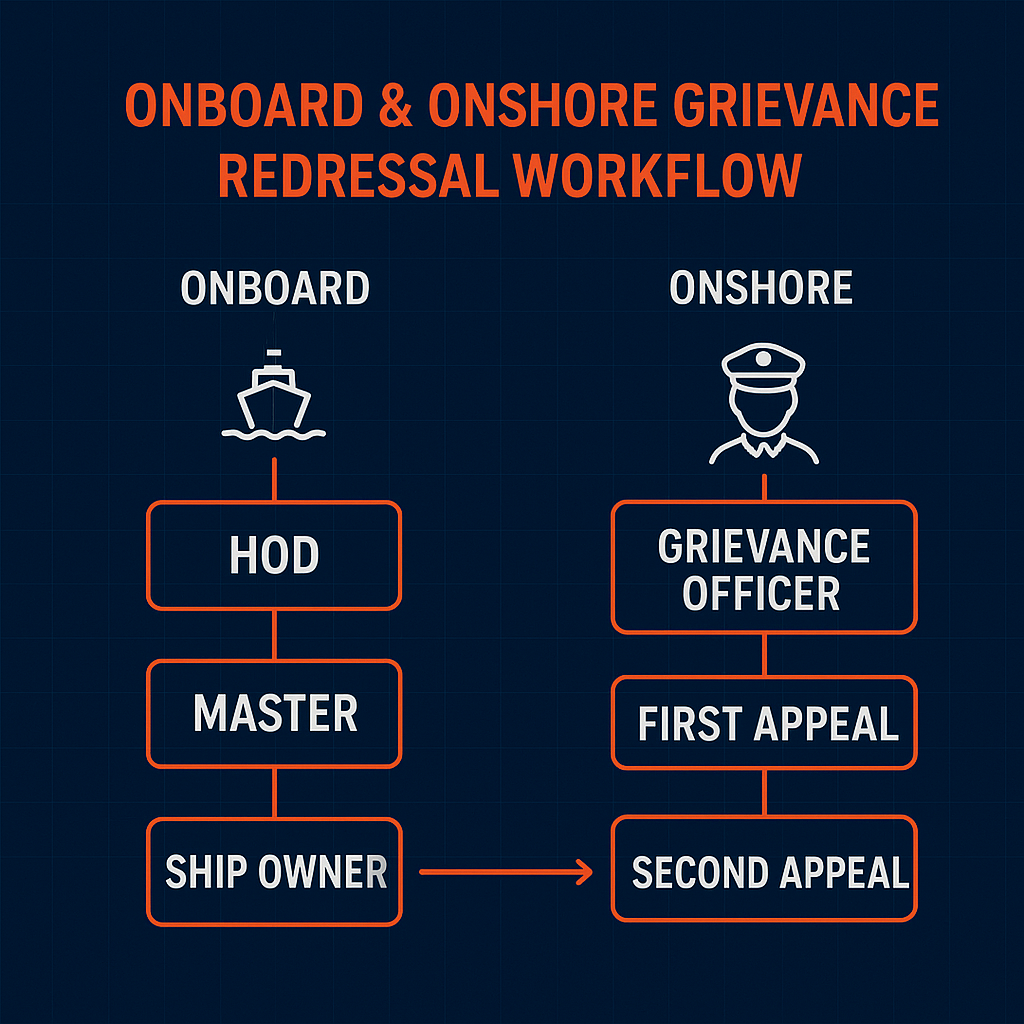
- First Step: An aggrieved seafarer should first submit a written complaint to their Head of Department (Deck/Engine) on board the ship.
- Escalation Path: If the Head of Department cannot resolve the issue within 3 days, it must be referred to the Master of the ship, who has 7 days to handle it. If the Master cannot resolve it, they must refer it to the ship owner, who has a maximum of 1 month to find a solution. Throughout this process, the seafarer has the right to be accompanied and represented by another seafarer of their choice.
- Record Keeping: All complaints and the decisions made must be formally recorded in the ship’s official record book. A copy of the decision must be given to the seafarer, and these records must be kept on board for at least three years for inspection. This is part of the ship-level seafarer grievance and crisis management procedure.
What is the Onshore Grievance Handling and Appeal Process?
If a complaint is not resolved by the ship owner within one month, the seafarer has the right to approach the onshore authorities.
- Designated Officers: A seafarer can submit a written grievance to a ‘Designated Grievance Redressal Officer’. These officers are located at various Mercantile Marine Department (MMD) offices and the offices of the Shipping Masters in Mumbai, Kolkata, and Chennai. The officer must dispose of the grievance within 30 working days.
- First Appeal: If unsatisfied with the decision, the seafarer can file a first appeal with the jurisdictional Principal Officer of the MMD, who serves as the First Appellate Authority [FAA]. This appeal must be filed within 30 days of receiving the initial decision.
- Second Appeal: A final, second appeal can be made to a designated officer in the Directorate General of Shipping [DGS], Mumbai. The decision of the DGS is considered final and binding. This is the final step in the onshore seafarer grievance and crisis management process.
Are There Special Procedures for Women Seafarers?
Yes, specific procedures are in place to handle complaints from women seafarers, particularly concerning sexual harassment.
- Onboard Complaints: Complaints of sexual harassment should be submitted in writing to a “Shipboard Enquiry Committee”. This committee then submits its report to a shore-based “Complaints Committee” within 7 days. A complainant can also report directly to the shore committee if they choose.
- Shore Committee: The shore-based “Complaints Committee” is guided by The Sexual Harassment of Women at Workplace Act, 2013, and must include two senior women seafarers. The members of this committee are officially nominated by DG Shipping.
- Online Reporting: Yes, a separate “Grievance Report for Women Seafarer” facility has been added to the e-governance portal of DG Shipping. This allows women to register grievances specifically related to “Sexual Harassment at workplace” and “Infrastructure and Facilities” online. This provides dedicated seafarer grievance and crisis management support.
How is a Maritime Emergency Handled Under the Seafarer Grievance and Crisis Management Protocols?
This section outlines the specific Standard Operating Procedures (SOPs) for different types of maritime emergencies, which are a key part of the seafarer grievance and crisis management system.
What Should You Do in a Case of Crew Abandonment?
- Warning Signs: Common warning signs of an impending abandonment include the ship being anchored for long periods with no orders, salaries not being paid for more than two months, denial of shore leave, and supplies of food and fresh water stopping.
- Immediate Actions: If you believe you are being abandoned, you should immediately seek outside help from multiple authorities. This includes the Port State Control authority, the Flag State of your ship, the nearest Indian embassy or consulate, DG Shipping, your trade union (like ITF), and local welfare organizations. This triggers the seafarer grievance and crisis management protocol for abandonment.
What is the Process if a Seafarer Goes Missing at Sea?
- SAR and Investigation: The vessel’s Master will immediately inform all parties and initiate a Search and Rescue (SAR) operation. If the seafarer is not found after an extensive search, the search will be called off, and flag inspectors and local law enforcement will board the vessel at its next port of call to conduct an investigation.
- Official Procedures: If the seafarer is found dead, the body is retrieved, and investigations are carried out before the mortal remains are repatriated. If the seafarer is not found, DG Shipping will direct the Shipping Master to cancel the CDC and will issue a Presume Death Certificate (PDC), which allows the Next of Kin to claim compensation. The SAR is a critical part of the seafarer grievance and crisis management plan.
What Happens if a Crew is Arrested or Detained Abroad?
- Initial Steps: If a crew is arrested and either confined onboard or taken to jail, you must immediately contact the ship owners or RPS agents, who will then inform the ship’s Flag State, the nearest Indian embassy or consulate, and DG Shipping.
- Government Role: DG Shipping coordinates with the Ministry of External Affairs (MEA) to provide consular access through the Indian embassy in that country. The government will then provide necessary legal support, ensure the crew’s welfare, and assist in repatriation through diplomatic channels. This involves diplomatic coordination within the seafarer grievance and crisis management system.
What Are the Reporting Procedures for a Pirate Attack?
- Post-Attack Actions: After an attack, any apprehended attackers should be placed in secure confinement. All evidence, including CCTV recordings and crew witness reports detailing distinguishing features of the attackers, should be secured for law enforcement. A full inventory of stolen or damaged goods must also be prepared.
- Reporting Channels: An attack must be reported to the designated coastal authorities and the ship’s flag administration (which for Indian ships is the DG Shipping). The IMO also recommends that reports be made to the relevant Rescue Coordination Centre (RCC) for the area. Immediate reporting is vital in the seafarer grievance and crisis management SOP.
Who Manages the Seafarer Grievance and Crisis Management System?
This section identifies the key teams and contact points responsible for the official seafarer grievance and crisis management response.
What is the Role of the DG Communication Centre in a Casualty?
- First Point of Contact: The DG Communication Centre is manned 24×7 and is considered the first point of contact for any marine casualty involving an Indian vessel, any vessel in Indian waters, or any Indian national.
- Actions: Upon receiving information, the DG Communication Centre initial actions include informing senior DG Shipping officers by phone, sending a ‘first information report’ to the owner or manager for updating in the online casualty module, and intimating the nearest Maritime Rescue Co-ordination Centre (MRCC). It is the central point for seafarer grievance and crisis management.
Who is on the Official Crisis Management Team?
- Composition: A dedicated “Crisis Management and Reaction Group” is in place, headed by the Director General of Shipping as Chairman. Members include the Additional DG, Deputy Director Generals from the Crew and Training branches, the Principal Officer of the MMD, and other designated Nautical Surveyors and Directors.
- Role: The primary role of this dedicated team for seafarer grievance and crisis management is to synergize collective expertise to ensure the prompt and effective handling of incidents. The team also provides technical assistance, gives advice to minimize damage, coordinates with authorities, and interacts with the media.
Where Can You Find the Official Contact and Escalation List?
- Key Contacts: Yes, Chapter 8 of the Crew Manual provides comprehensive contact tables for emergencies. This includes names, phone numbers, and emails for key personnel and control rooms, with clear first and second escalation levels for DG Shipping , the Indian Navy HQ , the Indian Coast Guard HQ , and regional MRCCs in Mumbai, Chennai, and Port Blair.
Why is This Structured System Important for Seafarers?
The official system provides clear, time-bound, and transparent pathways for resolving issues, from contractual disputes to life-threatening emergencies, ensuring that no complaint is lost and that every crisis has a defined response protocol. Knowing these procedures empowers seafarers, protects their rights, and reinforces the commitment of Indian maritime authorities to their welfare and safety. This structured seafarer grievance and crisis management system is a vital safety net for every Indian mariner. For expert assistance in navigating these modules or understanding your rights as a seafarer, you may contact us anytime.
Frequently asked questions
1. How can a seafarer check the status of a grievance after submitting it?
After submitting a grievance on the DG Shipping e-governance portal, a Ticket ID is generated. Seafarers can track the status by logging into their DG Shipping profile and visiting the “Grievance Module”. For offline complaints, the support unit updates the Grievance Master Excel Log, and acknowledgment is sent via email/WhatsApp.
2. Can a seafarer raise a complaint anonymously?
No. To maintain transparency and allow proper verification, all grievances must include INDOS and personal details. Anonymous complaints are not processed under the official SOP.
3. What should a seafarer do if an onboard grievance is ignored or mishandled?
If a grievance is not resolved onboard within the maximum 1-month timeline, the seafarer has the right to escalate directly to the Designated Grievance Redressal Officer at MMD/Shipping Master and then to First Appeal and Second Appeal authorities if still unresolved.
4. Are emergencies like abandonment, arrest abroad, or piracy handled through the same grievance system?
Yes. Emergencies fall under Crisis & Emergency Management SOPs. These are handled immediately by the DG Communication Centre (24×7) and the Crisis Management & Reaction Group, with coordinated support from the MEA, Indian embassies, MRCC, and Coast Guard depending on the situation.
5. Can a seafarer file multiple grievances at the same time?
Yes. A seafarer can file multiple grievances if they relate to different issues, such as documentation, employment, certification, or welfare. Each grievance will receive a separate Ticket ID and will be handled by the respective department under the SOP timelines. However, duplicate tickets for the same issue may be merged by the support unit.