
Table of Contents
The provisions regarding penalties within The Seafarers’ Code of Conduct, introduced by the Indian government’s Directorate General of Shipping (DGS), emphasize professional ethics, safety, and compliance for ships flagged or crewed by Indians. The code of conduct, featured as part of recent government regulations by DGS, as well as the Merchant Shipping Act, also prescribes detailed penalties like fines, forfeitures, imprisonment, and suspension of licenses, among others, due to acts like misconduct or negligence. The provisions regarding penalties of the Seafarers’ Code of Conduct are linked to other regulations in the Indian RPSL License.
Why Do Seafarers’ Code of Conduct Penalty Provisions Exist?
The Code of Conduct for Seafarers has been made comprehensive with the inclusion of penalty clauses to protect lives and prevent incidents in the maritime industry. The Code declares acts such as possession of narcotic substances, disobedience, and fraud as unlawful acts that carry severe punishments in line with DGS. The Code closely relates to Certification in MLC 2006 in connection with welfare in terms of DGS Order 2025.
These regulatory provisions are consistent with the Maritime Labour Convention 2006 Amendments, which encompass fair treatment. Non-compliance may have negative ramifications for one’s career, including being banned in one’s profession, which has been seen in the case of blacklisting, as presented in the company information given by RPSL.
What Penalties Apply for Common Seafarer Misconduct?
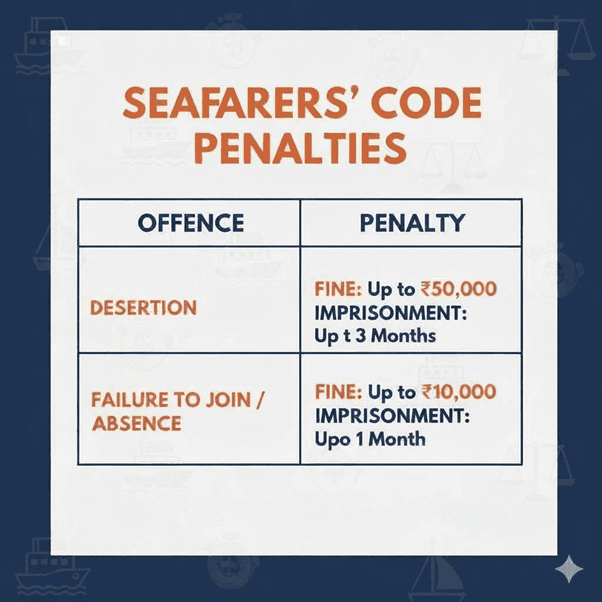
Under the Merchant Shipping Act, section 194, desertion, disobedience, and property damage, along with desertion, disobedience, and property-related crimes, can lead to punishment in the form of confiscation of wages, a fine of ₹500, and a jail term of 3 months (Section 194). The punishment for desertion includes the loss of property, wages, and imprisonment for 3 months (Section 191).
When Do Severe Penalties Like Imprisonment Apply?
When sailors act in a manner that disregards orders or when there is deliberate misrepresentation of documents or risking vessels, extreme penalties like imprisonment are applicable: Section 206 (aggregating a jail term of 3 months along with a fine of ₹200), or violation of oil discharge norms (fines up to a maximum of ₹5 lakhs for Section 356C). For each violation, there may be a suspension of the CDC/CoC or a ban to sail for 2 years.
Check for health regulations compliance using the list of approved doctors by the DG Shipping, to avoid being fined for health-related matters. For Startups, refer to Maritime Consultancy and RPSL Startups.
How Are Penalties Enforced Under the Code?
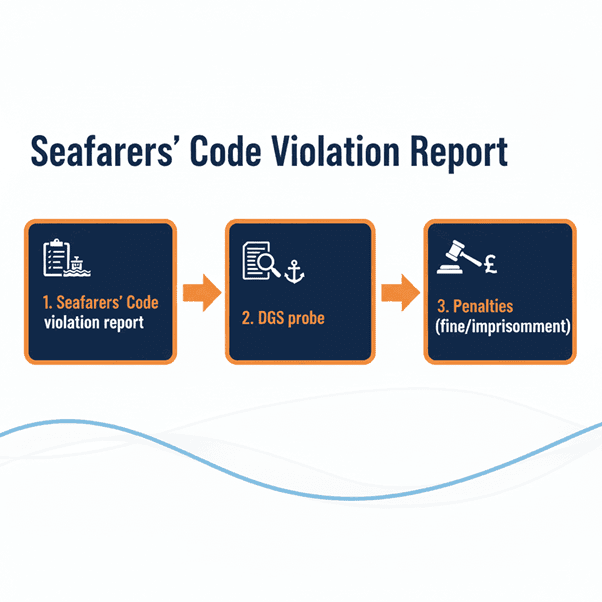
Investigations are carried out by DGS, accompanied by fair hearings and other punitive actions such as suspension of licenses and imposition of fines in enforcing punishments, based on underlying guidelines that are lenient towards innocent errors but stiff towards deliberate behavior as per the Code Manual. It is obligatory for RPSL agencies to make such reports; failure could lead to blacklisting.
Look for new RPSL companies to identify recruiters who comply with the law. Check the Contact Us page at Legalbabu for expert help.
What is the maximum fine for an oil discharge violation?
Under Section 356C, the amount provided for the masters of the tankers will not exceed ₹5 lakhs.
Can seafearers appeal code penalty points?
Yes, after a fair hearing conducted by the DGS enforcement.
Do penalties affect RPSL agencies?
Yes, non-compliance may result in a fine or blacklisting.
What happens for fraudulent certification?
Suspension of sailing rights for a period of a minimum of 2 years and CDC suspension.
What is the Risk Matrix in Seafarers Code Penalties?
The Risk Matrix assesses violation severity based on impacts to people, environment, assets, and reputation, guiding penalty selection list.
How Does the Star System Affect Seafarers Careers?
Stars track compliance for promotions/pay; losses from complaints lead to restricted placements or demotions under RPSL monitoring.
When Can RPSLs Suspend Seafarers Internally?
For minor violations via SMS, before DGS; escalates for repeats or risks per the sanction matrix.
What Defenses Can Seafarers Use in Investigations?
Necessity, duress, due diligence, or honest mistakes are evaluated during probes for fair outcomes.
How Do Unions Support in Complaint Processes?
Unions monitor conditions, provide legal aid, negotiate standards, and ensure rights under MLC 2006.