
Table of Contents
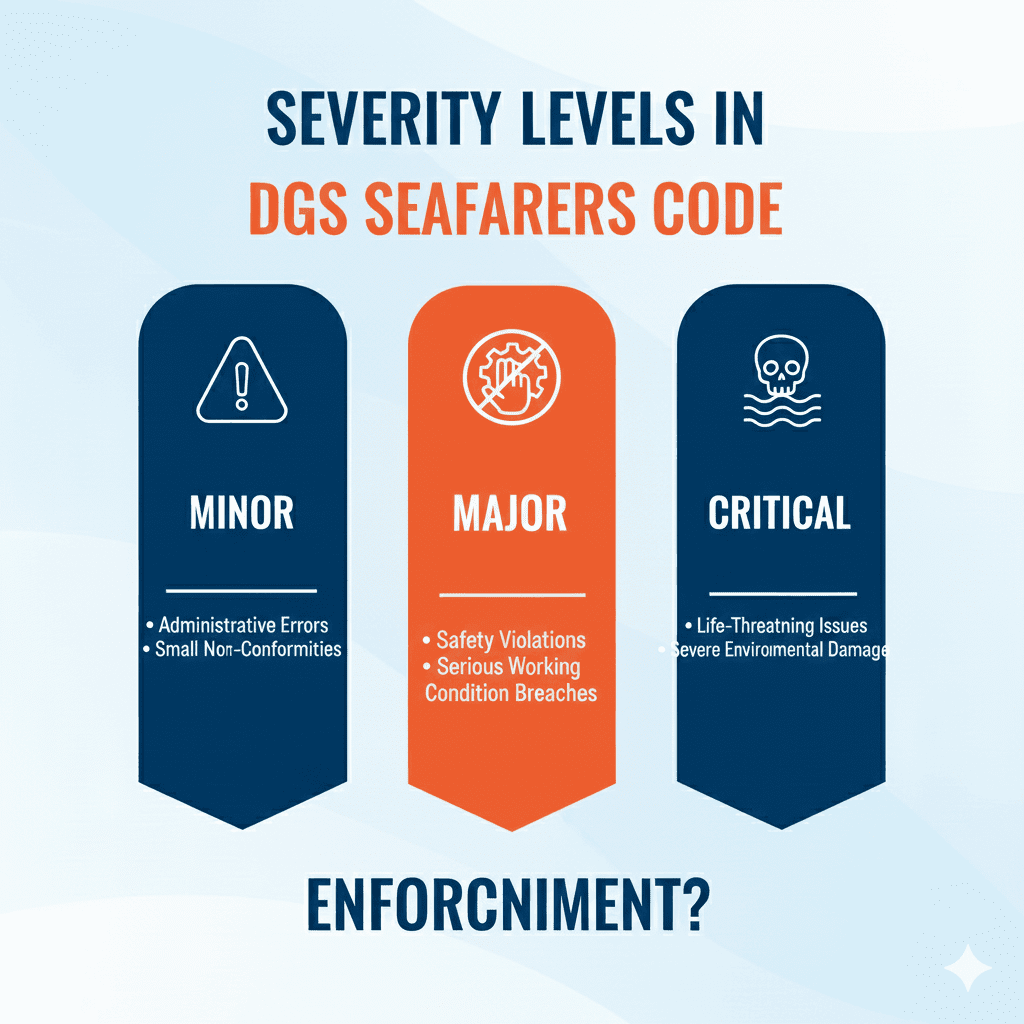
According to the DGS Seafarers Code of Conduct Compliance Enforcement Manual, issued by the Directorate General of Shipping, violations are categorized into three levels of severity based on their potential for risk to safety, environment, assets, and reputation. The present framework, applicable from 1 January 2026, will ensure that proportionate penalties are imposed on the seafarers, RPSL companies, and other stakeholders. Their levels can thus help ensure compliance with the Merchant Shipping Act and international standards, such as the Maritime Labour Convention 2006.
What Is the DGS Seafarers Code?
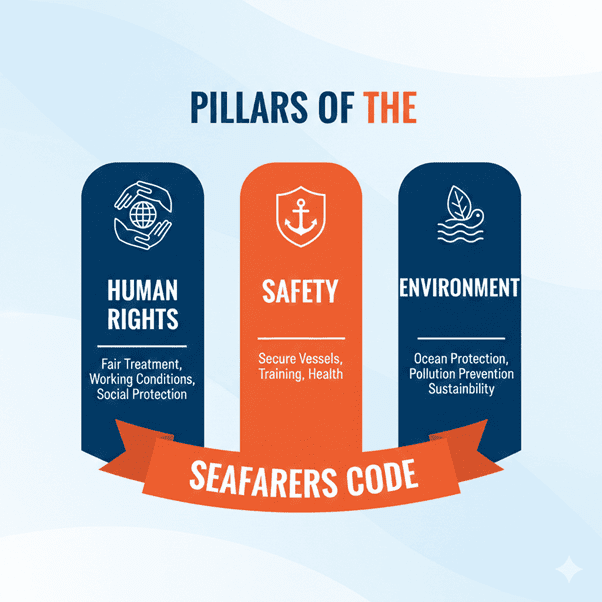
The DGS Seafarers Code initially comes from DGS Order No. 10 of 2025, which established a Compliance Enforcement Manual that was to guide seafarer behavior, well-being, and safety. The initiative covers human rights, health, safety, the principle of equal opportunities, training, social responsibility, care for the environment, and sustainability. The enforcement mechanism promotes voluntary compliance through warnings, suspension, and prosecution of the defaulters.
This guide is targeted at seafarers, RPSL License holders, training institutes, and ship managers coming under the purview of the DGS. It is in line with the standards laid out by STCW, SOLAS, MARPOL, and even the 2006 amendments to the Maritime Labour Convention. Incidents of failure to comply trigger detection, examination, and remedial measures using risk assessment mechanisms.
Why Do Severity Levels Matter in DGS Seafarers Code Enforcement?
This enables clear severity levels to provide a transparent and consistent scope of punishment according to risk. This further helps to improve trust in Indian shipping services. Here, they apply a risk matrix for assessing risks categorized into impacts on people ranging from first aid to death, impacts on the environment ranging from a small spill to massive pollution, impacts on assets ranging from a small loss to loss in millions, and reputation ranging from a local to an international outcry.
IT breaches of a low magnitude for RPSL Company Information trigger escalations in penalties, which later impact operations. Mariners’ certificates are suspended, and a firm’s license could be revoked. It is also associated with general rules and regulations, such as DGS Order 2025, which aims at promoting safety in the industry.
What Defines Severity Level 1 Violations in DGS Seafarers Code Enforcement?
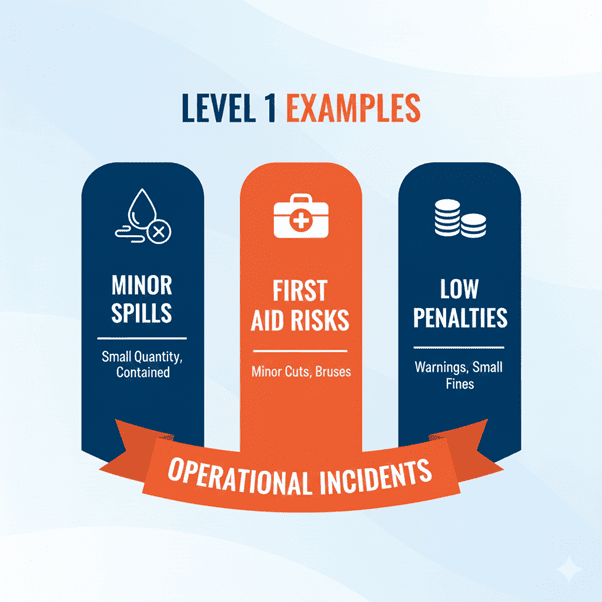
Severity Level 1 infractions include minor infractions with low safety risk. These infractions may include technical non-compliance where harm is unlikely to occur. Examples of this include first-time instances of fake logbook entries, which incur a six-month suspension, and off-duty breaches of the DA policy, also incurring a six-month penalty. For initial infractions, the penalties are mild: warnings or brief limitations.
The Sanction Matrix classifies first-level infractions as “Low”, then ” Moderate ” for subsequent occurrences. Oral counseling can help fix the unintentional mistake. New RPSL companies have the chance of remediation following initial minor infractions.
How Does Severity Level 2 in the DGS Seafarers Code Enforcement Work?
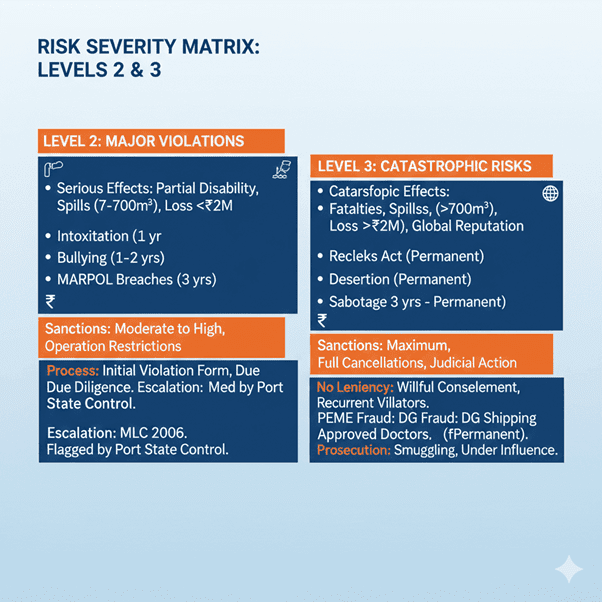
“Level 2” responds to major offenses that could cause serious consequences like impairment, leakage ranging from 7 to 700 cubic meters, or losses up to ₹2 million. “Examples” are: “suspension for one year for drunkenness during duty, one to two years for bullying, three years for non-compliance with MARPOL Regulations.” The restrictions for operation are “moderate to high level.”
Investigations use an Initial Violation Process Form, which considers defences such as due diligence. The progression of escalated repeated contacts is connected to the MLC 2006 Certification, ensuring a fair procedure. The port state control flags vessels during inspections.
What Makes Severity Level 3 in the DGS Seafarers Code Enforcement Catastrophic?
In level 3, there are catastrophic offenses, which include deaths, spills of over 700m3, damages of over ₹2 million, or damage to global reputation. The offenses of negligence resulting in loss of life or pollution will result in a permanent ban, as will abandonment. Sabotage leading to loss of life carries a sentence of 3 years, followed by a permanent ban. Stricter punishments shall be enforced.
There shall be strictly no tolerance shown to those who intentionally withhold information and repeat offenders. Connections to the List of DG Shipping Approved doctors for PEME. Prosecutors are laying charges regarding smuggling and offences related to being under the influence.
How Is Severity Determined Using a Risk Matrix?
In the initial phase, a Risk Matrix/Tabla de Sanciones will be used. The first step involves calculating the level of severity based on impact, where lethal effects have a level three. The second step includes the Sanction Matrix, based on a certain range that has been described, such as level 3, which falls under “High” in the first offense. There exists a separate table available for individuals, as well as organizations.
Important factors include: past wrongs, the motives of the wrongdoer, and justifications such as necessity and due diligence. The entries with the highest levels of gravity receive prioritized treatment. In seeking compliance guidance, links are made to the maritime consultancy firm RPSL Startup.
| Severity Level | People Impact | Environment | Asset Loss | Reputation | 1st Violation |
| Level 1 (Minor) | First Aid | Spill <7m³ | <₹5000 | Minor local | Low (Warning) |
| Level 2 (Major) | Disability | Spill 7-700m³ | ₹5k-2M | Major media | Moderate-High |
| Level 3 (Catastrophic) | Fatality | Spill >700m³ | >₹2M | International | High-Max (Cancellation) |
When Are Penalties Escalated?
Penalties become harsh depending on the number of repeated offenders: First Offense: Low to Moderate; Second Offense: Moderate to High; Third Offense: High to Maximum. Unreported results of surveillance investigations magnify the levels. Malicious reporting will provoke a suspension ranging from 3 to 12 months.
The show cause notice provides a right to natural justice before suspension/cancellation. Appeals to the higher authorities within the Department of General Services can be exercised.
Why Comply with DGS Enforcement?
By complying, one avoids negative effects from the star system, supports the INDOS Database, and fits into the effects under DGS Order 2025. It encourages voluntary reporting and has connections with SMS. It increases seafarers’ welfare standards, as per the Maritime Labour Convention 2006.
What is Severity Level 1 in the DGS Seafarers Code?
Minor violations posing remote harm risk, such as first-time fake logbook entries or off-duty drug/alcohol breaches. Typical penalty: 6-month certificate suspension or warning.
How does Level 2 differ from Level 1?
Level 2 involves major impacts like partial disability, medium spills (7-700m³), or losses up to ₹2M. Sanctions escalate to moderate-high: 1-2 year suspensions, operations restrictions.
What triggers Level 3 penalties?
Catastrophic outcomes—fatalities, spills >700m³, losses >₹2M, global reputation damage. Results in permanent bans, license cancellations, and judicial prosecution.
Who uses the Risk Matrix?
DGS officers/investigators apply the risk matrix for initial severity classification during the detection/investigation phases.
Can defenses reduce severity?
Yes, proven defenses like necessity, due diligence, or duress may downgrade levels or sanctions.
What is the first violation sanction for Level 2?
Moderate actions: e.g., 1-year suspension for duty intoxication, 3-year suspension for MARPOL breaches.
How to report violations?
Complete the Initial Violation Process Form with WHO/WHAT/WHEN/WHERE/WHY/HOW details; submit to DGS HQ immediately.
Does RPSL face the same levels?
Yes, identical severity tiers apply; repeats escalate to license suspension/cancellation per matrix.