
Table of Contents
The DGS Star System assesses the compliance of seafarers through the awarding of positive stars for outstanding performance in safety standards, skills, and professionalism, and the deduction of stars for non-compliance with the Seafarers’ Code of Conduct under the guidelines within the Compliance Enforcement Manual. This was introduced through DGS Order No. 10 of 2025 to come into force on January 1, 2026, to promote compliance with the Merchant Shipping Act and the MLC 2006. The levels within DGS enforcement relate to the promotion of accountability among seafarers and RPSL companies.
What Is the DGS Star System for Seafarers?
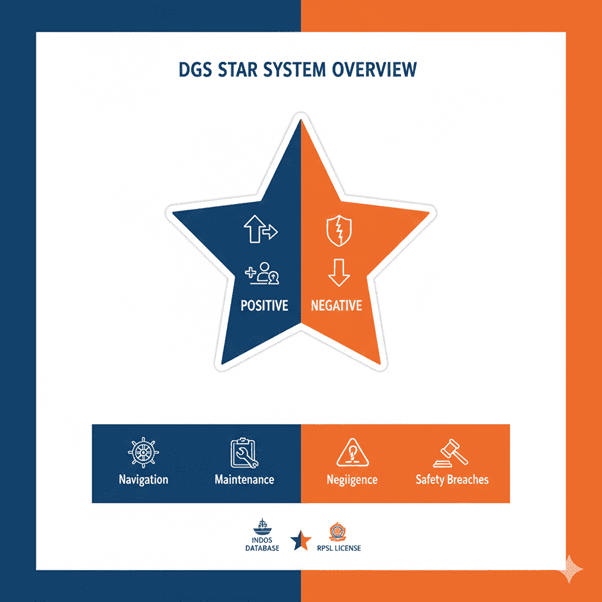
The proposed DGS Star System is a rating system based on performance, as described in section 6.7 of the manual. Seafarers are rewarded stars according to their own rating, rating by their counterparts, as well as their rating according to their supervisors regarding their ability to navigate, maintain ships, and their obedience to standards. Negligence, violation, or misconduct is punished through deductions of negative stars.
It encourages a professional culture through linkage to the INDOS database for a clear and transparent system. In contrast to fixed penalties, it provides incentives for excellence and penalized performance to complement the RPSL License regulation.
Why Was the Star System Introduced?
The star system ensures safety through encouragement of compliance with amendments of the Maritime Labour Convention of 2006, which results in a reduced level of violative cases. Indiscipline is demotivated through loss of stars, as well as reduced privileges such as those relating to career advancement. The Indian shipping sector benefits from a clear understanding of requirements, a positive competitive field, and recruiting bright minds.
This tackles existing provincial problems with the DGS Order 2025, ensuring a better image under international monitoring. Based on voluntary compliance concepts, emphasizing no harsh punishment for slight violations.
How Do Seafarers Earn Stars?
Stars fall within four major areas of navigation competency and skills, protocol adherence and safety compliance, teamwork and conflict resolution, and timely task completion. Rewards may be given for positive behavior, such as hazard reporting and environment-friendly actions, in the form of additional bonuses or the chance to be a leader. There is peer influence and leaderboards that allow individuals to be more accountable.
Evaluation involves the inputs of supervisors and feedback from peers to ensure fairness. Having access to a list of DG Shipping-approved doctors for fitness compliance improves rating scores.
What Causes Star Losses?
Violations of various levels of seriousness incur negative stars: Level 1 for minor infractions (e.g., logbook errors), Level 2 for major infractions (e.g., a breach of Drug and Alcohol policy), and Level 3 for catastrophic infractions (e.g., reckless accidents). Thresholds trigger suspensions, fines, or the banning of vessels. Repeat offenders are punished with long-term financial penalties.
Rewarding reporting earns stars; integrates with approval matrices. The operational output of the new RPSL companies is influenced by the low-rated seafarers. Explore MARPOL compliance for seafarers to avoid environmental stars.
How Are Stars Assigned in the DGS Star System?
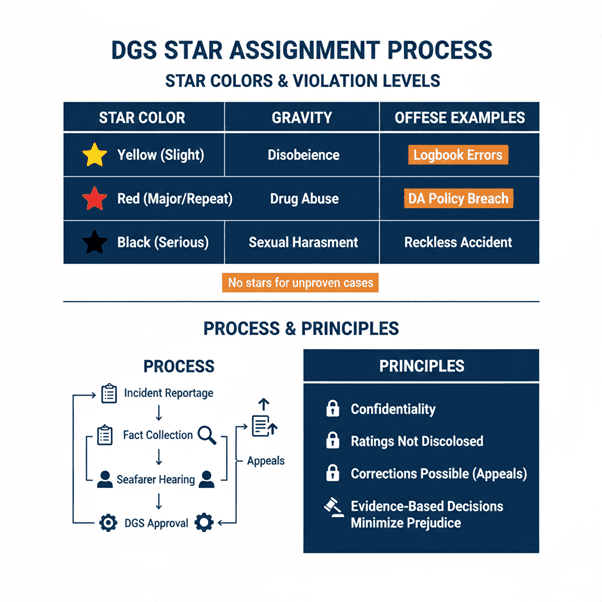
The procedure of allocating stars to these cases includes incident reporting, collection of facts, hearing of the seafarers, and approval from the DGS authorities. Depending on the gravity of the incident that occurred, it is either yellow (indicating slight offenses like disobedience), red (major/severe offenses such as drug abuse), or black (serious behavior like sexual harassment). Stars are not allocated in cases that have not been proved.
Confidentiality refers to whom the DGS views as ratings that are not disclosed. Appeals allow corrections to be made. Decisions made with evidence minimize the possibility of prejudice.
| Star Color | Misconduct Examples | Duration/Impact |
| Yellow | Minor insubordination, tardiness | 6-12 months, alert on renewal |
| Red | Alcohol on duty, bullying | 1-2 years, limits promotions |
| Black | Theft, sabotage, harassment | Permanent/indefinite, CoC suspension |
Why Maintain Confidentiality in Star Ratings?
Confidentiality protects the seafarer from employer prejudice, the kind that only DGS/DSEO can appreciate in the context of the relevant proceedings. Access is denied to RPSL/employers. However, alerts serve to notify them of conflicting actions like renewals and achieve a balance of oversight with fairness.
It complies with the standard of non-discrimination under the MLC 2006. See the DGS welfare measures for entitlements.
When Can Seafarers Appeal Star Ratings?
Appeals can be filed after notification and are usually provided within 15-30 days internally through the DGS procedures or the appellate authority. Evidence needs to be provided at hearings, and determinations reached are reviewable in nature. Schedules are clear to ensure fairness, even for sailors at sea.
How Does the Star System Impact Seafarer Careers?
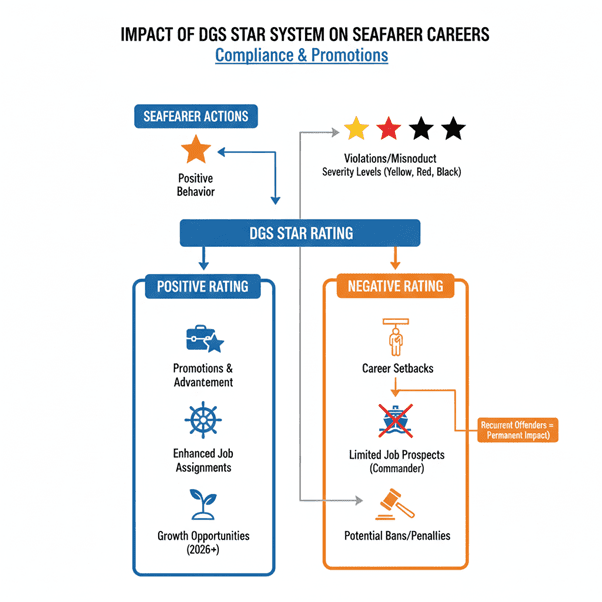
Stars influence job ratings, career advancement, and assignments; a black star may cause a commander to be temporarily relieved of duty. Positive behavior establishes uncredited opportunities for growth.
What Is the Purpose of the DGS Star System?
The DGS Star System monitors seafarer conduct to ensure accountability, promote excellence, and enhance safety standards as outlined in DGS Order 10 of 2025. It categorizes performance to reward compliance and deter violations across Indian maritime operations.
Why Is Seafarer Confidentiality Maintained in Star Ratings?
Seafarer confidentiality prevents discrimination by employers or RPSLs, ensuring fair hiring based on merit rather than past minor issues. Ratings remain accessible only to DGS and authorized officers.
When Do Yellow Stars Expire for Seafarers?
Yellow stars expire after proven improvement through a clean record period, typically 6-12 months without incidents, verified by DGS reviews.
Who Reports Incidents for Star Downgrades?
Ship masters, RPSLs, or DGS officials report incidents for star downgrades through formal channels like official portals or investigations.
What Evidence Supports Star Assignments?
Evidence includes VDR footage, witness statements, documents, and medical reports reviewed in fair hearings for objective assignments.
How Can Seafarers Avoid Red Stars?
Seafarers avoid red stars by strictly adhering to the code of conduct, reporting potential issues early, and completing regular training programs.
Why Appeal a Black Star Immediately?
Appealing a black star immediately suspends penalties, allows evidence review, and restores certifications faster during the process.
When Is Star Rating Visible to Seafarers?
Star ratings become visible during e-governance logins for CDC renewals, queries, or certification processes.
What Training Helps Maintain Green Stars?
STCW modular courses, advanced safety training, and DGS-approved programs help maintain green stars by demonstrating ongoing competence.