

Table of Contents
The Directorate General of Shipping (DGS) of India has introduced a draft order in late 2025 to revise the age norms for vessels operating under the Indian flag and foreign flagged vessels seeking licenses as per the Merchant Shipping Act, 2025. This draft order, born out of extensive stakeholder consultations and independent studies, aims to modernize the Indian fleet by setting clear age-related entry and exit age criteria for various ship categories, while considering economic realities and evolving global maritime safety and environmental standards.
Background and Need for Age Relaxation
India’s Directorate General of Shipping earlier issued age norms in 2023 placing a 25-year cap for the acquisition of certain types of vessels such as oil tankers, bulk carriers, and general cargo vessels. However, stakeholders representing shipowners and operators raised concerns about the rigidity of these limits, given the complexities of vessel construction, financial challenges in fleet replacement, and limited availability of newer suitable ships.
Responding to these concerns, DGS appointed the Indian Institute of Management (IIM) Indore for an independent study, which validated the need for an age-based regulatory framework but recommended prudent relaxations for specific categories based on vessel complexity, market conditions, and socio-economic impacts. The draft order reflects these recommendations and introduces a more calibrated approach to fleet age management, allowing for phased modernization while maintaining safety and environmental compliance.
Key Features of the Draft Order
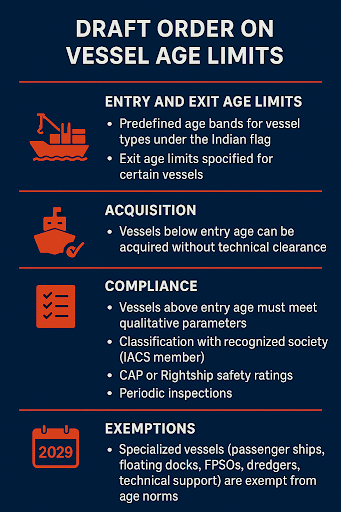
The draft order specifies age bands or “entry age” limits for different vessel types at which they may be registered under the Indian flag or licensed for operation within Indian waters. It also establishes “exit age” limits beyond which vessels are generally not permitted to operate unless they comply with specific sustainability indexing and safety criteria.
- Vessels below the entry age threshold can be acquired without prior technical clearance.
- Vessels above the entry age require compliance with qualitative parameters including classification with a recognized society like IACS member, obtaining CAP or Rightship safety ratings, and periodic inspections.
- Certain specialized vessels, such as passenger vessels, floating docks, FPSOs, dredgers, and other technical support vessels, like ETV’s are exempt from these age norms due to their operational complexities.
- Existing vessels operating before the issuance of this order may continue until a specified transition period up to 2029 or extendable up to 2031 subject to review and compliance with sustainability indexing.
The order covers a wide spectrum of vessel types with tailored age norms, for example:
| Vessel Type | Entry Age Limit | Exit Age Limit | Key Conditions |
| Oil Tankers | 15 years or below | 25 years | CAP 1 hull and CAP 2 machinery rating beyond 15 years; no second-hand acquisition beyond 20 years |
| Bulk Carriers/General Cargo | 15 years or below | 25 years | Rightship safety score required; no second-hand acquisition beyond 20 years |
| Offshore Fleet | 15 years or below | 25 years (30 for DP2 vessels) | OVID inspections from 15 years onwards |
| Gas/Chemical Carriers | 20 years or below | 30 years | CAP ratings and other survey requirements beyond 20 years |
| Harbour Tugs | 20 years or below | 30 years | Class certification and operational maintenance required |
| Container Vessels | 20 years or below | 30 years | Annual surveys mandated beyond 20 years |
| Non-self-propelled Cargo Barges | 20 years or below | 25 years | BIQ inspections and regulatory oversight |
Safety and Sustainability Emphasis

A fundamental objective of the draft order is to foster fleet modernization aligned with global maritime safety standards and environmental goals, particularly concerning emissions reduction and greenhouse gas control as guided by the International Maritime Organization (IMO). Vessels operating beyond certain age limits must comply with a “Sustainability Indexing” system, which will be introduced subsequent to broad stakeholder consultations. This indexing assesses compliance with pollution prevention measures, lifecycle sustainability, and energy efficiency.
The order also incorporates detailed inspection checklists developed by DGS for various vessel types, which include evaluation of structural integrity, safety management systems, pollution controls, lifesaving appliances, and fire fighting equipment. Compliance with these technical and operational standards is critical for permitting vessel operation regardless of their age.
Stakeholder Engagement and Implementation
The draft order was preceded by wide-ranging consultations with Indian shipping associations such as the Indian National Shipowners Association (INSA) and the Indian Coastal and Shipping Carriers Association (ICCSA). Feedback from these stakeholders helped shape the final provisions, ensuring that the order balances safety, environmental responsibility, and economic feasibility.
Furthermore, DGS retains discretionary authority to grant case-by-case exemptions or extensions based on inputs from industry bodies, provided public safety and national interest are safeguarded.
Conclusion
The DGS Draft Order on Vessel Age Relaxation represents a strategic framework to regulate vessel age while supporting safe, environmentally responsible, and economically viable shipping under the Indian flag. By aligning age norms with technical qualifications, safety ratings, and the upcoming sustainability indexing, the order aims to gradually phase out older, less efficient vessels while providing a realistic timeline and relaxations for complex and high-cost ships. This approach will help modernize India’s maritime fleet, enhance competitiveness, and contribute to global ocean governance initiatives.
This draft is slated to come into effect upon final approval, signaling a significant regulatory development in Indian merchant shipping poised to impact shipowners, operators, and maritime stakeholders considerably.
FAQ’s on DGS Draft Order on Vessel Age Relaxation
What is the main purpose of the DGS Draft Order on Vessel Age Relaxation 2025?
The order aims to revise and rationalize age limits for vessels operating under the Indian flag and foreign vessels requiring operating licenses, to promote fleet modernization while ensuring safety, environmental compliance, and economic feasibility.
Which types of vessels are exempt from the age norms under this draft order?
Exempted vessels include passenger vessels, Floating Storage Regasification Units (FSRU), Floating Production Storage and Offloading units (FPSO), highly specialized vessels like pipe laying, cable laying, research vessels, dredgers, and certain drilling and installation units.
What happens to vessels that were registered before the issuance of this order but exceed the new age limits?
Existing vessels are allowed to operate until March 31, 2029, with possible extension up to March 31, 2031, subject to a review based on compliance with the forthcoming Sustainability Indexing of Ships and continued safety.
What are the key technical requirements for vessels operating beyond the specified entry age range?
Vessels must have classification with an IACS member society, obtain CAP or Rightship safety ratings as applicable, and undergo regular safety inspections and surveys per the directives outlined in the draft order.
How does the draft order align with international maritime environmental goals?
The order supports the International Maritime Organization’s greenhouse gas reduction strategy by encouraging phasing out older vessels and adoption of more energy-efficient, low-carbon technology vessels through compliance with sustainability indexing and environmental regulations.