
Table of Contents
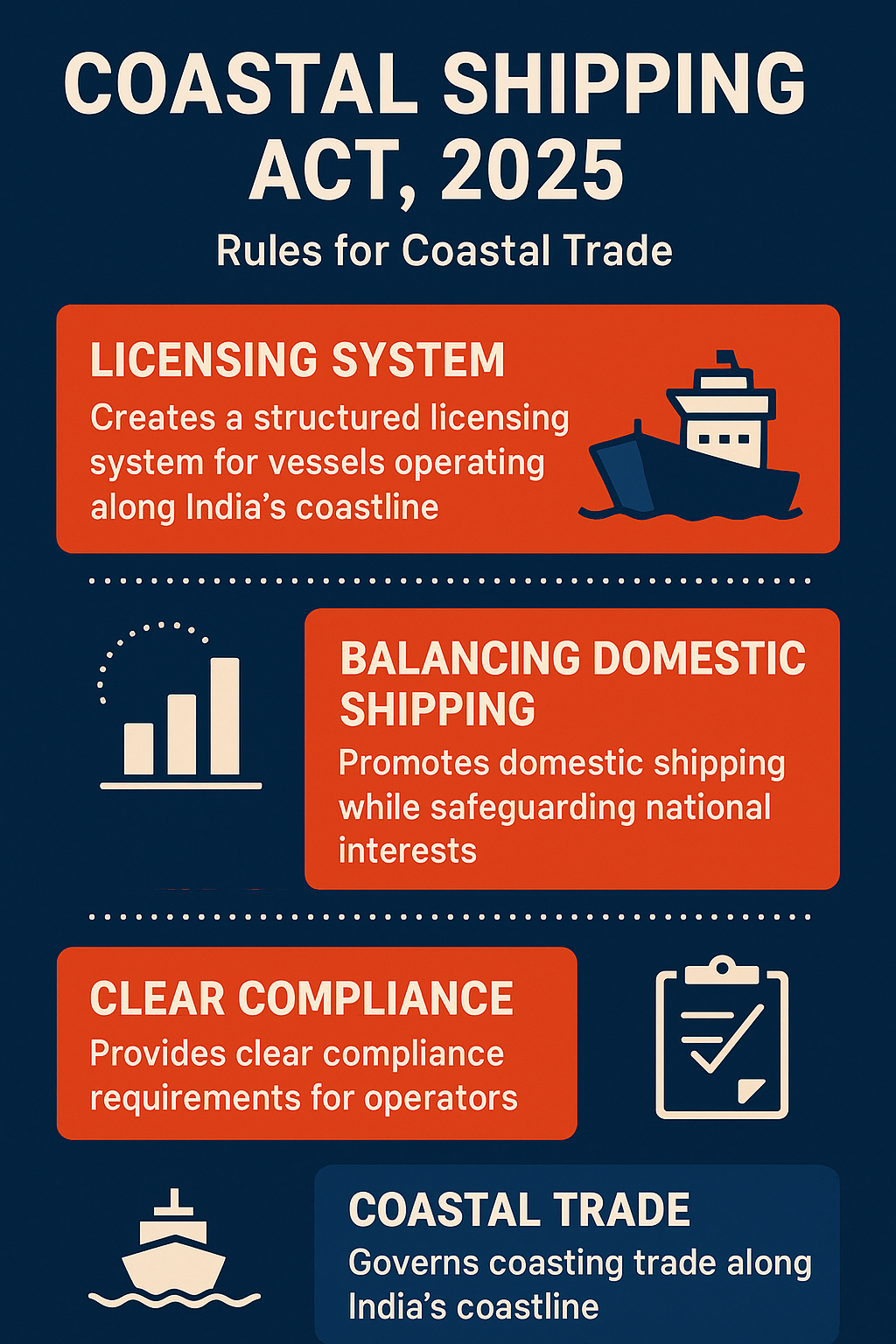
Recently the Indian government passed Coastal Shipping Act, 2025 which lists out the trade license rules so it is essential to understand for anyone, whether for RPSL license holders or seafarers involved in India’s maritime logistics and coastal transportation sectors. This act governs coasting trade by creating a structured licensing system that regulates which vessels can operate along India’s vast coastline. The rules ensure a balance between promoting domestic shipping and safeguarding national interests, while providing clear compliance requirements for operators. This blog delves deeply into the key features of the new coastal shipping act, explaining its provisions with clarity and expertise.
What is Coasting Trade?
Before discussing the trade license rules it’s important to understand “coasting trade.” The Act defines coasting trade as the carriage of goods or passengers by sea between Indian ports and places along the Indian coastline or within the country’s coastal waters. This does not include fishing operations but covers all commercial maritime transportation activities carrying cargo or passengers along the coast.
The Purpose of Coastal Shipping Act
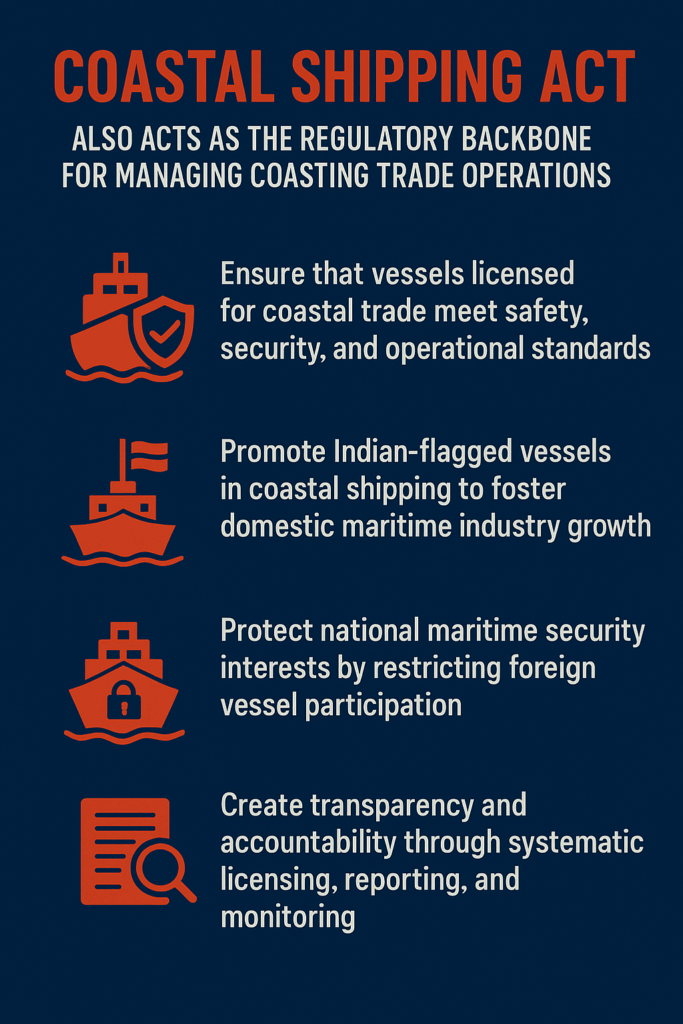
Trade license rules also act as the regulatory backbone for managing coasting trade operations. It aims to:
- Ensure that vessels licensed for coastal trade meet safety, security, and operational standards.
- Promote Indian-flagged vessels in coastal shipping to foster domestic maritime industry growth.
- Protect national maritime security interests by restricting foreign vessel participation.
- Create transparency and accountability through systematic licensing, reporting, and monitoring.
Licensing Requirements: Who Can Engage in Coasting Trade?
Central to new coastal trade rules is the clear licensing regime. The Act strictly prohibits any vessel other than an Indian vessel from engaging in coasting trade without a license issued by the Director-General of Shipping. Indian vessels are those registered under the Merchant Shipping Act, 1958, affirming their national affiliation.
Foreign vessels, including those registered under the Inland Vessels Act, 2021, may only participate if specifically permitted by the Director-General, subject to conditions ensuring alignment with India’s strategic commercial and security objectives.
The Licensing Application Process: What Operators Need to Know
Applying for a license to engage in coasting trade is a formal, regulated process. The new act mandates that every application must be submitted to the Director-General in a prescribed form and manner accompanied by the applicable fee.
The Director-General does not grant licenses arbitrarily. Instead, the decision is made after evaluating multiple important factors, including:
- Previous licensing history of the applicant, especially any cancellations.
- Record of compliance with the Act and prior violations.
- Nationality of the crew aboard the vessel.
- Vessel build and safety requirements.
- Availability of vessels servicing the intended route.
- Number of licenses already granted for the same route.
- Safety and maritime security considerations.
- Shipboard equipment, including communications systems.
- The National Coastal and Inland Shipping Strategic Plan.
- Cost efficiency and transport viability.
- Validity of certificates for vessel, crew, and insurance.
This robust vetting process ensures that licenses are granted responsibly, emphasizing safety, security, and economic factors, thereby building a trustworthy coastal shipping ecosystem.
License Conditions and Validity
Licenses granted under the new coastal shipping act come with conditions specified by the Director-General and must be adhered to strictly by licensees. These conditions may pertain to routes, types of cargo or passengers, operational safety, and more. Licenses are issued for a fixed period and in prescribed formats that facilitate standardized oversight.
The act empowers the Director-General to impose additional specific conditions necessary to meet the objectives of the Act. This flexibility allows for robust response to evolving market or security situations.
Suspension, Revocation, and Modification of Licenses
License holders must maintain compliance; failure to do so can have serious consequences. New act outlines clear provisions empowering the Director-General to suspend, revoke, or modify a license for reasons including:
- Violations of license conditions.
- Non-compliance with applicable laws.
- Failure to comply with directions issued under the Act.
- Non-payment of fines or sentences imposed.
However, the Act also guarantees procedural fairness. No license can be suspended or revoked without giving the licensee a reasonable opportunity to be heard. Licensees may also apply to modify license particulars within prescribed norms, allowing operational adaptability.
Reporting Requirements: Ensuring Transparency and Oversight
Transparency in shipping operations is vital for regulatory compliance and safety. Every vessel, including Indian vessels engaged in coasting trade, must report certain information to the Director-General in prescribed format and frequency. This reporting includes:
- Ports or places the vessel will visit during its voyage.
- Details of goods or passengers carried and their destinations.
- Any offshore areas where the vessel will operate.
- Additional information deemed necessary by the Director-General.
These requirements help the authorities monitor shipping activities, ensuring adherence to routes, passenger or cargo limitations, and other conditions safeguarding safety and national interests.
Consequences of Non-Compliance
Non-adherence to Coastal Shipping Act 2025 provisions can result in penalties, including:
- Detention of vessels that operate without a valid license.
- Heavy fines and/or imprisonment for license violations.
- Legal actions against licensees or agents failing reporting obligations.
- Restrictions on port clearances, curbing unauthorized trade.
These strict penalties serve as strong deterrents against unauthorized coasting trade and affirm the government’s commitment to orderly and secure coastal shipping.
Why New Coastal Trade License Matters for India’s Maritime Future

India’s coastline stretches over 11,098.81 kms, offering immense potential for coastal trade as a cost-efficient, sustainable transport alternative. The new licensing framework is fundamental in:
- Encouraging Indian ship ownership and operations along domestic routes.
- Enhancing maritime security by controlling foreign vessel participation.
- Streamlining operational transparency to improve safety and efficiency.
- Supporting Government initiatives aimed at ‘Atmanirbhar Bharat’ (self-reliant India) in maritime logistics.
- Strengthening integration between coastal shipping and inland waterways for multimodal transport.
Conclusion
The Coastal Shipping Act, 2025, establishes a comprehensive licensing and regulatory regime essential for managing India’s coasting trade. With clear definitions, a rigorous licensing process, stated conditions, and firm enforcement provisions, it forms the legal backbone supporting safe, secure, and economically viable coastal maritime transport.
For operators and stakeholders like RPSL companies and seafarers in India’s shipping and logistics ecosystem, understanding and complying with provisions of Coastal Shipping Act is not just mandatory but it is a strategic imperative. The framework it creates helps build a resilient coastal shipping industry that contributes meaningfully to India’s broader economic growth, national security, and sustainable development goals.
This act represents a significant modern step toward regulating India’s coastal maritime activities, aligning legal rigor with practical industry needs and national priorities. It offers a pathway toward a thriving, secure coastal shipping sector led by Indian enterprise and expertise.
FAQs on Prohibition and License for Coasting Trade
What is meant by coasting trade under the Coastal Shipping Act, 2025?
Coasting trade refers to the carriage of goods or passengers by sea between Indian ports or places along the Indian coastline or within coastal waters. It excludes fishing but includes commercial maritime activities like transportation of cargo and passengers within Indian territorial waters.
Who can engage in coasting trade in India as per this Act?
Only Indian vessels registered under the Merchant Shipping Act, 1958, are permitted to engage in coasting trade, unless a foreign vessel obtains a license from the Director-General of Shipping. The Director-General may also permit inland vessels registered under the Inland Vessels Act, 2021 under specified conditions.
What is the process for obtaining a license for coasting trade?
The vessel operator must apply to the Director-General with the prescribed form and fee. The licensing authority considers factors such as past compliance, vessel safety, crew nationality, route availability, maritime security, and alignment with the National Coastal and Inland Shipping Strategic Plan before granting the license.
What conditions are imposed on licenses and can they be suspended or revoked?
Licenses come with conditions related to routes, safety, operational requirements, and security. The Director-General has the authority to suspend, modify, or revoke licenses if conditions are violated or there is non-compliance, but licensees must be given a fair hearing before any such action.
What reporting requirements do vessels engaged in coasting trade have?
Vessels must report intended port visits, goods or passengers on board, offshore operating areas, and any other information the Director-General may require. These reports enable authorities to monitor compliance and operational safety.