
Table of Contents
In case a seafarer violates the DGS Seafarers Code of Conduct, they must be able to defend themselves under necessity, due diligence, and government-caused errors. These safeguards provide a guarantee for seafarers against discrimination during investigations, as outlined in the guidelines stipulated in the Compliance Enforcement Manual. These come into force from January 1, 2026. By offsetting charges such as star grade downgrades and suspensions with defences and evidence, seafarers will be enabled to protect themselves under tough rules and regulations relating to safety and conduct.
What is the Seafarer’s Code of Conduct?
Seafarers often encounter breaches of regulations, such as MLC 2006, STCW, and SOLAS. In addition, seemingly straightforward defenses exist to protect the rights of seafarers, including onboard complaints, appeals, and legal representation via the Directorate General of Shipping. Understanding these concepts thus helps prepare seafarers against unmeritorious charges.
Initial defences must start with documentation, union support, and a timely appeal. In the MV Anka case, after receiving complaints of abandonment, the DG Shipping sprang into action by arranging repatriation. It is very important that the complaint be accompanied by substantial proof to establish a better plea. For more information, you can consult Sefarer’s grievance and crisis management.
What are Common Maritime Code Violations for Seafarers?
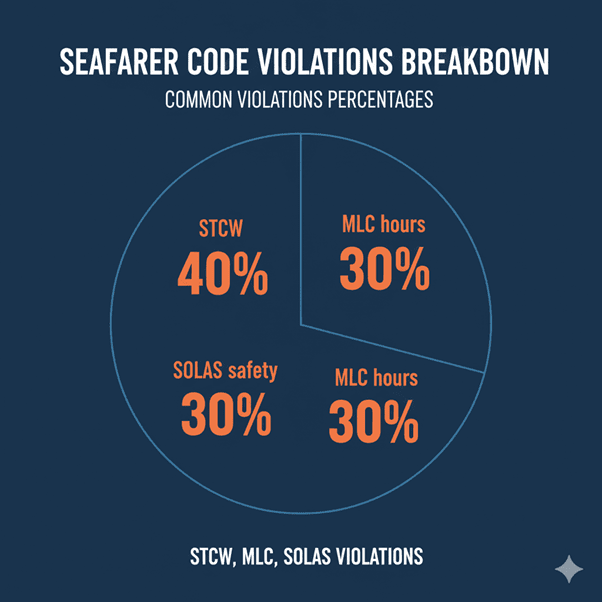
Mariners can also breach codes in cases where there is non-compliance with regulations on STCW training, overworked conditions beyond the requirement under the MLC, or non-adherence to SOLAS safety guidelines. Some examples include forged certificates, deficiencies in watchkeeping duties, or risky conduct leading to accidents. During port inspections, these can often be discovered by Shipowners or Port State Control.
ISM non-compliance, like poor maintenance records and late payments of MLC wages, are other breaches. Severe offenses, which include intoxication and damaged equipment, totaling 18, are listed in the 2025 Code of DG Shipping, where a dismissal can be expected. Fraudulent STCW certificates incur a ban of 2 years, but appeals allow authenticity to be checked.
An actual case involved the arrest of 25 Indians in 2025 in Iran; their release depended on emphasizing the violation of the MLC. For further information, see the DGS Fake Certificates Ban.
Why do Seafarers Need Defenses Against these Violations?
Defences protect jobs, reputation, and income against unjustified charges. A small mistake, including the incorrect recording of data, can result in the end of a career. MLC 2006 provides the right to a fair hearing, preventing victimization.
Repatriation of COVID cases led to a rise in complaints, and steps were taken for the recovery of pending wages. An average of 80% of complaints through the online portal of DG Shipping prevent being blacklist.
When Should Seafarers Start an Onboard Complaint?
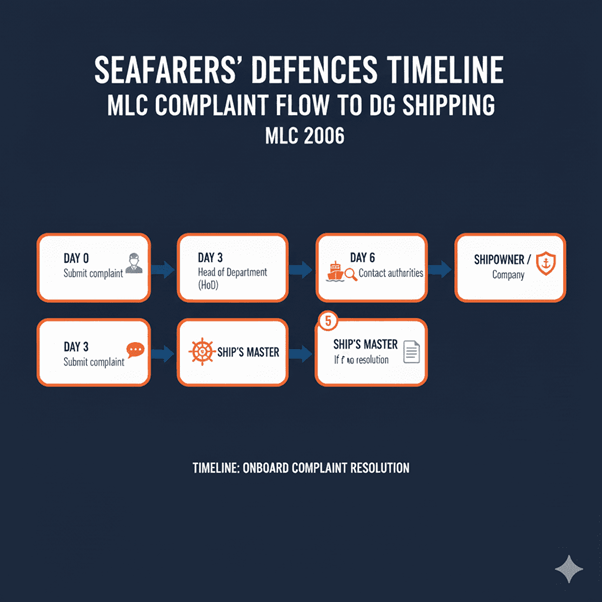
File the complaint immediately after the contravention notice in compliance with the MLC protocols. Send a written note to your Head of Department in the first five days. They have to respond in 3 days; if not, refer the complaint to the Master.
Pre-arrival action may be taken to prevent escalation, and anonymity may be preserved if you fear consequences.
How do Onboard Complaints Work Step-by-Step?
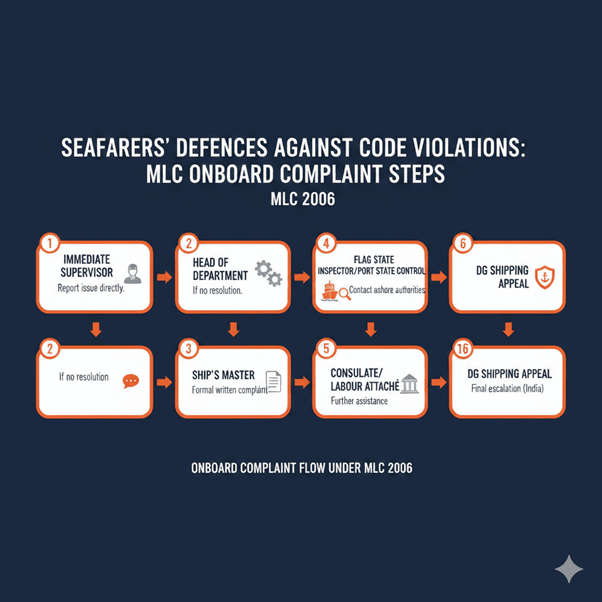
Follow these easy steps for MLC onboard complaints:
- Draft a formal complaint to the supervisor or Head of Department.
- This will be acknowledged and resolved within 3 days.
- Inform the Master if necessary and keep the seafarer fully informed.
- The master shall have to inform the shipowner if unresolved within a maximum of 15 days.
You can understand the full guide of this process by going throught DGS grievance mechanism.
What happens if the onboard complaint fails?
Inform the external agencies such as DG Shipping or the flag state, as soon as possible when the timeline given by the ship owner in order to resolve the matter is elapsed. If it is an urgent matter, then use the DG shipping e-Governance portal. Make sure to have a copy of the complaints aboard and the proofs.
MMD Principal Officers deal with initial appeals and track the status through the INDoS dashboard. The validity of seafarer complaints when being inspected by the Port State Control is independently investigated by the seafarer claims.
The process also entails the involvement of ITF inspectors at the ports. The success rates can be enhanced by the use of photographs and log books. For further guidance, refer to seafarer crisis management.
Why Use DG Shipping Appeals as Defense?
If one is not satisfied, a complaint has to be made within 30 days at the second instance at the DGS Head Office located in Mumbai. Even though their decisions are binding, a case can be contested at a court of law if any procedural irregularity has occurred; delayed submissions up to a period of 60 days are acceptable under valid grounds like ship delays.
Fake certificate cases have been invalidated through evidence like duty logs and testimony, and this has reinstated the authenticity of the CDC. DG’s crew annual reports show that resolution percentages exceed 75%, and this prevents improper suspension. This is in line with MLC Standard A4.4 regarding treatment.
When to Seek Legal Help for Code Violations?
Look for lawyers who specialize in maritime law and have experience with the Merchant Shipping Act or BNS Section 304A, especially where there is an incident requiring investigation for possible charges of negligence. First, appeal internally, then appeal for free initial advice to NUMAST or ITF unions; if the DG is late, the High Courts will process applications for writs.
The charge degree is higher in the case of pollution and collision. The reports for due diligence might help to lower the charge of imprisonment.
How can Documentation Strengthen your Defense?
Keep a daily log of logs, emails, weather, certificates, and photographs of sub-standard conditions to show the context of fatigue caused by 14+ hour shifts, which fail to comply with the MLC requirements. Obtain witness affidavits from the crew members.
Digital uploads to the INDoS or through the e-SID system track appeals effectively. According to the Act under IT law, emails qualify as the first form of evidence for the court. You can understand the Seafarer documentation process for further information.
What Role Do Unions Play in Defenses?
Shipowner disciplinary committees invite union involvement for an impartial inquiry, which also takes place when complaints are made under the Maritime Labour Convention. The global ITF network can assist with flag-state escalation and RPSL compliance.
They negotiate collective bargaining agreements, trying to rid them of unjustified clauses and defending their clients in tribunals.
What defences exist against MLC violations?
File formal onboard complaints with your supervisor first, including evidence like logs. Escalate to the Master within 3 days if unresolved, then to the shipowner within 15 days. External options include the DG Shipping portal or ITF if needed.
When must seafarers appeal DG Shipping orders?
Submit appeals within 30 days to the jurisdictional MMD Principal Officer via the INDoS e-Governance portal, with supporting documents. Late appeals up to 60 days allowed for valid reasons like ship delays.
Why keep detailed logs for defences?
Logs prove fatigue, context, or due diligence, strengthening appeals against charges. Include emails, photos, and weather data—accepted as court evidence under the IT Act.
How do STCW breaches impact careers?
Result in CDC suspension or a 2-year ban for fakes. Appeal with original cert proof via MMD; 2025 cases restored post-verification.
Can the crew appoint reps in hearings?
Yes, MLC Standard A4.4 allows union reps or legal aid for fair hearings.
Who handles first-level appeals?
Local MMD Principal Officer reviews initial cases via INDoS
Why call the DG helpline immediately?
Triggers urgent interventions for fraud or exploitation at 9004048406.
How challenge unfair dismissal?
Via the MLC grievance procedure, then DG appeals or High Court writs.
What stops employer retaliation?
MLC protections ensure anonymity and no victimization for complainants.