
Table of Content
- What Is SOLAS Regulation II-1/3-13?
- SOLAS Regulation II-1/3-13: Overview and Details
- Which Appliances Are Covered Under SOLAS Regulation II-1/3-13?
- Which Appliances Are Not Covered Under SOLAS Regulation II-1/3-13?
- What Are the Key Requirements Under SOLAS Regulation II-1/3-13?
- What are the Documents Required under SOLAS regulation II-1/3-13 to Demonstrate Compliance?
- Final Thoughts
- FAQs
The International Convention for the Safety of Life at Sea (SOLAS) has long been the cornerstone of maritime safety, preventing accidents and ensuring safety of life at sea. It has introduced and adopted several circulars and regulations to ensure vessels, crews, and passengers operate and function under high safety standards.
SOLAS has recently introduced a new regulation II-1/3-13, that addresses structural protection and enhanced safety of lifting appliances and anchor handling winches. Let’s see in detail what the SOLAS regulation II-1/3-13 is, its applicability, and its key requirements.
What Is SOLAS Regulation II-1/3-13?
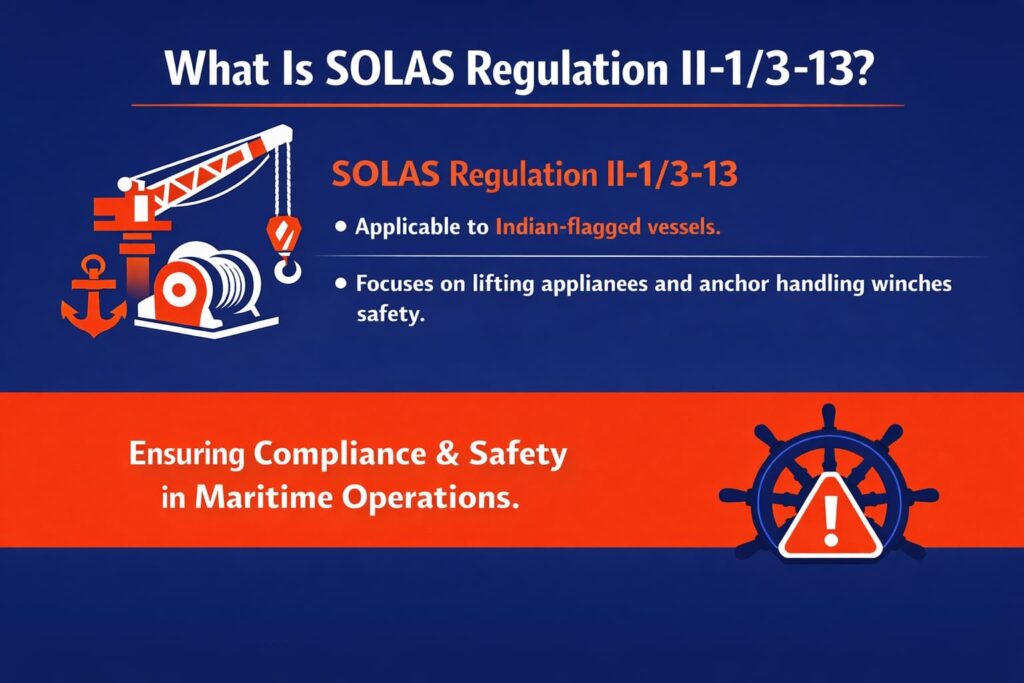
SOLAS regulation II-1/3-13 is a detailed provision containing rules and guidelines for lifting appliances and anchor handling winches. It is implemented by the Directorate General of Shipping (DGS) to enhance safety and operational standards across the maritime industry. These regulations are applicable to Indian-flagged vessels.
SOLAS regulation II-1/3-13 lays down provisions related to the construction and design, installation, testing and inspection, and maintenance of lifting appliances as well as anchor handling winches. It is compulsory for the vessel owners, operators and managers to abide by these regulations to avoid penalties and detention of the vessel.
SOLAS Regulation II-1/3-13: Overview and Details
Here is a detailed overview of the SOLAS regulation II-1/3-13:
| Title | SOLAS Regulation II-1/3-13 |
| Implemented By | Directorate General of Shipping |
| Notice No. | Merchant Shipping Notice No. 02 of 2026 |
| Resolution | Resolution MSC.532(107) |
| Effective Date | 01 January 2026 |
| Purpose | Improve safety of lifting appliances and anchor handling winches |
| Applicability | Applicable to Indian-flagged vessels |
Which Appliances Are Covered Under SOLAS Regulation II-1/3-13?
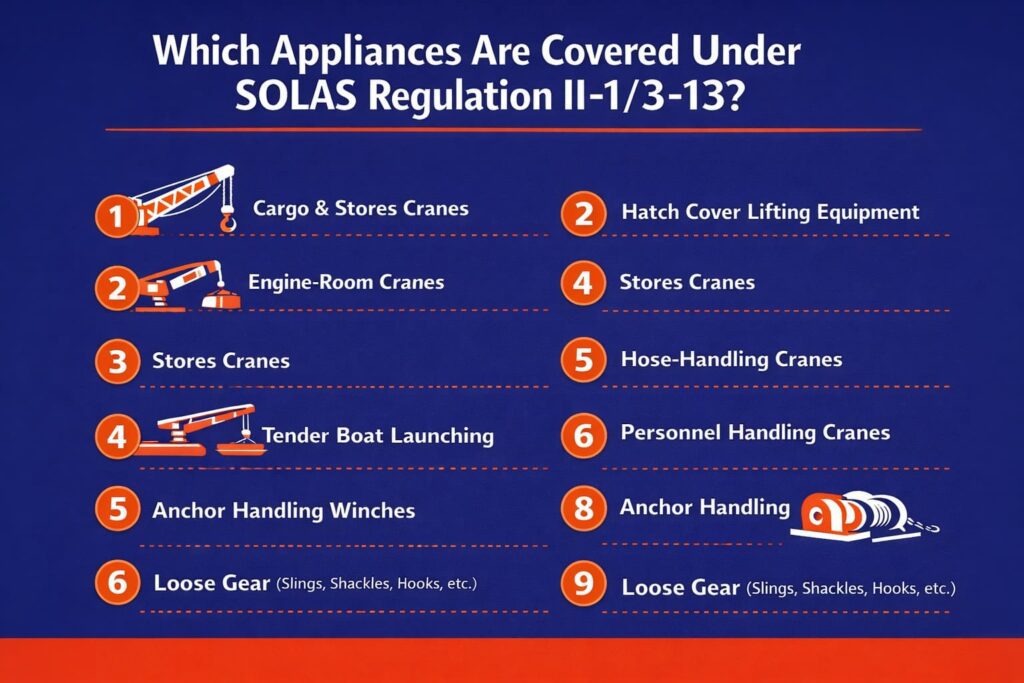
SOLAS regulation II-1/3-13 covers all lifting appliances and anchor handling winches with a safe working load of greater than or equal to 1000 kg, including:
- Cargo and stores cranes used for loading, transfer, and unloading
- Hatch cover and movable bulkhead lifting equipment
- Engine-room cranes
- Stores cranes
- Hose-handling cranes
- Cranes used for launching and recovering tender boats and similar craft
- Personnel handling cranes
- Anchor handling winches
- Associated loose gear, such as slings, shackles, blocks, hooks, wires and chains used with lifting appliances and winches
Which Appliances Are Not Covered Under SOLAS Regulation II-1/3-13?
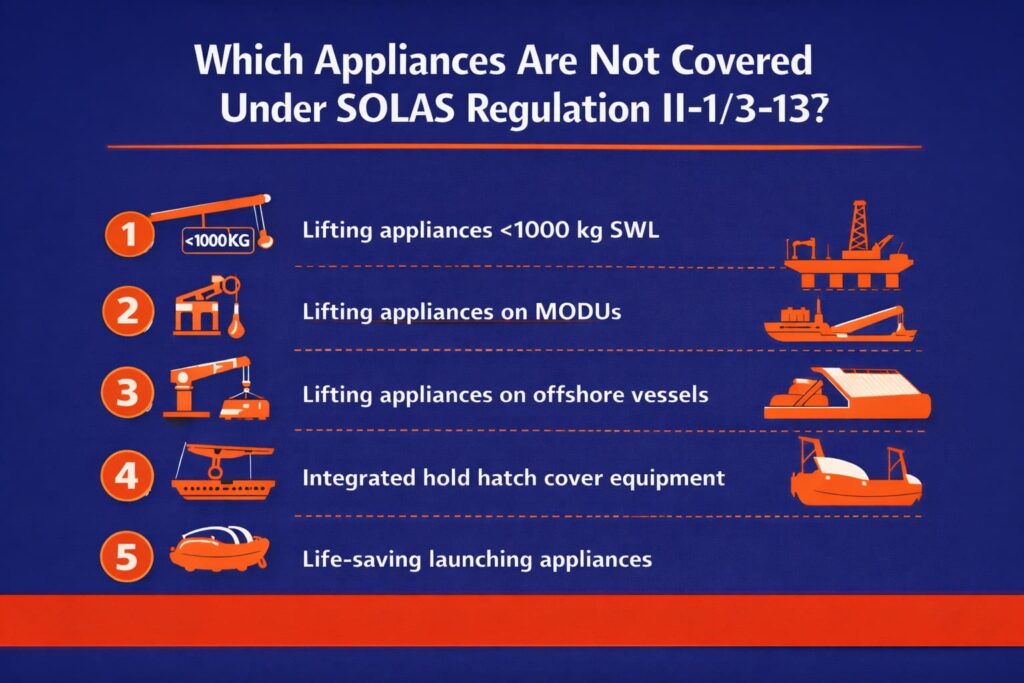
SOLAS regulation II-1/3-13 is applicable to shipboard lifting appliances and anchor handling winches used in routine ship operations. However, it excludes the following:
- Lifting appliances which have a safe working load of less than 1,000 kg.
- Lifting appliances on MODUs.
- Lifting appliances used on offshore construction vessels.
- Integrated mechanical equipment for opening and closing hold hatch covers.
- Life-saving launching appliances.
What Are the Key Requirements Under SOLAS Regulation II-1/3-13?
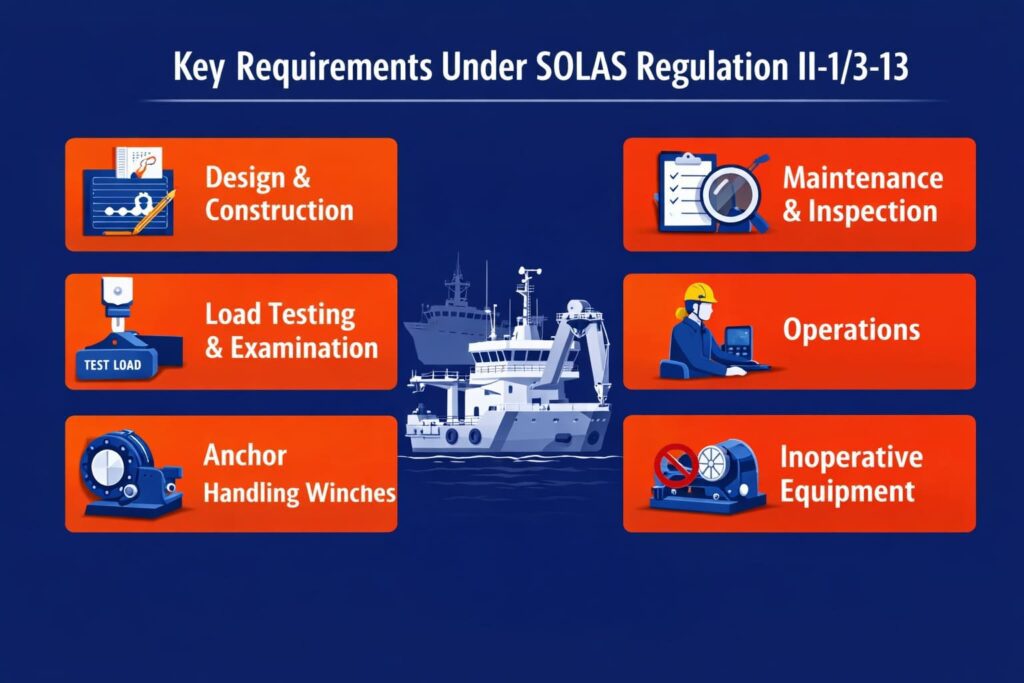
SOLAS regulation II-1/3-13 establishes certain key requirements related to the design, construction, load testing, examination, maintenance, and operations of the vessel. These requirements are as follows:
A. Design, construction and installation
1. Lifting appliances installed on or after 1 January 2026 must meet standards of a Recognised Organisation (RO) or equivalent safety standards.
2. Appliances must be load tested and thoroughly examined after installation and before first use.
3. Permanent marking of Safe Working Load (SWL) and documentary evidence is mandatory.
4. Anchor handling winches installed on and after 01 January 2026 must comply with MSC.1/Circ.1662 guidelines.
5. Appliances and anchor handling winches installed before 01 January 2026 must be tested by the first SAFCON renewal survey after that date.
6. Loose gear must be designed and manufactured as per RO-approved standards.
B. load testing and thorough examination of lifting appliances
1. Mandatory initial load testing by the competent person before first use and after major repairs or modifications.
2. Retesting is required at least once every five years.
3. For load testing of lift appliances, the test load as set out in table 1 of MSC.1/Circ.1663 should be established using the SWL.
4. Where SWL is undocumented, testing must be carried out as per MSC.1/Circ.1663 and MSC.1/Circ.1696 based on the nominated SWL by the company and approved by the vessel’s RO, and a thorough examination of non-certified existing lifting appliances.
5. Loose gear must have proof test certificates and be retested after major alterations.
6. Lifting appliances and loose gear must undergo thorough examination by a Competent Person as per MSC.1/Circ.1663.
7. Any lifting appliance found unsafe or non-compliant must be taken out of service, clearly marked “not to be used”, recorded in the lifting appliance register, and only returned to service after deficiencies are rectified to the satisfaction of the RO/MMD.
8. Records of load testing and thorough examination of lifting appliances and loose gear must be maintained on board in a register, documented in a clear and legible form, and authenticated by a competent person.
C. Testing and thorough examination of anchor handling winches
1. Anchor handling winches must undergo commissioning tests as per manufacturer’s instructions and MSC.1/Circ.1662 standards, recognised by the RO/DGS, and be retested after major repairs or modifications, including emergency release system tests where affected.
2. Winches not designed for towing are exempt from bollard pull tests, though all other functional tests remain mandatory.
3. Anchor handling winches and associated loose gear must be operationally tested annually and five-yearly. It also undergoes thorough examination to the satisfaction of the RO/MMD during SOLAS annual surveys.
4. Any winch or loose gear found unsafe or non-compliant must be taken out of service, clearly marked “not to be used”, recorded accordingly, and only reinstated after deficiencies are rectified to the satisfaction of the competent person and RO/MMD.
5. Testing and examination records must be clear, complete, and authenticated by a Competent Person, using approved or equivalent forms.
D. Maintenance, inspection, and operational testing
1. All lifting appliances, anchor handling winches, and associated loose gear must be tested, examined, operated, and maintained in accordance with MSC.1/Circ.1662 and MSC.1/Circ.1663, irrespective of installation date.
2. Maintenance, inspection, and testing intervals must follow manufacturer, industry, or classification society requirements acceptable to the DGS, considering the ship’s operational profile and environment.
3. Marine environmental conditions and safe work practices must be considered when implementing inspection and maintenance regimes.
4. Damaged or unsafe ropes, equipment, or loose gear must be inspected, discarded if necessary, and taken out of service, clearly marked “not to be used,” and recorded in the register.
5. A manufacturer’s maintenance manual must be available (or provided by an RO-approved competent party) and include the minimum items specified in MSC.1/Circ.1662 and MSC.1/Circ.1663.
E. Operations
1. All lifting appliances, anchor handling winches, and associated loose gear must be operated per the operations manual and MSC.1/Circ.1662/1663 guidelines, regardless of installation date.
2. Operators must be qualified, authorised by the master, familiar with the equipment, understand operational signals, and use appropriate PPE.
3. Operations should be planned, supervised, and conducted to minimise risks, considering environmental conditions, equipment limitations, and ship motion.
4. Effective communication and safe access for all personnel must be ensured, including shore-based staff, with safe stowage to prevent uncontrolled movement during voyages.
5. Operations manuals must be provided by the manufacturer or an RO-approved competent party and include design and operational limits, compatible loose gear, safety instructions, and operating procedures.
F. Inoperative lifting appliances and anchor handling winches
1. Malfunctions of lifting appliances, anchor handling winches, or loose gear do not make the ship unseaworthy if the master accounts for inoperative equipment in voyage planning and obtains necessary dispensations.
2. Inoperative equipment must not be operated and should be secured to prevent uncontrolled movement using proper restraints.
3. Inoperative wires and loose gear must be stored separately, clearly marked, and kept apart from in-service equipment.
4. All inoperative equipment must be recorded in the lifting appliance register until repairs, load/proof testing, and thorough examination are completed.
What are the Documents Required under SOLAS regulation II-1/3-13 to Demonstrate Compliance?
To demonstrate compliance with the regulations and guidelines of SOLAS regulation II-1/3-13, the following documents are required:
1. Plan appraisal of the lifting appliance and foundation connections.
2. Verification of materials used in the appliance.
3. Survey, testing, and examination records during fabrication.
4. Component certificates, including certificates for associated loose gear.
5. Testing and thorough examination records after installation on board.
6. Certificate of compliance with relevant SOLAS regulations (II-1/3-13.2.1, II-1/3-13.2.3, or II-1/3-13.2.4 as applicable).
7. Register of Ship’s Lifting Appliances and Cargo Handling Gear entries (Appendix 3 of MSC.1/Circ.1663).
8. Rigging plan and block list showing correct reeving, rigging arrangements, and loose gear positions (if applicable).
Final Thoughts
The new regulation of SOLAS is a significant step in enhancing maritime safety, particularly in lifting appliance protection and structural integrity. The new rules established under the SOLAS regulation II-1/3-13 lay down clear guidelines related to the design, construction, maintenance, operation, and inspection of lifting appliances used for loading, transfer, and other purposes. It also highlights the requirements for the operation and management of anchor handling winches.
For shipowners, operators, and maritime professionals, adherence to these revised requirements is no longer optional. It is essential for compliance and the safety of crew and passengers alike.
Frequently Asked Questions
1. Which ships are covered under the SOLAS regulation II-1/3-13?
The SOLAS regulation applies to Indian-flagged vessels, including cargo and passenger ships, subject to the applicability criteria.
2. Is load testing mandatory for new lifting appliances under SOLAS regulation?
Yes. Load testing and thorough examination are mandatory after installation and before first use, and after major repairs or modifications.
3. Who can conduct load testing and examinations under SOLAS regulation?
Testing must be carried out by a competent person to the satisfaction of the vessel’s RO or jurisdictional Mercantile Marine Department (MMD).
4. What happens if equipment fails a thorough examination?
The equipment must be taken out of service, clearly marked “NOT TO BE USED,” recorded in the register, and repaired before reuse.
5. Who qualifies as a competent person in India under the SOLAS requirement?
A competent person may be designated by DGFASLI or approved by an RO based on competence, equipment, and infrastructure.