
The Directorate General of Maritime Administration released a report of the STWC certification record/statistics through its nautical wing. The report offers a quick view of how India’s maritime officer workforce is growing and evolving. This data reflects how many qualified ship officers entered the global maritime workforce in 2025 and significant rise in the certifications, demonstrating year-on-year growth and supporting a skilled and compliant maritime workforce.
This new notice is all about data and statistics of the number of certifications issued across board in different categories to different ranks and workers. Before we dive in, there is one more notice that the DGMA has released in surveillance of STWC standards for a safer work environment on board, it is the mandatory harassment prevention training as per 2025.
Records of issuance of COC as of 2025.
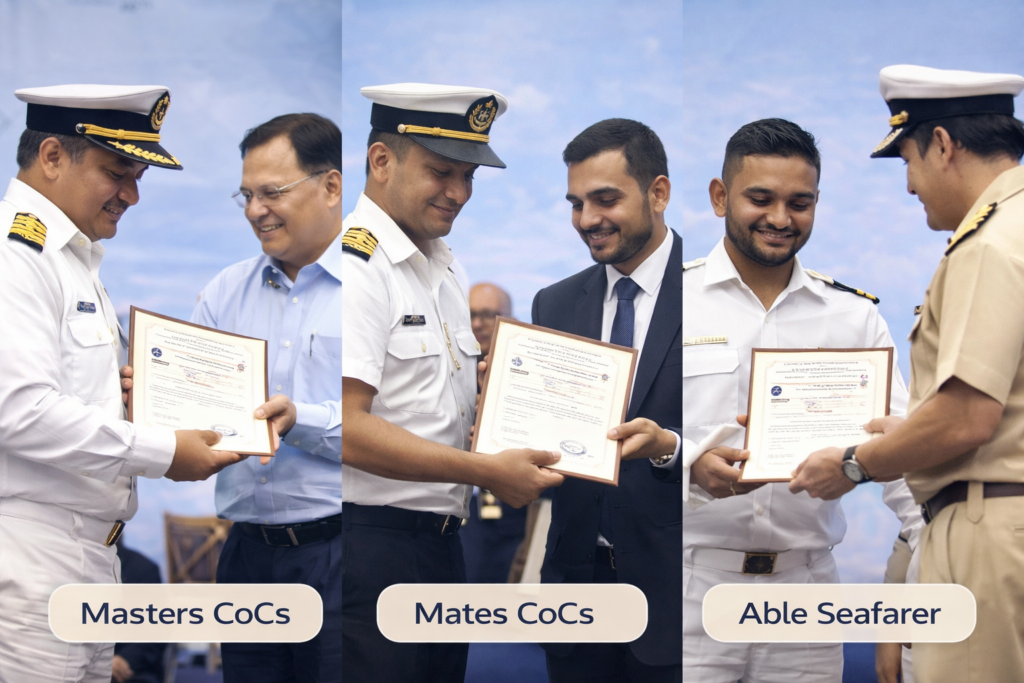
With a total of 4,333 certificates of competency issued for foreign going grades and a 100 of them for near coastal voyage (NVC) grades, they were distributed amongst different ranks as follows:
| RANKS | FOREIGN GOING GRADES | NVC GRADES |
| Master | 721 | 38 |
| First mate | 1,239 | 38 |
| Second mate | 2,373 | 31 |
| Total | 4,333 | 100 |
And for the global maritime distress and safety system certifications (COC) they were issued distributed amongst different MMD’s of different locations such as;
- Chennai – 1,237
- Noida – 2,256
- Kochi – 946
- Kandla – 120
- Kolkata – 1,345
- Mumbai – 3,021
A total of 8,916 GMDSS certificates were issued under this term across all the key maritime hubs in India. Units of GMDSS certificates issued are higher than that of general COCs because officers may renew or upgrade to it separately and it is mandatory for multiple ranks.
The statistics provided by the nautical wing are for the certificates already issued. If you are an individual looking to get certified to work for the maritime industry, here’s a simple guide on how to get DGMA approval as a doctor.
The number of foreign officer licences that were recognized by the Indian maritime was 19. This certificate is known as the certificate of equivalence (COE) that is given in rare cases to foreign officials. For ships operating in niche but high skill areas like arctic, antarctic and extreme cold regions got 121 basic polar COPs and 27 advanced polar COPs.
In total 4,433 COCs were issued, which is a 21.1% increase compared to 3,660 in 2024. This signals towards the growth in the maritime employment pipeline and more officials being qualified compared to last year.
Trends in certificates of competency according to STWC (2019 – 2025)
To understand the broader picture of India’s maritime workforce, it’s important to look beyond the statistics of just one year. The following charts track certificates of competency issued between 2019 and 2025, highlighting how officer certification trends have evolved over time.
Speaking of which, it is important to know the conditions behind obtaining these said certificates and if you are looking for a guide to become certified and have no idea where to start, here’s a comprehensive blog on the rights and rules for seafarers, under MS Act, 2025 that dives deeper into topics like the process for obtaining COC, CDC and COP certificates and the authority’s power over granting, suspending and withdrawing them when needed.
These year-on-year comparisons provide us a clear insight into recovery in the collapses after pandemic, changing industry demands, and the steady growth of India’s officer pipeline.
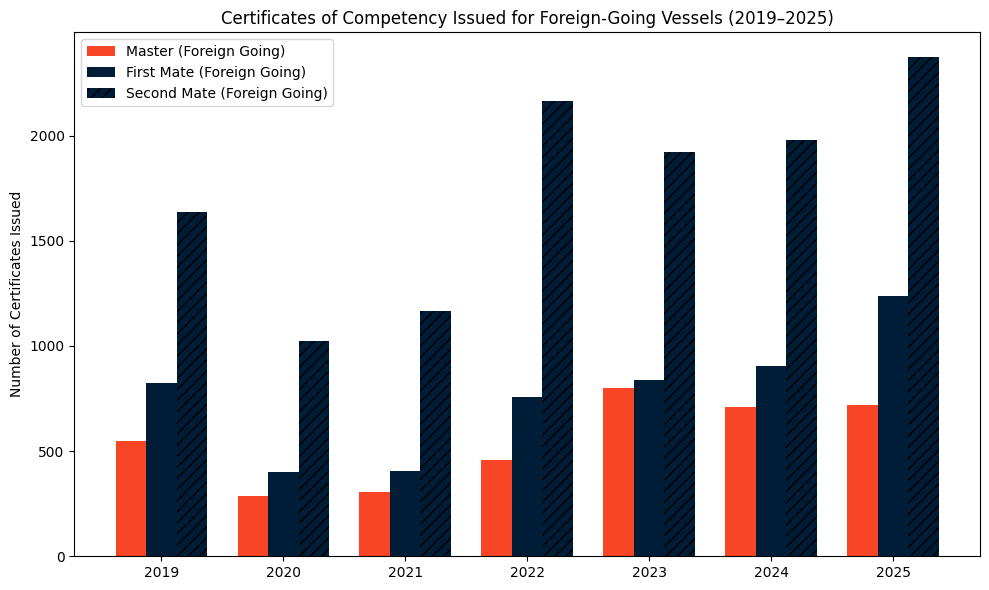
COCs issued for foreign going vessels covering the three top deck officer ranks such as master, first mate and second mate have shown a significant growth rate over the periods of 2019 to 2025 especially, for the levels of first and second mate.
Here’s a visual representation of the trends in a bar chart.
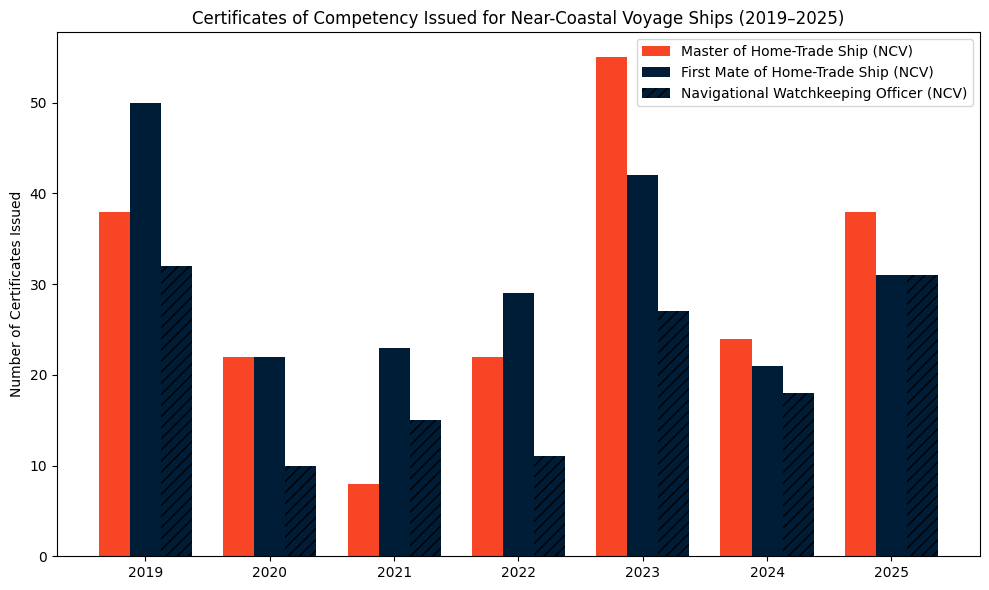
And for the certificates for near coastal voyages (NVC) the growth has been stable but limited. Compared to foreign-going certifications, NCV numbers remain nearly modest and stable, reflecting the smaller operational scope of coastal shipping. While fluctuations are visible year to year, the overall trend suggests a steady requirement rather than rapid expansion/growth in this segment.
Here’s a visual representation of the trends regarding NVC certifications;
Proficiency certificates for tanker operations and seafarers – STWC record statistics.
Beyond officer licensing this data also highlights the growing emphasis into specialized training in areas of safety and tanker operations. These certifications are critical for vessels carrying hazardous cargo and for maintaining international safety compliance. To ensure further safety DGMA has taken initiatives to take strict actions against forged CDC entries into the maritime industry.
In 2025, India issued thousands of certificates of proficiency (COP) in advanced tanker operations across oil, chemical, and gas carriers. These are mandatory for officers serving on tanker vessels and reflect the industry’s high safety standards.
Among the three categories, advanced oil tanker operations recorded the highest number of certifications with a whopping number of 3,879 units, followed by advanced chemical tanker and advanced gas tanker operations with 2,001 and 950 certificates respectively. MDD offices such as Mumbai, Noida, Chennai, and Kolkata accounted for the largest share with their role as key maritime certification hubs. With Kandla and Kochi scoring on the lower ends.
The report also points to the basic and intermediate COPs issued across board to different categories of workers to form safe ship operations across all types of vessels. The certificates issued in 2025 (COP) are as follows;
- 5,592 COPs in rating forming part of a navigational watch, which are ratings for watchkeeping.
- 3,333 COPs in able seafarer deck for deck operations.
- 4,470 IGF code basic certificates, for which are in support of ships using different fuels.
- 14,480 basic training for oil and chemical tanker cargo certifications
- 4,984 in basic training for liquefied gas, reflecting the growing gas carrier activity
These numbers go on to show us that the amount of certified safety workers entering the maritime workforce has increased as consistent efforts of the authorities and policy changes, this report being one of them to help us compare, correct and grow.
Overview of the multi-year STWC certification trends.
While the earlier sections outline the scale and scope of STCW certifications issued in 2025, the trend data from 2019 to 2025 adds an important layer of context. Across officer certifications, tanker endorsements, and core safety training, the charts indicate overall growth with short term fluctuations, particularly around the pandemic period.
Most certification categories recover strongly in subsequent years, reaching or exceeding levels before 2020, by 2024 and 2025. This pattern suggests both steady growth in maritime training systems and sustainable global demand for Indian seafarers across operational, safety, and specialised roles.
Here’s a brief overview of the multi year trends;
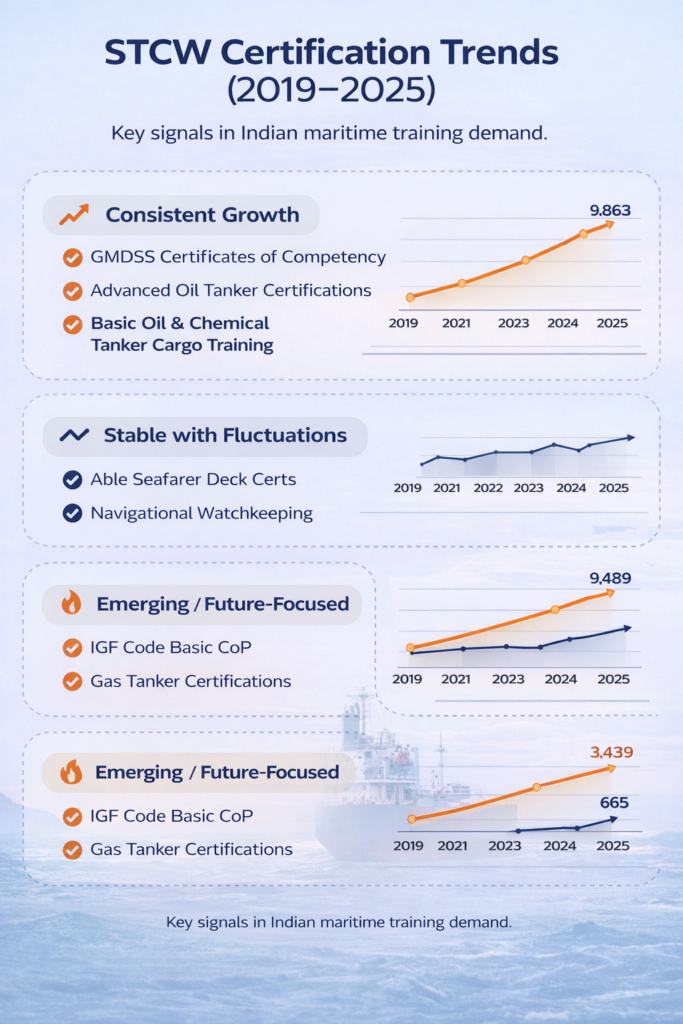
To conclude the trends regarding professionalizing and bringing more certified labor and officers into the maritime industry through tests and training has seen a significant raise over the years. This directly affects the safety, security and efficiency of both vessels and the seafarers on board as they focus on bettering themselves to be an approved officially trained worker/ship.
FAQ
What is a COC (certificate of competency)?
A certificate of competency is an official licence that allows a seafarer to serve in a specific officer rank on board a ship, such as Master or Mate. It confirms that the holder has completed the required training, sea service, and examinations under international STCW standards. Without a COC, an officer cannot legally sail in that role.
What are IGF code certificates?
IGF code certificates relate to training for ships that use alternative fuels such as LNG. These certificates ensure seafarers understand the safety, handling, and operational risks associated with low-flashpoint fuels. As the shipping industry moves toward cleaner energy, IGF training is becoming increasingly important.
What does MMD stand for?
What is a COE (Certificate of Equivalence)?
A certificate of equivalence allows a foreign-issued maritime certificate to be recognized for service on Indian-flag vessels. It confirms that the training and qualifications meet Indian and STCW requirements. COEs are typically issued in limited numbers for specific operational needs.
Why is this report released, and who does it affect?
This report is released to provide transparency on maritime certification trends and workforce readiness in India. It affects seafarers, shipping companies, training institutes, regulators, and international employers. The data helps assess safety compliance, skill availability, and long-term industry capacity.
What is a COP (certificate of proficiency)?
A certificate of proficiency confirms that a seafarer has completed specialised or safety-related training, such as tanker operations or watchkeeping duties. Unlike a COC, it does not grant rank but certifies competence in a specific function. COPs are mandatory for many onboard roles and safety responsibilities.