
What Is DGMA Circular 13 of 2026?
If you are a deck officer and your ship sails through polar waters, then DGMA Circular 13 of 2026 is something you really need to know about. Now as we all know, the IMO keeps updating rules for seafarers from time to time. Back in 2016, the IMO passed two resolutions called MSC.416(97) and MSC.417(97), and through these resolutions, a brand new training requirement was added to the STCW Convention under Regulation V/4.
This regulation specifically deals with ships that operate in polar waters. Now India is an active member of the IMO, and through this circular issued on 9th March 2026, the DGMA Circular 13 of 2026 has formally implemented these requirements in India. So what this DGMA Circular 13 of 2026 is basically saying is that if your ship operates in polar waters, you now need a special certificate to sail on that ship as a deck officer. Let us understand the whole thing in detail.
Why Is Polar Waters Training So Important?
Now you might be wondering why there is so much importance given to polar waters specifically. As we all know, polar regions like the Arctic and the Antarctic are some of the most extreme environments on the planet. The temperatures are brutally low, the ice conditions keep changing constantly, and if something goes wrong out there, help is extremely far away.
There is almost no infrastructure for rescue or emergency response in these areas, which makes every situation out there significantly more dangerous than in normal sea conditions. And because of climate change, Arctic shipping routes are becoming more and more accessible now, which means more ships are sailing through these waters than ever before.
So naturally the risk has also increased, and this is exactly why the IMO said that officers on these ships must be specially trained for polar conditions. That is what this circular is implementing in India.
Who Does This DGMA Circular 13 of 2026 Apply To?
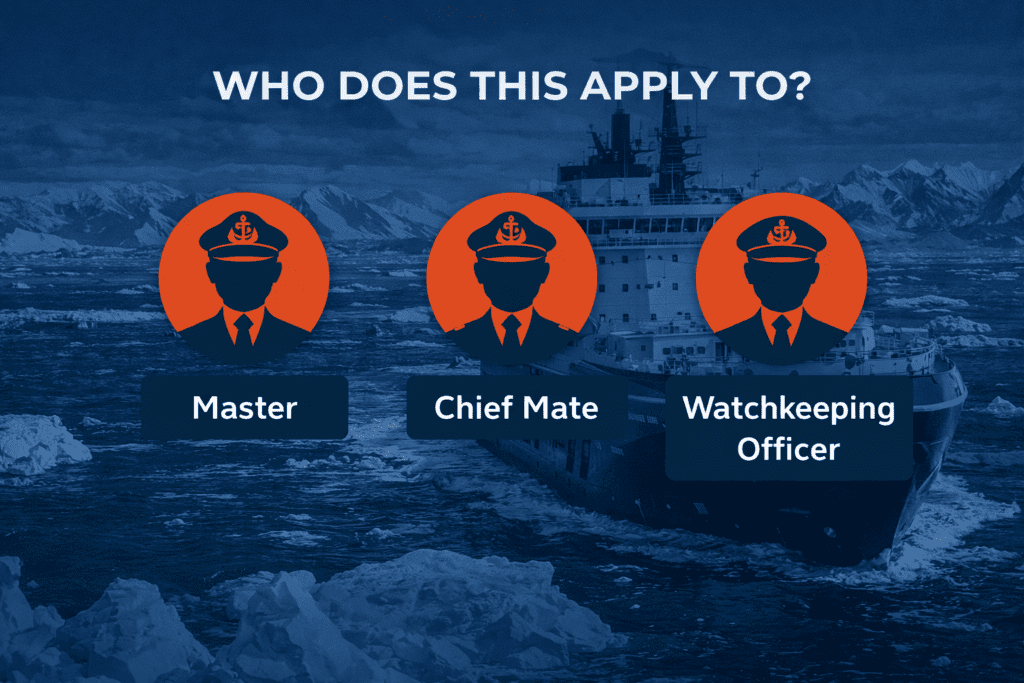
Now this circular does not apply to every seafarer. It applies specifically to deck officers on ships that operate in polar waters. So if you are a Master, meaning the captain of a ship that sails through polar waters, this applies to you.
If you are a Chief Mate on such a ship, this applies to you as well. And if you are an Officer in Charge of a Navigational Watch, which means a 2nd Mate or 3rd Mate on a polar bound ship, this applies to you too. Now the key thing to remember here is that the trigger is always whether your ship operates in polar waters. The moment it does, these certification requirements kick in for you regardless of your rank.
Basic Training and Advanced Training
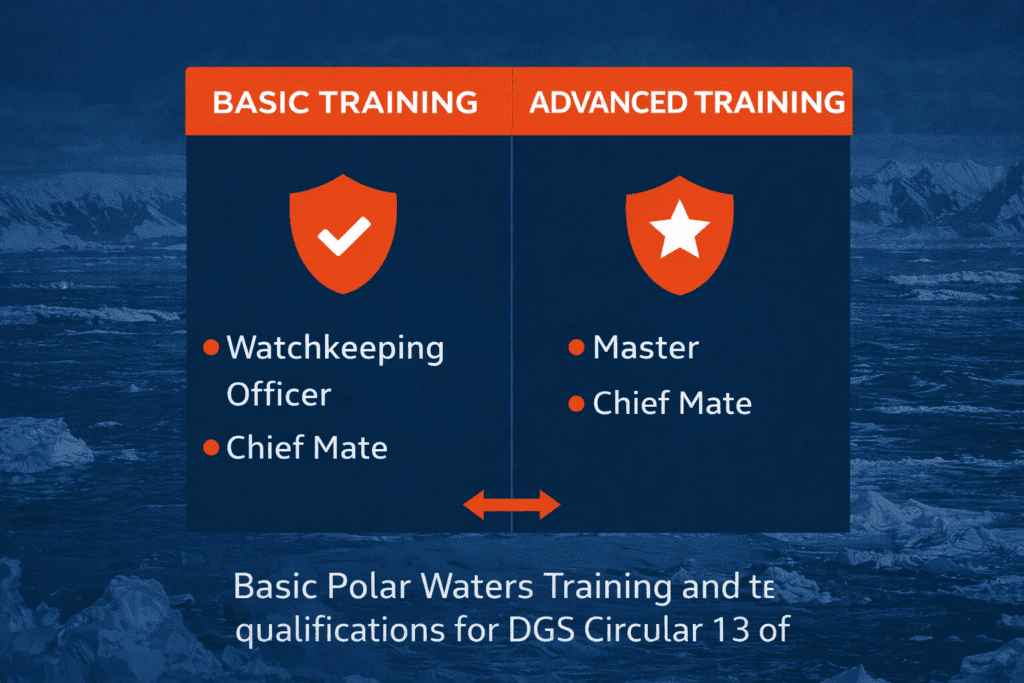
Now this DGMA Circular 13 of 2026 has set up two levels of certification. There is a basic level and there is an advanced level. Every Master, Chief Mate, and watchkeeping officer on a polar bound ship must complete the basic training.
The advanced training is only for Masters and Chief Mates. So if you are a watchkeeping officer, you only need the basic certificate for now. But if you are a Master or Chief Mate, you need both. Let us understand what each level covers.
What Is Basic Training for Polar Waters as per the DGMA Circular 13 of 2026?
To get the basic certificate, you need to complete an approved basic training programme and demonstrate competence in the areas specified in Annexure A of this DGMA Circular 13 of 2026. Now the first thing this training covers is ice knowledge, and when we say ice knowledge we do not just mean knowing that ice is cold and hard.
You need to understand how ice forms, how it grows, how it ages, and how it melts. You need to know the different types of ice like first year ice, multiyear ice, sea ice, land ice, pack ice, and icebergs, and you need to understand how ice pressure, ice concentration, and ice movement work in polar environments.
You also need to know the difference between Arctic and Antarctic ice because they behave quite differently from each other, and you need to understand spray icing, which is when seawater sprays onto your ship and freezes on the deck and superstructure. This can become very dangerous if it is not managed properly, and this is why it is specifically covered in the training.
Now apart from ice knowledge, the training also covers how your vessel performs in ice and in very low air temperatures. As we all know, every ship is different and some ships are ice strengthened while others are not designed for ice at all.
What Is Advanced Training for Polar Waters as per DGMA Circular 13 of 2026?
Now the advanced training is only for Masters and Chief Mates, and before you can even start it you need to meet three conditions. You must already have the basic polar waters certificate, you must have at least 2 months of approved seagoing service in the deck department in polar waters either at management level or as a watchkeeping officer, and you must complete an approved advanced training programme and meet the competency standards in Section A-V/4, paragraph 2 of the STCW Code.
So as you can see, the advanced certificate is not just about sitting in a classroom. You actually need real polar sea experience, and that two month requirement is there for a very good reason.
At the advanced level, you need to be able to plan a complete polar voyage from start to finish, and this is much more complex than planning a regular voyage. You need to know all the relevant information sources for polar navigation, understand the reporting regimes specific to polar regions, and develop safe routing and passage plans that avoid ice wherever possible.
You also need to know when icebreaker assistance or ice pilotage is required and how to factor that into your plan. Now one very important thing that advanced training emphasizes is the limitations of hydrographic charts in polar regions. Many polar charts are incomplete or inaccurate because these areas have not been fully surveyed, and as a Master or Chief Mate you need to recognize when the chart information you are working with may not be reliable enough for safe navigation.
You also need to understand that compasses develop significant errors at high latitudes, GPS can become unreliable, and radar struggles to distinguish ice features from other targets. All of these limitations need to be understood and managed carefully.
Now the most detailed part of advanced training is managing the ship’s actual operations in ice at a command level. Before you even approach an ice field, you need to do a thorough risk assessment considering icebergs, wind, darkness, swell, fog, and pressure ice, and all of these factors need to be carefully weighed before you proceed.
In many polar routes, especially in the Arctic, you will be navigating in convoy with icebreakers, so you need to know how to communicate with them properly, understand convoy terminology, and follow their instructions safely. Sometimes when ice is too thick to push through normally, you need to use ramming techniques.
There are two types called single ramming and double ramming, where a double ram means you reverse the ship and go forward again to break through the ice, and you need to know when and how to use these techniques safely.
Now ice concentration is measured from 1/10 to 10/10, where moderate ice is between 1/10 and 5/10 and dense ice is between 6/10 and 10/10, and as an advanced officer you must be able to manoeuvre safely through both. Besetment is when your ship gets completely stuck in ice and cannot move at all, and it is one of the most dangerous situations in polar shipping.
You need to know how to avoid it, how to free a beset vessel, and what the consequences of besetment can be for both the ship and the crew. Towing in ice is also very different from towing in open water, and docking and undocking in ice covered waters is significantly more challenging because ice can push the ship around and affect propulsion and steering in unexpected ways.
Anchoring in polar waters also has its own specific risks because ice can build up on the hawse pipe and ground tackle, making it very difficult to retrieve the anchor when you need to.
There are also some unique visibility conditions in polar regions that can actually give you very useful information about ice and water nearby. Sea smoke indicates open water in a sea ice area. Water sky is a dark patch on the horizon that also indicates open water ahead. And ice blink is a bright glare on the horizon that tells you there is ice ahead.
These are important navigational cues that every advanced officer must be able to recognize and use properly when sailing in polar waters.
At the advanced level, you also need to be able to manage safety systems and emergency responses in polar conditions. This includes knowing the procedures for abandoning ship and surviving on ice or in ice covered waters, which is very different from abandoning ship in normal sea conditions.
You need to understand the limitations of firefighting systems and life saving appliances in extreme cold because many of these systems simply do not perform well in very low temperatures. And you need to be fully prepared to manage actual emergency responses in polar environments where everything is harder, slower, and more dangerous than in any normal situation at sea.
Basic vs Advanced Training at a Glance
| Basic Training | Advanced Training | |
| Who needs it | All Masters, Chief Mates, and Watchkeeping Officers on polar ships | Only Masters and Chief Mates |
| Pre-requisite | Complete an approved training course | Basic certificate plus 2 months polar sea service |
| Focus | Foundational knowledge and awareness | Command level decision making and operations |
| Regulatory Reference | Table A-V/4-1, Annexure A | Table A-V/4-2, Annexure B |
What Training Methods Are Accepted as Per DGMA Circular 13 of 2026?
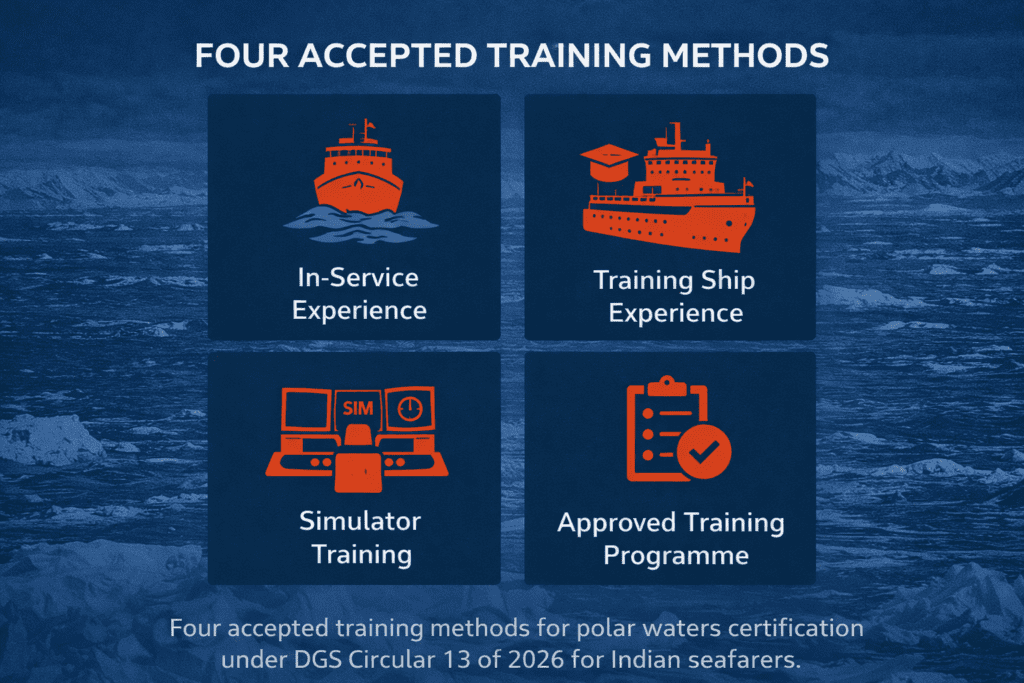
Now you might be wondering how you actually go about completing this training. The DGMA Circular 13 of 2026 accepts four methods which are approved in-service experience on board a ship in polar waters under an approved framework, approved training ship experience on a dedicated approved training ship, approved simulator training since modern bridge simulators can replicate polar ice conditions very realistically, and an approved training programme at a recognized Maritime Training Institute.
In most practical cases, you will end up doing a combination of a training programme at an MTI and actual sea service experience in polar waters, and both together will help you build the competence you need for certification.
How Does This DGMA Circular 13 of 2026 Relate to Earlier Circulars?
Now this DGMA Circular 13 of 2026 does not stand alone and it is important that you understand how it connects to earlier circulars. It supplements and clarifies NT/EXAM Circular No. 02 of 2018, which was the first circular that introduced polar waters training requirements in India.
So if you were already in the middle of your certification process when this new circular came out, the transitional provisions from the 2018 circular still apply to you. This DGMA Circular 13 of 2026 also needs to be read together with DGMA (NT/ENG) Circular No. 18 of 2025, which deals with the engineering side of polar operations. Reading all three circulars together will give you a complete picture of everything that is required for polar water operations.
What Should You Do Now after the DGMA Circular 13 of 2026?
So now that you understand everything about this DGMA Circular 13 of 2026, let us talk about what you should actually do. If you are a watchkeeping officer on a polar bound ship, you need to enroll in an approved basic polar waters training programme as soon as possible if you have not done so already.
If you are a Chief Mate or Master, you need to complete your basic training first and then plan your advanced training, and make sure you are also building your two months of approved polar sea service because you will need that for the advanced certificate.
If you are already sailing in polar waters without this certificate, you need to speak to your company immediately because sailing without the required certification is something you want to avoid completely. And if you are planning to work on polar routes in the future, this is a great time to get ahead, get your basic training done early, and start building your polar sea service hours so you are fully ready when the time comes.
FAQs
1. What is DGMA Circular 13 of 2026 about?
If you are a deck officer sailing on a ship that operates in polar waters, then DGMA Circular 13 of 2026 directly applies to you. Now as we all know, the IMO had passed two resolutions called MSC.416(97) and MSC.417(97) back in 2016, and through these resolutions a brand new training requirement was added to the STCW Convention under Regulation V/4.
This DGMA Circular 13 of 2026, issued on 9th March 2026 is India’s formal implementation of those requirements. So in simple words, this circular is making it mandatory for all deck officers on polar bound ships to hold either a basic or advanced polar waters training certificate depending on their rank.
2. Who needs to complete basic polar waters training?
Every Master, Chief Mate, and Officer in Charge of a Navigational Watch serving on ships that operate in polar waters must complete the basic polar waters training as specified in Annexure A of this circular.
So if your ship sails through Arctic or Antarctic waters, this requirement applies to you. It does not matter whether you are the captain or a watchkeeping officer. If your ship goes to polar waters, you need this certificate.
3. What is the difference between basic and advanced polar waters training?
Now as we all know, the basic training is the foundation level and it is required for all deck officers on polar ships. It covers things like ice knowledge, vessel performance in ice, safe operations, regulatory requirements, crew safety, and environmental protection.
The advanced training on the other hand is only for Masters and Chief Mates and it goes much deeper than the basic level. It focuses on voyage planning at a command level, managing ship operations in ice, and emergency response in polar conditions. And on top of all this, you also need 2 months of actual polar sea service before you can even qualify for the advanced training, which is not required for the basic level.
4. How many months of sea service are needed for the advanced polar waters certificate?
You need at least 2 months of approved seagoing service in the deck department in polar waters, either at management level or as a watchkeeping officer.
Now if you do not have direct polar sea service, equivalent approved sea service is also accepted by the DGMA . But you must meet this requirement before you can enroll in the advanced training programme. Without this sea service, you simply cannot apply for the advanced certificate no matter how much classroom training you have done.
5. Which IMO resolutions does this circular implement?
This circular implements IMO Resolutions MSC.416(97) and MSC.417(97), which were adopted by the Maritime Safety Committee of the IMO back in 2016.
Now through these resolutions, polar waters training requirements were introduced under Regulation V/4 of the STCW Convention. And DGMA Circular 13 of 2026 is India’s formal way of saying that these international requirements are now officially in place here and everyone needs to comply.
6. What is Regulation V/4 of the STCW Convention?
Regulation V/4 is a special regulation that was added to the STCW Convention specifically for seafarers serving on ships that operate in polar waters.
Now this regulation was introduced through the 2016 amendments to the STCW Convention, and it sets out both basic and advanced training and certification requirements for deck officers on these ships. You can think of it as the international foundation on which this entire circular is based.
7. Does DGMA Circular 13 of 2026 replace NT/EXAM Circular No. 02 of 2018?
No, it does not replace it. DGMA Circular 13 of 2026 only supplements and clarifies the 2018 circular. Now if you were already going through the certification process before this new circular came out, the transitional provisions from NT/EXAM Circular No. 02 of 2018 still apply to you.
So you do not need to worry about starting from scratch. Just make sure you are reading both circulars together to get the complete picture.
8. What training methods are accepted for polar waters certification?
The circular accepts four methods. You can complete approved in-service experience on board a ship in polar waters, or you can do approved training ship experience on a dedicated training ship. Approved simulator training is also accepted since modern bridge simulators can replicate polar ice conditions very realistically.
And finally, you can complete an approved training programme at a recognized Maritime Training Institute. Now in most practical cases, you will end up doing a combination of classroom training at an MTI along with actual sea service experience in polar waters.
9. Which ships fall under the polar waters classification?
Ships operating in polar waters means ships that sail through Arctic or Antarctic waters as defined under the IMO Polar Code. So if your ship’s trade route takes it through these regions, the polar waters training requirements apply to you. It does not matter what type of cargo you are carrying or what size your ship is. As long as it operates in polar waters, these rules apply to every deck officer on board.
10. When does this circular come into effect?
The circular was issued on 9th March 2026 and it is effective immediately. So if you are already sailing on a polar bound ship or planning to do so, you need to make sure you have the required certification in place as soon as possible. And if you were already in the middle of your certification process before this circular came out, you need to refer to NT/EXAM Circular No. 02 of 2018 for the transitional arrangements that apply to you.