
The Indian maritime industry is booming, and with the addition of more ships and seafarers, the risk of accidents increases too. To tackle this, the Directorate General of Maritime Administration has issued a draft Merchant Shipping Notes that outline the guidelines and criteria for the empanelment and retention of salvage firms.
These guidelines decide how the salvors will be approved and retained. The new set of rules aims to build a faster, stronger, and more reliable maritime safety system for both the vessels and the workers.
In today’s blog, we will learn about
Basis and Objectives of the New Draft
Basis
The Merchant Shipping Notice No. 01 of 2026, dated 15.01.2026, outlines criteria including financial stability, operational setups on Indian coasts, salvage experience, and tie-ups for emergency response. Empanelment applications must follow the annexed checklist, with the process starting from 01st February 2026, ahead of forthcoming rules. This framework prioritizes rapid mobilization within 24 hours for towing, firefighting, and spill response.
Objective
The official Merchant Shipping Notice No. 01 of 2026 from the Directorate General of Maritime Administration (DGMA) outlines the establishment of a “National Salvage Ecosystem” to create a robust, coordinated framework for addressing maritime emergencies. This ecosystem focuses on rapid response mechanisms to mitigate risks from vessel incidents in Indian waters.
Core Vision Breakdown
- The primary goal involves developing capabilities for emergency services, including towing, firefighting, salvage operations, and oil spill response, ensuring deployment within 12 hours of incident notification.
- It mandates resource and financial readiness for salvors, covering both Indian-flagged vessels and foreign vessels transiting or port-calling in India.
Compliance Options
Vessels must proactively prepare by either:
- Maintaining in-house assets like firefighting equipment, oil spill response units, and high-bollard pull tugs at key locations, or
- Partnering with approved local salvage companies to secure on-call emergency resources positioned strategically.
Criteria for Empanelment and Retention of Wreck Salvage Firms
Salvage firms, referred to as salvors, must meet specific essential criteria for empanelment and ongoing retention under the Merchant Shipping Notice No. 01 of 2026 issued by the Directorate General of Maritime Administration. These requirements ensure a robust national salvage ecosystem capable of rapid response to maritime incidents along Indian coasts.
Registration and Financial Stability
Applicants must be duly registered entities, either Indian companies or joint ventures with Indian partners for foreign firms. A minimum paid-up capital of ₹1 crore is mandatory, along with audited financial statements showing positive net worth and a turnover of at least ₹5 crore in the last year (or preceding turnovers for new joint ventures).
Operational Infrastructure
Salvors need at least one centralized headquarters with a warehouse and must establish operational bases or stand-by locations on both the east and west coasts of India within 12 months of empanelment. Expansion to a minimum of four locations nationwide is required within three years, supported by evidence of existing facilities and detailed setup plans.
Assets, Equipment, and Personnel
Firms must maintain salvage assets and equipment in India (or readily shippable), including tugboats, salvage gear, oil spill kits, diving equipment, and in-house firefighting/spill-response capacity. Qualified personnel such as salvage masters, naval architects, chemists, firefighting experts, and other salvage professionals with relevant experience and security clearances are mandatory.
Proven Experience and Memberships
Evidence of at least four successful salvage operations (wreck removal, refloating, spill recovery, or underwater repairs) in the last five years is required, with preference for two or more in the Indian Ocean Region, Red Sea, Gulf of Aden, or Persian Gulf over the last 10 years. Membership in the International Salvage Union (or equivalent, including for JV partners) and details of any unsuccessful operations must also be provided.
Emergency Response Tie-ups
Tie-ups with recognized Marine Pollution Response Operators (MPROs) in India, including equipment lists and locations, are essential. Agreements or MoUs with ship operators, owners, or tug managers must ensure tug mobilization within 24 hours of an incident, alongside 24×7 contact availability, professional indemnity insurance, and an affidavit affirming compliance with Indian laws like the Merchant Shipping Act, 2025.
While salvors follow this empanelment process under the Merchant Shipping Act, 2025, related businesses like RPSL companies face annual compliance obligations. Check the RPSL Annual Compliance Service to simplify licensing.
Stakeholder Consulation
The Criteria for Empanelment and Retention of Salvors are detailed in Merchant Shipping Notice No. 01 of 2026, issued by the Directorate General of Maritime Administration (DGMA) on 15.01.2026. All stakeholders, Indian and foreign salvage firms, ship operators, and related entities are invited to review the criteria, checklist in Annexure-I and provide comments or suggestions. Submit feedback to ensure alignment with the Merchant Shipping Act, 2025, as the empanelment process commences from 01st February 2026.
Submission Details
- Direct applications and expressions of interest for establishing salvage hubs in India to the Competent Authority (Directorate General of Maritime Administration), per the prescribed checklist.
- For clarifications on essential criteria like financial stability, operational setups, assets, manpower, experience, ISU membership, MPRO tie-ups, and 24-hour tug mobilisation, contact DGMA officials.
Mastering the Latest DGMA Circulars and E-Governance will be Crucial for Your Maritime Career, especially with rules like Merchant Shipping (Wreck & Salvage) Rules, 2026, mandating contracts with empanelled salvors.
Procedure for Salvors Empanelment
The empanelment process for salvage firms follows a structured framework outlined by the Competent Authority – Directorate General of Maritime Administration (DGMA) – under the Merchant Shipping (Wreck and Salvage) Rules, 2026.
Application Submission
Interested entities must submit applications strictly per the Annexure-1 checklist, including all supporting documents evidencing technical capability, operational readiness, and financial stability. The Competent Authority conducts a thorough evaluation, potentially convening meetings for clarifications or additional information.
Evaluation & Approval
An advisory committee of experts may assist in assessing applications. Successful applicants receive formal empanelment notification through official channels. The Authority’s decision remains final.
General Compliance Provisions
Prospective salvors must meticulously follow all criteria and definitions from the Merchant Shipping Act, 2025, and related rules.
DGMA Rights Reserved: The Directorate General of Maritime Administration retains authority to request additional information, modify criteria, impose conditions, or suspend empanelment to safeguard maritime safety, environmental protection, and national salvage ecosystem development.
Checklist for Evaluating Applications for Approval of Empanelment and Retention of Salvage Firms
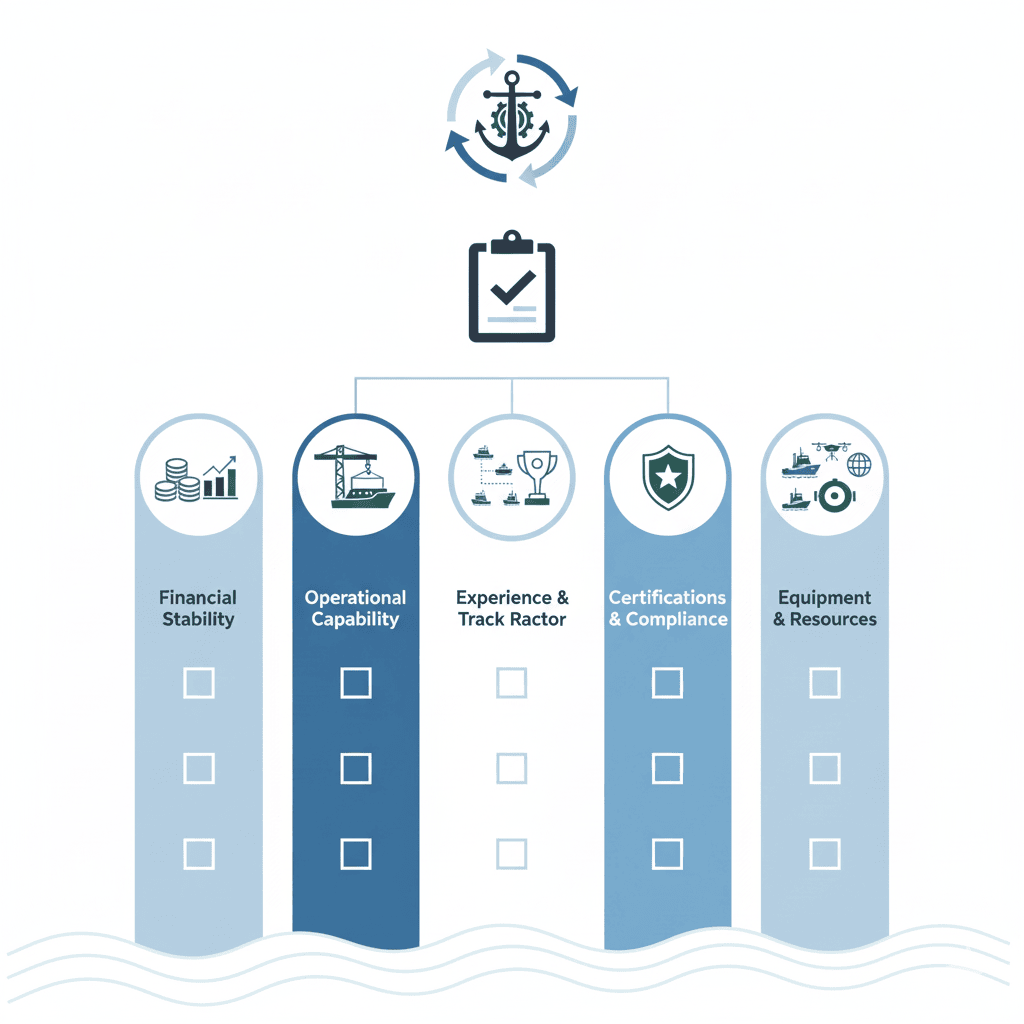
This checklist serves as the comprehensive evaluation framework for assessing applications from prospective salvors seeking to establish salvage hubs and operational capabilities across Indian coastal waters.
| Sr No. | Criteria | Requirements | Remarks |
|---|---|---|---|
| 1 | Registration with the relevant regulatory body (Ministry of Corporate Affairs) | Mandatory | Copy of certificate of incorporation to be submitted |
| 2 | Evidence to be submitted for the existing facility. Detailed. The setup plan to be submitted along with the application | Mandatory | In case of a joint venture, details of all entities to be submitted |
| 3 | Total paid-up capital of the Company | 1 (one) crore (Mandatory) | Evidence required to be submitted with the application |
| 4 | Audited Financial Statements indicating positive net worth and turnover of the Indian entity/Joint Venture with Indian entity | Last 1 year’s financial statement and Turnover of 5 crores (Mandatory) | Evidence required to be Submitted with the application Note: In case of a newly formed Joint Venture entity, the preceding turnovers of each entity shall be taken into account, to the Financial Statements indicating positive net worth and turnover criteria. |
| 5 | Operational set-up/standby locations around the Indian Coast | Establishment of minimum Operational set-up/standby locations at any one location on the East and West Coasts of India within 12 months (Assurance of setting up a minimum of 4 locations around the Indian Coast within 3 years) | Evidence to be submitted for the existing facility. Detailed. The setup plan is to be submitted along with the application |
| 6 | Operational set-up/ Stand-by locations around Indian Coast | Minimum Operational set-up of 1 centralized Headquarters with warehouse / Stand-by locations at 1 location on East and West Coast of India each within 6 months (Assurance of setting up a minimum 6 locations around the Indian Coast within 2 years) | Evidence to be submitted for the existing facility. Detailed setup plan to be submitted along with the application |
| 7 | Manpower Requirements (Salvage Master, Naval Architect, Chemist, Firefighting Expert and other salvage personnel) | Mandatory | Details, qualification experience of Salvag Master, Naval Architect, Chemist, Firefighting and other salvage pe to be provided |
| 8 | Experience of successful completion of salvage operations in last 05 years | Successful completion of a minimum 4 salvage operations (Mandatory) | Evidence of successful completion of salvage operation to be submitted |
| 9 | Experience in conducting salvage operations around Indian Ocean Region, Red Sea, Gulf of Aden, and Persian Gulf in the last 10 years | Successful completion of minimum 2 salvage operations (Preferred) | Evidence of successful completion of salvage operation to be submitted |
| 10 | Details of any unsuccessful salvage operations | As applicable | Details required to be submitted with the application |
| 11 | A Member of the International Salvage Union or equivalent accreditation | Mandatory | Evidence required to be submitted with the application. Note: ISU accreditation may be of one of the partners in case of a JV. |
| 12 | Adequate Professional Indemnity insurance by a reputable insurer to be maintained by Salvage company | Mandatory | Evidence required to be submitted with the application |
| 13 | Tie up with MPRO (Marine Pollution Response Operators) in India with the list of equipment’s and its locations | Mandatory | Evidence of tie-up with MPRO is required to be submitted with the application |
| 14 | Tie up/MOU with Ship operators/owners/managers for the emergency deployment of Tugs | The agreement should state that the tugs should be mobilized within 24 hours of reporting (Mandatory) | Evidence of tie-up/MOU with Ship operators/owners/managers is required to be submitted with the application |
| 15 | 24 X 7 availability of the Point of Contact for salvage | Mandatory | Evidence of a tie-up/MOU with Ship operators/owners/ managers is required to be submitted with the application |
| 16 | Affidavit to comply with Indian laws | Mandatory | In compliance with the Merchant Shipping Act, 2025, Indian Ports Act, 2025 & other extant applicable Indian Laws |
Conclusion
Merchant Shipping Notice No. 01 of 2026 establishes India’s comprehensive salvage ecosystem under the Merchant Shipping Act, 2025, mandating empanelled salvors for all vessels entering Indian waters. From February 1, 2026, ship operators must maintain contracts with DGMA-approved firms equipped for 24-hour emergency response, wreck removal, firefighting, and spill containment.
This framework enhances maritime safety, environmental protection, and rapid incident response across India’s coastline through financially stable, operationally ready salvors.
Who is the Competent Authority for salvor empanelment?
The Directorate General of Maritime Administration oversees applications and final decisions under [Merchant Shipping (Wreck & Salvage) Rules, 2026].
What documents must accompany applications?
Complete Annexure-1 checklist with certificates of incorporation, financial statements (₹1 crore capital, ₹5 crore turnover), operational plans, and evidence of 4+ successful salvage operations.
When does the empanelment process begin?
Applications accepted from February 1, 2026, align with mandatory salvor contracts for all vessels entering Indian ports.
Can foreign firms apply?
Yes, through Joint Ventures with Indian entities, requiring ISU membership, MPRO tie-ups, and 24-hour tug mobilization capability.
What evaluation steps follow submission?
Detailed examination of technical, operational, and financial criteria, plus potential applicant meetings and expert committee review.
Are operational bases required?
Minimum 1 East + 1 West Coast location within 12 months, expanding to 4 nationwide locations within 3 years.
What if my firm lacks Indian experience?
4 successful salvage operations (past 5 years) mandatory; Indian Ocean/Red Sea experience preferred but not required.