
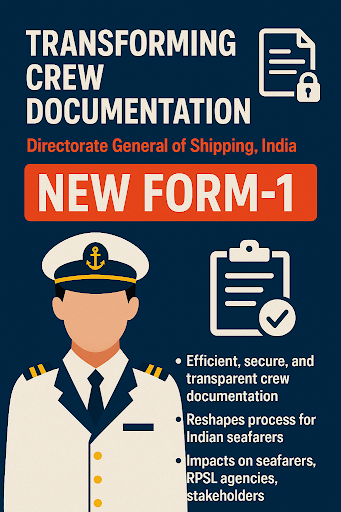
Efficient, secure, and transparent crew documentation is the foundation of any thriving maritime industry. On November 20, 2025, the Director General of Maritime Administration (DGMA), India, released a groundbreaking circular that is set to reshape the process for Indian seafarers traveling abroad to join foreign-flag vessels. This new form–1 (RPSL) for seafarers on foreign-flag vessels is another right step from DSMA in streamlining themaritime administration in India. In this blog, let’s unpack the need for this change, the challenges it addresses, and the impact on seafarers, RPSL agencies, and stakeholders.
Understanding the Change: New Form–1 (RPSL) for Seafarers on Foreign-Flag Vessels?
For years, Indian seafarers, shipowners, and RPSL (Recruitment and Placement Service License) agencies encountered persistent problems at airport immigration checkpoints. Airline staff and officials regularly insisted on the production of the old Form I, even when travelers bore all other valid documents such as visas, guarantee letters, CDCs, and more—the consequences: delays, denial of boarding, and undue stress.
To remedy this, DGMA has introduced a revised New Form–1 (RPSL) for Seafarers on Foreign-Flag Vessels, specifically for Indian seafarers recruited through RPSL companies and assigned to foreign-flag vessels. This is part of a trio: New Form–1for those joining Indian-flag ships, and Form–1B for non-seafarer categories such as auditors, technicians, and cruise ship hotel crew. Each form aims to clarify the documentation standards for immigration and airlines across India’s ports and airports.
Addressing Real-World Problems
Numerous incidents, such as those reported at Mumbai, Delhi, and Varanasi airports, revealed that outdated practices were still causing hardship for seafarers, despite their compliance with every other requirement. The older Form-I was not only imposed on all travelling personnel, regardless of their category, but was also found to be editable and easy to forge. This vulnerability created the risk of innocent seafarers being wrongly criminalized.
DGMA’s solution is both practical and protective. By making the forms non-editable and embedding multiple security features like watermarks, serial numbers, and Emigrate Reference Number integration. The new process introduced via new form–1 (RPSL) for seafarers on foreign-flag vessels eliminates ambiguity and blocks fraudulent agencies from manipulating documentation.
What Makes the New Form–1 Unique?
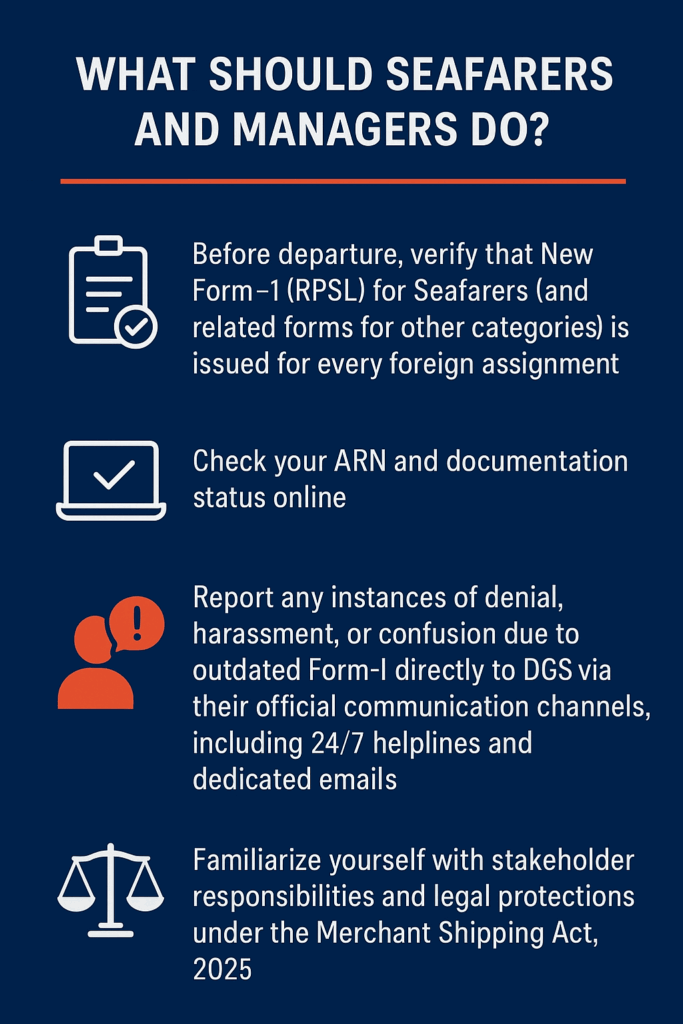
- The new New Form–1 (RPSL) for Seafarers on Foreign-Flag Vessels, and its sibling forms, are:
- Generated exclusively via the DGMA e-Gov module, RPSL agencies and shipowners cannot use old templates or manual edits.
- Equipped with watermarks of both the DGMA logo and the Emigrate Application Reference Number.
- Featuring a unique, auto-generated serial number for traceability.
- Designed as non-editable PDFs, making forgery or unauthorized changes virtually impossible.
This standardization of new form–1 (RPSL) for seafarers on foreign-flag vessels ensures airlines and immigration officials can validate seafarer documentation quickly and accurately, supporting India’s ambitions for a more robust and ethical maritime workforce.
The Impact: Streamlined Travel and Increased Trust
For seafarers, the new system means less hassle and more confidence at the airport. With Form–1 for acceptance uniformly, cases of unnecessary scrutiny and last-minute refusal drop sharply. The integration of the Emigrate Reference Number (ARN) with the passport also means that every form’s authenticity can be checked online, empowering shipowners, agencies, and even the crew themselves to ensure everything is in order.
Stakeholders, such as RPSL agencies, are required to:
- Issue the correct forms before travel.
- Upload all details in the DGMA E-Gov module to generate and link the ARN.
- Provide the crew with travel documents matching the new standards.
This structured approach avoids the pitfalls of manual paperwork, ambiguous verification, and legal gray areas. It also supports compliance with the Merchant Shipping Act, 2025, which classifies seafarers as “key workers,” emphasizing the need for smooth, unhindered movement during embarkation, shore leave, and medical emergencies. The overall impact of new form–1 (RPSL) for seafarers on foreign-flag vessels is less harassment and a smoother onboarding process.
For Agencies: Ensuring Compliance and Professionalism
RPSL agencies must now:
- Stay updated on DGMA notifications and requirements.
- Use only official DGMA channels to generate New Form–1 (RPSL) for Seafarers on Foreign-Flag Vessels.
- Maintain thorough records and timely uploads.
- Prepare for inspections and audits with fully compliant documentation.
The revised workflow, reinforced by routine checks and digital validations, helps agencies maintain ethical standards, legality, and reputational strength within the maritime industry.
What Should Seafarers and Managers Do?
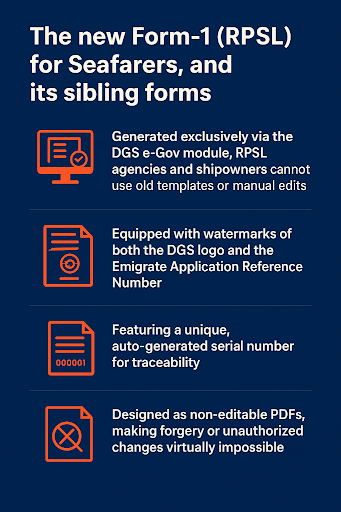
- Before departure, verify that New Form–1 (RPSL) for Seafarers on Foreign-Flag Vessels (and related forms for other categories) is issued for every foreign assignment.
- Check your ARN and documentation status online.
- Report any instances of denial, harassment, or confusion due to outdated Form-I directly to DGMA via their official communication channels, including 24/7 helplines and dedicated emails.
- Familiarize yourself with stakeholder responsibilities and legal protections under the Merchant Shipping Act, 2025.
Conclusion
With Form–1, DGMA is raising the bar on maritime recruitment transparency. The process is now more secure, reliable, and straightforward for all parties. Trust in documentation is essential, and the new Form–1 (RPSL) for Seafarers on Foreign-Flag Vessels sets a precedent for future reform in the Indian shipping sector. As this regulation takes effect on December 1, 2025, staying informed and compliant is not just best practice but also mandatory now.
The era of ambiguous forms and travel uncertainties is ending. Indian seafarers, agencies, and shipping operators now have a clear path forward, ensuring smooth passage from India’s shores to the world’s oceans. The steps, such as this new Form-1 and the digitization of the license process for foreign-flagged vessels, will aid the growth of the maritime industry in India.
FAQs on New Form–1 (RPSL) for Seafarers on Foreign-Flag Vessels
1. What is the new Form–1 (RPSL) introduced by DGMA, and why was it implemented?
The new Form–1 (RPSL) is a standardized, secure digital form issued to Indian seafarers recruited through RPSL license holders for foreign-flag vessels. It replaces the older editable Form-I to prevent forgery and reduce travel delays. The revised form has enhanced security features, including a non-editable PDF format, watermarks, and a unique serial number to ensure authenticity recognized uniformly by airlines and immigration authorities.
2. Who needs to obtain the new Form–1, and are there related forms for other categories?
2Indian seafarers recruited by RPSL companies for foreign vessels must obtain the new Form 1. There are also Form–1A for seafarers on Indian-flagged ships and Form–1B for non-seafarer personnel like technicians, auditors, or cruise ship hotel staff. Each form corresponds to the category of personnel to streamline verification at immigration checkpoints.
3. How do RPSL agencies and shipowners generate the new Form–1?
Authorized RPSL companies and Indian shipowners must generate and download Form 1 from the Directorate General of Shipping’s e-Governance portal. They upload the necessary seafarer details, which generates an Emigrate Application Reference Number (ARN) embedded in the form to secure further and authenticate the document.
4. What should a seafarer do if denied boarding or faced with issues at immigration despite having the new form–1 (RPSL) for seafarers on foreign-flag vessels?
Seafarers should immediately report incidents of boarding denial or harassment to DGMA Shipping via their official helplines and dedicated emails (e.g., support.dgma@gov.in). The DGMA provides 24/7 support and monitors such complaints to ensure compliance by airlines and authorities.
5. When did the new form–1 (RPSL) for seafarers on foreign-flag vessels requirements come into effect, and what is the legal backing?
The requirement for the new form–1 (RPSL) for seafarers on foreign-flag vessels took effect on December 1, 2025. It is supported by Section 56(3) of the Merchant Shipping Act, 2025, which treats seafarers as “key workers,” facilitating their unhindered movement for boarding, shore leave, and medical treatment. Airlines and immigration authorities are legally required to accept the updated new form–1 (RPSL) for seafarers on foreign-flag vessels as valid proof of identity and clearance.
How to apply form 1