
With the booming scale of employment opportunities at the maritime industry and the number of seafarers entering the workforce gradually, it’s crucial that the governance takes steps for the sake of seafarer welfare, In this case the ministry of law and justice introduced the MS Act 2025, in which certain sections under part V expand on the seafarer right to safety, accommodation, food, medical care, wages, job security, wages and the right to access/acquire legal protection when needed.
These guidelines place a clear responsibility on ship owners and authorities to ensure that all workers are paid on time and facilitated with the right number of resources to keep them safe, healthy and efficient. Some parts of the act also dive into the legal rights seafarers have on their schedule, wages and safety.
Before we dive in, it’s important to understand the previous part where we discuss the rights and rules for seafarers under MS Act 2025.
What rights do the workers have on their job security, manning levels & accommodation?
Job security – If the ship is lost or sinks in any case, the ship owner is obliged to compensate every seafarer onboard for the loss of employment; this is to protect the workers from any kind of loss due to incidents that are beyond their control.
Manning levels – Every vessel must carry enough seafarers to operate safely and efficiently. Manning rules must consider some factors such as safety, security and the workers fatigue to allow rest through changing shifts along with the nature and length of the voyage to prevent understaffing or overworking of crews. And as a new step towards safety of workers/crew onboard, there has been stricter rules for registration of vessels as per this very act.
Accommodation & food – Ship owners are mandated to provide decent living spaces that meet the basic living standards of the workers and facilitate spaces that improve seafarer physical and mental health.
And for the food part, the ship owners are directed to provide nutritious food, water and other catering necessities to all workers free of cost, they are also required to take into consideration all the cultural, personal and religious preferences of their employees. An owner must also make sure that the crew that are assigned to be cooks on board are well trained, qualified and approved by the directorate general.
If you are an individual looking to get to work in maritime as a medical professional here’s how to get DGMA approval as a doctor.
Rules for medical care and social security under Seafarer welfare programs.
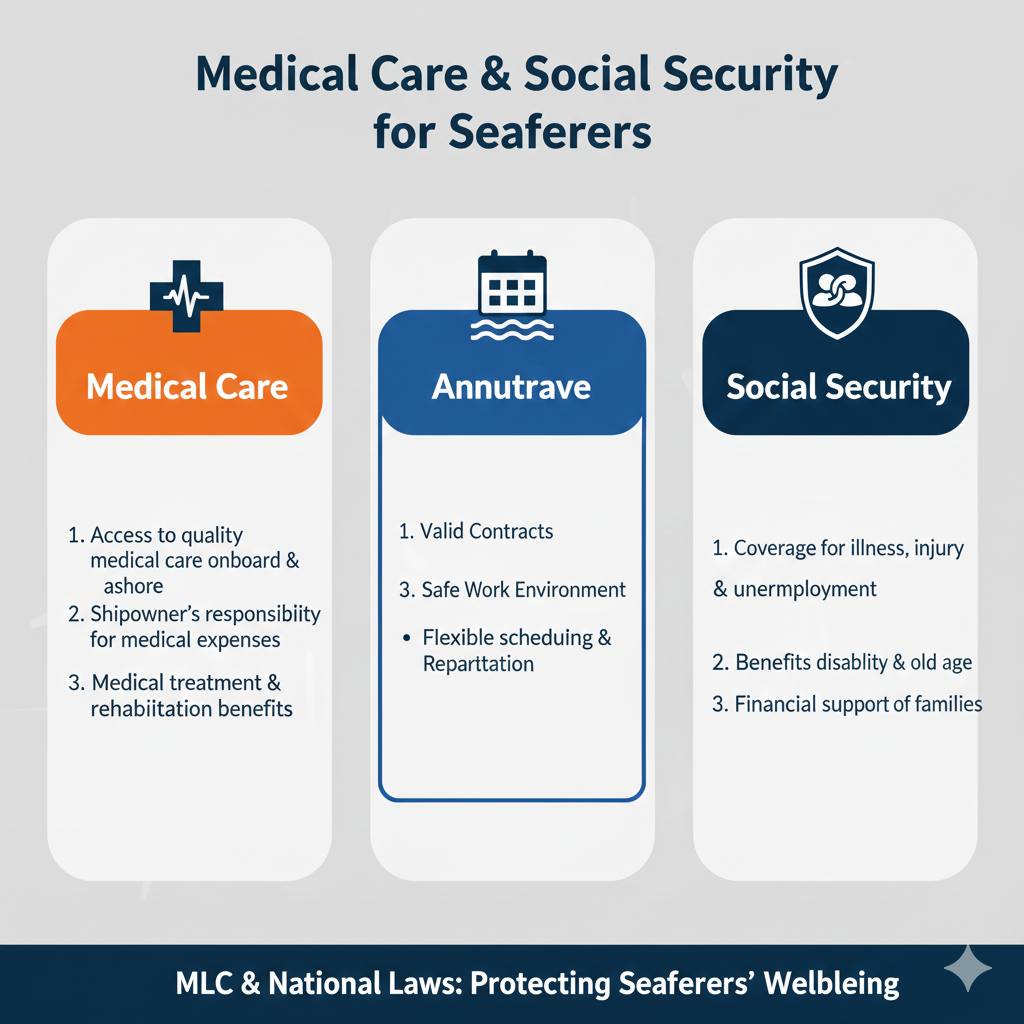
Shipowners must provide medical care and health protection at no cost to seafarers while onboard or employed. To complement this DGMA has also introduced a concept of mandatory minimum medical test seafarers as of 2025, And if the worker gets sick or dies while onboard the ship owners are liable to provide financial assistance at any cost. The death of the seafarer does not take his/her right away to claim the compensation.
As per the guidelines of DGMA shipowners must ensure:
- Health protection
- Safe, clean, and hygienic living and working conditions
- Accident prevention measures
All of the workers are to have access to social security schemes like insurance, welfare etc. If the ship owners fail to deliver these the worker is free to seek advice through higher ups and claim their given rights.
State responsibilities & maritime law compliance
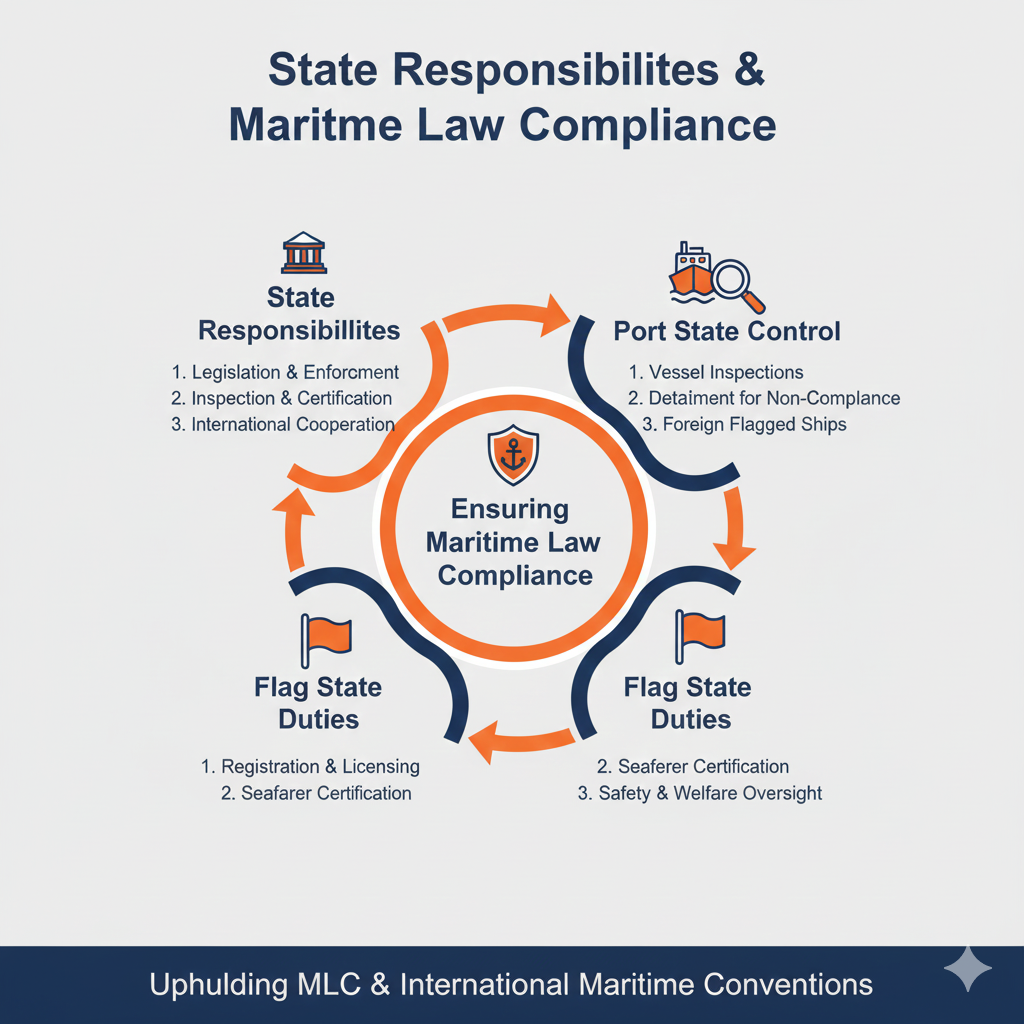
The state responsibilities and the central government control over the rule making power helps enforce welfare guidelines & programmes easily. These help seafarers work in an effective system of inspection, guidance and safety. The responsibilities are delegated as follows:-
Flag state: The central government must set up systems for:
(a) establishing an effective system for inspection and certification of maritime labor conditions
(b) authorize public institutions or other organizations competent to carry out inspections or grant certificates
(c) effective and coordinated system of regular inspections, monitoring and other control measures
(d) onboard complaint procedure for the fair, effective and expeditious hearing of seafarer’s complaint alleging breach of the Maritime Labor Convention and
(e) compliance and enforcement.
Certain vessels must carry a Declaration of Maritime Labour Compliance (DMLC).
Port state: The central government must make rules for matters such as:
(a) establishing an on-shore complaint redressal procedure
(b) establishing a procedure for inspections in port
(c) compliance and enforcement.
The directorate general is mandated to develop a system for the inspection of vessels and a procedure for port state inspections, along with:
(a) the requirement to develop, maintain and update an electronic inspection database, containing all information required for implementation of an effective and coordinated system of regular inspections; and
(b) specifying risk profile of all vessels calling at Indian ports in the inspection database.
The central government also has the power to make decisions on the enforcement and compliance of MLC standards; it can decide and make rules on matters such as:
- minimum age
- medical certificate
- training and qualifications
- recruitment and placement
- seafarers’ employment agreements
- payment of wages
- hours of work and hours of rest
- entitlement to leave
- repatriation
- compensation in case of loss of vessel or foundering
- manning levels
- service conditions including skill development opportunities
- accommodation, recreational facilities, food and catering
- ship owners’ liability
- health protection, medical facilities, welfare and social security protection
- any other matter which is to be or may be required for compliance and enforcement of the Maritime Labor Convention.
If you want to learn more about the convention discussed above, read about the maritime labour convention amendments 2006 discussed through a 2022 lens.
Guidelines for termination and wage protection
To ensure maximum job security and proper living standards on and offboard for the workers, if any seafarer is discharged due to wreck of vessel, illness, injury or abandonment he/she is still viable and has all the right to claim their pending wages.
Wrongful or foul discharge will result in a penalty and the owner will have to pay the worker up to 1-3 months of wages; 1 month worth of wages if the discharge happens before commencement and 3 months worth of wages if the discharge happens after commencement.
Seafarer discharge – A seafarer while onboard:
- Must not be discharged early without consent
- Must be repatriated if discharged abroad
- Cannot be left behind without proper authority
- Cannot be discharged before the expiration of his/her engagement period onboard.
Unauthorized discharge/ discharge without the seafarer’s consent will be treated as illegal and the executives onboard are required to keep record of the seafarers they have discharged.
If a seafarer goes missing or is left behind (discharged due to his inefficiencies/ other reasons) his/her wages of the work done in prior should be paid and their personal property must be safeguarded and handed back lawfully. Unclaimed wages left behind by the workers can be used towards the seafarer welfare programs after six years of time.
What are the instructions for dispute regulation and legal remedies?
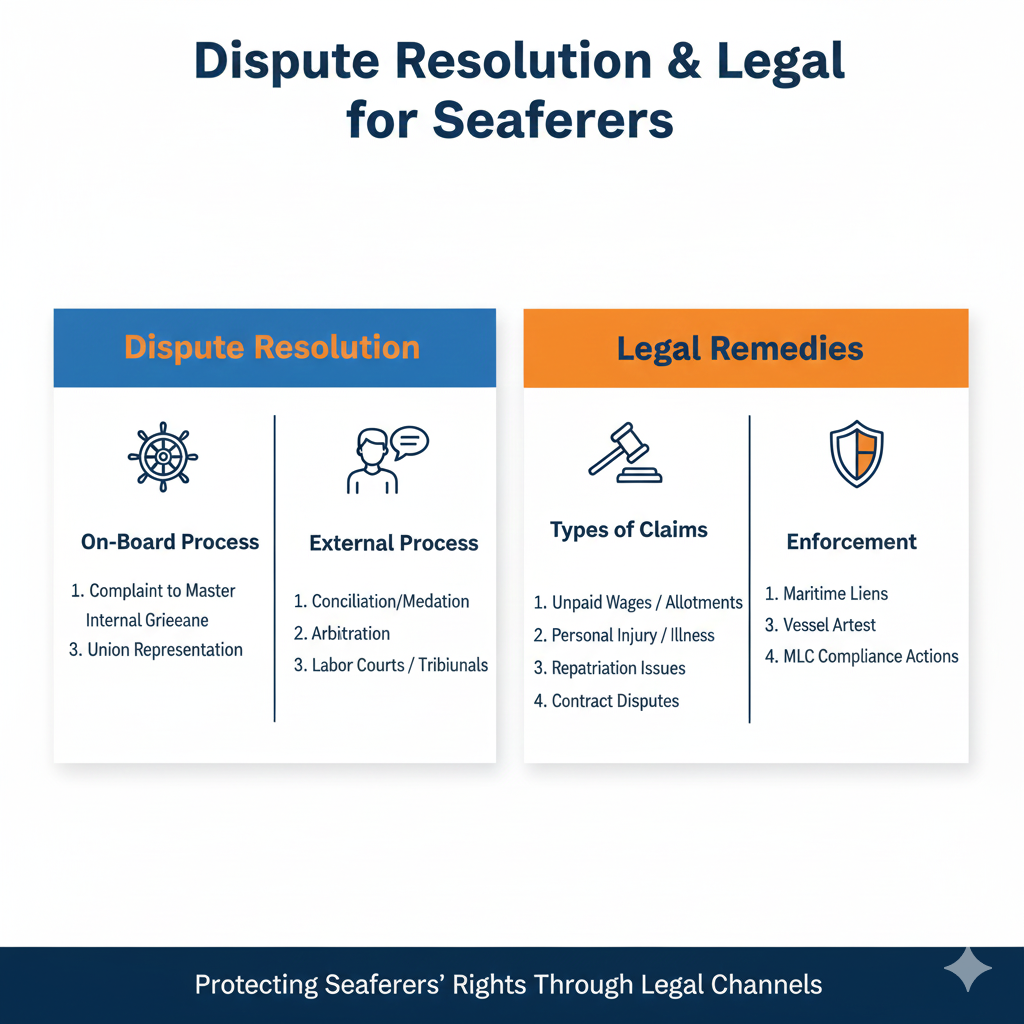
Any form of dispute and disturbances between the crew onboard whether it’s between the seafarer and the shipowner or anyone else, it must be reported to the shipping master and he/she is mandated to hear out either of the parties before reasoning and making a decision. The said decisions are legally enforceable like court decrees.
More changes have been made by the DGMA to tackle and decrease the number of disputes including cases of harassment, the mandatory harassment prevention training as per STWC 2025 being one of the major steps.
During the decision-making process the shipping master has the power to demand log books, contracts and attendance of parties to ensure efficiency and fair results/ consequences.
Seafarers engaged in voyages that end in India are not eligible to sue abroad for wages unless they have made a written agreement in prior with the ship owners or executives. And unpaid wages can be claimed quickly before a Judicial Magistrate, with a fast and final decision. The master of vessels can and will have the same rights as seafarers regarding matters such as: wages, disbursements and liabilities incurred for the vessel.
Civil courts can hear wage cases only in limited situations like insolvency, vessel arrest and court reference. And for major disputes, the central government is said to interfere, this is so they can set up a special tribunal with members experienced in maritime matters and refer the dispute directly to this tribunal for decision. The central government will only interfere for matters that involve a larger scale/ class of seafarers or industrial peace at sea.
How does the tribunal proceedings work?
It is not bound by strict civil court procedures or evidence laws and is directed to follow principles of natural justice (fair hearing for both sides), it also has powers similar to a civil court, including powers such as summoning witnesses, calling documents, examining evidence.
Proceedings by the tribunal will be treated as judicial proceedings under the sections section 229 and section 267 of the Bharatiya Nyaya Sanhita, 2023.
No party involved is allowed to have legal representation at the proceedings unless they have the consent of all parties involved along with the approval of the tribunal. And the tribunal must submit its award to the central government within a specific period of time. And once the award is submitted, the central government may approve, modify or reject it. If approved then the award becomes enforceable with an expiration period of 30 days, once enforced the award binds all owners, successors and assignees as they will be obligated to pay the award money to seafarers in the form of unpaid wages.
During the proceedings where the dispute is still pending, seafarers cannot strike and the shipowners cannot worsen service conditions or punish seafarers for suing, this is to ensure stability of vessel operations while the dispute is still being resolved actively.
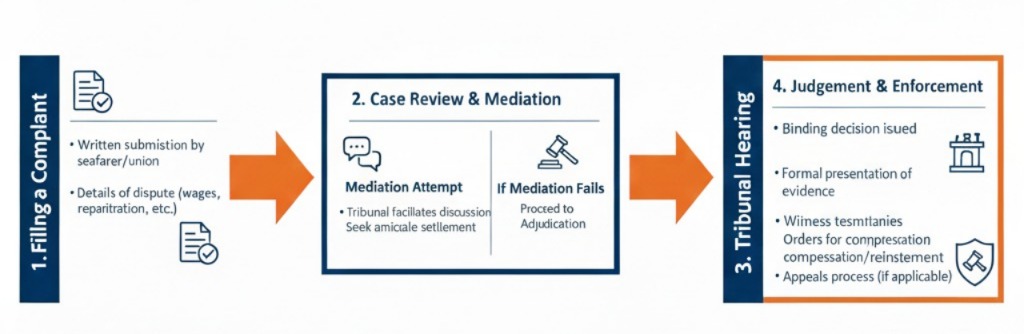
Key legal impact due to this act regarding the dispute resolution are as follows:
- Industrial Disputes Act, 1947 does not apply to these disputes
- Tribunal awards usually last one year, unless terminated properly
- Tribunal dissolves after completing its function
Final thoughts
This is a comprehensive framework designed to safeguard workers and achieve maximum scale of seafarer welfare, while the sections laying out rules for job security, medical care and accommodations helps seafarers lead an efficient life at sea, the guidelines for state responsibilities, termination and dispute regulation facilitates in making the executives job easier, safe and fair than ever.
This reinforces the idea that seafarers are not merely crew members and that they are essential workers whose welfare is central to a safe and sustainable maritime industry while acting as a compliance roadmap for shipowners operating under Indian maritime law.
1. What protections do seafarers get beyond wages under MS Act 2025?
The act of 2025 ensures safe working conditions, proper accommodation, nutritious food, medical care, social security, job security in case of vessel loss, and legal remedies if a seafarer is unfairly treated or abandoned.
2. What happens if a vessel is lost or sinks during a voyage?
If a vessel is lost or founder, the shipowner must compensate every seafarer onboard for unemployment caused by the incident. Seafarers are also entitled to wages and other benefits as prescribed under the law.
3. Are shipowners responsible for a seafarer’s medical care?
Yes. Shipowners must provide medical care and health protection at no cost to the seafarer. If a seafarer is injured, falls ill, or dies due to work-related reasons, the shipowner is financially responsible, without affecting the seafarer’s right to claim further compensation under other laws.
4. Can a seafarer be discharged or left behind without consent?
No. A seafarer cannot be discharged early or left behind without proper consent and legal authorization. If this happens, the seafarer is entitled to wages, compensation, and repatriation at the shipowner’s expense.
5. How are employment disputes between seafarers and shipowners resolved?
Individual disputes are handled by the shipping master, while large or collective disputes may be referred by the Central Government to a special maritime Tribunal. These mechanisms provide faster, maritime-specific resolution without lengthy court proceedings.
6. Are seafarers allowed to strike during a dispute?
No. Once a dispute is referred to a Tribunal, seafarers cannot go on strike, and shipowners cannot worsen service conditions or punish seafarers. This ensures safety and continuity of vessel operations while the dispute is being resolved.