
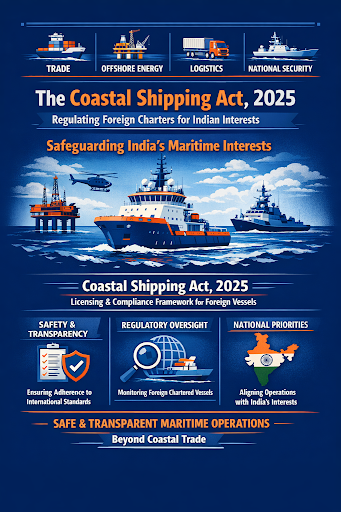
India’s maritime ecosystem supports critical sectors such as trade, offshore energy, logistics, and national security. To maintain regulatory oversight when Indian interests charter foreign vessels, the Coastal Shipping Act, 2025 establishes a structured licensing and compliance framework for vessels operating beyond domestic coastal trade.
This framework ensures that international maritime operations connected to India remain safe, transparent, and aligned with national priorities.
When Is a Licence Mandatory for Chartered Vessels?
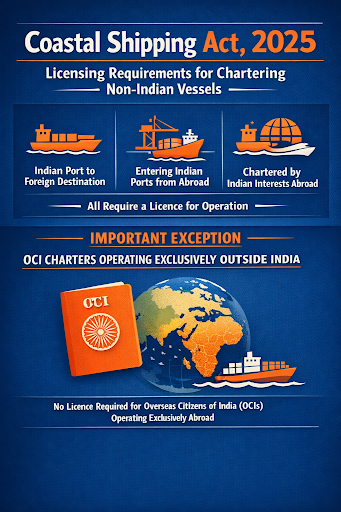
Under the Coastal Shipping Act, 2025, non-Indian vessels chartered by Indian citizens, Non-Resident Indians (NRIs), Overseas Citizens of India (OCIs), or Indian entities are required to obtain a licence before proceeding to sea. This applies when a vessel:
- Operates from an Indian port to a foreign destination
- Enters Indian ports from abroad
- Is chartered by Indian interests, even if the voyage is entirely outside India
The law recognizes that charter arrangements involving Indian stakeholders require oversight, regardless of where the vessel physically operates.
An important exception exists: vessels chartered by OCIs exclusively for operations outside India are exempt from licensing. This reduces regulatory burden while preserving control over India-linked maritime activity.
Flexible Licensing Options for Different Operations
The Act allows licensing authorities to issue different types of licences based on operational needs, including:
- General licences for ongoing or recurring operations
- Time-bound or voyage-specific licences for limited engagements
This flexibility supports commercial efficiency without compromising safety or compliance.
Application, Conditions, and Modifications
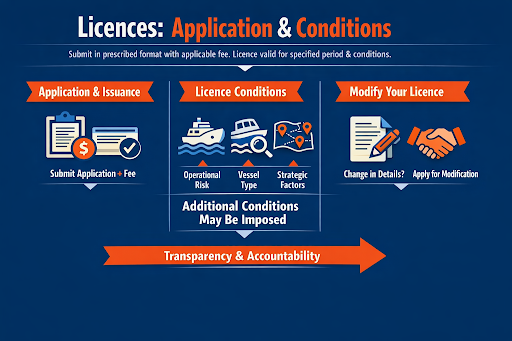
Licence applications must be submitted in the prescribed format and accompanied by the applicable fee. Once issued, a licence is valid only for the period and conditions specified.
Regulatory authorities may impose additional conditions depending on operational risk, vessel characteristics, or strategic considerations. If operational details change, licensees are permitted to apply for modification of licence particulars through a formal process, ensuring transparency and accountability.
Suspension or Revocation: Safeguards and Due Process
The Coastal Shipping Act, 2025 empowers authorities to suspend, revoke, or modify a licence when circumstances demand regulatory intervention. However, this power is balanced by procedural fairness to help Indian seafarers and non-seafarers.
No adverse action is taken without giving the licensee a reasonable opportunity to be heard, reinforcing confidence in the regulatory system and protecting legitimate operators.
Port Clearance Depends on Licence Compliance
Port clearance is strictly linked to licensing. A vessel requiring a licence cannot be granted clearance unless the owner, master, or agent produces a valid and subsisting licence. This ensures that only compliant vessels are allowed to operate in connection with Indian ports and interests.
Why This Regulatory Framework Is Important
This licensing regime strengthens India’s maritime governance in several key ways:
- Enhances national and maritime security
- Improves accountability in international charter arrangements
- Ensures compliance with safety and operational standards
- Aligns Indian maritime law with global best practices
By regulating chartered vessels effectively, the Coastal Shipping Act, 2025 supports responsible global participation while safeguarding Indian interests.
Conclusion
The Coastal Shipping Act, 2025 provides a balanced and forward-looking approach to regulating chartered vessels involved in international maritime operations. For ship owners, charterers, and maritime professionals, understanding these requirements is essential not only for legal compliance but also for building long-term credibility in India’s maritime sector.
Frequently Asked Questions (FAQs)
1. Who is required to obtain a licence under the Coastal Shipping Act, 2025 for chartered vessels?
Any non-Indian vessel chartered by an Indian citizen, Non-Resident Indian (NRI), Overseas Citizen of India (OCI), or an Indian entity must obtain a chartering licence before proceeding to sea, if the operation is connected to India or Indian ports.
2. Are all OCI-chartered vessels required to obtain a licence?
No. If a vessel is chartered by an Overseas Citizen of India exclusively for operations outside India, a licence is not required. Licensing becomes mandatory only when the operation involves India.
3. What types of licences can be issued for chartered vessels?
Licences may be issued as general licences for ongoing operations or as time-bound or voyage-specific licences, depending on the nature and duration of the charter.
4. Can a licence be suspended or cancelled after it is granted?
Yes. Authorities may suspend, revoke, or modify a licence if circumstances require it. However, the licensee is given a reasonable opportunity to be heard before any such action is taken.
5. Is a licence mandatory for port clearance?
Yes. A vessel that requires a licence cannot receive port clearance unless a valid licence is produced by the owner, master, or agent of the vessel.