
MS Act, 2025 not only discusses the ways to implement welfare programs for seafarers, it is also about the prevention of accidents and defining rules for when things at sea go wrong. Certain sections under part V of the act dive deep into the guidelines for some of the most sensitive and serious issues of maritime employment: abandonment of seafarers, government intervention, vessel inspections, onboard, desertion & discipline, and criminal misconduct.
To understand this part of the act you will have to first browse through the rights & rules for seafarers along with the Welfare programs & legal rules as per MS, Act 2025 which come under the same part we are now discussing in this blog.
The guidelines speak for seafarers that work in risky and uncertain conditions, they set standards for safety and make sure there is help available on time. Together, these sections aim to ensure safety, accountability, and order while still protecting seafarers from being left helpless in crisis situations.
How does the government protect the abandoned seafarers?
The government steps in and helps the seafarers in case of abandonment by the ship owner in the following way:
- If the seafarer is abandoned in a foreign country, the Indian ambassador should step in and help arrange the repatriation to a proper return port, along with the necessary clothing/maintenance goods until return.
However, this help is only available as prescribed under the rules.
All the costs for the process of repatriation shall be counted as debt owed to the central government and recovered from the shipowners, shipowners are to cover the costs and never recover the said costs from the seafarers except in the cases where abandonment happened due to: desertion, misconduct or imprisonment.
And if a ship is abandoned and crew need to be repatriated:
- The government may arrange replacement crews to take over the vacancies.
- All costs are should be covered and paid by the shipowner
- A government certificate declaring abandonment is and will be considered as conclusive proof.
Who has the inspection powers? And what are the rules for MLC?
Authorised officers such as shipping master, surveyor, welfare officer, Indian ambassador, may board vessels at any point and inspect matters such as:
(i) the provisions and water
(ii) the weights and measures
(iii) the accommodation for seafarers
which the vessel is required to provide to its seafarers under this Act and they can also inspect space, equipment used for the storage and managing items of food, water and any other equipment used for the preparation and service of meals to the workers onboard.
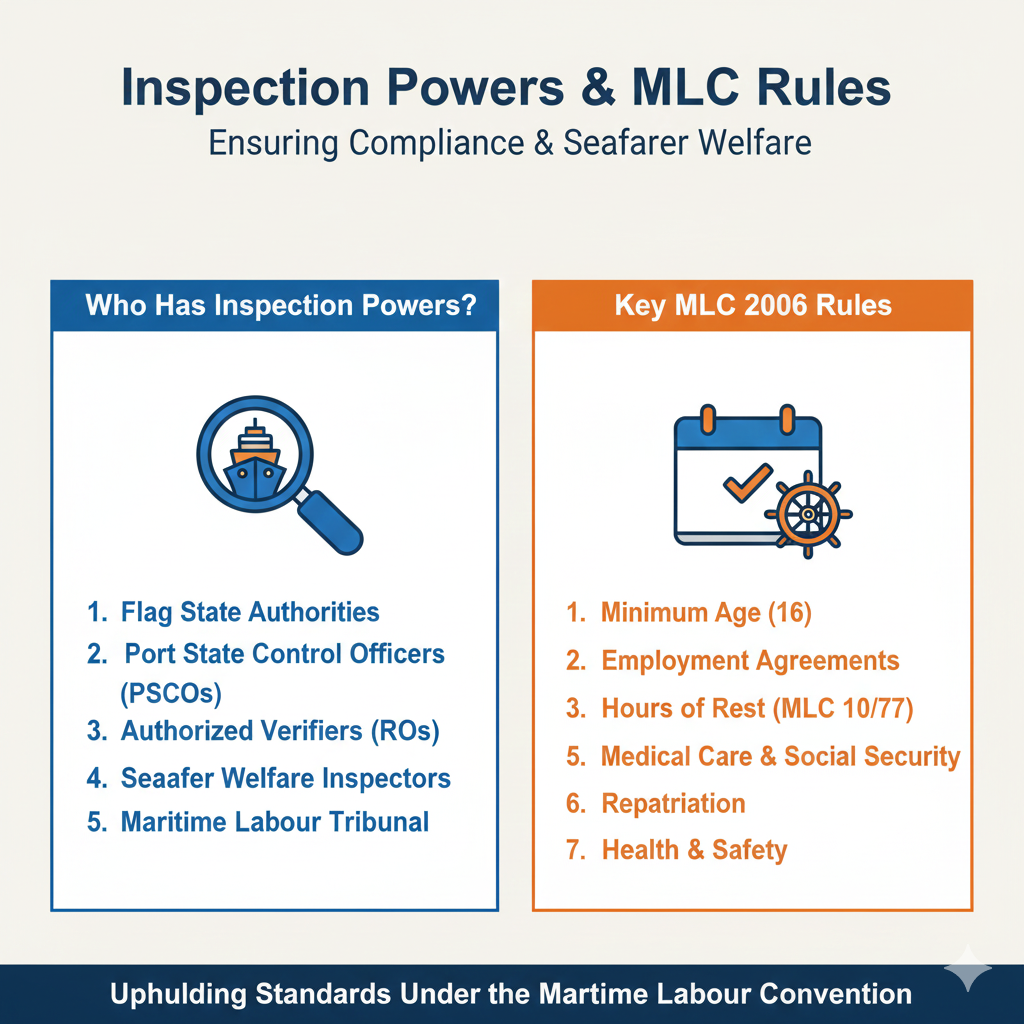
Officers may board vessels to muster the seafarers, verify whether all of the engagement is happening in a lawful way and also to prevent illegal recruitment onboard.
And for verifications, Indian vessels on international voyages must carry a Maritime Labour Certification and the Declaration of Maritime Labour Compliance. Other vessels may be required to carry certificates unless exempted from doing so.
And if you are a vessel or ship owner trying to expand your maritime businesses there are more documents along with the certificates mentioned above that are needed, here’s a clear guide on how to obtain an RPSL license for maritime companies and kick start your entrepreneur journey.
Guidelines for legal status, onboard control and handling complaints.
The legal status of the workers onboard is decided based on the official/legal definitions of their positions and jobs. And according to the act a seafarer is considered as “serving seafarer” right from the date signing the agreement and until 30 days after his/her final discharge. They will receive legal protection during this period.
And if the seafarer wants to complain against the master/owner or a fellow seafarer, the master must allow them to go ashore and file the complaints to a proper authority.
To protect the ship and other seafarers, any person if caught boarding the ship illegally or without permission then the master has the right to detain them, hand them over to the police or produce them before a judicial magistrate. This not only helps protect vessel safety but also helps in implementing disciplinary actions.
Rules for duties, penalties, desertion and discipline check-ups.
To prevent any kind of serious endangerment, seafarers are prohibited from participating in any activities that might damage the vessels or endanger the lives of other seafarers working on the ship. They are also mandated to follow their lawful duties that are put in place to protect the ship or crew. These regulations must be followed and will be treated as serious violations if disobeyed.
And for the desertion rules, no seafarer is allowed to desert the vessel or abandon his duties. Without any reasonable cost. He also is not allowed to refuse to sail after agreement or remain absent without any leave permissions except for the cases when the vessel is unseaworthy. Desertions are only justified if:
- The vessel is unsafe
- The seafarer reports said problems to the proper authorities to solve.
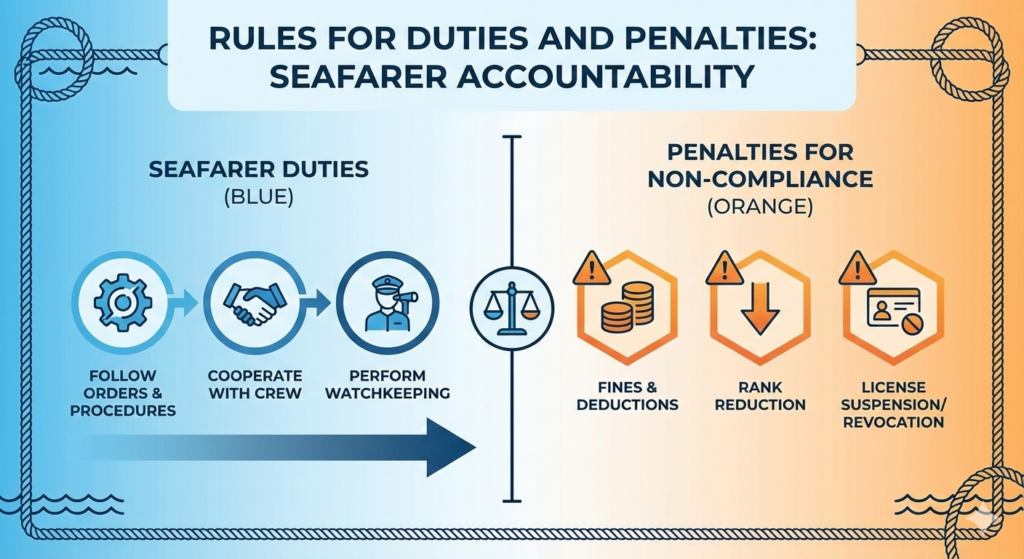
The penalties for desertion without proper reasons are as follows:
- Continuous Discharge Certificate may be withheld
- Certificates of competency may be suspended or cancelled
But before the penalty is carried out the seafarer must be given a fair hearing, the masters will have the right to arrest or convey the deserted seafarers onboard if legally permitted.
A seafarer will be liable to pay penalties for offences such as:
- Wilfully disobeying lawful commands
- Neglecting duty while on board
- Assaulting crew members or the master himself
- Committing acts that contribute to damaging the ship or cargo
- Acting out in ways that obstruct the navigation process of the vessel.
DGMA has also taken an initiative to further the penalty for violation of safety guidelines, the latest one being taking strict action against forged CDC entries as per 2025
The Director General may and has the right to suspend or cancel the certificates of the said seafarer after hearing out his side of the explanation argument once.
Rules for suppression (smuggling) & logging.
If any seafarer is convicted of smuggling illegal substances onto the vessel then he/she is mandated to compensate the shipowner for losses when penalized, to cover this the ship owner is allowed to withhold the seafarers wages and the directorate or the executives at sea may suspend/cancel their certificates.
And when a seafarer commits any kind of desertion, absence without leave, an offence against discipline or any misconduct that attracts a fine under the seafarers agreement, the law does not allow punishment without any kind of documentation. These guidelines focus on how discipline is recorded, proved and imposed and regulated on board vessels.
The following steps are mandatory in the process of logging the activities:
- The offence must be recorded and signed by the master & the officer on watch
- The seafarer must be given a copy of the said log, read out clearly and audibly to him along with it, all of this must be done before the vessel reaches the next port or before the departure if already in port.
- The seafarer has the right to give his side of the explanation for his actions while his response must be recorded and signed.
- The log book entries must be produced in any kind of legal proceedings and if they aren’t produced the court may refuse to accept evidence of misconduct.
The process is to assure all the legal cases are fair, lawful and strongly presented.
Guidelines for desertion and forfeiture of wages
If a seafarer is desert or absent without any notice or permission outside India and within India, the master of the ship within 48 hours is required to report this to the ship-owner or an officer approved by the central government.
And when the desertion happens outside India, on foreign waters, the master must make a log and present it to the Indian ambassador which the ambassador should make a copy of and must send it to the shipping master at the port. This copy can be used as legally admissible as evidence. This ensures legal continuity even outside Indian jurisdiction.
To cover the costs of penalties due to break of rules by the seafarer, the owner can forfeit wages of the said worker. But to do so, he must present documents of proof that the seafarer has committed the punishable activity. Here’s what the owner has to provide and prove in order to win his case legally:
- Provide proof that the seafarer was properly engaged in his work prior to the desertion.
- Provide proof that the seafarer left before the completion of the ongoing voyage
- Provide proof of the desertion entry in their log books.
These will presume that the desertion is proven and the seafarer will be penalised unless he provides a discharge certificate or provides sufficient justification for doing so.
If wages or property are forfeited due to desertion, they will be used to recover the expenses caused to the shipowner or master. And any remaining amount is paid to the central government.
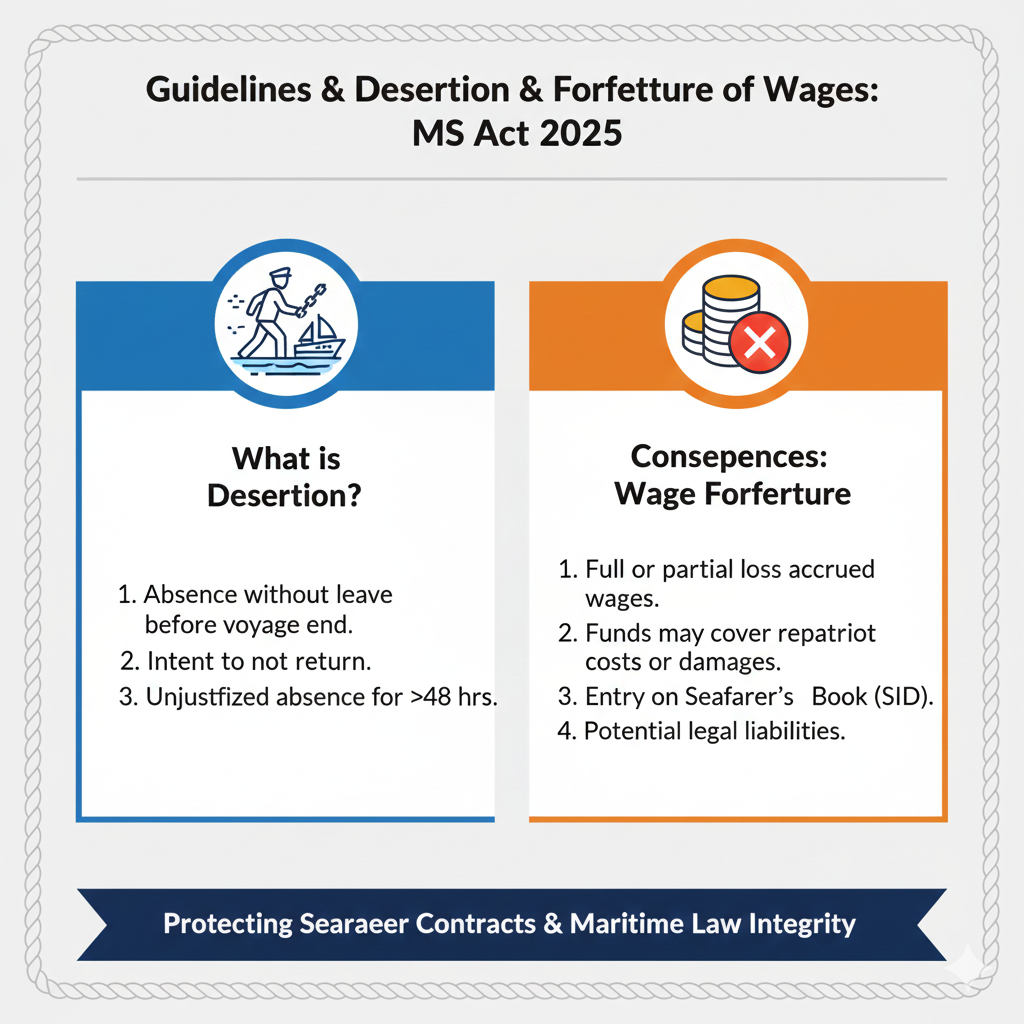
Even if the case has had no criminal trial, the offence committed is punishable by imprisonment and no criminal case has been filed, the government can still decide whether the wages should be forfeited/deducted or not, this is so that criminal prosecution and employment consequences can be separated.
Maintaining order, authority and accountability onboard.
To maintain discipline and order, fines are imposed on seafarers for the case of any misconduct, while discharged Indian waters they are collected through deducting wages and paying it to the shipping master. And when discharged on foreign waters, the fine is sanctioned through the Indian ambassador and deducted on log books so it can be paid to the shipping master after returning to India.
Along with this the DGMA also dives into mandatory harassment prevention training as per guidelines of STWC, 2025 to ensure more order, safety and discipline amongst the workers.
Note: Once a fine is imposed and paid, the same misconduct cannot be punished again. All fines collected must be used only for seafarer welfare, as directed by the central government.
The laws of MS Act 2025, strictly prohibits encouraging or pursuing another seafarer into deserting or abandoning his duties at sea, it also prohibits anyone from harboring or hiding a deserter after knowing he did that. However, a seafarer’s spouse is not covered under the harbouring prohibition. To protect vessel and crew safety, no person is allowed to board the vessel without the permission of the shipping master, authorised person and the owner. And no one is allowed to hide on the vessel either.
If a master is replaced during a voyage, he must handover all the information, logs, navigation and documentation to his successor. And if he fails to lawfully hand these over, the director general has the right to suspend or withdraw the certificate of
competency of a master after he has been given an opportunity to be heard.
If another country provides reciprocal assistance towards the penalising of deserters and other issues then India may extend similar legal help.
In such cases:
- Indian courts can issue warrants to apprehend foreign seafarers who desert in India.
- The deserter may be returned to the vessel.
This section supports international maritime cooperation.
Every vessel of 200 gross tons or more must maintain an official logbook and it must be given to the shipping master when required. No entry can be made after more than 24 hours after arrival at the final port or for incidents that occurred earlier. This helps to prevent manipulation or retrospective entries.
Rulemaking powers of central government

The central government has broad authority to make rules for implementing this entire part, enforcing the Maritime Labor Convention, regulating procedures, documentation, welfare measures, and discipline. And the central government also has the right to make rules about matters such as:
(1)
- discharge of seafarers
- payment of wages
- advance and allotment of wages
- rights of seafarers in respect of wages
- mode of recovering wages
- disputes between seafarers and employers
- property of deceased seafarers
- repatriation of seafarers and abandoned seafarers
- provisions, health and accommodation
- special provisions for the protection of seafarers in respect of litigation
- provisions for the protection of seafarers in respect of other matters
- provisions as to discipline
- official logbooks
(2)
- categories and minimum manning scales of seafarers and the scales for different classes of vessels
- conditions subject to which vessel shall be in possession of a certificate
- form and manner of the grant of continuous discharge certificate and seafarer’s identity documents
- conditions subject to which license may be granted
- form of certificate to be possessed by seafarer and the authority who grants that certificate to the effect that the seafarer is medically fit
- authority to whom and the form and manner in which the incident is to be reported
- authority to whom and the form, manner and the time within which the reports is to be submitted
- other responsibilities of the recruitment and placement agency
- form and manner of seafarer’s employment agreement
- rate of interest on the wages payable to a seafarer
- hours of rest provided to every seafarer
- conditions subject to which seafarers are given annual paid leave
- circumstances and conditions for repatriation of seafarers
- financial security and manner of repatriation of seafarers
- indemnity amount to be paid to the seafarer
- number of seafarers to be employed onboard the vessel
- accommodations and recreational facilities for seafarers
- measures for providing protection of health and medical care to seafarers
- branches of social security protection to seafarers
- terms and conditions and the period during which a seafarer shall not be entitled to wages
- exceptions where a seafarer shall not be disentitled to claim wages
- manner of discharge from service of seafarer
- manner of discharge of property
- manner and the restrictions and conditions for utilization of any unclaimed amount deposited with or recovered by shipping master for the welfare of seafarers
- qualifications and experience of persons appointed to the Tribunal and any other matter
- period within which the Tribunal shall submit its award to the Central Government
- extent and the conditions subject to which a seafarer shall be maintained or sent to a proper return port
- manner of possession of certificate and the form of such certificate
- terms, conditions and manner of protecting a seafarer who is a party to litigation
- form and manner of keeping logbook
- any other matter which is required to be or may be prescribed
Final thoughts
This Part of the law brings the everyday realities of seafaring into legal focus. It balances discipline onboard with strong protections for wages, safety and dignity. It sets clear responsibilities for ship owners and authorities alike. Most importantly, it ensures that seafarers are not left vulnerable in situations of abandonment, dispute, or crisis.
FAQ
What is desertion?
Desertion means a seafarer leaving the vessel or failing to join it without permission or a valid reason while still under a service agreement.
What are repatriation expenses?
Repatriation expenses mean expenses incurred due to returning an
abandoned seafarer to a proper return port and providing him with
necessary clothing and maintenance until his arrival at such port, and
includes in the case of a shipwrecked seafarer, the repayment of expenses incurred in conveying him to a port after shipwreck and maintaining him
What two certificates should a vessel carry all the time?
A vessel should carry a Maritime Labor Certificate and a Declaration of Maritime Labor Compliance at all times, where applicable.
What is international maritime cooperation?
International maritime cooperation refers to countries working together to enforce maritime laws, protect seafarers, and ensure safety and fair treatment across borders.
What is a Continuous Discharge Certificate?
A Continuous Discharge Certificate is an official document issued to a seafarer that records their sea service, including details of vessels served on, ranks held, and periods of engagement. It serves as proof of a seafarer’s professional experience and is essential for employment, certification, and career progression in the maritime industry.