

Table of Contents
The safety and dignity of seafarers are paramount in the maritime industry, yet numerous cases of abandonment, unpaid wages, and unsafe working conditions continue to plague many Indian seafarers aboard foreign vessels. Recognizing this distressing reality, the Directorate General of Shipping (DGS), India, has issued a powerful directive to blacklist vessels repeatedly involved in such violations. This initiative aims to uphold the rights of Indian seafarers, ensure adherence to international maritime labor standards, and compel shipping companies to maintain ethical practices.
The Issue at Hand: Seafarer Abandonment and Exploitation
Seafarer abandonment is a grave violation where crew members are left stranded aboard vessels without wages, support, or means of safe repatriation. The DGS has documented recurring complaints about Indian seafarers abandoned on ships that frequently operate without mandatory legal documentation, including valid Protection & Indemnity (PI) insurance. These ships often fail to respond when regulatory authorities or support agencies intervene.
The consequences for seafarers involve withheld wages, psychological distress, poor living conditions, and insecurity about their future.Such cases not only devastate the lives of individual seafarers and their families but also conflict with India’s commitments under the Maritime Labour Convention (MLC), 2006, which guarantees decent working conditions, timely repatriation, and wage protections. By taking a firm stance, the DGS intends to restore dignity and security to these professionals who play an indispensable role in global trade and commerce.
Understanding the Blacklisting Directive
After thorough investigations by the Directorate’s competent authorities, including the Director of Seamens Employment Offices (DSEO) and the Crew Branch of DGS, a total of 86 vessels were identified as repeatedly involved in abandonment and related violations. These vessels are now officially blacklisted, which means:
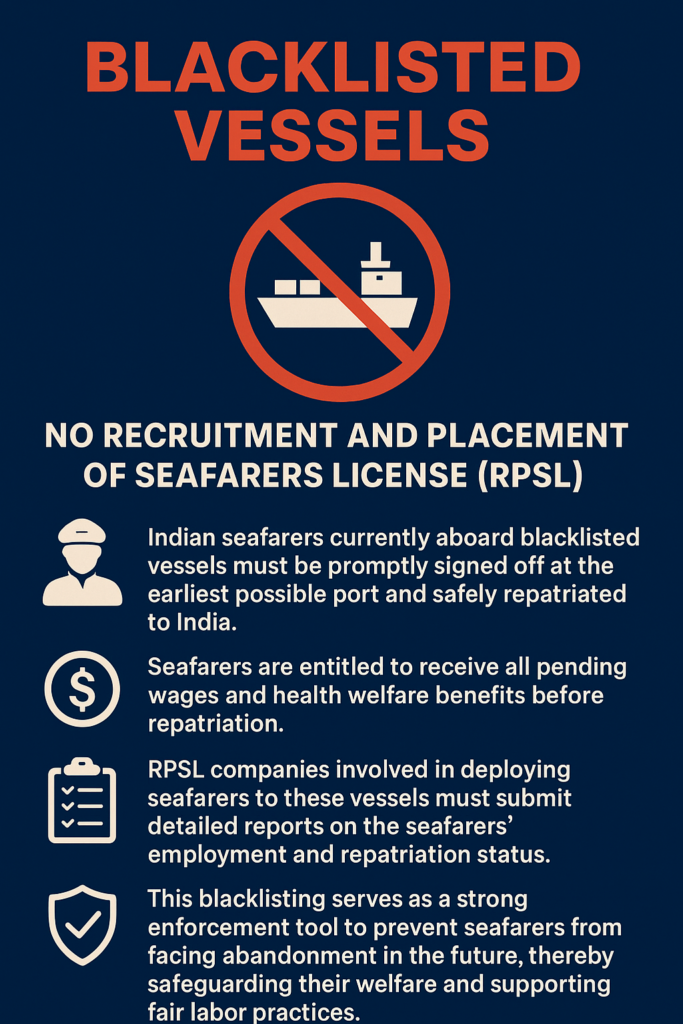
- No Recruitment and Placement of Seafarers License (RPSL) company can recruit or place Indian seafarers on these ships.
- Indian seafarers currently aboard these blacklisted vessels must be promptly signed off at the earliest possible port and safely repatriated to India.
- Seafarers are entitled to receive all pending wages and health welfare benefits before repatriation.
- RPSL companies involved in deploying seafarers to these vessels must submit detailed reports on the seafarers’ employment and repatriation status.
This blacklisting serves as a strong enforcement tool to prevent seafarers from facing abandonment in the future, thereby safeguarding their welfare and supporting fair labor practices.
Compliance and Enforcement: Protecting Rights and Welfare
The circular issued by the DGS clearly sets out consequences for non-compliance by RPSL companies or other stakeholders. These include suspension or cancellation of licenses, blacklisting of the agencies themselves, and potential legal action under the Merchant Shipping Act and relevant provisions of the MLC. By implementing these strict penalties, the DGS underscores the seriousness with which it views seafarers’ rights and the need for transparent accountability within the shipping industry.
For seafarers who have suffered due to abandonment or unsafe conditions, the directive provides a pathway for redress and repatriation. Ensuring safe and timely repatriation with full wage settlement is a vital lifeline that promises dignity and relief to those affected.
The Role of International Conventions and National Responsibility
India’s commitment to the Maritime Labour Convention highlights the country’s responsibility to enforce international standards for seafarers’ working conditions. The MLC is often dubbed the “seafarers’ bill of rights,” and it sets minimum requirements for employment terms, onboard conditions, health and safety, and repatriation procedures.
This blacklisting initiative aligns India’s regulatory efforts with international norms, signaling to the global maritime community the country’s commitment to safeguarding its seafarers. It also sends a message to ship owners and operators worldwide to prioritize compliance and humane treatment of crew members.
The Human Cost Behind the Statistics
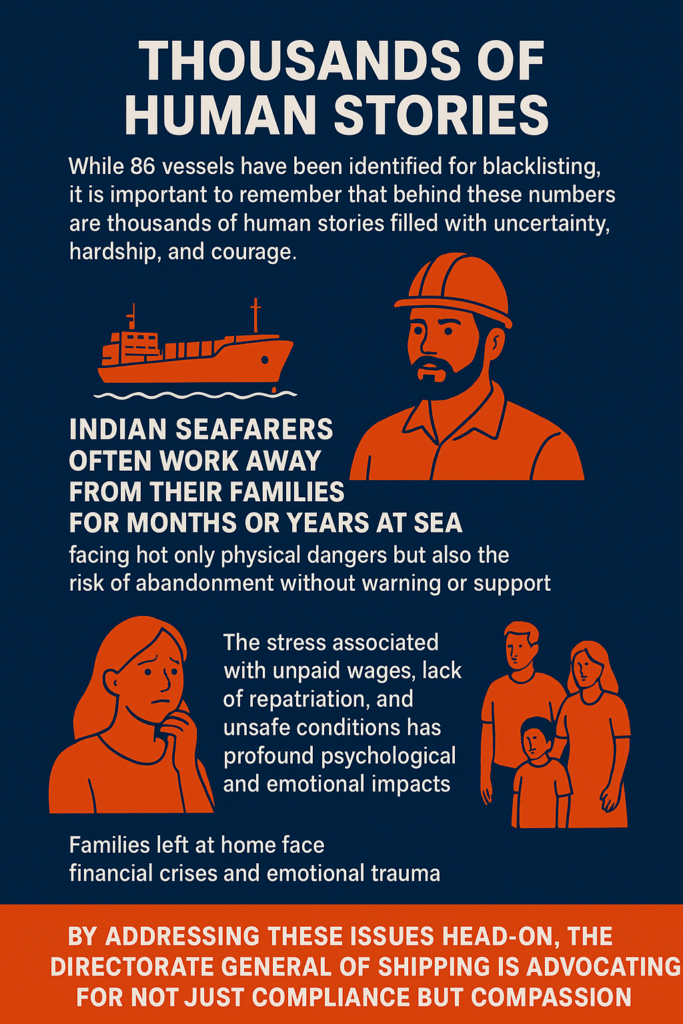
While 86 vessels have been identified for blacklisting, it is important to remember that behind these numbers are thousands of human stories filled with uncertainty, hardship, and courage. Indian seafarers often work away from their families for months or years at sea, facing not only physical dangers but also the risk of abandonment without warning or support.
The stress associated with unpaid wages, lack of repatriation, and unsafe conditions has profound psychological and emotional impacts. Families left at home face financial crises and emotional trauma. By addressing these issues head-on, the Directorate General of Shipping is advocating for not just compliance but compassion.
Blacklisted Vessels List
The following table lists all 86 vessels blacklisted by the Directorate General of Shipping (DGS) as per the draft circular dated 05.09.2025. Each entry includes the serial number (SR NO), IMO number, and vessel name. These vessels are prohibited for recruitment or deployment of Indian seafarers due to repeated involvement in abandonment cases.
| SR NO | IMO NO | Vessel Name |
| 1 | 7205910 | KEVALAY QUEEN |
| 2 | 9124885 | SV CLOVER |
| 3 | 9146091 | Lord 17 |
| 4 | 9417490 | Arabian Energy |
| 5 | 9119933 | RT 10 |
| 6 | 9190274 | OXIN |
| 7 | 9615494 | HIMS 11 |
| 8 | 9118795 | PHOSPHERUS NH |
| 9 | 8914087 | CAPTAIN ADAM 1 |
| 10 | 9845336 | HADI 49 |
| 11 | 9644897 | STAR APOLLO |
| 12 | 9043146 | SEDRA |
| 13 | 9010010 | SISTER 12 |
| 14 | 9467885 | AYAT |
| 15 | 9760964 | HADI 54 |
| 16 | 9170913 | NEREUS PROGRESS |
| 17 | 9123855 | ESTRELLA CHARLENE |
| 18 | 8008498 | CECILIA |
| 19 | 9944388 | BGMS SUPERB |
| 20 | 9327126 | MISTER YUNIS |
| 21 | 9108489 | MYGAN |
| 22 | 9375082 | BABEK MAHMUDHU |
| 23 | 1072294 | PETRO DOLPHIN |
| 24 | 9041772 | Maria |
| 25 | 9589920 | HADI 38 |
| 26 | 9174232 | HAWKS JAVAAHIRU |
| 27 | 9104419 | SUKHOR ALKHALEEJ |
| 28 | 9153135 | Tanya |
| 29 | 6927092 | LSS SUCCESS |
| 30 | 8101599 | EMMA |
| 31 | 9422859 | GLOBAL HAWK |
| 32 | 1066219 | AYODHYA |
| 33 | 9071167 | AMIR 2 |
| 34 | 9152571 | ZEG GLORY |
| 35 | 8360688 | RD1 |
| 36 | 9199775 | Al Filk |
| 37 | 8223244 | Hashim Legacy |
| 38 | 8319976 | GELIBOLU 2 |
| 39 | 8008498 | Cecilia |
| 40 | 9005869 | Anatolian |
| 41 | 9376189 | Med Sea Fox |
| 42 | 8975976 | ALIM PASA |
| 43 | 9103025 | VSG GLORY |
| 44 | 9255933 | CIMARRON |
| 45 | 9361926 | Seashine 7 |
| 46 | 9177674 | MISTRAL |
| 47 | 9119725 | Gas Parrot |
| 48 | 9414503 | YAMATO SPIRIT |
| 49 | 8310164 | GULF WAVE 4 |
| 50 | 9150365 | OHAR |
| 51 | 9297101 | ASPHALT MARIS |
| 52 | 9212759 | OLYM |
| 53 | 9234616 | Pulmonis |
| 54 | 8519942 | Berk |
| 55 | 9114048 | Emano 11 |
| 56 | 8660947 | BYB OTHELLO |
| 57 | 8418667 | ISTAKEL-2 |
| 58 | 9430844 | ELEEN NEPTUNE |
| 59 | 9240914 | CHEM |
| 60 | 9158161 | NIRVANA |
| 61 | 9750488 | SHWE LIN YONE |
| 62 | 9221267 | GLOBAL BEAUTY |
| 63 | 9365415 | ANKA |
| 64 | 9164172 | MV STAR 96 |
| 65 | 7946875 | MV ASSO-6 |
| 66 | 9062398 | MT SERDAR |
| 67 | 7729007 | MT MARGOL |
| 68 | 9118745 | NADIYA |
| 69 | 9540924 | BERGE TORRE |
| 70 | 9348194 | VESSEL NAME NOT AVAILABLE |
| 71 | 9228590 | SANA |
| 72 | 9540924 | GLOBAL CHERLYN |
| 73 | 9681388 | RANIAH |
| 74 | 9240914 | MT CHEM |
| 75 | 9857169 | VESSEL NAME NOT MENTIONED |
| 76 | 9191802 | VESSEL NAME NOT MENTIONED |
| 77 | 870641 | M.V. BETELGEUSE |
| 78 | 8879689 | PEARL G |
| 79 | 9588146 | VESSEL NAME NOT MENTIONED |
| 80 | 9329760 | EAGLE S |
| 81 | 9550216 | TRANSFORMER OL |
| 82 | 9408504 | MV SHIP SEA STAR 2 |
| 83 | 9150365 | MT JETTA |
| 84 | 9410026 | SINA 10 |
| 85 | 8731356 | SAMANTA 1 |
| 86 | 7930498 | STRATOS |
Moving Forward: Creating Safer Seas for Indian Seafarers
This blacklisting circular acts as a beacon for safer labor practices and supportive enforcement mechanisms. It empowers Indian seafarers by excluding exploitative vessels from their employment possibilities and ensures that recruitment agencies adhere strictly to legal and ethical guidelines.
To further support this effort, continuous monitoring and cooperation between regulatory bodies, RPSL companies, port authorities, and international maritime organizations are essential. Stakeholders must prioritize seafarers’ welfare as a cornerstone of the maritime industry’s sustainability.
Final Thoughts
The Directorate General of Shipping’s proactive blacklisting of vessels involved in abandonment cases is a necessary step to protect Indian seafarers from exploitation. By enforcing strict regulations and prioritizing repatriation and wage payments, India sets a strong example of upholding human rights in the maritime sector. This initiative promises a brighter, more secure future for the thousands of Indian men and women who dedicate their lives to navigating the world’s oceans.
Empowering seafarers through legal protections and regulatory oversight not only benefits individual workers but also strengthens India’s global maritime standing. It is a call to action for all stakeholders in the maritime ecosystem to foster safe, fair, and respectful working environments.
Frequently Asked Questions on DGS Vessel Blacklisting
What is the purpose of the DGS blacklisting circular?
The Directorate General of Shipping (DGS) issued this draft circular dated 05.09.2025 to blacklist 86 vessels repeatedly involved in seafarer abandonment, wage non-payment, unsafe conditions, and related violations, protecting Indian seafarers’ rights under the Maritime Labour Convention (MLC), 2006.
Which vessels are blacklisted and why?
The blacklisted vessels, listed in Annexure I with their IMO numbers (e.g., KEVALAY QUEEN IMO 7205910, SV CLOVER IMO 9124885), were identified through DGS investigations for recurring issues like lack of PI insurance, fraudulent agents, and detention by port authorities, leading to severe hardship for Indian crew.
What must RPSL companies do if seafarers are on blacklisted vessels?
RPSL companies must ensure prompt sign-off, safe repatriation to India, and settlement of all wages and welfare entitlements for any Indian seafarers currently aboard; they also need to submit detailed reports on deployed seafarers within 14 working days.
What are the penalties for non-compliance?
Failure to follow directives can result in RPSL license suspension or cancellation, agency blacklisting, and legal action under the Merchant Shipping Act, 1958, and MLC provisions.
Can RPSL companies deploy seafarers on blacklisted vessels in the future?
No, no RPSL company may recruit, engage, or deploy Indian seafarers on these vessels henceforth, unless prior written DGS permission is obtained with all valid statutory documents including verifiable PI insurance.