
Table of Contents
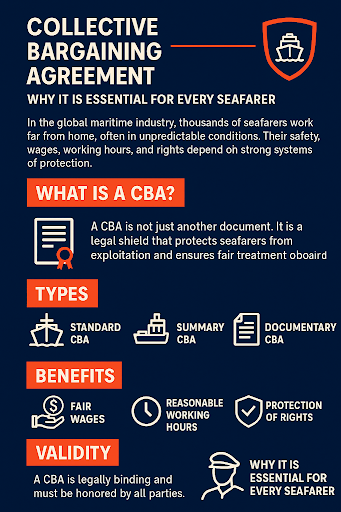
In the global maritime industry, thousands of seafarers work far from home, often in unpredictable conditions. Their safety, wages, working hours, and rights depend on strong systems of protection. This is where a Collective Bargaining Agreement (CBA) becomes extremely important.
A CBA is not just another document. It is a legal shield that protects seafarers from exploitation and ensures fair treatment onboard. This blog explains what a CBA is, its types, benefits, validity, and why it is essential for every seafarer and RPSL company to understand it.
What Is a Collective Bargaining Agreement (CBA)?
A Collective Bargaining Agreement (CBA) is a legally binding contract negotiated between a union (such as ITF – International Transport Workers’ Federation) and a shipping company.
It sets out:
- Minimum wages
- Working hours
- Leave and overtime
- Safety standards
- Medical coverage
- Repatriation rights
- Compensation for injury or death
- Rules for termination
- Protection against unfair treatment
For seafarers, a CBA ensures that they are not at the mercy of the shipowner. Instead, they work under internationally recognised standards, regardless of their nationality or the flag the ship flies.
Why CBAs Are Crucial in the Maritime Industry
The shipping industry is global, and many vessels operate under Flags of Convenience (FOC), countries where regulations may be weak.
Without a CBA, seafarers may face:
- Low wages
- Long working hours
- Unsafe vessels
- Delayed salaries
- Lack of medical support
- Poor living conditions
A CBA prevents these problems by forcing the company to follow strict rules approved by international authorities like the ITF and the Maritime Labour Convention.
Types of Collective Bargaining Agreements for Seafarers
1. ITF Standard Agreement
- Used mainly on non-FOC vessels.
- Provides strong protection and high wage standards
- Strict enforcement of minimum rest hours, safety rules, and welfare rights.
2. ITF Uniform TCC Agreement (Total Crew Cost)
- Used mainly for Flag of Convenience (FOC) ships.
- Covers wages, overtime, leave, repatriation, medical rights, and manning scales.
- One of the most widely used CBAs globally.
3. IBF Agreements (International Bargaining Forum)
- Negotiated between ITF and major maritime employer groups.
- Covers large fleets with thousands of seafarers.
- Provides additional benefits like:
- Warlike area bonuses
- Extra protection during piracy incidents
- Higher compensation packages
4. National CBAs
- Negotiated between national maritime unions and local shipowners.(examples are INSA-MUI agreement, NMB Agreement and FSUI CBA agreement.
- Follow national laws and minimum wage standards.
- Benefits vary by country.
5. Company-Specific CBAs
Large shipping companies sometimes have their own CBAs. They often include extra benefits like:
- Higher wages
- Insurance
- Training programs
- Faster promotion tracks
Key Benefits of a CBA for Seafarers
1. Guaranteed Minimum Wages
Wage tables (often listed in the annex) ensure fair pay for:
- Officers
- Engineers
- Ratings
- Catering staff
No company can legally pay below the CBA wage.
2. Overtime Protection
CBAs define:
- Standard working hours (usually 8 hours/day)
- Guaranteed overtime (e.g., 103 hours/month under ITF TCC)
- Overtime rate (normally 1.25x the basic hourly wage)
This ensures seafarers are not forced into excessive work without extra payment.
3. Rest Hours Compliance
Under STCW and MLC rules:
- Min 10 hours rest/day
- Min 77 hours rest/week
CBA guarantees proper rest records and compliance.
4. Medical Care and Sick Pay
If a seafarer becomes sick or injured:
- The company must provide full medical care
- Hospitalisation is covered
- Sick wages continue for 130 days or until recovery
This protects families from financial stress.
5. Repatriation Rights
If a contract ends or an emergency occurs:
- The company pays for travel home
- Food, accommodation, and wages until arrival are covered
- Personal baggage transportation is included.
This is extremely important on international vessels.
6. Compensation for Injury or Disability
CBAs provide robust disability compensation for seafarers injured in shipping accidents, offering financial security to workers and their families even without fault. In the ITF Uniform TCC CBA (2024-2025), 100% disability rates stand at $116,299 for ratings, $155,063 for junior officers, and $193,828 for senior officers in 2025, with pro-rata payments for lesser degrees and full 100% payout if deemed permanently unfit for sea service (50%+ disability or per medical certification).
A new ITF-IBF two-year pay agreement for 2026-2027 brings a 3.5% increase in wages and benefits starting January 1, 2026, followed by 1.5% in 2027, explicitly covering death and disability compensation—though exact updated rates await the full CBA publication on the ITF Seafarers website.
This ensures seafarers like ratings could see 100% disability rise to around $120,459 (projected at 3.5% from 2025), maintaining protection amid rising costs. Check ITF resources for the official 2026 figures once released.
7. Death-in-Service Compensation
If a seafarer dies while onboard or during travel to/from the vessel:
- Nominated beneficiary receives compensation
- Each dependent child also receives a fixed amount
- Repatriation of the body is paid by the company
This protects the family after a tragic event.
8. Protection Against Harassment & Discrimination
CBA requires:
- Zero tolerance for bullying
- Protection from harassment
- Gender and nationality equality
- Fair grievance procedures
Validity of a CBA
A CBA usually has a fixed validity period, for example:
- ITF TCC 2024–2025 is valid for two years
- Some CBAs run for 1 year, others 3 years
Renewal involves:
- Reviewing wages
- Updating compensation
- Adding new MLC requirements
- Adjusting for inflation and market changes
A CBA remains valid until the end date unless replaced by a newer version.
How Seafarers Can Check If Their Ship Is Covered by a CBA
A genuine CBA must be:
- Posted onboard in English
- Signed by the company and ITF
- Mentioned in the employment contract
- Available for inspection during PSC or flag audits
Seafarers can also:
- Ask the Master
- Contact their union
- Check through the ITF’s official website
- Verify with the ITF inspector when the ship is in port
Why Every Seafarer Should Care About CBAs
A Collective Bargaining Agreement (CBA) is a whole lot more than just some formal piece of paper. Its impact is felt daily by seafarers out at sea – it determines their pay, their grub, their digs, the safety precautions they work with, how much time they get to rest, and what support they get if things go wrong.
What really matters, though, is that it gives them long-term stability for themselves and the people they care about. The upshot is that without a CBA, seafarers can quickly find themselves scrambling to make ends meet on low wages, living in pretty crummy conditions, being dragged out for long shifts, and having their backs pretty well left uncovered.
Having a CBA in place, especially on those Flag of Convenience ships, though, does give seafarers a safety net of sorts, a way to ensure that some decent international rules and maritime conventions are being followed, which safeguards their rights and guarantees that they’re treated reasonably and humanely for the whole length of their contract.
Final Thoughts
For thousands of seafarers, a Collective Bargaining Agreement is the backbone of their employment rights. It ensures fairness, safety, dignity, and financial protection for them and their families. Whether you are joining your first ship or your fiftieth, understanding your CBA is one of the most important things you can do for your career.
If your vessel has a valid CBA, you are protected. If it doesn’t, you should immediately seek support from your union or the ITF. CBA in addition to MS Act 2025 is a pragmatic step to ensure the safety of seafarers during ocean voyages.
Frequently Asked Questions on Collective Bargaining Agreement
1. Why is a collective bargaining agreement (CBA) important for seafarers working on Flag of Convenience (FOC) ships?
A collective bargaining agreement protects seafarers on FOC vessels from low wages, long working hours, and unsafe conditions by enforcing ITF/MLC-approved standards that the shipowner must legally follow.
2. Does a collective bargaining agreement guarantee minimum wages and overtime for all ranks on board?
Yes. A collective bargaining agreement includes detailed wage scales for officers, engineers, and ratings, along with guaranteed overtime (e.g., 103 hours/month under ITF TCC), ensuring no seafarer is underpaid.
3. Are seafarers entitled to medical care and repatriation under a collective bargaining agreement?
Absolutely. A collective bargaining agreement ensures free medical treatment, sick wages, hospitalisation, and full repatriation at company expense if a seafarer is injured, sick, or if the contract ends.
4. What compensation does a seafarer or family receive in case of injury or death?
The collective bargaining agreement specifies clear compensation tables for permanent disability and death-in-service, including payments to the nominated beneficiary and dependent children.
5. Can a seafarer refuse to sail into a Warlike Operations Area under a CBA?
Yes. Under ITF CBAs, seafarers have the right to refuse sailing into war zones without punishment and are entitled to bonuses and double compensation if they do enter such areas.