
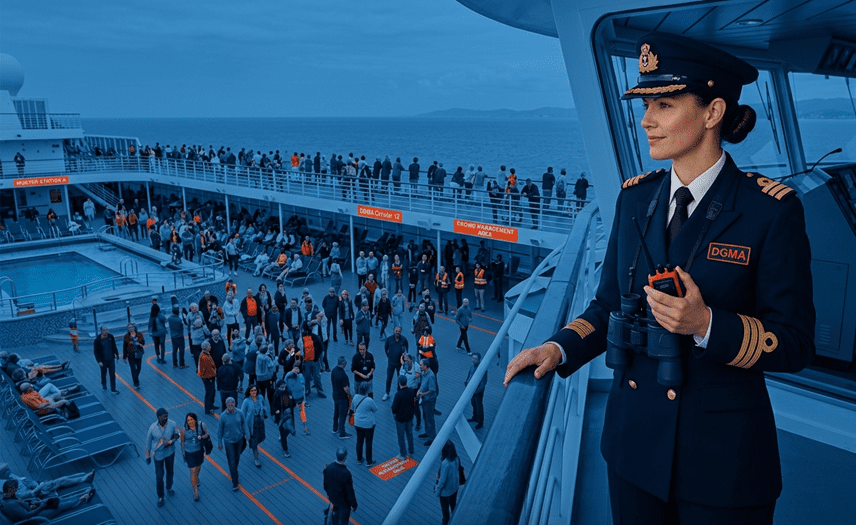
What Is DGMA Circular 12 of 2026?
If you are working on a passenger ship, then DGMA Circular 12 of 2026 is something you really need to know about. The Directorate General of Maritime Administration issued this circular on 9th March 2026, and it is also referred to as DGMA STCW Circular 02 of 2026. Now as we all know, the IMO keeps updating rules for seafarers from time to time.
Back in 2016, the IMO passed two resolutions called MSC.416(97) and MSC.417(97), and through these resolutions, revised and enhanced training and certification requirements were introduced under Regulation V/2 of the STCW Convention specifically for personnel serving on passenger ships.
Now India is an active member of the IMO, and through this DGMA Circular 12 of 2026 , the Directorate General of Maritime Administration has formally implemented these requirements in India. So what this DGMA Circular 12 of 2026 is basically saying is that if you are serving on a passenger ship engaged on international voyages, you now need specific training and certification depending on your role and rank on that ship. Let us understand the whole thing in detail.
Why Is Passenger Ship Training So Important?
Now you might be wondering why there is so much focus on passenger ships specifically. As we all know, passenger ships are very different from cargo ships. When something goes wrong on a cargo ship, you are dealing with the safety of a relatively small and trained crew.
But on a passenger ship, you could be dealing with hundreds or even thousands of passengers who have no maritime training at all and have no idea what to do in an emergency. They might panic, they might not follow instructions, and they might not even understand the language the crew is speaking in.
This is exactly why the IMO said that personnel on passenger ships need to be specially trained to handle these unique challenges, and this is what DGMA Circular 12 of 2026 is implementing in India
Who Does This DGMA Circular 12 of 2026 Apply To?
Now this DGMA Circular 12 of 2026 does not apply to every seafarer. It applies specifically to personnel serving on passenger ships engaged on international voyages. Now the DGMA Circular 12 of 2026 has set out five different training requirements, and each one applies to a specific group of people on board.
The key thing to remember here is that even if you are not the captain or an officer, you may still need to complete certain training under this DGMA Circular 12 of 2026 depending on what your role is on the ship. Let us go through each requirement one by one so you understand exactly what applies to you.
Passenger Ship Emergency Familiarization Training
The first and most basic requirement under this DGMA Circular 12 of 2026 is the Passenger Ship Emergency Familiarization Training. Now this one applies to absolutely everyone serving on board a passenger ship engaged on international voyages without any exception.
It does not matter what your rank is or what department you work in. Before you are assigned any shipboard duties on a passenger ship, you must complete this training.
It covers the competencies prescribed in Section A-V/2, paragraphs 1 and 2 of the STCW Code, and it makes sure that every single person on board knows what to do when an emergency happens on a passenger ship.
Safety Training for Personnel Providing Direct Service to Passengers
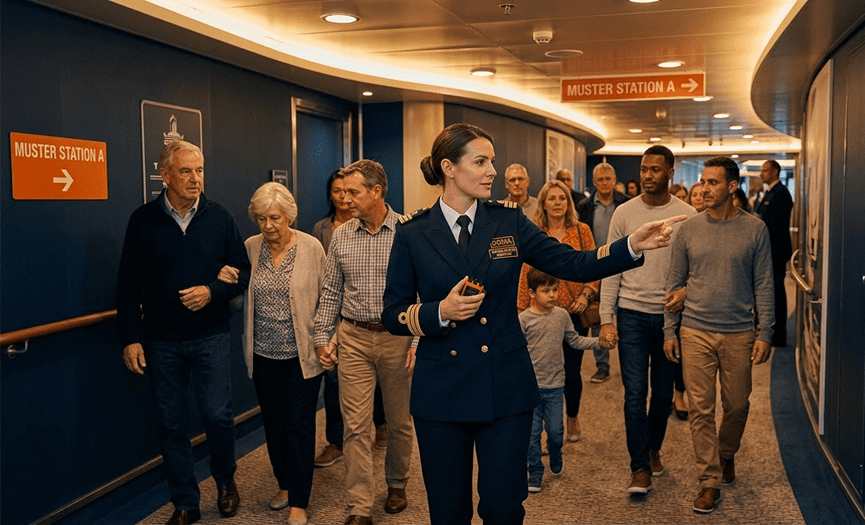
Now apart from the basic familiarization training, there is an additional safety training requirement specifically for personnel who provide direct service to passengers in passenger spaces.
If you think about who these people are, they are your cabin stewards, restaurant staff, and anyone else who works directly in areas where passengers are present throughout the voyage.
These are the people who are in constant contact with passengers, and because of that they need to be better prepared to handle passenger related safety situations than someone who works in the engine room or on the bridge. This additional safety training is required under Regulation V/2, paragraph 6, and it is on top of the basic familiarization training that everyone needs to complete.
Passenger Ship Crowd Management Training
Now the third requirement is the Passenger Ship Crowd Management Training, and this one applies to Masters, officers, ratings qualified under chapters II, III, and VII of the STCW Convention, and any personnel who are designated on the muster list to assist passengers in emergency situations.
As we all know, managing a large crowd of panicking passengers on a ship is one of the most challenging things you can face at sea, and this is why this specific training exists. The competency standards for this training are set out in Table A-V/2-1 of the STCW Code, which is annexed as Annexure A of this DGMA Circular 12 of 2026 .
Now in this training you need to know the shipboard emergency plans, instructions, and procedures related to managing and evacuating passengers, and you need to understand what crowd management techniques and equipment are available to assist passengers in an emergency. You also need to know the muster list and emergency instructions thoroughly so you can act quickly and correctly when something goes wrong.
On the practical side, you need to be able to give clear and reassuring orders to passengers, manage passengers moving through corridors, staircases, and passageways, and keep escape routes clear of obstructions at all times.
You also need to know how to evacuate disabled persons and persons who need special assistance, and how to search passenger accommodation and public spaces during an emergency. And one very important part of this training is effective mustering, which means knowing how to keep order, how to reduce and avoid panic, how to use passenger lists for evacuation counts, making sure passengers are suitably clothed when they come to muster stations, and checking that every passenger has properly donned their life jacket.
Crisis Management and Human Behavior Training
Now this is the most advanced and detailed training requirement in the entire DGMA Circular 12 of 2026 , and it applies to Masters, Chief Mates, and any person designated on the muster list as having responsibility for the safety of passengers in emergency situations.
Before being assigned to shipboard duties, all of these people must complete the approved Crisis Management and Human Behavior Training as required under Regulation V/2, paragraph 8. The competency standards are set out in Table A-V/2-2 of the STCW Code, annexed as Annexure B of this DGMA Circular 12 of 2026.
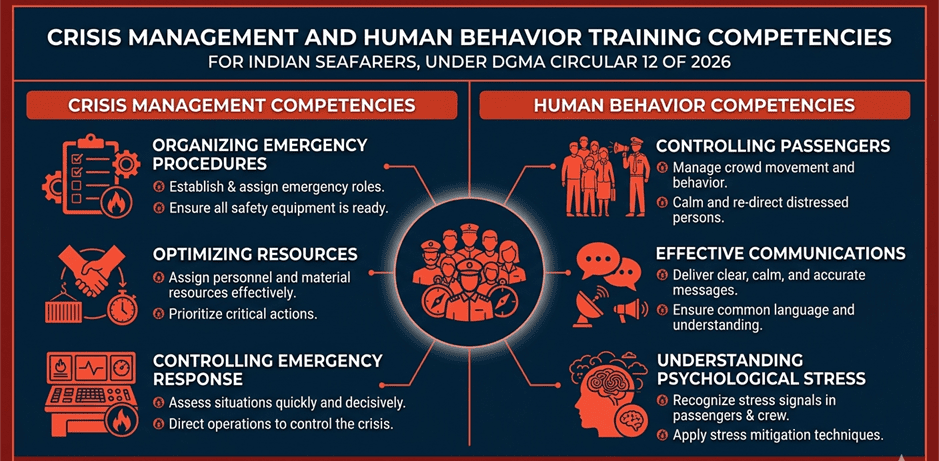
Now this training starts with organizing shipboard emergency procedures. You need to know the general design and layout of the ship, the safety regulations, and the emergency plans and procedures in detail.
You also need to understand the principles for developing ship-specific emergency procedures, including the importance of pre-planning and conducting drills regularly, and making sure that all personnel know and follow pre-planned emergency procedures as carefully as possible when an actual emergency happens.
The training also covers optimizing the use of resources during an emergency. Now as we all know, in an emergency on a passenger ship, resources can become very limited very quickly. You need to know how to make the best possible use of whatever personnel and equipment are immediately available, and sometimes you will need to improvise when the situation demands it.
Establishing and maintaining effective communications is also covered in this training. You need to know how important it is to give clear and concise instructions and reports, and you need to actively encourage passengers and other personnel to share information and give feedback during an emergency.
You also need to know how to keep passengers informed about what is happening and what they need to do, and this means being able to communicate in the languages of the principal nationalities of passengers on that particular route. Sometimes oral communication is simply not practical in an emergency, and in those situations you need to know how to communicate through demonstration, hand signals, or by directing attention to the location of instructions, muster stations, life-saving devices, or evacuation routes.
Passenger Safety, Cargo Safety and Hull Integrity Training for Ro-Ro Passenger Ships
Now the fifth requirement under this DGMA Circular 12 of 2026 is specifically for Ro-Ro passenger ships, which are ships that carry both passengers and vehicles. Before being assigned to shipboard duties on a Ro-Ro passenger ship, Masters, Chief Mates, and every person assigned immediate responsibility for embarking and disembarking passengers, for loading, discharging or securing cargo, or for closing hull openings on board must receive the Passenger Safety, Cargo Safety and Hull Integrity Training required under Regulation V/2, paragraph 9.
Now Ro-Ro ships have very specific and unique risks related to their design, particularly around hull openings and vehicle decks, and this is why there is a separate training requirement specifically for this type of ship that does not apply to regular passenger ships.
What About Certificates Already Issued?
Now this is something very important that many seafarers will want to know. If you have already completed training and received a certificate under DGS Training Circular No. 05 of 2016, you do not need to worry at all. DGMA Circular 12 of 2026 specifically states that the training requirements, course content, assessment standards, and certificate format prescribed under that earlier circular shall be deemed to satisfy the requirements of this new DGMA Circular 12 of 2026.
So your existing certificate remains valid, subject to continued service and compliance with national regulations, and you do not need to redo your training just because this new DGMA Circular 12 of 2026 has come out.
What Happens If You Do Not Comply With the DGMA Circular 12 of 2026?
Now this is something you need to take very seriously. DGMA Circular 12 of 2026 is very clear that RPSL Managers, ISM Managers, Maritime Training Institutes, and seafarers must all ensure compliance with the provisions of this DGMA Circular 12 of 2026.
And if you do not comply, action will be taken under the applicable provisions of the Merchant Shipping Act and STCW Rules. So this is not something you can ignore or push to one side. Non-compliance has real legal consequences for everyone involved, whether you are a seafarer, a manning agent, or a training institute.
How Does This DGMA Circular 12 of 2026 Connect to Earlier Circulars?
Now this circular does not stand alone and it is important that you understand how it connects to earlier circulars. DGMA Circular 12 of 2026 supplements and clarifies Training Circular No. 05 of 2016, which was the earlier circular that set out passenger ship training requirements in India.
So if you were already going through the certification process before this new circular came out, the provisions of the 2016 circular still apply to you. This circular also needs to be read together with DGS (NT/ENG) Circular No. 18 of 2025. Reading all three together will give you a complete and up to date picture of all the training requirements for personnel on passenger ships in India.
You can also read our article on DGMA Circular 13 of 2026 on Polar Waters Training to understand the other major STCW circular that was issued on the same date, because both of these circulars are part of the same batch of 2016 STCW amendment implementations that India has now formally adopted.
Training Requirements at a Glance
| Training | Who Needs It |
| Passenger Ship Emergency Familiarization Training | All personnel on passenger ships on international voyages |
| Safety Training for Direct Service Personnel | Personnel providing direct service to passengers in passenger spaces |
| Crowd Management Training | Masters, Officers, Ratings under chapters II, III and VII, and muster list personnel |
| Crisis Management and Human Behavior Training | Masters, Chief Mates, and muster list personnel responsible for passenger safety |
| Passenger Safety, Cargo Safety and Hull Integrity Training | Masters, Chief Mates, and responsible personnel on Ro-Ro passenger ships only |
What Should You Do Now After the DGMA Circular 12 of 2026?
So now that you understand everything about this DGMA Circular 12 of 2026, let us talk about what you should actually do. If you are serving on a passenger ship on international voyages and you have not yet completed the Passenger Ship Emergency Familiarization Training, you need to enroll in an approved programme as soon as possible because this is mandatory for everyone on board without exception.
If you are a Master or Chief Mate on a passenger ship, make sure you have completed both the Crowd Management Training and the Crisis Management and Human Behavior Training before you are assigned to shipboard duties. If you are working on a Ro-Ro passenger ship and you have responsibilities related to passengers, cargo, or hull openings, make sure you have the specific Ro-Ro training in place as well.
If you already have certificates from DGS Training Circular No. 05 of 2016, check your certificates carefully and make sure everything is in order. If you are an RPSL Agency or ISM Agency , make sure all the seafarers you are placing on passenger ships have the required training and certification before they are assigned to shipboard duties.
And if you want to understand how Indian seafarer employment trends are shaping up or what the latest RPSL annual compliance service looks like, those are worth going through as well because both of these directly affect how you plan your compliance as a company.
FAQs
What is DGMA Circular 12 of 2026 about?
So DGMA Circular 12 of 2026 is basically about training requirements for people serving on passenger ships on international voyages. This DGMA Circular 12 of 2026 was issued on 9th March 2026 by the Directorate General of Maritime Administration. Now as we all know, the IMO keeps updating rules for seafarers from time to time.
Back in 2016, the IMO passed two resolutions called MSC.416(97) and MSC.417(97), and through these resolutions revised training requirements were introduced under Regulation V/2 of the STCW Convention specifically for people working on passenger ships.
Who needs to complete Passenger Ship Emergency Familiarization Training?
Passenger Ship Emergency Familiarization Training is mandatory for every single person serving on a passenger ship engaged on international voyages, and it must be completed before you are assigned any shipboard duties.
Now it does not matter what your rank is or which department you work in. As we all know, passenger ships carry hundreds and sometimes thousands of people who have no maritime training at all, and this is exactly why every person on board must complete this training without any exceptions.
What is the difference between Crowd Management Training and Crisis Management Training?
Crowd Management Training is required for Masters, officers, ratings, and personnel designated on the muster list to assist passengers in emergencies. This training covers practical things like guiding passengers to muster stations, keeping escape routes clear, managing crowds in corridors and stairways, preventing panic, and assisting disabled persons during evacuations.
Now Crisis Management and Human Behavior Training is a different requirement altogether. This one is only for Masters, Chief Mates, and muster list personnel who have direct responsibility for passenger safety in emergencies, and it goes much deeper than crowd management.
Do I need to redo my training if I already have a certificate from DGS Training Circular No. 05 of 2016?
If you already have a certificate issued under DGS Training Circular No. 05 of 2016, you do not need to redo your training at all. DGMA Circular 12 of 2026 specifically states that the training requirements, course content, assessment standards, and certificate format prescribed under that earlier DGMA Circular 12 of 2026 shall be deemed to satisfy the requirements of this new circular.
So your existing certificate remains valid, subject to continued service and compliance with national regulations. You do not need to go through the training again just because this new circular has come out.
Which IMO resolutions does this circular implement?
DGMA Circular 12 of 2026 implements IMO Resolutions MSC.416(97) and MSC.417(97), which were adopted by the Maritime Safety Committee of the IMO back in 2016. Now through these resolutions, revised and enhanced training requirements for personnel on passenger ships were introduced under Regulation V/2 of the STCW Convention.
India is an active member of the IMO, and through this circular the Directorate General of Maritime Administration has formally implemented these international requirements in India. So what was decided at the IMO level in 2016 is now officially in place in India and everyone needs to comply.
What is Regulation V/2 of the STCW Convention?
Regulation V/2 is a special regulation in the STCW Convention that deals specifically with training and certification requirements for personnel serving on passenger ships. As we all know, the STCW Convention is the international framework that governs the training and certification of seafarers all over the world.
Regulation V/2 sits within that framework and covers everything from basic emergency familiarization for all crew members to advanced crisis management training for Masters and Chief Mates. This regulation was significantly revised through the 2016 amendments to the STCW Convention, and DGMA Circular 12 of 2026 is the formal implementation of those revised requirements in India.
What happens if an RPSL company or ISM Manager does not comply with this circular?
DGMA Circular 12 of 2026 is very clear on this point. RPSL Managers, ISM Managers, Maritime Training Institutes, and seafarers must all ensure compliance with the provisions of this circular.
And if you do not comply, action will be taken under the applicable provisions of the Merchant Shipping Act and STCW Rules. As we all know, non-compliance with DGMA circulars is not something that is taken lightly in India.
Who needs the Ro-Ro specific training under this circular?
The Passenger Safety, Cargo Safety and Hull Integrity Training is specifically for people serving on Ro-Ro passenger ships, which are ships that carry both passengers and vehicles.
Before being assigned to shipboard duties on a Ro-Ro passenger ship, Masters, Chief Mates, and every person assigned immediate responsibility for embarking and disembarking passengers, loading, discharging or securing cargo, or closing hull openings on board must complete this training.
Does this circular apply to all passenger ships or only international voyages?
DGMA Circular 12 of 2026 applies specifically to passenger ships engaged on international voyages. As we all know, there is an important difference between international voyages and domestic voyages in maritime regulations, and this circular is specifically tied to international voyages.
So if your ship only operates on domestic routes within India, you need to check the applicable national regulations separately. But the moment your passenger ship starts sailing between ports in different countries, these training requirements apply to every person on board regardless of their rank or role on that ship.
When does this circular come into effect?
DGMA Circular 12 of 2026 was issued on 9th March 2026 and it is effective immediately. So if you are already serving on a passenger ship or planning to do so, you need to make sure you have all the required training and certification in place as soon as possible.