

For years, starting a career as an electrical officer in the merchant navy involved complex entry routes and strict age limits. Under the newly released DGMA Circular 25 of 2026 issued by the DGMA (Directorate General of Maritime Administration), Indian seafarers now have a highly structured and accessible pathway to secure their Electro-Technical Rating CoP (Certificate of Proficiency) under STCW Regulation III/7.
The biggest win in this update is that the DGMA has completely removed age limits for career progression, making this a golden opportunity for ratings, ITI holders, and technical diploma students to climb all the way to a full Electro-Technical Officer (ETO) rank.
Whether you hold an ITI, a technical diploma, an engineering degree, or a GP Rating certificate, here are the exact qualifications, required sea-going service, and training milestones you need to secure your Certificate of Proficiency and successfully build your maritime career.
What is DGMA Circular 25 of 2026?
DGMA Circular 25 of 2026 is a major regulatory update introduced by the DGMA (formerly known as the Directorate General of Shipping – DGMA). This circular officially establishes standard guidelines for issuing the Electro-Technical Rating CoP and details the career progression rules to help ratings transition into ETO ranks.
By superseding the older NT/ENGG Circular No. 2 of 2016, the DGMA aims to align Indian seafarer training with international STCW Regulations III/7 (for support-level ETRs) and III/6 (for operational-level ETOs). In practical terms, this update widens access for candidates with various technical backgrounds to meet the growing global demand for qualified crew capable of handling modern, automated, and hybrid-electric marine power systems.
What are the Eligibility Criteria for the Electro-Technical Rating CoP?
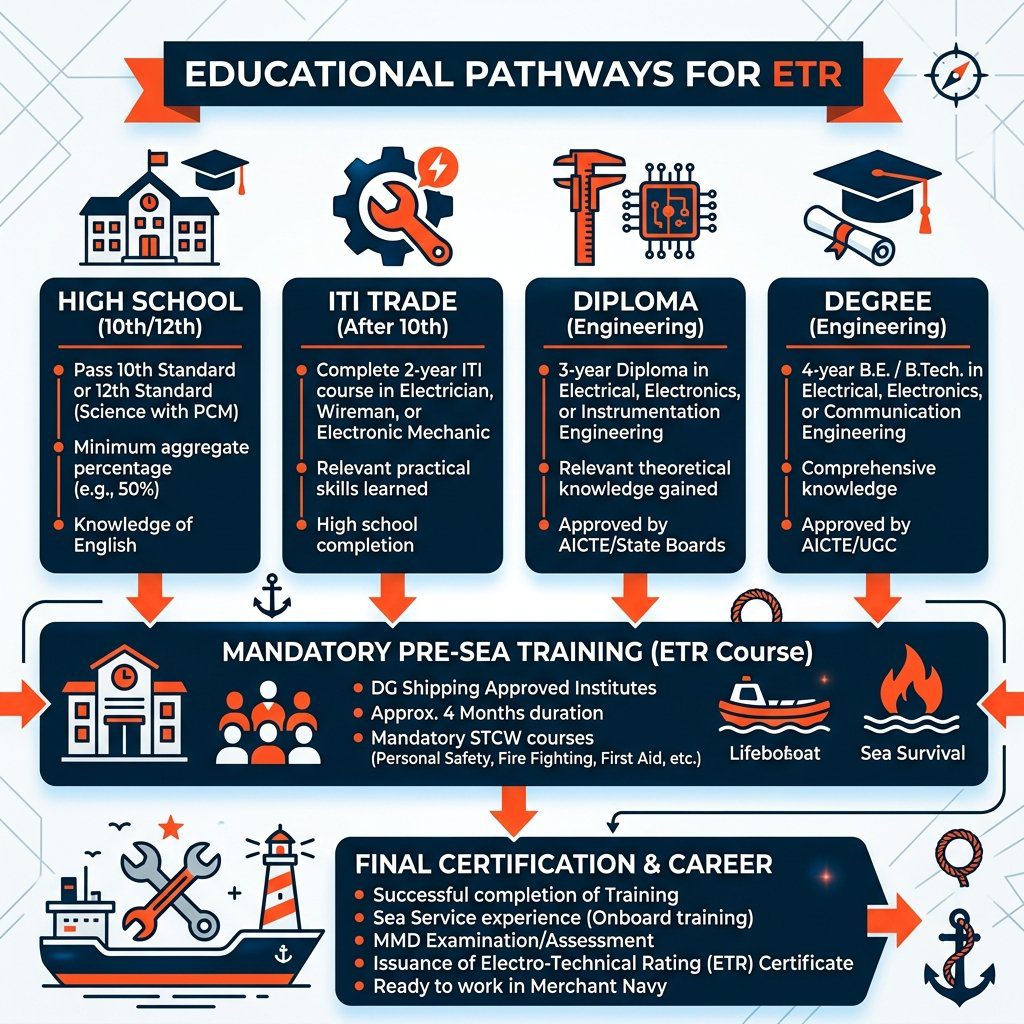
To apply for the Electro-Technical Rating CoP, you must satisfy specific educational standards and complete a mandatory period of sea-going service performing electrical duties. The DGMA defines four distinct entry criteria to accommodate different technical backgrounds.
If you are looking to enter the merchant navy through other routes, you can also explore courses like Diploma in Nautical Science (DNS), B.Tech Marine Engineering, or Graduate Marine Engineering (GME).
The table below breaks down the four distinct pathways to qualify:
| Pathway (Criteria) | Minimum Educational Qualification | Required Sea-Going Service (on Ships ≥ 750 kW) | Additional Training & Requirements |
|---|---|---|---|
| Criteria I | • 10th Standard pass (Science & Math, min. 40% aggregate) • Min. 40% in English in 10th, 12th, or higher • Full-time ITI Trade Certificate in Electrical or Electronics | 9 Months performing shipboard electrical duties | • A completed and verified ETR TAR Book is mandatory for assessment. |
| Criteria II | • 3-Year Diploma in Electrical, Electronics, Telecommunication, Instrumentation, Control, or equivalent • Min. 40% in English in 10th, 12th, or Diploma | 6 Months performing shipboard electrical duties | • A completed and verified ETR TAR Book is mandatory for assessment. |
| Criteria III | • Engineering Degree in Electrical, Electronics, Telecommunication, Instrumentation, Control, or equivalent • Min. 40% in English in 10th, 12th, or Degree | 6 Months performing shipboard electrical duties | • A completed and verified ETR TAR Book is mandatory for assessment. |
| Criteria IV | • Pass DGMA-approved GP Rating Course and Exit Exam • Min. 40% in English in 10th, 12th, or higher | 12 Months performing shipboard electrical duties | • Must complete the 10-day DGMA-approved ETR Bridging Course before joining a ship as Trainee ETR. • Verified ETR TAR Book is mandatory. |
Pre-Onboarding Checklist
Before stepping on board to start your sea service, ensure you have ticked off these vital items:
- DGMA-Approved Medical Certificate: You must be certified fit by a DGMA-approved medical practitioner. You can find active doctors near you through the DGMA Approved Doctors Directory.
- ETR TAR Book: Obtain an official Training and Assessment Record Book from an approved maritime training institute.
- STCW Safety Courses: Ensure your standard safety certificates are active and updated.
How Can GP Rating Holders Qualify Under Criteria IV?
For GP Rating holders without a formal diploma or degree in electrical engineering, Criteria IV provides a structured route to transition into specialized electrical roles. The GP Rating pre-sea training is a popular 6-month course for 10th-pass candidates.
However, there is an important department rule to keep in mind: this electrical pathway is strictly open to GP Rating holders. It does not apply to CCMC (Certificate Course in Maritime Catering) holders, who operate in the saloon/galley department and cannot transition into technical deck or engine roles via this circular.
To transition, GP Rating crew must complete a 10-day ETR bridging course. This course ensures you gain the fundamental electrical knowledge, safety procedures, and practical shipboard wiring skills required before onboarding as a Trainee ETR. To find a certified class, check the list of DGMA approved maritime training courses available across India.
What is the ETR Bridging Course Syllabus?
The ETR bridging course is an intensive 10-working-day program (totaling 60 hours) designed specifically for GP Rating certificate holders. It features 32 hours of theoretical instruction and 28 hours of hands-on practical training. While it is a custom program, it acts as a supplement to mandatory international courses like Basic Safety Training (BST).
The syllabus is divided into four core training areas:
- Electrical Safety & Safe Working Practices (Familiarization): Teaches the causes and prevention of electric shocks, LOTO (Lock-Out/Tag-Out) isolation, electrical fires, and emergency first aid.
- Basic Electro-Technology: Covers fundamental electrical theories, AC/DC circuit basics, generator operations, transformers, and distribution boards.
- Shipboard Machinery & Systems (Awareness): Focuses on electrical motors, propulsion machinery controls, shipboard pumps, compressors, steering gear machinery, and basic lighting systems.
- Maintenance & Repair (Support Level): Focuses on routine electrical maintenance, replacing bulbs/fixtures, identifying simple wiring faults, reading electrical drawings, and safe tool handling.
At the end of the course, candidates must pass a 3-part assessment: a 1-hour written safety exam, a 1-hour practical wiring test, and a 1-hour oral evaluation.
What is the ETR TAR Book for the Electro-Technical Rating CoP?
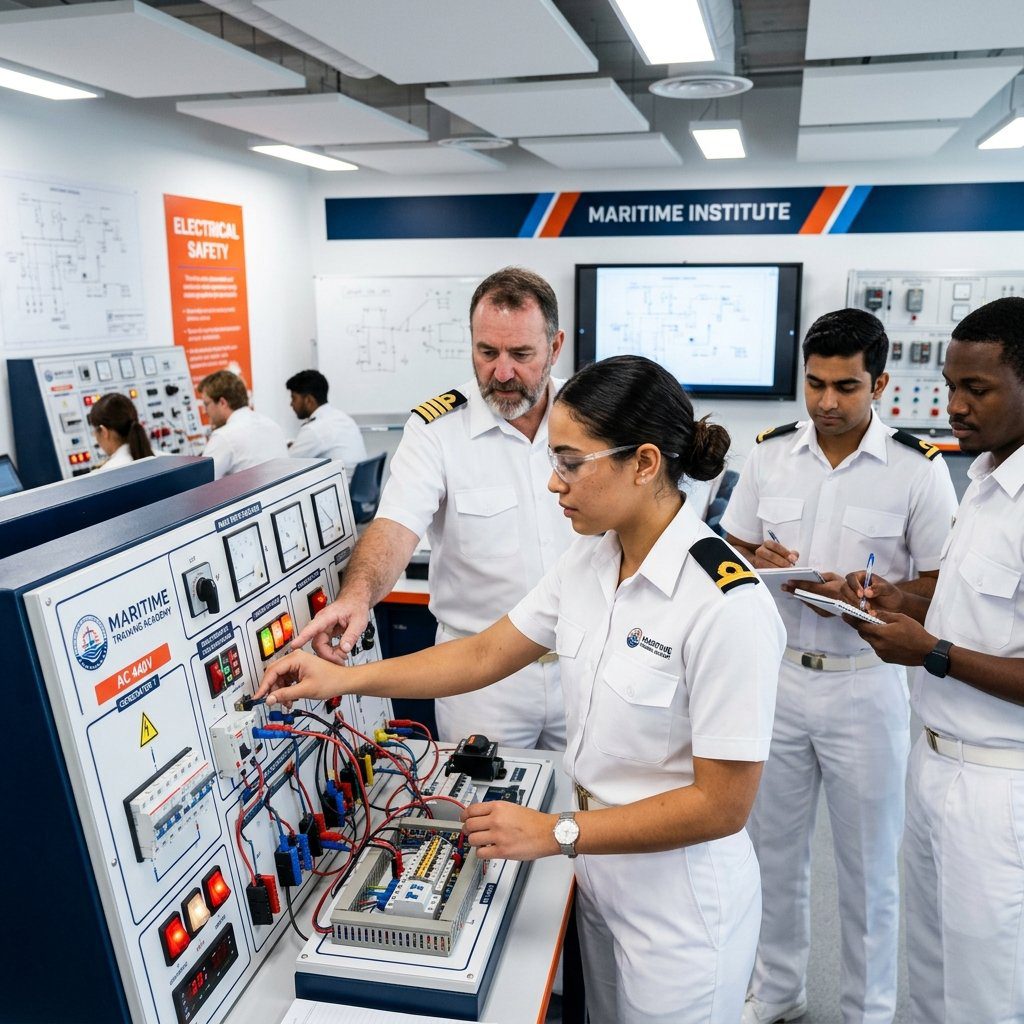
The ETR Training and Assessment Record (TAR) Book is a structured record book approved by the DGMA. It acts as an official record of the practical electrical tasks you perform on board under the supervision of a qualified engineer.
Completing the ETR TAR Book is a mandatory requirement for all ETR candidates, regardless of whether you qualify through an ITI, a diploma, a degree, or a GP Rating. During your sea service, senior shipboard officers must sign off on each completed task. The Mercantile Marine Department (MMD) officers will thoroughly audit this book before issuing the Electro-Technical Rating CoP.
Crucial Advice on Shipping Companies: To ensure your sea service is accepted by the DGMA, you must complete your onboard training on vessels owned or managed by officially registered shipping companies. You can check the licensing details, active status, and ratings of recruiting agencies on the RPSL Companies Directory.
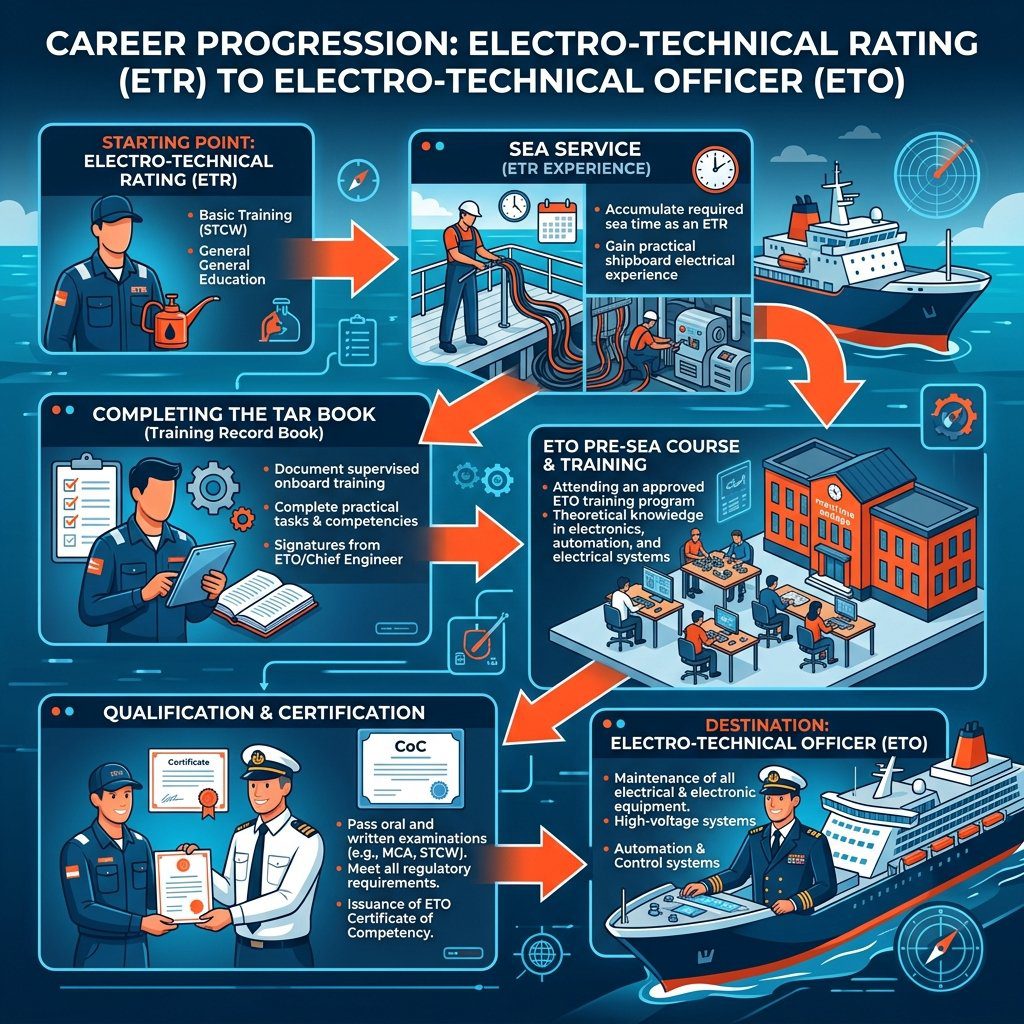
How to Progress from Electro-Technical Rating (ETR) to Electro-Technical Officer (ETO)?
One of the most significant career advantages introduced by DGMA Circular 25 of 2026 is the complete removal of the age limit for seafarers progressing from an Electro-Technical Rating CoP to an ETO Certificate of Competency (CoC). This enables ratings with years of experience to transition into officer roles.
To climb to an ETO rank, you must complete a 4-month Electro-Technical Officers (ETO) course at a DGMA-approved Maritime Training Institute (MTI) and complete post-CoP sea service. Candidates must also complete advanced safety training, including High Voltage Safety and Switch Gear (Operational Level) or Management Level.
Important Selection Tip: When selecting a Maritime Training Institute (MTI) for ETR bridging or ETO courses, always check its rating under the DGMA’s mandatory Comprehensive Inspection Programme (CIP). Opting for institutes with A1 or A2 grades ensures superior instruction quality, better facilities, and strong shipboard placement records.
The career progression rules depend on your initial academic background:
| Category | Educational Status | Required Sea-Going Service (Post-Electro-Technical Rating CoP) | Mandated ETO TAR Book Duration | Course & Exam Requirements |
|---|---|---|---|---|
| Category A | ETR without a Diploma or Degree in Electrical/Electronics | 24 Months on merchant ships ≥ 750 kW under senior supervision | Minimum 12 Months documented in an approved ETO TAR Book | • Attend DGMA approved 4-month pre-sea ETO course. • Pass written and oral examinations conducted by DGMA. |
| Category B | ETR holding a recognized Diploma or Degree in Electrical/Electronics | 12 Months on merchant ships ≥ 750 kW under senior supervision | Minimum 6 Months documented in an approved ETO TAR Book | • Attend DGMA approved 4-month pre-sea ETO course. • Pass written and oral examinations conducted by DGMA. |
What are the Key Steps to Obtain the ETO CoC?
If you are looking to advance your career from a rating to an ETO under the new circular, here is the exact step-by-step pathway:
- Obtain Electro-Technical Rating CoP: Complete your initial ETR sea service (6 to 12 months depending on your entry criteria) and secure your ETR CoP.
- Complete Post-CoP Sea Service: Complete the required service (24 months for Category A, 12 months for Category B) on ships powered by main propulsion machinery of 750 kW or more.
- Document in the ETO TAR Book: Ensure that a minimum of 12 months (Category A) or 6 months (Category B) of your onboard training is signed off in an approved ETO TAR Book under senior supervision.
- Complete ETO Pre-Sea Course: Enroll in and complete the 4-month pre-sea ETO course at a DGMA-approved maritime training institute.
- Pass MMD Examinations: Submit your files to the Mercantile Marine Department (MMD) for assessment and pass the written and oral examinations to secure your ETO CoC.
Why is the Transition to DGMA Important?
Seafarers should note that the Directorate General of Shipping (DGMA) has transitioned to the Directorate General of Maritime Administration (DGMA). The official web portal is now active at dgma.gov.in. All applications for Electro-Technical Rating CoPs, course eligibility assessments, and CoC examinations are now processed through the updated DGMA e-governance portal. This administrative change is designed to streamline maritime documentation, digitize records, and speed up certificate processing times.
Frequently Asked Questions
What is the new name of the Directorate General of Shipping (DGS)?
The Directorate General of Shipping (DGS) has transitioned to the Directorate General of Maritime Administration (DGMA). Its official website is dgma.gov.in.
What is the difference between ETR and ETO?
An Electro-Technical Rating (ETR) holds an Electro-Technical Rating CoP (Certificate of Proficiency) and operates at the support level under STCW Regulation III/7. An Electro-Technical Officer (ETO) holds a Certificate of Competency (CoC) and works at the operational level under STCW Regulation III/6, carrying higher technical responsibilities.
What is the duration of the ETR bridging course?
The ETR bridging course has a duration of 10 working days (60 hours total), consisting of 32 hours of theory, 28 hours of practical training, and 3 hours of final assessment.
Is there an age limit for progressing from ETR to ETO?
No, DGMA Circular 25 of 2026 has completely removed the age limit for seafarers progressing from Electro-Technical Rating CoP to ETO, provided they meet the mandated sea service requirements.
What is the sea service requirement for an Electro-Technical Rating CoP with an ITI certificate?
Under Criteria I, an ITI certificate holder requires a minimum of 9 months of electrical-related sea-going service on a vessel powered by main propulsion machinery of 750 kW or more to apply for the Electro-Technical Rating CoP.
What is a TAR Book and is it mandatory for ETR?
Yes, the ETR Training and Assessment Record (TAR) Book is a mandatory record of shipboard practical tasks. It must be filled out during sea service and verified by MMD officers before they issue the Electro-Technical Rating CoP.
Can a GP Rating seafarer apply for the Electro-Technical Rating CoP?
Yes, under Criteria IV, a GP Rating holder can qualify by passing the exit exam, completing the 10-day ETR bridging course, completing 12 months of sea service on ships ≥ 750 kW, and completing the ETR TAR Book.
What are the main propulsion power requirements of ships for ETR sea service?
All sea-going service for ETR eligibility must be performed on vessels powered by main propulsion machinery of 750 kW propulsion power or more.
Who conducts the ETO CoC written and oral examinations?
The written and oral examinations are conducted under the authority of the Directorate General of Maritime Administration (DGMA) through the Mercantile Marine Department (MMD).
Where can seafarers join the 4-month ETO course?
The 4-month pre-sea ETO course must be completed at a DGMA-approved Maritime Training Institute (MTI). You can search the list of approved MTIs on the official DGMA portal, browse directories on IndoSearch, and review their ratings under the Comprehensive Inspection Programme (CIP) to see how they are graded based on placement success.