
This guide covers how to join Merchant Navy in India after 10th, and how to get a job in Merchant Navy in India after 12th or engineering. Choosing the correct course based on your education and budget and being aware of the various other requirements, such as the age limit, is crucial before beginning the course, which can get expensive and time-consuming.
This one-stop-complete guide helps you know what course to choose, where to study, what the approximate fee is for the course, the average package, and how and when the application process begins.
What Is Merchant Navy and Who Can Join It?
Merchant Navy refers to trade ships, tankers, and other commercial vessels used for transporting goods and people rather than a nation’s military fleet. India has one of the world’s largest merchant navies, with citizens working on ships registered in different countries.
Any Indian citizen who meets the required physical and academic criteria can join Merchant Navy, regardless of their gender, religion, or ethnicity. While there are some standard entry requirements, they vary depending on the course and specialization.
The different courses one can pursue to join Merchant Navy depend on the entry requirements:
- After 10th or After 12th PCM Course: These courses have stricter eligibility conditions, such as age and physical fitness requirements.
- Graduate or Postgraduate Degree Course: One needs a bachelor’s degree to pursue this course from an approved university; there are no age restrictions for these courses.
- Medical and other Specialization Courses: Apart from the core disciplines of deck and engine, one can pursue a course in medical specialization to become a doctor in the Merchant Navy.
What Is the Eligibility to Join Merchant Navy Courses?
Eligibility criteria depend on the courses and specializations; however, there are a few standard requirements to join Merchant Navy courses, such as age, educational qualifications, subjects required, and marks, and physical and medical fitness.
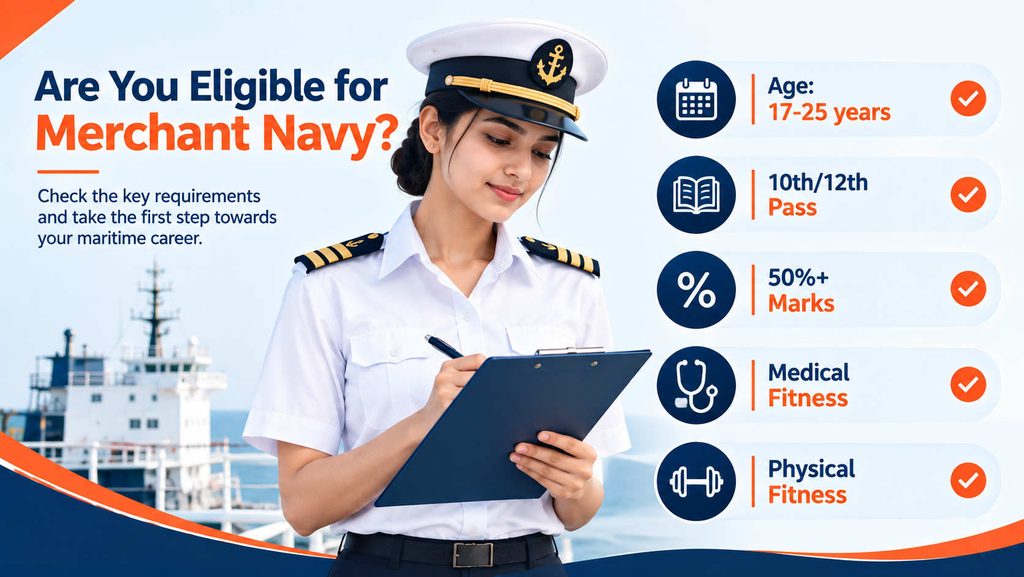
| Criterion | Typical Requirement |
| Age limit | 17 to 25 years for most entry-level courses (some diploma routes allow up to 27-28) |
| Educational qualification | 10th pass (GP Rating) or 12th pass with PCM (Nautical Science, Marine Engineering) |
| Required subjects | Physics, Chemistry, Mathematics (PCM) for officer-track courses; Science and Maths for GP Rating |
| Minimum marks | 50-60% aggregate in PCM for officer courses; 40-50% in Science/Maths/English for GP Rating |
| Medical & eyesight | 6/6 or 6/9 vision without correction for deck roles (varies by course); no colour blindness |
| Physical fitness | Minimum height ~150-160cm, BMI within range, no major physical disabilities, fit for sea service |
Medical standards to join Merchant Navy are set according to DGMA guidelines as outlined in the Merchant Shipping (Medical Examination) Rules. A pre-sea medical examination by a doctor approved by DGMA is required before you can start any training course. It is smart to get this medical done early before applying so you avoid being disappointed if you are selected but fail the medical check later.
Join Merchant Navy Courses After 10th and 12th
Your final exam results determine which courses you can join:
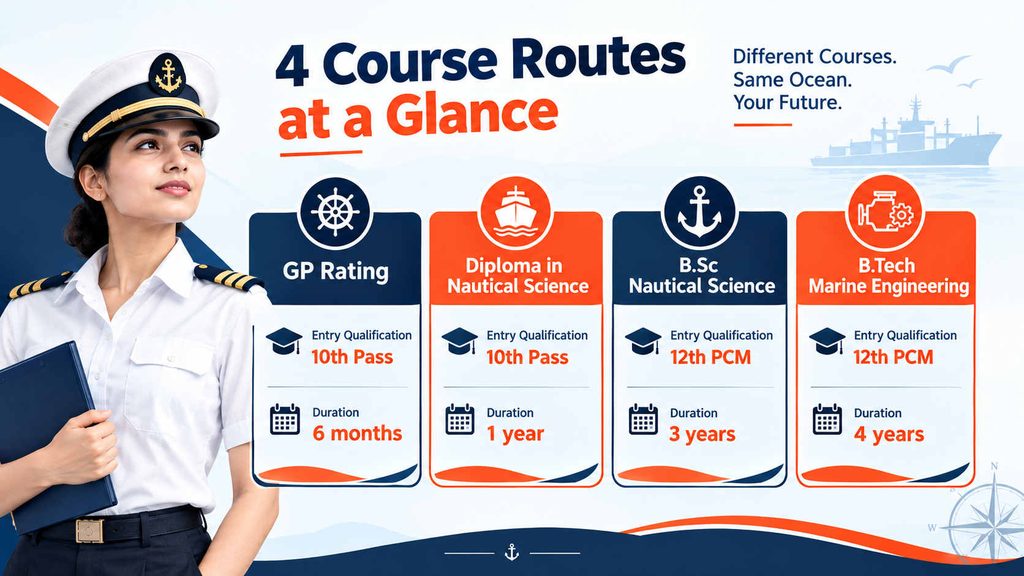
- GP Rating (General Purpose Rating): This is a 6-month -sea course designed for students who have passed their 10th standard. It leads to a job as a deck rating or engine rating on board ships. It’s the way to join Merchant Navy.
- B.Tech Marine Engineering: A 4-year degree program that requires you to have completed 12th with Physics, Chemistry and Mathematics (PCM). This course prepares you to become a Marine Engineer Officer for ship machinery and systems.
- B.Sc Nautical Science: A three year degree course that includes one year of sea training followed by sea service and more classroom terms. It is open to students who have passed 12th with PCM. This path leads to a career, as a Deck Officer handling navigation and ship operations.
- Diploma in Nautical Science (DNS) and other DGMA-approved diploma programs: These are alternatives to degree courses. They offer a route to join Merchant Navy after 12th especially for those who want to become officers without pursuing a full degree.
If you have passed 10th but do not have PCM then GP Rating is your option. It does not require PCM subjects. You can find details about eligibility and the curriculum on the GP Rating course page. If you have completed 12th with PCM and want to become an officer your main options are B.Sc Nautical Science or B.Tech Marine Engineering.
The decision, between these options depends on two factors:
1. How soon you want to begin earning.
2. Whether you prefer working on the deck (navigation). In the engine room (machinery).
GP Rating allows you to reach sea faster. You start at the rating level. Degree or diploma programs take longer. They let you launch your career directly as an officer.
Admission Process to Join Merchant Navy
For degree and diploma courses such as B.Sc Nautical Science, B.Tech Marine Engineering and Diploma in Nautical Science admission is through IMU-CET the Indian Maritime University Common Entrance Test. This test is held a year and acts as the entrance exam, for all IMU campuses and colleges that are connected to IMU.
IMU-CET Requirements:
- A level online exam covering Physics, Chemistry, Mathematics and English at the 10+2 level.
Entrance Examination:
- Usually held in April or May each year.
- Results and counselling happen within a weeks after the exam.
Application Process:
- Apply online via the IMU-CET portal.
- Upload identity documents during registration.
Selection Process:
- Based on your rank in IMU-CET.
- Followed by document verification and seat allotment through counselling.
Medical Examination:
- A mandatory medical fitness test by a DGMA-approved doctor.
- Completed after selection. Before joining the course.
Sponsorship Requirements:
- Some courses require a sponsorship letter from a shipping company at the time of admission or after.
- This letter confirms that the company will provide sea-time training and placement.
For GP Rating the admission process differs. Individual DGMA-approved training institutes conduct their selection. Each institute runs its cycle, which includes a written test, personal interview and medical exam. The process varies slightly between institutes.
Merchant Navy Course Fees
Course fees vary depending on the college and the type of program. Government-run campuses of Indian Maritime University are generally more affordable than affiliated colleges.
| Course | Approximate Fee Range (Total) |
| GP Rating (6 months) | ₹1.5 lakh – ₹3.5 lakh |
| Diploma in Nautical Science (1 year) | ₹3 lakh – ₹6 lakh |
| B.Sc Nautical Science (3 years) | ₹6 lakh – ₹12 lakh |
| B.Tech Marine Engineering (4 years) | ₹8 lakh – ₹16 lakh |
Besides tuition students should also plan for:
- Hostel and mess charges: ₹8,000 to ₹15,000 per month if these are not already included in tuition.
- Personal gear.
- Examination and INDoS registration fees.
- STCW certificate course fees: ₹50,000 to ₹1.5 lakh depending on the course.
Join Merchant Navy Top Colleges in India
The Indian Maritime University (IMU) has campuses in Chennai, Mumbai, Kolkata, Visakhapatnam and Kochi. It also works with a network of institutions across India. These are some of the trusted and well-known centers for maritime education in the country.
Some of the respected names in the field include IMU and its affiliated colleges. These include Tolani Maritime Institute in Pune Samundra Institute of Maritime Studies in Lonavala and Mumbai Marine Engineering and Research Institute. MERI in Kolkata and Mumbai MANET in Pune, AMET in Chennai, International Maritime Institute in Greater Noida and Coimbatore Marine College.
You can check the list of DGMA-approved maritime training institutes on our directory of maritime training institutes (MTI). This list can be filtered by state, status and rating. Before paying any fees always cross-check the courses listed on the DGMA-approved maritime training courses page.
Institute Directory by Location
Use the directory page for your city or state below to search for and verify a specific college. You can also filter the master MTI directory by name.
| Location | Indosearch directory link |
| Delhi NCR | Maritime Training Institutes in Delhi NCR |
| Mumbai | Maritime Training Institutes in Mumbai |
| Navi Mumbai | Maritime Training Institutes in Navi Mumbai |
| Tamil Nadu | Maritime Training Institutes in Tamil Nadu |
| West Bengal | Maritime Training Institutes in West Bengal |
| Kerala | Maritime Training Institutes in Kerala |
| Top-rated (any location) | 5 Star Rated Maritime Training Institutes |
| IMU-affiliated only | IMU Affiliated MTI |
Reference List of Well-Known Institutes
| Institute | Location | Type |
| Indian Maritime University (IMU) | Chennai, Kolkata, Mumbai, Kochi, Visakhapatnam | Central university, govt |
| Tolani Maritime Institute (TMI) | Pune (Talegaon / Induri) | Private, IMU-affiliated |
| Samundra Institute of Maritime Studies | Lonavala / Mumbai | Private |
| MANET (Maharashtra Academy of Naval Education & Training) | Pune | Private, IMU-affiliated |
| AMET (Academy of Maritime Education and Training) | Chennai | Private university |
| International Maritime Institute (IMI) | Greater Noida | Private |
| Coimbatore Marine College | Coimbatore | Private |
Duration of Merchant Navy Courses
| Course | Pre-Sea Training | Typical Time to Officer Rank |
| GP Rating | 6 months | 4-6 years (rating to officer, with further exams) |
| Diploma in Nautical Science | 1 year | 3-4 years to Second Mate |
| B.Sc Nautical Science | 1 year + sea service + further terms | 3-4 years total to Second Mate |
| B.Tech Marine Engineering | 4 years (includes sea service) | 4-5 years to Fourth/Third Engineer |
Onboard training or sea service is the element under-estimated by most first-time applicants. Even after completing classroom training, you’ll need a defined period of documented sea time before being eligible for officer competency exams – this sea time is what certifies a cadet to an officer, not the classroom course.
Merchant Navy Placement and Sponsorship
When a shipping company commits, in writing, to taking you on as a cadet for your mandatory sea time after pre-sea training, it is called a sponsorship. Placement is the more umbrella term for when an institute or agency helps you find a ship and company to sail with, sponsored or otherwise.
Most students get their first ship through one of three options: direct company sponsorship before starting a course, placement assistance from the training institute after completing a course, or independent applications through a licensed RPSL (Recruitment and Placement Service Licence) agency. Always confirm an agency’s RPSL licence number before paying any placement fee – this is the biggest reason for fraud complaints in this industry.
- Placement vs sponsorship: a sponsorship is a pre-course guarantee from a specific company, whereas placement is post-course job search assistance with no guarantee
- Important points before joining an institute: get the sponsorship or placement commitment in writing, verify the sponsoring company’s fleet and safety record, and never pay any agent or agency outside a verified RPSL licence
Merchant Navy Job Opportunities
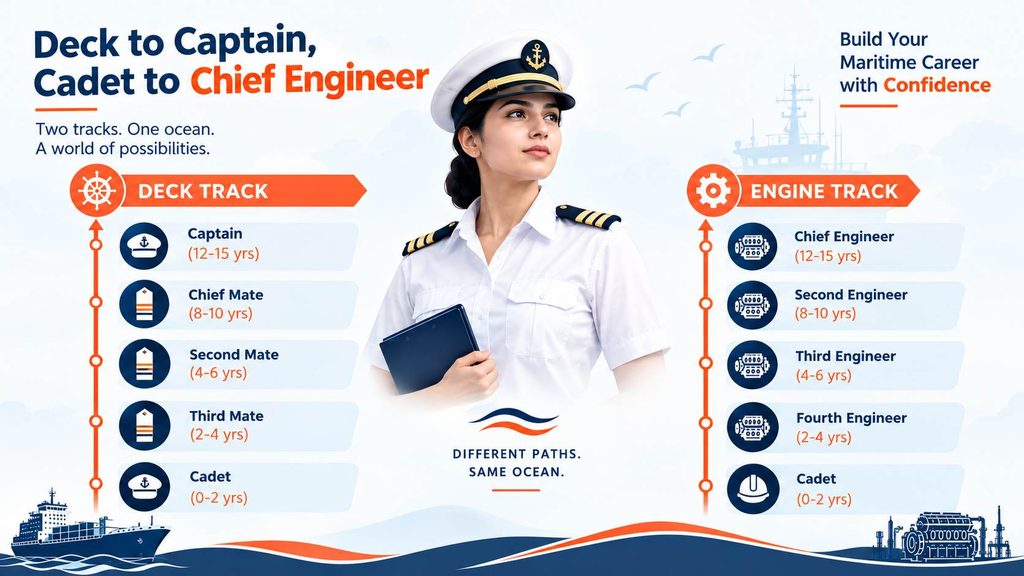
- On the deck: Deck Cadet to Second Mate, Chief Mate and Captain, responsible for navigation, cargo operations and safety
- In the engine: Engine Cadet to Fourth, Third, Second Engineer and Chief Engineer, for propulsion and machinery
- GP Rating / ratings: Ordinary Seaman, Able Seaman, Oiler and similar rating roles, to assist both deck and engine
- Catering / hospitality: Steward, Cook and Chief Cook roles, for catering and hospitality onboard
- Offshore and other: support vessels, oil rigs, dredging and shore-based (technical/superintendent roles), for experienced officers
Merchant Navy Career Growth
| Track | Progression |
| Deck Officers | Deck Cadet → Third Mate → Second Mate → Chief Mate → Captain/Master |
| Marine Engineers | Engine Cadet → Fourth Engineer → Third Engineer → Second Engineer → Chief Engineer |
| Ratings | Ordinary Seaman/Wiper → Able Seaman/Oiler → Bosun/Pump-man → (with further study) Officer track |
Each promotion requires passing a Competency exam (like Second Mate, Chief Mate, Master or the equivalent engineering exams) conducted under DGMA, plus a minimum documented sea-time requirement at the rank below. Ratings can also move into the officer track through study and exams and this route takes longer than starting as a cadet. After gaining experience many officers often transition to shore‑based roles such, as superintendents, surveyors, pilots or maritime training faculty.
Salary When You Join Merchant Navy
| Level | Approximate Monthly Salary (INR) |
| Cadet / trainee (during sea-time) | ₹25,000 – ₹50,000 |
| Rating (Ordinary/Able Seaman) | ₹65,000 – ₹1.5 lakh |
| Junior Officer (Third Mate/4th Engineer) | ₹2 lakh – ₹3.75 lakh |
| Senior Officer (Chief Mate/2nd Engineer) | ₹4.15 lakh – ₹6.65 lakh |
| Captain / Chief Engineer | ₹6.65 lakh – ₹12.5 lakh+ |
Salaries vary by ship type (tankers, gas carriers generally pay more than general cargo), flag state, shipping company and whether you’re on an Indian or foreign payroll. Ship type, rank, company reputation and years of sea experience are the four biggest factors that determine take-home pay, more than the base course you’ve completed.
Scholarships and Financial Assistance for Merchant Navy Students
- Merit and need-based scholarships offered directly by some IMU campuses as well as private maritime institutes
- Education loans from nationalised and private banks under standard professional-course education loan schemes, since maritime degrees typically qualify
- Government and institutional assistance schemes for SC/ST/OBC and economically weaker candidates, applied for through the respective institute’s admission office
Given that course fees run into several lakhs, it’s worth applying for institute-specific scholarships on admission, rather than after the course begins (most scholarships have early deadlines).
Documents Required to Join Merchant Navy
- Valid passport showing a validity period required for sea travel.
- INDoS number, which is the Indian National Database of Seafarers registration; this is required for every seafarer.
- STCW certificates, such, as Basic Safety Training and Personal Survival Techniques.
- Medical fitness certificate issued by a doctor approved by DGMA.
- Educational documents, including 10th/12th mark sheets and any degree or diploma certificates that apply.
- Other documents. CDC (Continuous Discharge Certificate), police clearance certificate and company‑specific joining documents.
Advantages and Challenges of a Merchant Navy Career
Careers in the Merchant Navy offer tax-free income for many sailing categories, faster progress in career than shore jobs, a chance to travel and see the world, and long-term earning potential once ranked up as an officer. It’s also one of the few careers where a 10th-pass can carve a well-paying respected professional career through the rating-to-officer route.
The trade-offs are long contracts away from family (typically 4-9 months at a stretch), isolation and confined living spaces, physically and mentally tiring work in all conditions, and a truly hard and competitive route to your first ship if you don’t have a sponsorship secured before course completion. It’s a good career option for people comfortable with structure, discipline and time away from home.
Conclusion
If you want to join Merchant Navy, it is one of the career choices in India that gives a paying job for students who have passed 10th and 12th with PCM. The Merchant Navy is still one of the career choices, in India that gives a paying job for students who have passed 10th and 12th with PCM. It can lead to a recognized career if you pick the right training course, check that your institute has DGMA approval, and look closely at their placement history. You also need to be honest about what the lifestyle will require — periods away from home, strict discipline and demanding work hours. If you are ready for that, you can join Merchant Navy for a strong and growing career path in 2026.
Merchant Navy: Frequently Asked Questions
Can a Merchant Navy officer later switch to the Indian Navy or Army?
Yes. Prior Merchant Navy service does not disqualify you and the sea experience and technical skills gained are generally seen as valuable. You would still need to go through the defence recruitment process, exams and medical requirements applicable at the time the same as any other applicant.
Can someone from the Indian Navy switch to Merchant Navy instead?
Yes this transition happens regularly. Is documented in DGMAs training and assessment framework, which sets out how naval officers and sailors can move across. Those making this switch from the engineering side often go on to work as electrical officers or engineers in Merchant Navy.
Is arranging sponsorship harder than clearing the IMU-CET exam?
For aspirants yes. Accounts from people who’ve been through the process describe passing IMU-CET as the more straightforward part while securing a shipping companys sponsorship for sea time afterward is where the real difficulty and delay tends to happen. It’s worth working on this well before you finish your course not after.
Can Merchant Navy salaries fall during a recession or market slowdown?
Yes. The Merchant Navy is part of the shipping industry. Like global trade-related sectors it is affected by economic cycles. During a recession or market slowdown shipping demand can drop. That leads to jobs and lower wages. When there is much supply of seafarers salaries may fall. This is why experienced sailors often say their income is not stable. It changes from year to year.
Can I wear glasses. Get LASIK surgery to meet the eyesight requirement?
Yes many positions in the Merchant Navy allow wearing glasses. The acceptable limit is usually up to plus or minus 2.5 diopters. If your vision is corrected with glasses you can still qualify. LASIK surgery is also generally accepted in India. The surgery must be completed well before your medical exam. After that the medical officer at the company or training institute must approve your eyesight. Rules vary by department. So it’s best to check your eyesight standards with the course you plan to join.
Is swimming compulsory to join Merchant Navy?
No being able to swim is not a requirement to join Merchant Navy. There is no swimming test during the admission process. However some training institutes include swimming in their curriculum. Also during your training you might have to take part in water safety drills. In those cases you are required to wear a life jacket not swim. The ability to swim is not tested. Safety is important.
Is there a retirement age in Merchant Navy?
Yes the standard retirement age is 60. In some cases sailors can work until 65. This is only possible if the shipowner agrees and the seafarer is medically fit. The medical fitness must be confirmed by the company doctor. So while 60 is the limit extensions are possible under special conditions.
Is Merchant Navy income tax-free or are there conditions?
It depends on residency status, not just the job title. If you work outside India for 183 days or more in a financial year, as recorded on your CDC- the full form of CDC is Continuous Discharge Certificate, your foreign income becomes non-taxable in India under NRI seafarer rules. If you don’t cross that 183-day threshold in a given year, your income is taxed normally like any other resident’s salary — so “tax-free” isn’t automatic, it depends on your actual sailing days that year.
Do seafarers get internet or phone access while on a ship?
Most modern ships now provide satellite internet and phone access.. The service is usually slower and more limited than what you get on land. It can also cost extra. Some older ships still offer email access only. The availability of communication tools varies depending on the vessel and the shipping company. Generally you can stay in touch, with family and friends even if the connection is not always fast.
Can I take my family onboard a ship when I join Merchant Navy?
Sometimes, but it depends entirely on company policy. Only spouse and children more commonly allowed for senior officers than cadets and often restricted on certain high-risk trading routes.
Is piracy a risk for Merchant Navy sailors today?
It’s a geographically limited risk concentrated in specific areas like parts of the Gulf of Aden and certain West African waters rather than a general threat, across all routes.