
With the booming scale of the Indian maritime industry and more staff brought in each season, it is more crucial than ever to make sure the staff entering the workforce (seafarers) are all certified, well trained and actual professional workers to ensure the safety of the vessel and other seafarers within the vessel.
Along with making the workers more efficient, trustworthy and productive, the ministry of law and justice has taken a further step to enhance maritime efficiency by introducing a new draft of the MS act, 2025. In which the fourth part discusses the importance and guidelines for maritime training for all seafarers.
Before diving into this particular part of the act, check out and understand the preliminary part of the act along with what the rules are for establishment of NSB & SWB. These initial sections lay out the basic foundations for the entire act following through.

This part of the act deals with how India ensures the proper training of seafarers, and how it makes sure all of them are certified/qualified before they work on ships, and how training institutes are regulated. It is aligned with the international STCW convention (Standards of Training, Certification and Watchkeeping for Seafarers).
Table of Contents
Qualifications of seafarers and criteria for issuing of certifications:
GUIDELINES FOR THE VESSEL
- Every vessel should have the right number/ scale of seafarers based on the category of the vessel, area and types of operations it will have to carry out, this is to ensure the availability of skilled labour on board at all times.
GUIDELINES FOR THE SEAFARERS
- Each seafarer is mandated to obtain and carry a certificate of competency (COC) or certificate of proficiency (COP) relevant to their rank.
- Indian nationals including overseas nationals of India with recognized foreign certificates may also work at Indian seas if the said certificates are approved by the directorate general of shipping.
To grant/issue the certificate of competency and the certificate of proficiency the central government will appoint an authority. No certificate is issued unless the seafarer meets STCW requirements, such as sea service duration, age limits, medical fitness, approved training courses (including onboard training) and exams conducted by the board.
The authority is also allowed to issue additional certificates with some of the rules for the factors of these certificates defined in prior, they are as follows:
- The form
- The fee
- The period of validity and the manner of keeping record of COC and COP
Regulation and approval of maritime education & training institutions as per MS Act 2025:
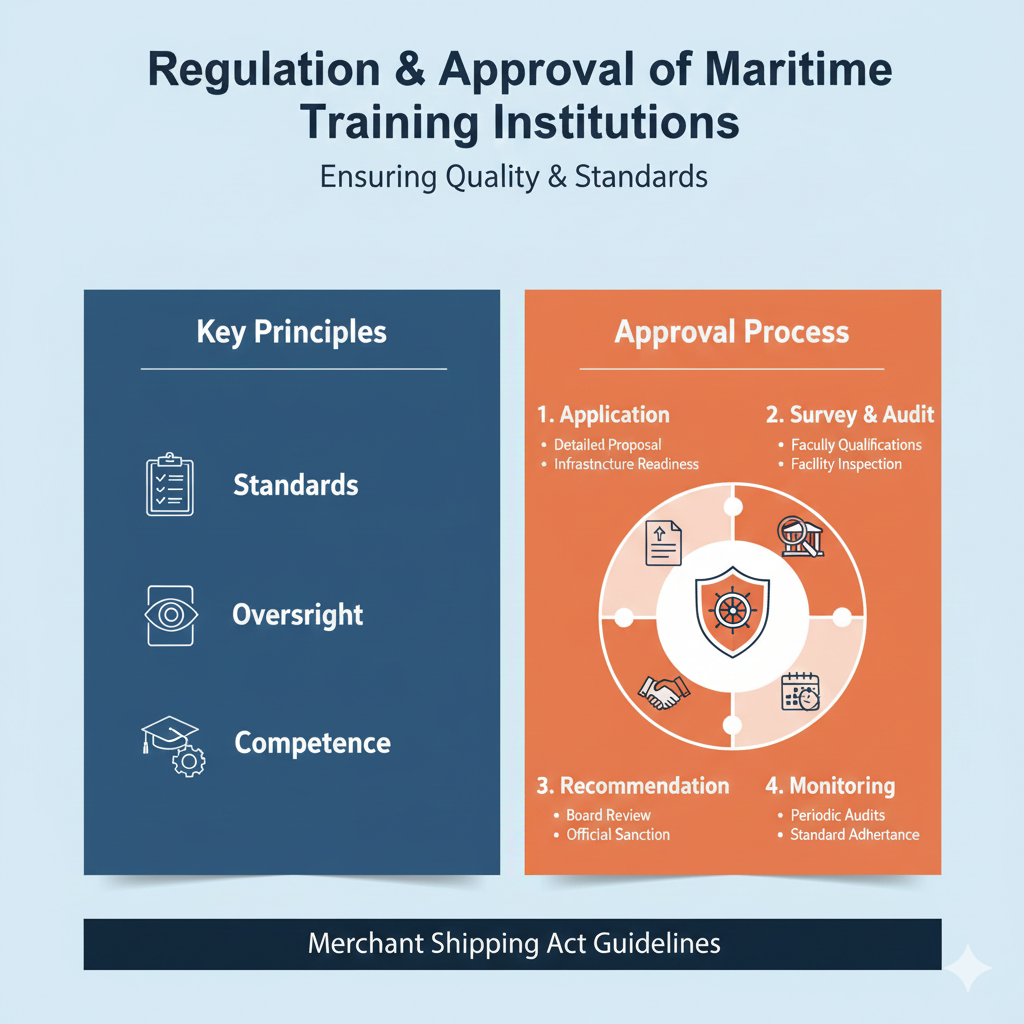
The directorate general is advised to manage and supervise all maritime training in India. Only the DGS approved institutes and recognized courses can issue COCs and COPs, the directorate will also be responsible for authorizing inspectors to monitor these training institutes. Finding approved institues can be difficult, here’s a comprehensive list of the top maritime trainging institues and MTI comapnies.
No certificate is allowed to be issued unless the seafarer has gone through training under DGS approved methods and institutes and if any of these institutes has violated the laws under this act, the directorate general is allowed to withdraw the approval granted for training seafarers or suspend them directly after giving them a chance to explain themselves.
The central government may and will have the power to undertake action against any institute operating without the approval of Directorate and the pilots at ports must undergo specific training from time to time and hold certificates as ordered by the directorate.
This is to make sure the seafarers going on board are skilled and fool proof, this is very similar to the initiative DG shipping took to take strict actions against forged CDC entries to ensure safety and efficiency at sea.
Examination procedure for the certificates
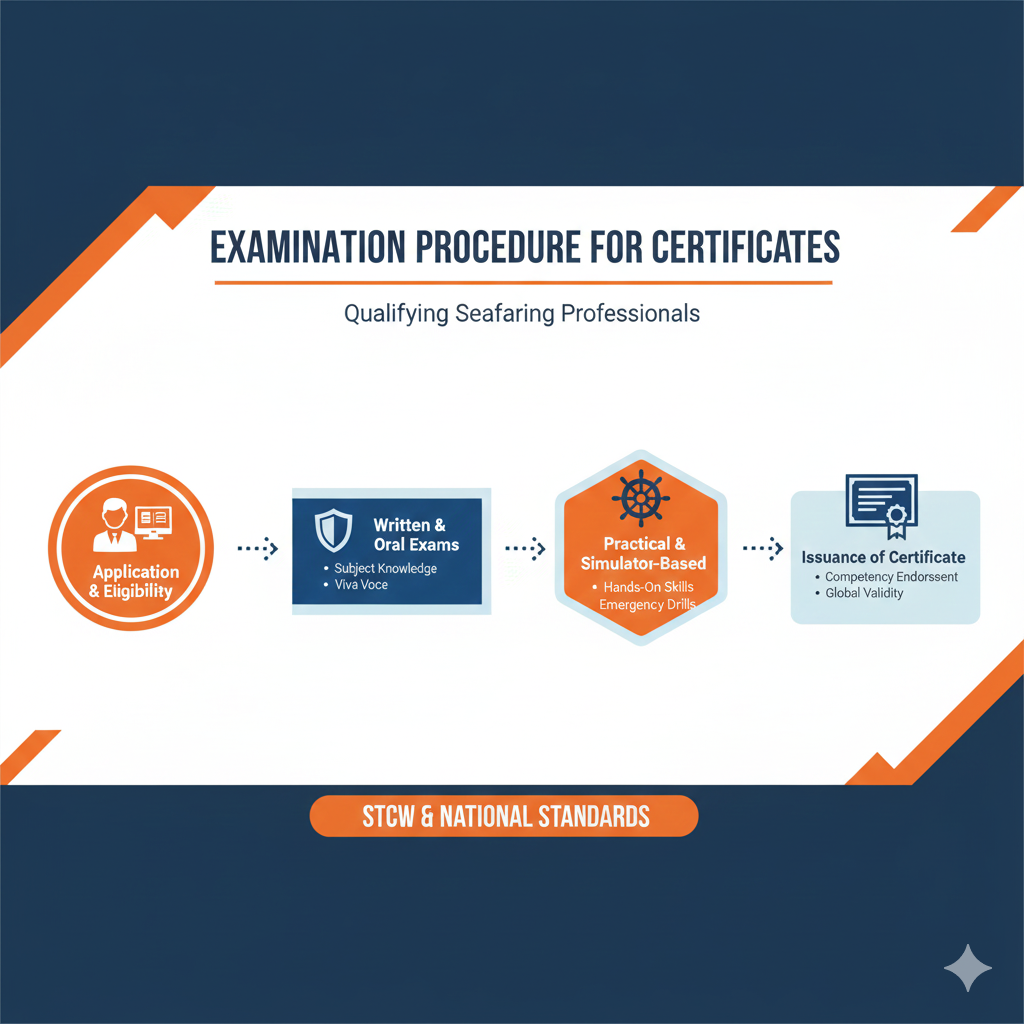
To acquire the certifications needed (COCs and COPs) seafarers will have to go through different levels of examinations. Under the STCW convention, the central government is advised to select and appoint 2 chief examiners to invigilate the exams conducted, the two chief examiners are as follows:
- Nautical Advisor – Master & deck officers
- Chief Surveyor – Engineering officers
And in their absence the central government is allowed to appoint any surveyor to act as the chief examiner. The procedure, rules and fees for the conduction of these exams shall be followed as prescribed by the directorate.
The certificates are only issued if the examiner confirms that the performance of the seafarer is up to the mark in factors such as competence, good conduct, and sobriety.
If the certificate issuing authority thinks the examiners judgement is off set, he/she is allowed to call for a re-examination and demand and inquiry into the applicant’s testimonials and character. And contrarily if the authority thinks the applicant is unworthy of the certificate or donuts that he/she has got through the examiner through fraudulent measures, they are allowed to cancel, suspend or withdraw the issued certificate after giving the applicant the opportunity to be heard/ defend themselves.
Certificates can be withdrawn/suspended/cancelled if obtained fraudulently or if the seafarer is guilty of:
- Misconduct
- Incompetence
- Indiscipline
- Actions compromising safety/security/environment
And if the applicant thinks this is unfair or is misjudged they are allowed to appeal against such an order before the central government. Lost/ damaged certificates can be reissued after the appeal and payment for the process.
These examinations and certificates are all for normal seafarers, if you are a medical professional interested in getting into maritime it’s important to learn how to get DGS approval as a doctor ,so you can work with the shipping sector.
Production of certificates and recognition of foreign ones
The owner of the ship is required to produce/provide certificates of competency of his crew and of the vessel to any authority (surveyor) when requested, he/she is also responsible for providing the authority with a proper list that shows each crew member’s certificate grade, including his own.
And for the foreign ones, Indian surveyors can accept the certificates of the foreign seafarers if:
- The issued certificates are not granted under standards that are lower than Indian maritime standards
- The responsible foreign state accepts Indian certificates.
Central government recognized states and certificates are and shall be treated the same as Indian ones.
A foreign vessel departing from an Indian port must have proper STCW certified crew and equipment, a surveyor of any person given the authority by the central government can go on board at any time and monitor/check/make sure all the safety requirements and standards defined by the Indian directorate are thoroughly met. If not, the authority can detain the vessel until the shortcomings are fixed and the requirements are fulfilled.
And if you own a foreign vessel, here’s how to get a chattering licence for foreign-flagged vessels in India so you can ensure safe, smooth operations on Indian waters.
National emergency and rule making power
Every Indian citizen that has obtained the certificate of competency, the certificate of proficiency or any certificate recognised under section 50 shall serve on board in times of national emergency under the guidelines of the central government for a particular period of time.
The central government can make detailed rules to implement everything in this part, this is to ensure maxim safety, security and efficiency in carrying out the missions, the central government is allowed to make rules and guidelines on:
- (a) the manning scales of the seafarers based on different categories of vessel, areas and types of operations
- (b) the grade of a certificate and the conditions and restrictions subject to which seafarers may serve on Indian vessels
- (c) the requirements and procedure for grant of certificate ofcompetency or certificate of proficiency to the different grades of seafarer
- (d) the requirement and procedure for grant of other COC or COP
- (e) the form of certificate, fees and the validity of such certificate and the manner in which the records of certificates are to be kept
- (f) the procedure in accordance with which the Central Government may undertake action against training institutes operating without approval of the Director-General
- (g) the manner of conducting examination for certificate of competency or certificate of proficiency, fee to be charged and payment to be made to the examiners
- (h) the procedure in accordance with which a person may appeal before the appellate authority against the order passed by the issuing authority
- (i) the fee for grant of certificate if lost or deprived,
- (j) the certificate of endorsement
- (k) any other matter which is required.
Final thoughts
Under the MS act 2025, the section of maritime training and education focuses heavily on training the crew from time to time to keep them active, educated and certified. This not only helps improve efficiency at sea but also helps prevent accidents due to uncertified/ untrained seafarers. The new initiative pushes workers at sea to be more detailed, safe and attentive with their craft and crew.
FAQs
What is STCW?
STCW stands for Standards of Training, Certification, and Watchkeeping for Seafarers. It is an international convention established by the International Maritime Organization (IMO) in 1978, aimed at promoting safety of life and property at sea through standardized training for merchant mariners worldwide. The STCW sets minimum qualification standards for seafarers on seagoing merchant ships and large yachts, ensuring a consistent level of training across countries.
What are Certificate of Competency (COC) or Certificate of Proficiency (COP)?
A Certificate of Competency (COC) and a Certificate of Proficiency (COP) are official documents issued to seafarers to prove they are qualified, trained, and legally allowed to perform specific duties on a ship.
Are foreign certificates recognized under this act?
Yes, if the certificate meets or exceeds Indian standards and the foreign country recognizes Indian certificates in a mutual agreement
Can a certificate be suspended or cancelled under the new rules?
Certificates can be withdrawn/suspended/cancelled if obtained fraudulently or if the seafarer is guilty of misconduct, incompetence, indiscipline, actions compromising safety/security/environment
Who is responsible for approving maritime training institutes under this act?
The directorate general of shipping is responsible for approving, inspecting and suspending the maritime education and training institutes.