
The Guidance provided by the International Maritime Organization on the Use of Ammonia Cargo as a Fuel in Shipping (MSC.1/Circ.1702), published on July 7 2026, has created a regime for gas carriers allowing them to utilize ammonia cargo as fuel instead of oil. It has been approved by the Maritime Safety Committee after a series of processes involving a submission from the Sub-Committee on the Carriage of Cargoes and Containers in view of achieving safety levels equal to existing ones, for LNG fuel engines. This article serves as an in-depth analysis of the contents of the document broken down into its constituent sections.
What Is MSC.1/Circ.1702?
The MSC published MSC.1/Circ.1702 at its session held from May 13 to 22, 2026 and passed the interim regulations for the use of the ammonia cargo as fuel in ships. This happened due to the recommendations of the Sub-Committee of the MSC on the Carriage of Cargoes and Containers posed at its meetings held just ahead of the MSC session from September 8 to 12, 2025.
The purpose of the circular is to guide the usage of ammonia cargo as fuel with respect to the International Code, for the Construction and Equipment of Ships Carrying Liquefied Gases in Bulk (the IGC Code). The guidelines are found in the annex.
Why Did the Committee Issue These Guidelines?
The Committee’s own stated reasoning is narrow and specific: it recognised the importance of providing guidance for the safe use of ammonia cargo as fuel on board ships, to a standard that provides at least the same level of safety as comparable LNG-fuelled main and auxiliary machinery installations. In other words, ammonia is not being held to a lower bar than the LNG-as-fuel systems already accepted under the IGC Code. It is being held to the same one, adapted for ammonia’s specific hazards.
The circular also notes MSC.1/Circ.1681, which allows voluntary early implementation of the amendment to paragraph 16.9.2 of the IGC Code, the provision that permits the use of ammonia cargo as fuel in the first place. Shipowners tracking the underlying certification framework may also find our guide on the Indian Merchant Shipping (MS) Rules and Acts, 2025 useful background, since DGMA’s implementation of IMO circulars for Indian-flagged vessels flows through that Act.
Which Ships Do the Guidelines Apply To?
The guidelines apply to gas carriers as described by regulation VII/11.2 of SOLAS which must comply with the IGC Code for vessels using ammonia fuel for their cargo. They are applicable outside the cargo area in accordance with paragraph 16.4.1.1 of the IGC Code, except where a risk assessment or a specific provision requires otherwise. Owners evaluating a chartering license for foreign-flagged vessels should note that this vessel-type restriction applies regardless of flag or charter arrangement.
The guidelines define ammonia fuel as anhydrous ammonia listed in Chapter 19 of the IGC Code, which can exist in either a liquefied state (ammonia liquid) or a gaseous state (ammonia vapour). Wherever the IGC Code’s Chapter 16 provisions refer to “gas,” that reference is to be read as referring to ammonia, in either state, for the purposes of these guidelines.
| Term | Definition Under the Guidelines |
| Ammonia fuel | Anhydrous ammonia per IGC Code Chapter 19, in liquid or gaseous state |
| Ammonia fuel consumer | Any unit on the ship using cargo ammonia vapour or liquid as fuel |
| Ammonia fuel preparation room | Space with pumps, compressors, treatment systems or vaporizers for fuel preparation; treated as a cargo machinery space |
| ARMS (Ammonia Release Mitigation System) | A system that processes ammonia released from the fuel supply system |
What Is the Underlying Goal of the Guidelines?
Section 2.2 of the annex states the goal in a single sentence: to ensure safe and reliable operation of fuel supply systems and consumers for use of ammonia cargo as fuel. Every functional provision and additional requirement that follows exists to serve that one goal, in line with the goal-based approach set out in MSC.1/Circ.1394/Rev.2. This means a shipowner can propose an equivalent design, provided it is justified in accordance with paragraph 1.3 of the IGC Code and SOLAS regulation II-1/55.
What Are the Core Functional Provisions?
Section 2.3 of the annex sets out eight functional provisions that any ammonia cargo as fuel system must satisfy, regardless of how the design achieves them.
- All ammonia fuel storage and processing equipment must be located within the cargo area
- A single failure in the ammonia fuel system must not lead to a release of ammonia outside the cargo area
- Ammonia fuel preparation rooms may combine with cargo machinery spaces only after a risk assessment covering high-pressure fuel preparation equipment leakage
- Ventilation and detection for ammonia leakage must be effective, taking into account ammonia’s specific characteristics and physical properties
- Ammonia cargo as fuel characteristics must be suitable for the operation of the fuel consumer in question
- Fuel supply systems must be designed to prevent unintended phase changes during processing, considering design temperature and pressure
- Uncontrolled and direct release of ammonia may only occur in emergency situations, per paragraph 7.1.3 of the IGC Code
- Fire detection, protection and extinction measures appropriate to the hazards concerned must be provided
What Supplementary Guidance Applies to Chapter 16 of the IGC Code?
Section 2.4 adds specific clarifications on top of Chapter 16’s existing requirements. Crew must receive ship- and equipment-specific familiarisation beyond what paragraph 18.7 of the IGC Code already requires. Ammonia cargoes may be consumed in Category A machinery spaces, but only in boilers, internal combustion engines, gas combustion units, gas turbines, or other devices specifically designed to consume ammonia as fuel.
Fuel supply systems and consumers must be designed for the full range of possible ammonia fuel compositions, and information about acceptable specifications must be kept on board. The exposed exterior surfaces of ammonia cargo as fuel supply piping, including double-wall piping, must be coloured in a distinguishable way, and each fuel consumer needs a separate exhaust system with no external visible flame. Isolation valves on supply and return piping must follow specific fail-safe logic: shut-off valves fail to close, while the bleed valve fails to open.
What Does the Risk Assessment Have to Cover?
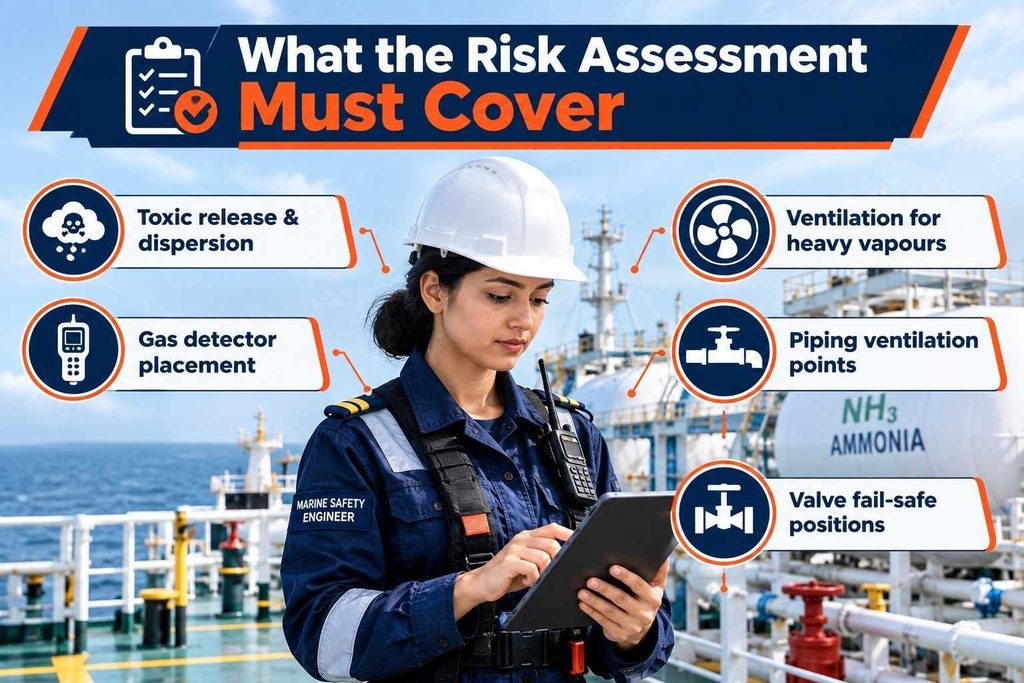
Section 2.5.1 makes the risk assessment the central compliance document for the entire system. It must cover the whole ammonia cargo as fuel system design and arrangement, document that it achieves the same safety level as natural gas, and also cover ammonia fuel arrangements installed within the cargo area itself.
The assessment must specifically address fuel leakage consequences, accounting for ammonia’s toxicity and corrosivity, and its potential to accumulate or escape into adjacent spaces. The annex lists over a dozen specific hazards the assessment must consider, including toxic releases and their dispersion, gas detector placement and suitability, ventilation arrangements given ammonia’s tendency to form vapours heavier than air, double-wall piping ventilation inlet and outlet locations, storage tank location risks, reactions between ammonia and water, drip tray and bilge contamination risks, and fail-safe positions for all remotely operated valves.
What Are the Space Arrangement Requirements?
Section 2.5.2 sets four requirements for spaces containing ammonia fuel consumers. Machinery spaces with ammonia-fuelled machinery must be gas-safe machinery spaces. A single failure of the fuel system in that space must not lead to a gas release within it. Fuel piping must be double-wall or ducted, with a continuous, gastight outer boundary; non-continuous double barriers are not permitted in the machinery space. Direct access from a space containing ammonia fuel consumers to a fuel supply system space or fuel preparation room is not allowed, in line with paragraph 3.2 of the IGC Code.
What Do the Fuel Supply Requirements Cover?
Section 2.5.3 covers nine specific requirements for the fuel supply system itself. Where liquid ammonia is supplied, venting and purging systems must drain to dedicated tanks or a gas-liquid separator, with heating arrangements considered for cold-area operation. Expansion joints and bellows should be minimised outside the cargo area, though engine-mounted joints may be accepted after evaluation. Where gaseous ammonia is supplied, provisions must prevent condensate from reaching the consumer, and direct release to atmosphere outside an emergency is not permitted.
Every fuel supply system needs an Ammonia Release Mitigation System (ARMS) capable of handling releases from bleed valves and from purging and draining operations. Where dedicated fuel tanks exist, pressure and temperature must stay within design range at all times under Chapter 7 of the IGC Code, and venting fuel vapour to control tank pressure is not acceptable outside emergencies. Ventilation inlets for double-wall piping must sit in a safe location outside the engine room, with outlets in a safe location within the cargo area; inerting the annular space is an accepted alternative to ventilation.
What Ventilation and Gas Detection Requirements Apply?
Section 2.5.4 requires the ammonia cargo as fuel preparation room to have independent access directly from the open deck wherever practicable, or an airlock compliant with paragraph 3.6 of the IGC Code where it is not. Openings to spaces with potential release sources must be arranged so gas cannot escape into inappropriately zoned spaces.
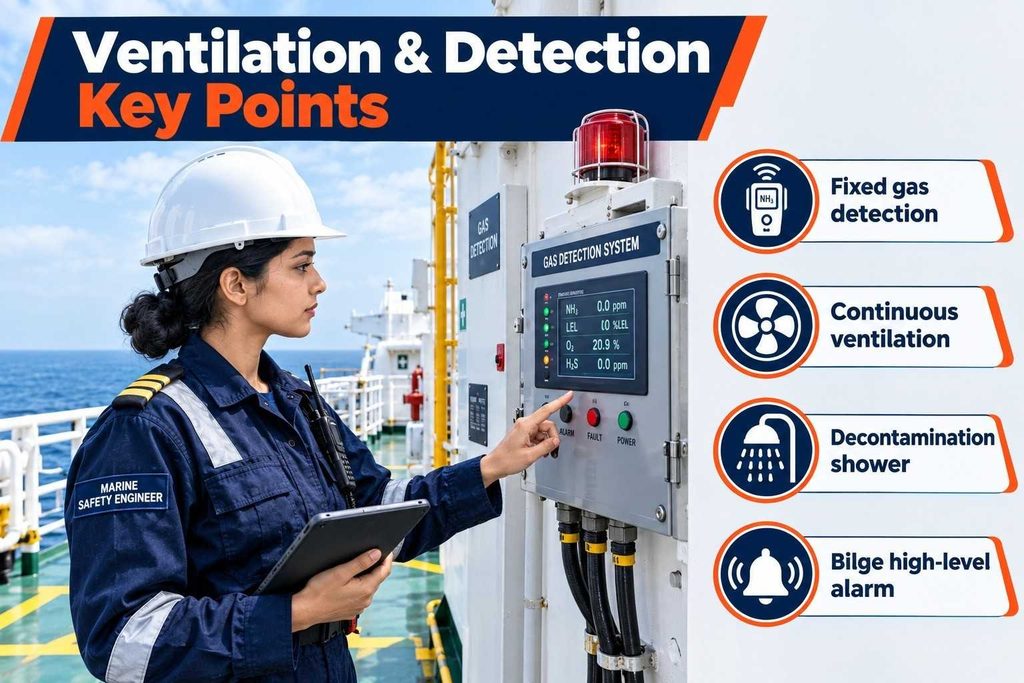
Special consideration must go to ammonia’s density, toxicity, corrosivity, and lower explosion limit, with ventilation capacity supported by numerical calculations such as computational fluid dynamics (CFD) analysis. A fixed ammonia gas detection system is required at locations specified in paragraph 13.6.2 of the IGC Code, plus additional fixed detection in enclosed spaces with fuel piping or handling equipment, ventilation inlets to accommodation and machinery spaces where the risk assessment calls for it, and ventilated annular spaces of double-wall piping. Portable detection equipment cannot substitute for a permanently installed system. Decontamination showers and eyewash stations must sit near ammonia fuel preparation room exits and in machinery spaces with ammonia fuel consumers, and the preparation room needs bilge wells with a high-level alarm, segregated from other bilge systems.
What Alarm and Shutdown Requirements Apply?
Section 2.5.5 requires remote stops at the locations specified in paragraph 16.5.2 of the IGC Code, plus an additional remote stop adjacent to ammonia fuel preparation rooms. Enclosed spaces with ammonia cargo as fuel equipment where personnel may be present need continuous gas detection, with an audible and visual alarm per paragraph 13.6.13 of the IGC Code. Alarm setpoints must follow a recognised standard and be approved by the Administration.
The leak detection system required under paragraph 16.4.2 of the IGC Code must be described in a documented safety concept, enabling continuous monitoring of the fuel piping system. The alarm and shutdown arrangement required under paragraph 16.4.8 must be determined through a risk assessment that specifically considers crew health and safety, with setpoints approved by the Administration against a recognised standard.
What Combustion Equipment Requirements Apply?
Section 2.5.6 requires a safety concept for every ammonia fuel consumer, approved by the Administration. Exhaust gases released to atmosphere must not present a health hazard at the point of release, and explosion venting must be directed away from areas where people are normally present.
Safety concepts must address both explosion hazards and toxic injury potential, documenting arrangements to prevent toxic injury specifically. The fuel supply system downstream of the master gas fuel valve must purge automatically outside the cargo area whenever that valve shuts on a safety action, with purged gas routed to the ARMS. A suitable, ammonia-compatible purging system must also be available for maintenance work. Gas turbines require a gastight enclosure unless the fuel supply piping meets the requirements of paragraph 16.4.3 of the IGC Code along with the additional requirements in these guidelines, with leakage consequences evaluated through the risk assessment. Operators comparing this to other alternative-fuel compliance tracks may find our LNG Bunkering Guidelines a useful reference, since both fuel types share similar fuel-supply and purging safety logic.
How Do These Guidelines Reach Indian-Flagged Ships?
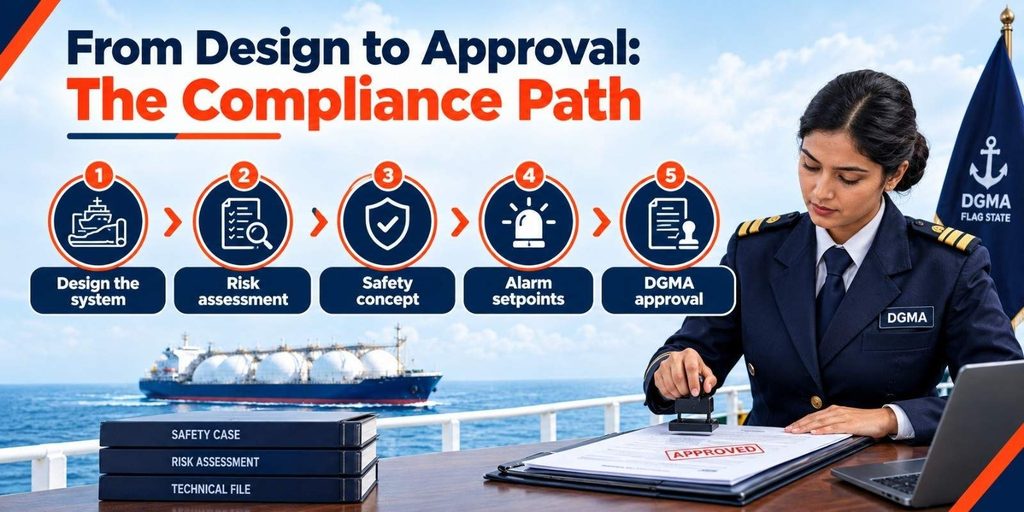
As India’s maritime regulator, the Directorate General of Maritime Administration (DGMA) is responsible for Administration-level approvals referenced throughout the annex, including risk assessment sign-off, alarm setpoint approval, and safety concept approval for ammonia fuel consumers. Owners and operators of Indian-flagged gas carriers should watch for a corresponding DGMA circular implementing MSC.1/Circ.1702 domestically, in the same way DGMA has issued implementing circulars for other IMO instruments. Our coverage of the DGMA approved bunker supplier list is a useful starting point for understanding how DGMA administers fuel-related approvals more broadly.
Frequently Asked Questions
How is MSC.1/Circ.1702 different from IMOs ammonia cargo as fuel guidelines?
MSC.1/Circ.1702 is used for gas carriers that burn ammonia while carrying ammonia cargo as fuel. It is used under the IGC Code. IMO has rules that deal with ammonia used as a bunkered fuel and those rules are for types of ships under the IGF Code.
Can an existing gas carrier be retrofitted to comply ors this for newbuilds?
An existing gas carrier can be changed to meet MSC.1/Circ.1702 if the ship can provide the required space and containment. However adding the needed systems when the ship is built is usually easier and cheaper.
Does the circular cover ammonia produced onboard through cracking or reforming?
No. MSC.1/Circ.1702 deals with ammonia that’s already on board as a cargo, either liquid or gas. Ammonia that is made on board by cracking or reforming is a technology. Is not covered by MSC.1/Circ.1702.
Is MSC.1/Circ.1702 expected to become a part of the IGC Code?
MSC.1/Circ.1702 is marked as “interim.” In practice that means the rules are used as a working draft until more experience is gained, before any permanent change, to the IGC Code is made.
Are any ammonia-fuelled gas carriers already operating under this framework?
A few new ammonia-fulled gas carriers were, under construction. They began service when the IGC Code change took effect in 2026.
What is the practical cost impact of complying with MSC.1/Circ.1702?
Meeting MSC.1/Circ.1702 means buying and installing safety equipment such as the Ammonia Release Mitigation System, double‑wall pipes and fixed gas detectors. MSC.1/Circ.1702 also requires a risk assessment and an approval process, all of which add to the cost.
Do these guidelines apply to LPG carriers or only to gas carriers using ammonia?
MSC.1/Circ.1702 applies to gas carriers that use ammonia cargo as fuel. LPG carriers are covered by IMO rules for LPG fuel.
Do the guidelines address gas carriers that also carry cargoes other than ammonia?
MSC.1/Circ.1702 focuses on ammonia cargo as fuel systems. If a ship carries cargoes too the owner must check MSC.1/Circ.1702 and also the IGC Code rules that apply to the other cargo.
Do these guidelines cover ammonia fuel cells or combustion‑based systems?
MSC.1/Circ.1702 talks about boilers, internal combustion engines, gas turbines and other combustion machines. It also says that other devices that are made to use ammonia as fuel are acceptable so fuel cell technology can be included even though it is not named directly.
Where can shipowners access the official text of MSC.1/Circ.1702?
Ship owners can read the full MSC.1/Circ.1702 text from IMO’s official documents or, from industry groups and classification societies that follow alternative‑fuel safety rules.