
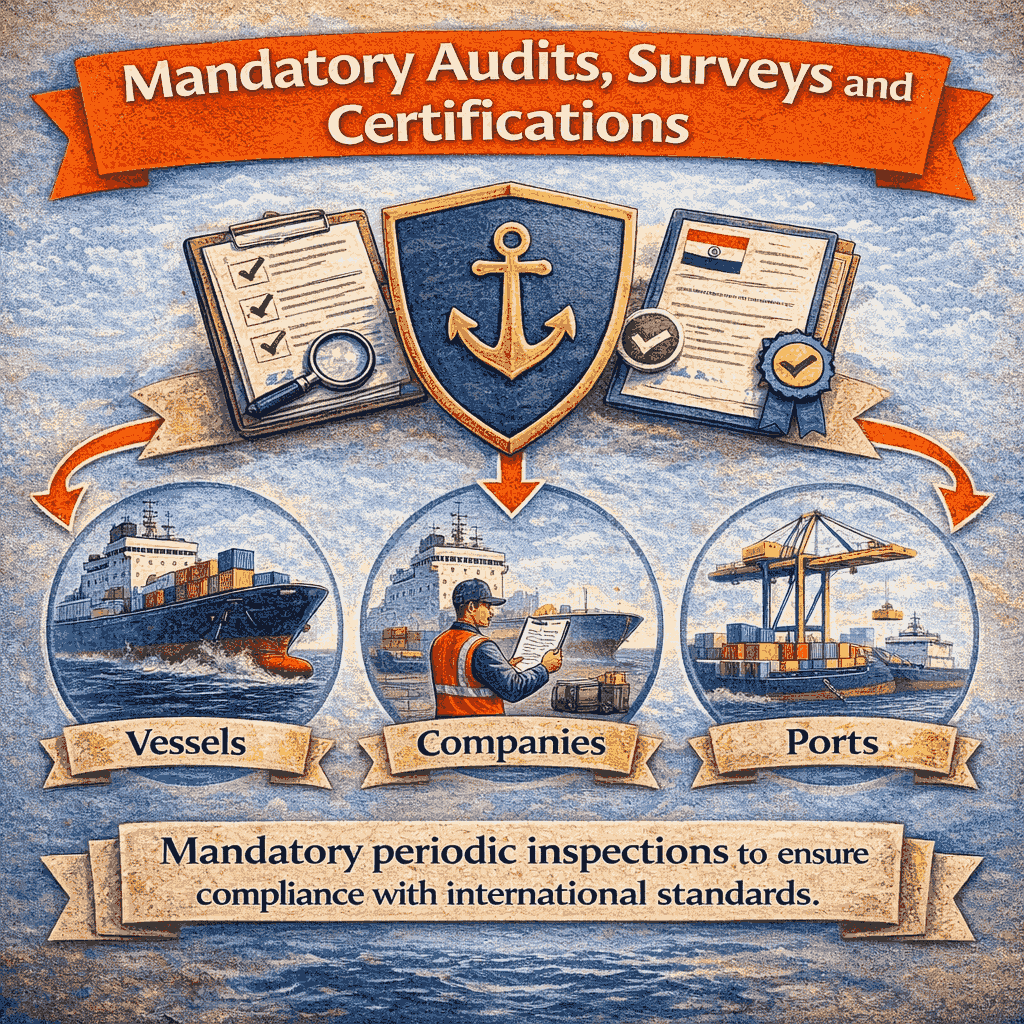
In the maritime industry, safety, environmental protection and order of things has become crucial and absolutely necessary. And with the growing number of ships, cargo & staff entering the workforce/industry it is more important than ever to follow through and keep the vessels safe and functioning. Regular audits, surveys & certification rules for vessels, companies & ports which help keep track of the things mentioned above, the MS, ACT 2025 lays out the framework for these procedures and expands on the importance of following them thoroughly.
To understand this better it is crucial to understand the preliminary of this act for the base knowledge and desertion and discipline rules to get a hold of the guidelines for similar check-ups for discipline on vessels, penalties and desertion rules for both authorities and seafarers.
This part not only defines when surveys must be conducted but also grants powers to surveyors and the central government to inspect vessels, demand information, suspend or cancel certificates, and ensure corrective action where violations are found.

Table of Contents
How do mandatory audits, surveys & certification rules affect vessels, ports & companies?
It is mandatory that every Indian vessel, company, or port must undergo survey, audit, or certification unless the government decides otherwise, depending on the type/class of vessel, company or port. This is to verify whether they comply with the international maritime conventions listed below:
- International Convention for the Safety of Life at Sea
- MARPOL Convention
- International Convention on the Control of Harmful Anti-Fouling Systems on Ships
- International Convention for the Control and Management of Ships’ Ballast Water and Sediments
- International Convention on Load Lines
- International Convention on Tonnage Measurement of Ships
- Special Trade Passenger Ships Agreement, 1971
- Convention on the International Regulations for Preventing Collisions at Sea
- International Convention on Maritime Search and Rescue
- Maritime Labour Convention
A surveyor or any person with the DGMA (Director General of Maritime Administration)’s permission can and has the ability to grant these certificates to those who have passed the survey conducted in accordance with the act. This is to ensure the maximum efficiency of the candidate and prevent fraud.
While these rules apply for vessels, companies and ports, anyone that is a medical professional looking to get a certification to enter the maritime workforce, here’s how to get DGMA’s approval as a doctor.
Once a vessel, company, or port has been surveyed or audited and granted certificates, no changes can be made to its structure, equipment, fittings, arrangements, materials, systems, or construction details without prior permission from the central government. This is important because any modification could affect safety or compliance with international conventions.
And if the central government suspects that the vessels have made changes/modifications to the structure, equipment etc. Then they have the right to
- Order a re-survey or re-audit,
- Modify, suspend, cancel, revoke, or require surrender of the certificate.
However, before taking such action, the concerned party will be given an opportunity to be heard.
No vessel is allowed to go to sea unless the required certificates and documents are kept onboard. This ensures that compliance is not just procedural but practically enforced before sailing.
There are also guidelines and new rules for registration of vessels under the same act, which is crucial and beneficial to the certification process.
What are powers of surveyors and guidelines for foreign certificates?
A surveyor can board a vessel at any reasonable time and inspect the:
- Structure
- Equipment
- Fittings
- Systems
- Stores
- CargoCertificates (including seafarers’ certificates)
However, the surveyor must not delay or hinder the vessel’s operation or voyage unnecessarily.
Surveyors have powers similar to a civil court under the Code of Civil Procedure, 1908, including summoning persons, examining them under oath, requiring document production and receiving evidence.
The owners or masters or anyone in charge of the ship must allow space for inspections, provide information about the vessel when asked for and be co-operative, if not, then the act will be considered a violation of rules and can result in penalties.
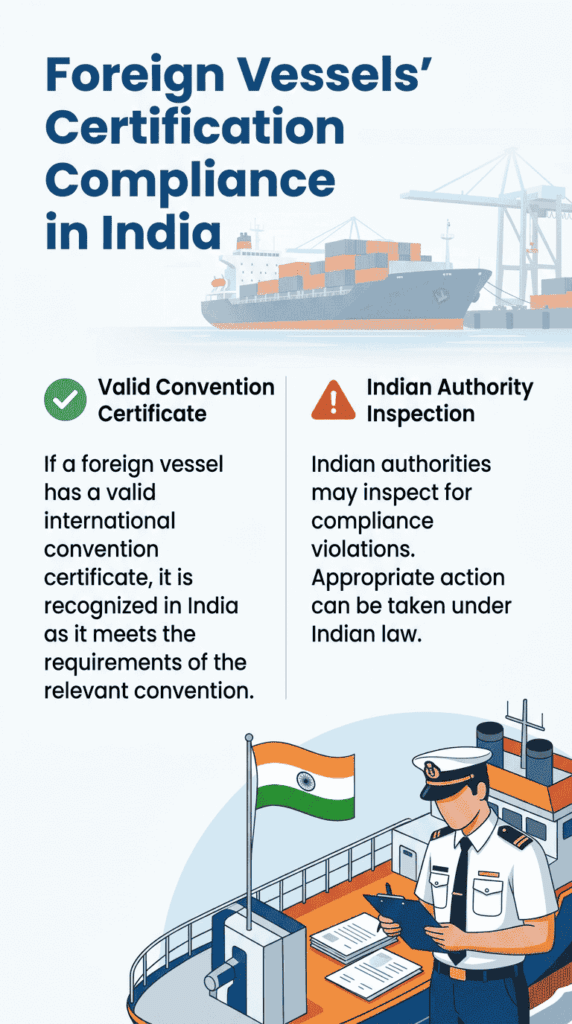
Foreign vessels holding certificates issued by their own government will be recognized by the Indian maritime government and if they follow the guidelines of any conventions mentioned above, this ensures that there is mutual agreement of acceptance between international waters and governments.
And if any of these said foreign vessels are in need of an Indian certificate then the authorities can grant it if their government has acknowledged it and has made a request on behalf of the ship. This can only happen if the said vessel meets the compliance standards. It must be made clear on the document that it was issued because of the request from the foreign government.
To go further into the certification procedure and topic, it’s beneficial to get a proper overview of how many certificates have been actually issued for all the sectors of the industry (workforce – seafarers, owners and authorities) one can refer to the STWC, certification statistics & trends as of 2025.
India may also request another country to issue a certificate for an Indian vessel, such a certificate will have the same legal effect as if issued by India itself. This supports international cooperation
What are the powers of central government & authorized personnel in these surveys and audits?
The central government and other authorized personnels have the power to ask the owners/master’s to provide information or any documents for the sake of inspection.
Central government can appoint inspectors to verify any sort of violations of the act/guidelines under this act regarding the audits/surveys/certifications, along with investigating upon a request from foreign contracting states and conduct inspections for other prescribed matters.
All and any violations of such guidelines, if witnessed, must be reported to the authorized personnel or the central government directly. Based on the report, the Government may take action or direct corrective steps.
The central government has the right and will have the power to make rules on the following topics in order to effectively implement this part of the act:
(a) The requirements for different classes of vessels, company or ports for survey, audit and certification
(b) The manner of re-survey, audit and certification of vessel, company or port and modification, revocation, suspension, cancellation or surrender of the certificates and documents
(c) The certificates to be possessed by a vessel, company or port
(d) Any other convention relating to survey, audit or certification
(e) Any other power of the surveyor or other person
(f) Any other matter for compliance of which inspections may be conducted
(g) The form and manner of report to be made to the Central Government
(h) Any other matter which is required to be or may be prescribed
Conclusion
This part of the MS act establishes a structured compliance system that ensures vessels, companies, and ports operate in accordance with national and international maritime standards. Through mandatory surveys, audits, and certification requirements, the law creates a mechanism to verify safety, environmental protection and labor compliance.
It empowers and enriches surveyors and the central government with strong enforcement authority, including inspection, suspension, and cancellation of certificates when necessary.
By aligning domestic enforcement with global maritime conventions, this Part strengthens India’s credibility in international shipping while safeguarding safety, environmental integrity, and operational accountability.
1. What does “company” mean according to this Act?
Under this Act, the term “company” has the same meaning as defined in Section 115(a). It generally refers to the organization responsible for the operation of a vessel, including the owner or any person or entity that has assumed responsibility for its management. This ensures accountability not only of ships but also of the entities operating them.
2. Do foreign vessels also have to face these audits and surveys?
Yes. Foreign vessels entering Indian waters must comply with applicable international conventions. While India recognizes valid convention certificates issued by their home country, authorities may still inspect such vessels to verify compliance. If violations are found, action can be taken under Indian law.
3. What is the Code of Civil Procedure, 1908?
The Code of Civil Procedure is an Indian law that governs the procedure followed by civil courts in handling legal disputes. Under this Act, surveyors are given powers similar to a civil court, such as summoning individuals, requiring document production, and examining witnesses under oath. This gives legal authority to investigations.
4. Why are these surveys conducted?
Surveys and audits are conducted to verify compliance with international safety, environmental, and labor conventions. They ensure that vessels are structurally sound, properly equipped, and operated responsibly. The goal is to prevent accidents, environmental damage, and unsafe working conditions at sea.
5. How long are these certificates valid for?
The validity of certificates depends on the specific convention and rules prescribed by the central government. Generally, certificates are valid for a fixed period and may require periodic renewal through re-survey or audit. They can also be suspended or cancelled if compliance is no longer maintained.
6. What is the Special Trade Passenger Ships Agreement, 1971?
The Special Trade Passenger Ships Agreement, 1971 is an international agreement that sets safety standards for passenger ships operating in specific trade routes, particularly in regions where large numbers of passenger’s travel under special conditions. It ensures enhanced safety requirements for such vessels to protect passenger welfare.
7. What will happen if a vessel, company, or port does not have these certificates?
A vessel cannot proceed to sea without the required certificates. Authorities may detain the vessel, suspend operations, or impose penalties. Certificates may also be cancelled or revoked. Continued non-compliance can lead to legal action and operational restrictions.
8. Why are regular surveys required for vessels under the MS Act, 2025?
Regular surveys ensure that vessels continue to comply with safety, construction, equipment, and environmental standards throughout their operational life. These inspections help detect structural defects, machinery failures, or safety risks early, hence preventing accidents and protecting both crew members and the marine environment.
9. What happens if a vessel fails to comply with survey requirements?
If a vessel fails to comply with mandatory certification or survey requirements, authorities may impose several regulatory actions. These may include suspension or cancellation of certificates, detention of the vessel at port, fines, or other legal penalties.
10. How do audits contribute to maritime safety and compliance?
Audits play an important role in ensuring that shipping companies and maritime operators follow established safety management and operational procedures. These audits examine documentation, crew training, maintenance practices, and operational systems to ensure compliance with maritime regulations.