
If you have ever asked what is DNS course in merchant navy, you are not alone. One of the most popular pre-sea courses in India, which many students opt for to become Deck Officers in merchant shipping, is the Diploma in Nautical Science (DNS). It is a short, focused, and government-approved course which takes a student from Class 12 straight onto a career at sea.
In this blog, we will explain the DNS course in simple terms, including its duration, eligibility, syllabus, fees, sponsorship, and career growth, so you can decide whether it is right for you.
What is DNS Course in Merchant Navy? (Quick Overview)
The Diploma in Nautical Science, or DNS, is a credential that sailors earn. It is a year-long residential training programme before sea, approved by the Directorate General of Maritime Administration (DGMA) (formerly known as DGMA Shipping). On completion of the diploma, students will be able to join a ship as a Deck Cadet, as they have been trained in navigation, seamanship and ship safety.
Most DNS courses are also associated with a DIY marvel known as Indian Maritime University (IMU). They can eventually progress into a B.Sc in Applied Nautical Science after the candidate has finished the necessary sea service. Here is the full list of maritime training courses approved by DG Shipping, so you will get a clear idea about the place of DNS in the other merchant navy training courses.
Why do Students Select the DNS Course?

Many students prefer DNS over a full 3-year degree course because it gets them to sea faster. This is why DNS is still the popular option:
- It is only 1 year of classroom and lab training, followed by sea time.
- It leads directly to a job as a Deck Cadet on a merchant ship.
- It is recognised by DGMA and accepted internationally under the STCW standards.
- It provides a clear progression towards becoming a Third Officer and subsequently a Second Officer, Chief Officer and Captain.
- Many institutes that offer DNS also assist with placement from sponsoring shipping companies.
Who Can Apply? DNS Course Eligibility Criteria
Check before applying if you are eligible for DNS course basics. The table below summarises the main requirements set by DGMA-approved institutes.
| Eligibility Criteria | Requirement |
| Educational Qualification | 10+2 (Class 12) with Physics, Chemistry, and Mathematics (PCM) |
| Minimum Marks | At least 60% aggregate in PCM (varies slightly by institute) |
| Age Limit | 17 to 25 years for general category; relaxation for reserved categories |
| Medical Fitness | Certificate from a DGMA approved doctor; 6/6 eyesight, no colour blindness |
| Marital Status | Candidate must be unmarried at the time of admission |
| Entrance Test | IMU-CET qualification or sponsorship from a shipping company |
| Other Documents | Valid passport recommended before joining the course |
If you are unsure whether your shipping company recruiter is genuine, you can always verify them through the list of registered RPSL companies on Indo Search before signing any sponsorship documents.
How Long Is the DNS Course, and What Is the Training Pathway?
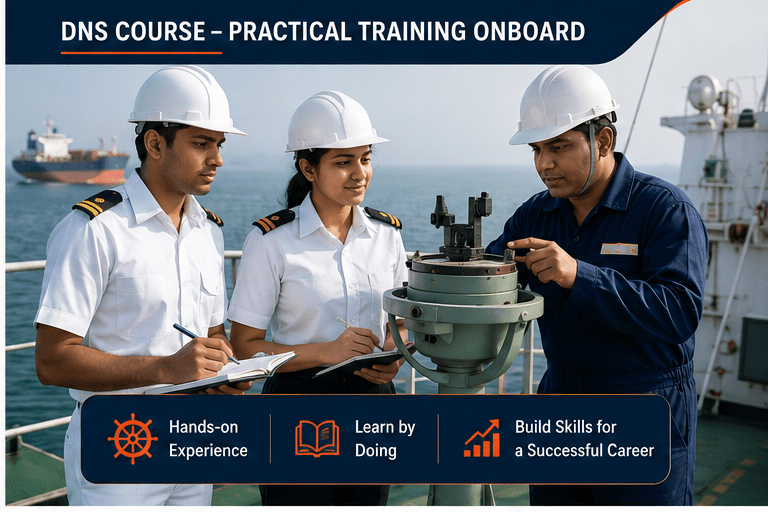
The complete duration from Class 12 to the average duration to become a Deck Officer is approximately 3 years. It consists of classroom training, sea training and a final exam for licensing.
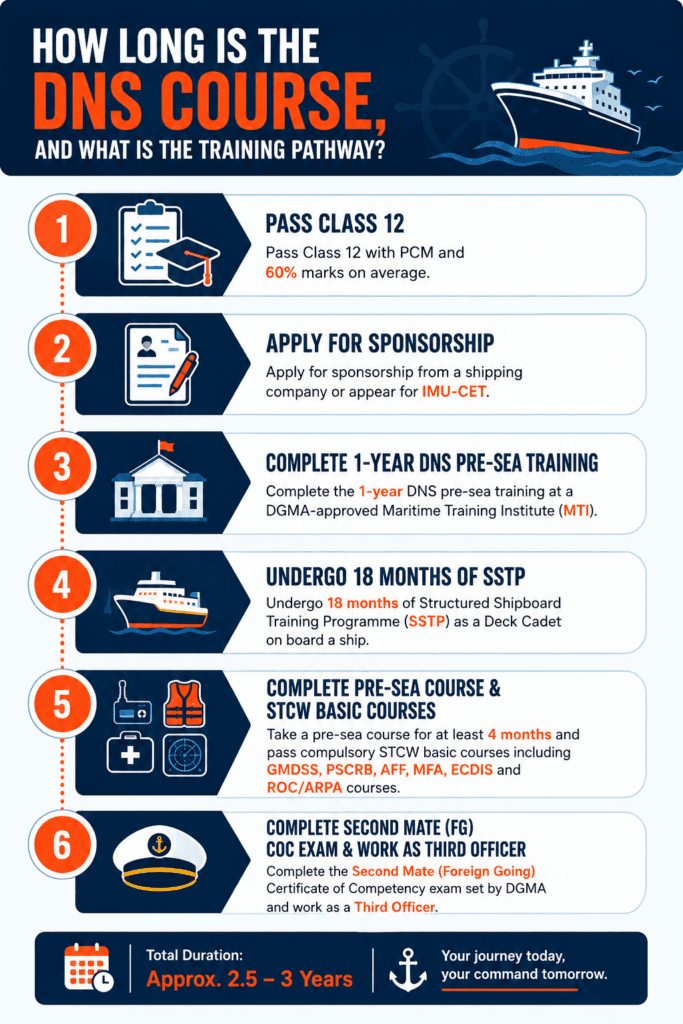
The step-by-step course sequence is outlined:
- Pass Class 12 with PCM and 60% marks on average.
- Apply for sponsorship from a shipping company or appear for IMU-CET.
- Complete the 1-year DNS pre-sea training at a DGMA-approved Maritime Training Institute (MTI).
- Undergo 18 months of Structured Shipboard Training Programme (SSTP) as a Deck Cadet on board a ship.
- Take a pre-sea course for at least 4 months and pass compulsory STCW basic courses including GMDSS, PSCRB, AFF, MFA, ECDIS and ROC/ARPA courses.
- Complete the Second Mate (Foreign Going) Certificate of Competency exam set by DGMA and work as a Third Officer.
To select the institute where you want to enrol for your DNS pre-sea training, you can check all the DGMA-approved maritime training institutes at Indo Search.
Which Subjects are covered in the DNS Syllabus?
The DNS syllabus is based on the International Maritime Organisation’s STCW (Standards of Training, Certification and Watchkeeping) requirements. Subjects are split across two semesters in the first year.
| Subject Area | What You Learn |
| Navigation | Chart work, position fixing, voyage planning |
| Seamanship | Ropes, anchoring, mooring, watchkeeping duties |
| Ship Stability | How cargo and ballast affect a ship’s balance |
| Meteorology | Reading weather patterns for safe voyages |
| Cargo Handling | Loading, securing, and discharging cargo |
| Maritime Communication | Radio procedures and signalling |
| Maritime Law | Basic rules and regulations at sea |
| Safety Training | Firefighting, first aid, and survival at sea |
This is comparable to the Deck Cadet pre-sea training programme because they both train for the same jobs in the deck department; only the DNS programme offers a diploma and a more defined path to a B.Sc degree.
Is Sponsorship Required for the DNS Course?
Yes, sponsorship by a shipping company is highly recommended, and often required at many institutes. Sponsorship involves a shipping company agreeing in advance to take you for sea training when you choose to complete your 1-year pre-sea course.
This is important because:
- Sea time is required to complete your certification.
- Sponsored candidates are generally guaranteed a seat on the plane!
- It decreases the chance of finishing the diploma without a ship to join.
- Shipping firms that sponsor include reputable names such as Anglo-Eastern, such as Fleet Management, MSC, Tolani Shipping, TORM, and V-Ships.
To verify if a shipping company is registered before accepting a sponsorship offer, visit the list of registered RPSL companies on Indo Search.
DNS vs B.Sc Nautical Science: Which One Should You Pick?
One of the most common questions students ask is a comparison between DNS and a 3-year B.Sc Nautical Science course. The result is the same (Deck Officer), but the structure differs.
| Feature | DNS (Diploma in Nautical Science) | B.Sc. Nautical Science |
| Duration | 1 year (Pre-sea training) | 3 years (Academic degree) |
| Sea Time Required | 18 months onboard as Deck Cadet | 12 months onboard as Deck Cadet |
| Time to 3rd Officer | 4 to 4.5 years (faster route) | 5 to 6 years |
| Initial Fees | ₹3.5 Lakhs to ₹8 Lakhs | ₹6.6 Lakhs to ₹18 Lakhs |
| Sponsorship | Mandatory before admission | Recommended, but direct admission is often possible |
| Career Flexibility | Highly specialized for seafaring | Broader academic base; easier transition to shore jobs |
To get more information on the course details of the Diploma in Nautical Science, one can directly find it on Indo Search.
How Much Does the DNS Course Cost?
DNS course fees depend on the type of institute and the facilities offered. Here’s a quick breakdown:
- Government campuses (IMU): ₹2,75,000 to ₹3,00,000 for the academic year
- Private maritime academies: ₹4,50,000 to ₹8,00,000, with premium institutes going up to ₹9,00,000
- Additional costs: ₹50,000 to ₹1,00,000 extra for IMU-CET fees, DGMA medical exams, uniforms, books, and safety gear
- What’s typically provided: Tuition, housing, uniforms, and initial training material
Since fees change often, confirm the latest figures directly with your shortlisted DGMA-approved maritime training institute rather than relying on outdated numbers online.
DNS course fees depend on the institute, hostel facility and training infrastructure. Fees will normally include tuition, accommodation, uniform or basic training material.
Since fee structures change often, it is best to confirm the latest fees directly with your shortlisted DGMA-approved maritime training institute rather than relying on outdated figures online.
What Career Growth Can You Expect After DNS?
Candidates study DNS and, upon finishing, embark on a career path as a Third Officer and work their way up with experience and additional exams. Career advancement is achieved through sea time and competency exams administered by DGMA.
A typical growth path is as follows:
- Deck Cadet
- Third Officer
- Second Officer
- Chief Officer
- Captain (Master Mariner)
Each promotion will be based on the candidate completing a certain number of sea service and passing a Certificate of Competency exam set by DGMA.
Top maritime institutes offering the Diploma in Nautical Science (DNS)
The top maritime institutes offering the Diploma in Nautical Science (DNS) course in India are primarily categorized:
| Institute Name | Location | Key Features & Placement Support |
| Anglo-Eastern Maritime Academy (AEMA) | Karjat | Highly coveted; provides 100% company-assured sponsorship and guaranteed placement with Anglo-Eastern fleets. |
| Tolani Maritime Institute (TMI) | Pune | Offers world-class, ship-in-campus training and collaborates with top global shipping companies. |
| Samundra Institute of Maritime Studies (SIMS) | Mumbai & Lonavala | Sponsored by Executive Ship Management (ESM); known for advanced simulators and strong industry ties. |
| HIMT College | Chennai (Kalpakkam) | A highly reputed institution in Tamil Nadu known for excellent infrastructure, ship-in-campus facilities, and strong international sponsorships. |
| Great Eastern Institute of Maritime Studies (GEIMS) | Lonavala | Backed by Great Eastern Shipping; features a highly structured training pipeline with excellent onboard placements. |
Why is DGMA Approval Important for DNS Courses?

DG Shipping has now been renamed the Directorate General of Maritime Administration (DGMA). But before you apply anywhere, understand why this approval is important:
- Your certificate will count! DGMA-approved training only is acknowledged as valid to gain a certificate of Competency, which is the required document to be able to work as a Deck Officer.
- It opens doors worldwide. DGMA certificate is accepted in any ship sailing in any flag other than in India, as the training has been approved by DGMA according to international STCW standards.
- Protects you against fake or unrecognised institutes. Maritime training has its share of unapproved players. Enrolling in one can mean wasting a year and still not being eligible to sail.
- It helps maintain your sponsorship! Shipping companies only sponsor candidates from DGMA-approved institutes, since they need assurance the training meets official standards.
- It’s an easy thing to verify. You don’t have to take an institute’s word for it. Check the official list of DG Shipping-approved maritime training courses on Indo Search before paying any admission fees.
Final Thoughts
For those who have done Class 12 with PCM subjects, the DNS course is a practical and quicker pathway into the merchant navy. It combines classroom learning with real sea training and leads to a respected career as a Deck Officer. Before enrolling in any institute, always check the approval by the DGMA and your sponsoring company through the Registered Companies List of RPSL on the Indo Search site; then you will begin your merchant navy journey on the right track.
FAQs
1. What is DNS Course in Merchant Navy?
DNS (Diploma in Nautical Science) is a 1-year pre-sea training course designed to prepare students to become Deck Officers in the merchant navy, and is recognised by the DGMA.
2. What is the eligibility for the DNS course after 12th?
The candidates have to be Class 12 passed with Physics, Chemistry and Mathematics (PCM) with a minimum 60% aggregate marks and are required to meet the medical fitness criteria as per DGMA.
3. What is the age limit for admission in DNS?
The age should be in the range of 17 to 25 years; relaxations apply according to the government rule for reserved categories.
4. Is sponsorship compulsory for the DNS course?
Sponsorship is not always legally compulsory, but most DGMA-approved institutes prefer or require it, since it guarantees sea training placement after the diploma.
5. What is the duration of the DNS course?
The classroom phase of DNS is 1 year, followed by 18 months of structured shipboard training, and the total pathway to becoming an officer is about 3 years.
6. Can a girl apply for the DNS course?
Yes, female candidates are also entitled to apply for DNS provided they fulfil the same academic, medical and age qualifications as other candidates.
7. What are the differences between DNS and B. Sc. Nautical Science?
DNS is a 1-year diploma, and you get to sea faster, whereas B.Sc Nautical Science is a 3-year degree course completed before sailing. Both are a path to the same Deck Officer career.
8. Does DNS lead to a B.Sc degree?
Yes, after completing sea training and the required IMU semester exams, DNS candidates can earn a B.Sc in Applied Nautical Science.
9. Is IMU-CET required for DNS admission?
IMU-CET is required for admission to IMU-affiliated DNS institutes, unless a candidate is admitted through direct company sponsorship.
10. What jobs can you get after DNS?
After DNS and the required sea service, candidates can work as Third Officer, Second Officer, Chief Officer, and eventually Captain on merchant ships.
11. Where can I find DGMA-approved institutes for the DNS course?
To find the complete list of maritime training institutes approved by DGMA for verified and approved maritime colleges, check Indo Search.