

If you are a ship owner, a shipping agent, a CHA, or someone getting into ship-breaking or coastal trade in India, then this one is for you. There is a very common misconception in the shipping industry that if a vessel is exempt from import duty, then no paperwork is needed. That is completely wrong. And it has cost the industry lakhs in penalties and adjudication notices.
The import of Indian vessels is strictly governed by the Customs Act, 1962, the Merchant Shipping Act, 1958, and a very specific circular called CBEC Circular No. 16/2012-Customs dated 13 June 2012. This circular makes one thing absolutely clear – even if you are not paying any duty, you still have to file the Import General Manifest (IGM) and the Bill of Entry. No exceptions.
Let us break this down properly.
What Does “Import of Indian Vessels” Even Mean?
This is the part most people get wrong from day one. When we say import of Indian vessels, we are not just talking about goods being carried on a ship. We are talking about the ship itself being treated as imported goods.
Under Section 2(25) read with Section 2(22) of the Customs Act, 1962, the word “imported goods” includes any vessel entering India from any place outside the country. So the moment a vessel crosses into Indian territorial waters for any purpose other than pure conveyance, it becomes goods under customs law.
And this changes everything. Because now three things kick in:
- You have to file an Import General Manifest (IGM) under Section 30
- You have to file a Bill of Entry for home consumption or warehousing
- You have to pay or claim exemption from applicable customs duty and CVD
To understand the base statute, you can check the Customs Act directly on the India Code portal. Also, if you are dealing with vessels regularly, it helps to understand how vessel age impacts safety, pollution control and insurance risk because that plays a role in valuation too.

What Is the Legal Framework Behind This?
The import of Indian vessels is not governed by just one law. It sits at the intersection of two statutes and one binding circular. Let us look at each one quickly.
Customs Act, 1962 – Section 2(22), 2(25) and Section 29
Section 2(22) defines “goods” so widely that vessels are covered. Section 2(25) says imported goods include vessels entering India from outside. Section 29 says foreign vessels can only arrive at notified customs ports.
Customs Act, 1962 – Section 30
This is the section that mandates the filing of the Import General Manifest (IGM). The person-in-charge of the vessel has to file this electronically on ICEGATE before or immediately upon arrival. And this is non-negotiable – even for a nil-duty vessel.
Merchant Shipping Act, 1958 – Sections 406 and 407
Section 406 deals with licences for Indian ships to be taken outside India. Section 407 deals with licences for chartering Indian or foreign ships for coastal trade. And of course, before an imported vessel can display the Indian flag, it has to be registered with the Mercantile Marine Department. You can read the full Act on the Director General of Maritime Administration (DGMA).
CBEC Circular No. 16/2012-Customs-
This is the operational instruction that ties everything together. Issued by the Central Board of Excise and Customs (now CBIC) on 13 June 2012, it clarifies exactly what has to be filed for each type of vessel. This is the circular field officers use when they hit you with an adjudication notice.
And while we are on the topic of maritime compliance, it is also worth knowing about audits, surveys and certifications under the MS Act 2025 because these interlink with customs filings during vessel inspection.

How Are Vessels Categorised for Customs Purposes?
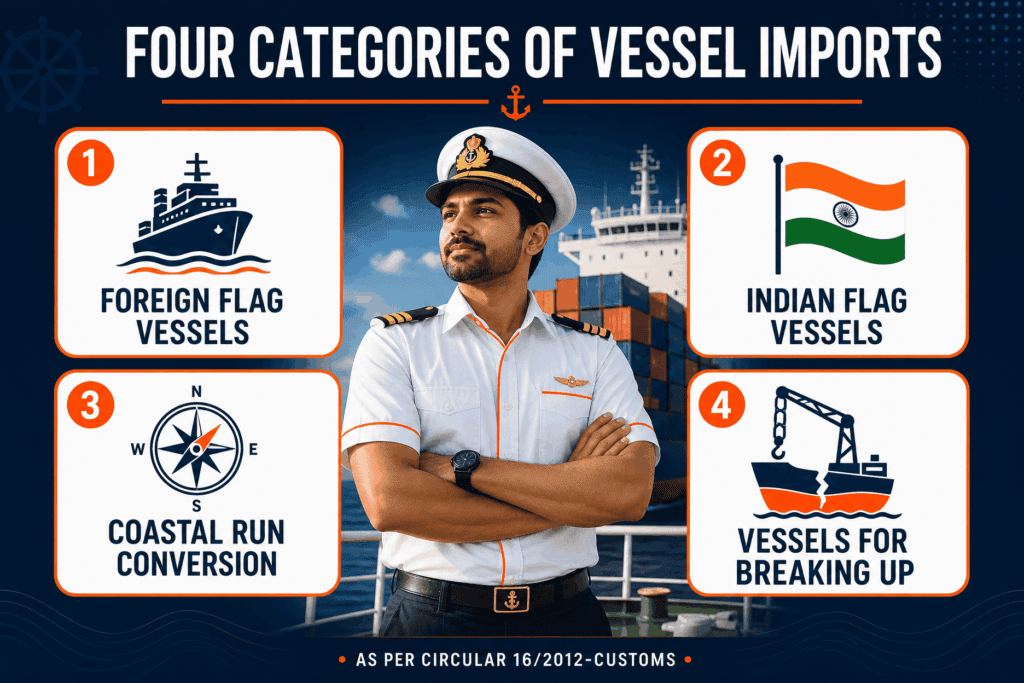
CBEC Circular 16/2012 splits the import of Indian vessels into four clear categories. This table is the single most important thing to bookmark from this blog.
| Vessel Category | IGM Needed? | Bill of Entry Needed? | Duty Position |
| Foreign Flag Vessel (used as conveyance) | No For vessel; Yes For cargo/passengers | No | No duty on the vessel |
| Indian Flag Vessel (first-time entry) | Yes | Yes | Exempt, but must file |
| Vessel converted to coastal run | Yes | Yes(Fresh BoE at conversion) | CVD payable |
| Vessel imported for breaking up | Yes | (Initial + fresh at breaking) | Duty applicable |
Let us now look at each of these one by one.
What About Foreign Flag Vessels?
A foreign-flag vessel is a ship that is registered outside India and enters Indian waters only to carry imported or exported cargo or passengers during its foreign run. Since the ship is being used purely as a conveyance, you do not need to file an IGM or a Bill of Entry for the vessel itself.
But there is a catch. You still have to file an Import General Manifest for the cargo and passengers on board under Section 30 of the Customs Act. If you skip that, penalties under Section 116 of the Customs Act kick in immediately.
This is where shipping lines, steamer agents, and NVOCCs need to be very careful. The vessel is exempt, but the manifest for what it carries is not.
What About Indian Flag Vessels Entering India for the First Time?
This is the heart of the importance of the Indian vessels framework.
When a vessel enters India for the first time to be registered as an Indian flag vessel with the Mercantile Marine Department, the vessel itself is treated as imported goods. That means:
- Registration under Part-V of the Merchant Shipping Act, 1958, requires the ship to be Indian
- Both the IGM and the Bill of Entry have to be filed with the jurisdictional customs authority
- The vessel is fully exempt from import duty under Serial No. 461 of Notification No. 12/2012-Cus dated 17.03.2012 (if it falls under Heading 8901)
- But the exemption does not waive the filing requirement
So what you have to do is file the Bill of Entry and claim the exemption on it. You cannot skip the Bill of Entry and assume the exemption applies automatically. Many first-time Indian flag registrations have got stuck because the operator assumed nil duty meant nil filing.
If you are also planning to place workers on such a vessel, do check out the rights and rules for seafarers under the MS Act 2025 so that crew paperwork is also in order.
You can also check this: Convert a Foreign Vessel to an Indian Flag Easily
What Happens When a Vessel Is Converted for Coastal Run?
A coastal run or coastal trade is basically a voyage between two or more Indian ports. And any vessel – Indian flag or foreign – can be used for coastal trade only after getting a licence under Section 407 of the Merchant Shipping Act, 1958, from the Director General of Maritime Administration (DGMA).
At the time of this conversion, three things happen simultaneously:
- A fresh Bill of Entry has to be filed at the point of conversion
- Countervailing Duty (CVD) becomes payable under Serial No. 306 of Notification No. 12/2012-Cus
- The earlier exemption enjoyed as a foreign-going vessel ceases to apply
Now the interesting part. CVD on such conversions was originally imposed from 01.03.2011. But then, retrospective exemption was given for the period 01.03.2011 to 16.03.2011 through Clause 129 of the Finance Act, 2012. So from 17.03.2012 onwards, CVD is strictly applicable, and Circular 16/2012 makes it very clear that field officers must insist on IGM and Bill of Entry filing from that date.
If your vessel is used in both foreign and coastal runs alternately, then every switch technically triggers a fresh filing.
What About Vessels Imported for Breaking Up?
Ship-breaking is a huge industry in India, especially at Alang in Gujarat. And the import of Indian vessels for breaking up carries some very specific filing duties.
Here is the two-stage requirement:
- At the time of initial import, file the IGM and Bill of Entry, claiming exemption under Heading 8901 if applicable
- At the time of actual breaking – file a fresh Bill of Entry and pay the applicable duty
The exemption under Serial No. 461 of Notification No. 12/2012-Cus specifically excludes vessels imported for breaking up. So duty will be payable – the question is only when.
Skipping the initial filing on the assumption that “the ship will be broken anyway” is one of the most litigated errors in this segment. Do not do it.
Also, if you are operating in the ship-breaking or salvage space, it is worth knowing the criteria for empanelment and retention of salvors because that ties into how such vessels are handled after import.
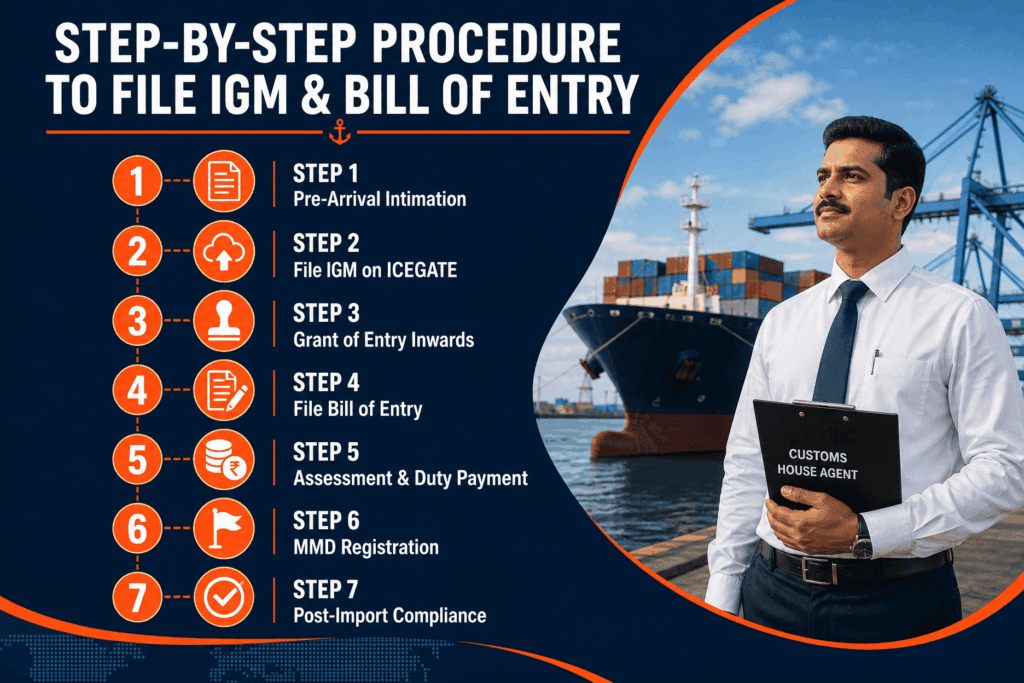
Step-by-Step Procedure to File IGM and Bill of Entry
Now that you know the categories, let us walk through the actual procedure for the import of Indian vessels. This is the practical workflow.
Step 1 – Pre-Arrival Intimation
The shipping agent notifies Indian customs about the vessel’s expected arrival at the port.
Step 2 – File the IGM on ICEGATE
The person-in-charge or the shipping agent files the Import General Manifest electronically through the ICEGATE portal, within the timelines mandated by Section 30 of the Customs Act. Advance IGM filing is encouraged.
Step 3 – Grant of Entry Inwards
The proper officer grants Entry Inwards. This is important because the rate of duty applicable to the vessel is fixed on this date.
Step 4 – File the Bill of Entry
The importer or the Customs House Agent (CHA) files the Bill of Entry, declaring the vessel, its HS code (usually Heading 8901 or 8908), and the specific exemption serial number being claimed.
Step 5 – Assessment and Duty Payment
Customs assesses the Bill of Entry. Duty or CVD is paid, or the exemption is granted based on the notification quoted.
Step 6 – Registration with the Mercantile Marine Department
For Indian flag registration, complete the Part-V formalities under the Merchant Shipping Act, 1958.
Step 7 – Post-Import Condition Compliance
If you claimed exemption at the initial import, you must file the fresh Bill of Entry at the time of coastal conversion or breaking. Missing this step is where the trouble usually starts.
What Are the Duties and Exemptions Under Notification No. 12/2012-Cus?
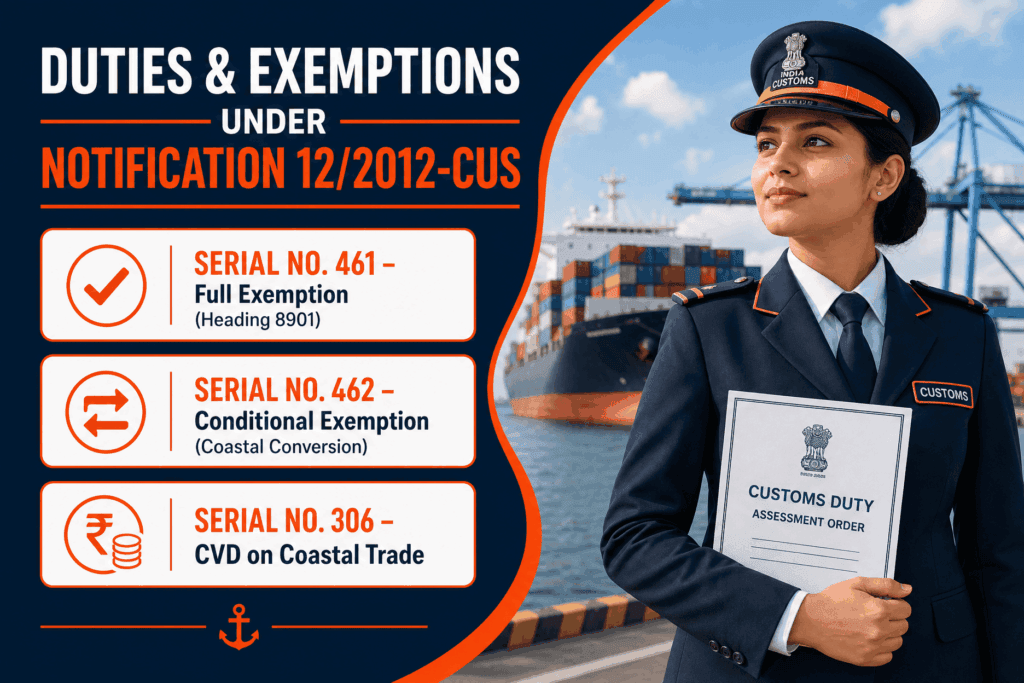
The whole duty position for the import of Indian vessels revolves around three key serial numbers of Notification No. 12/2012-Cus dated 17.03.2012.
| Provision | Applies To | Effect |
| Serial No. 461 | Vessels under Heading 8901 (transport of persons or goods), excluding those imported for breaking up | Full exemption from import duty, subject to filing a fresh Bill of Entry at breaking |
| Serial No. 462 | Foreign-going vessels are being converted to coastal run | Conditional exemption; fresh Bill of Entry and CVD payable at conversion |
| Serial No. 306 | Vessels used for coastal trade | Excise duty / CVD applies |
Notice the pattern – every exemption is conditional. The condition is always the same: file the fresh Bill of Entry when the trigger event happens. If you do not, the department can recover the entire duty foregone along with interest and penalty.
The full notification is available on the CBIC official notifications page.
What Happens If You Do Not File the IGM or Bill of Entry?
This is where things get serious. Paragraph 6 of Circular 16/2012-Customs specifically directs field formations to adjudicate all past cases where the IGM or Bill of Entry was not filed at the time of import, first arrival, or coastal conversion. And field officers actively use this circular.
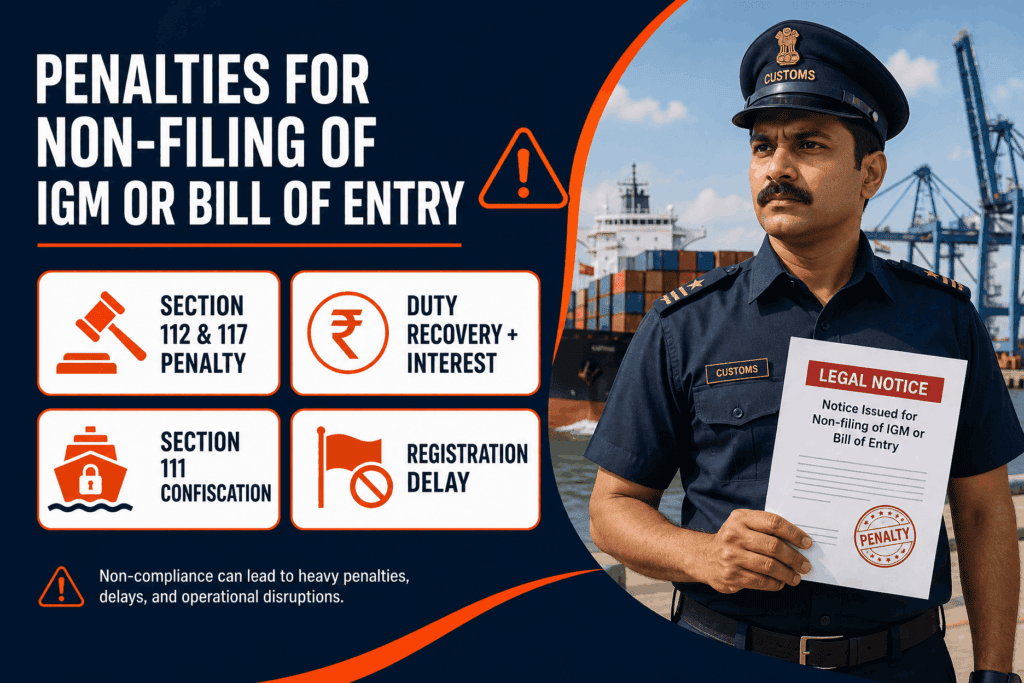
Here is what you can be hit with:
- Penalty under Section 112 and Section 117 of the Customs Act
- Recovery of duty foregone along with interest
- Confiscation of the vessel under Section 111 of the Customs Act
- Recovery of CVD from 17.03.2012 onwards for coastal-converted vessels
- Delay or refusal of Indian flag registration formalities
The bottom line is simple. Exemption from duty is not an exemption from procedure. The Board could not have said it more clearly.
Also, if you are in the vessel operations space, it helps to be aware of the DGMA shipping order on blacklisted vessels because non-compliance in customs filings can indirectly impact your standing in such lists, too.
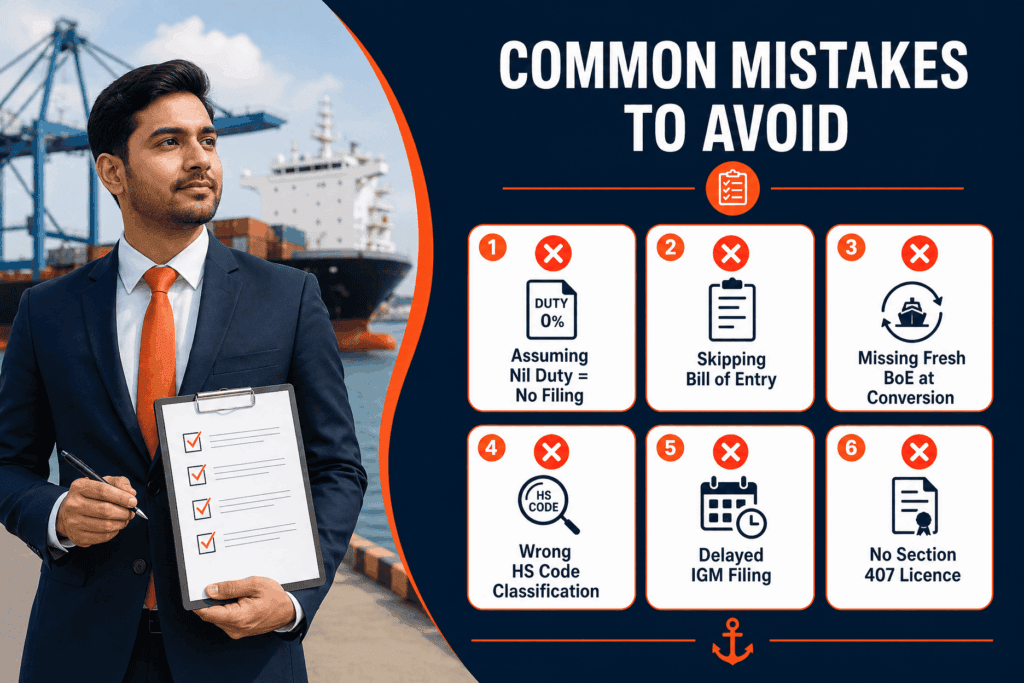
Common Mistakes People Make and How to Avoid Them
Based on real cases seen in the field, here are the recurring compliance failures during the import of Indian vessels:
- Assuming that nil duty means no filing is required
- Filing the IGM but forgetting the Bill of Entry
- Missing the fresh Bill of Entry at the coastal conversion
- Not paying CVD post-17.03.2012 on converted vessels
- Skipping the Section 407 licence from the DG Shipping
- Misclassifying breaking-up vessels under Heading 8901 instead of 8908
- Delayed IGM filing beyond Section 30 timelines
- Quoting the wrong exemption serial number on the Bill of Entry
- Not maintaining supporting documents for the exemption claim
Every one of these is fully avoidable with a structured pre-import checklist. If you are entering the space fresh, also look into maritime technical consultancy for RPSL and startups in India, so that all your related licences are in order, too.
Quick Summary: What You Must Remember
If you take away only five things from this blog, make it these:
- The import of Indian vessels treats the ship itself as imported goods, not just the cargo on it.
- IGM and Bill of Entry must be filed for Indian flag vessels, vessels for coastal conversion, and vessels for breaking up – even if duty is nil.
- Foreign-flag vessels as conveyance need no IGM or Bill of Entry for the vessel, but do need an IGM for the cargo they carry.
- CVD is payable on vessels converted to coastal trade from 17.03.2012 onwards.
- Skipping the fresh Bill of Entry at coastal conversion or breaking triggers full duty recovery with interest and penalty.
Conclusion
The import of Indian vessels is one of those areas where the biggest risk is not the duty amount; it is the procedure. CBEC Circular No. 16/2012-Customs made it crystal clear more than a decade ago – whether the vessel comes in as a foreign flag conveyance, gets registered as Indian flag for the first time, is converted for coastal trade, or is brought in for breaking up, the IGM and Bill of Entry filings are mandatory. Duty exemption is always conditional on filing; it is never a substitute for it.
If you are planning the import of Indian vessels, or if you are dealing with an adjudication notice for past non-filing, the key is to treat the paperwork as seriously as the duty payment itself. Bookmark the four-category table from this blog, follow the seven-step procedure, and keep your Bill of Entry conditions in check right through to coastal conversion or breaking. That is how you keep field officers away from your fleet.
For more such deep dives into Indian maritime regulations, shipping orders, and compliance updates, keep checking the IndoSearch Learn portal.
FAQs about the Import of Indian Vessels
Is an IGM mandatory even if the vessel is exempt from import duty?
Yes, absolutely. Under CBEC Circular No. 16/2012-Customs, exemption from duty does not exempt the importer from filing the IGM and Bill of Entry. Filing is a procedural obligation that is entirely independent of duty liability. Field officers will still issue adjudication notices for non-filing.
Who is responsible for filing the IGM for the import of Indian vessels?
The person-in-charge of the vessel – typically the master of the ship or the appointed shipping agent – is responsible under Section 30 of the Customs Act, 1962. For the Bill of Entry, the importer or the Customs House Agent files it on behalf of the importer through ICEGATE.
What is the difference between a foreign-flag vessel and an Indian flag vessel for customs?
A foreign-flag vessel is registered outside India and used as a conveyance – no IGM or Bill of Entry is filed for the vessel itself, only for its cargo. An Indian flag vessel entering India for first-time registration is treated as imported goods, and both IGM and Bill of Entry are mandatory.
When is Countervailing Duty (CVD) applicable to vessels?
CVD applies to vessels being converted for coastal trade from 17.03.2012 onwards, as per Serial No. 306 of Notification No. 12/2012-Cus. A fresh Bill of Entry has to be filed at the time of conversion, and CVD paid on that fresh assessment.
What happens if a vessel is imported for breaking up?
The importer has to file the IGM and Bill of Entry at the initial import, claiming any exemption available. Then, at the time of actual breaking up, a fresh Bill of Entry has to be filed and the applicable duty paid. Both filings are mandatory – skipping either triggers a penalty.
What is the deadline to file the IGM for a vessel?
Under Section 30 of the Customs Act, the IGM must be filed electronically before or immediately upon arrival of the vessel at an Indian customs port. Advance IGM filing through ICEGATE is strongly encouraged to avoid demurrage and clearance delays.
Can the Bill of Entry be filed before the vessel arrives?
Yes. An Advance (Prior) Bill of Entry can be filed up to 30 days before the vessel’s arrival. This allows customs to complete pre-assessment and gives you a much smoother clearance once Entry Inwards is granted.
Which notification governs the duty exemption for the import of Indian vessels?
Notification No. 12/2012-Cus dated 17.03.2012 is the key notification. Serial No. 461 covers transport vessels under Heading 8901, Serial No. 462 covers foreign-going vessels being converted, and Serial No. 306 covers CVD on coastal trade vessels.
What penalties apply for non-filing of the IGM or Bill of Entry?
Penalties can be levied under Sections 112, 116 and 117 of the Customs Act, along with recovery of duty foregone with interest. In serious cases, the vessel can be confiscated under Section 111. Adjudication proceedings are specifically directed by Paragraph 6 of Circular 16/2012.
Where can I learn more about maritime compliance for Indian ship owners and operators?
You can explore the full range of maritime compliance topics – DGMA orders, MS Act 2025, RPSL, seafarer rights, vessel safety, and much more – on the IndoSearch Learn portal. Every important circular and shipping regulation is broken down in plain English there.