
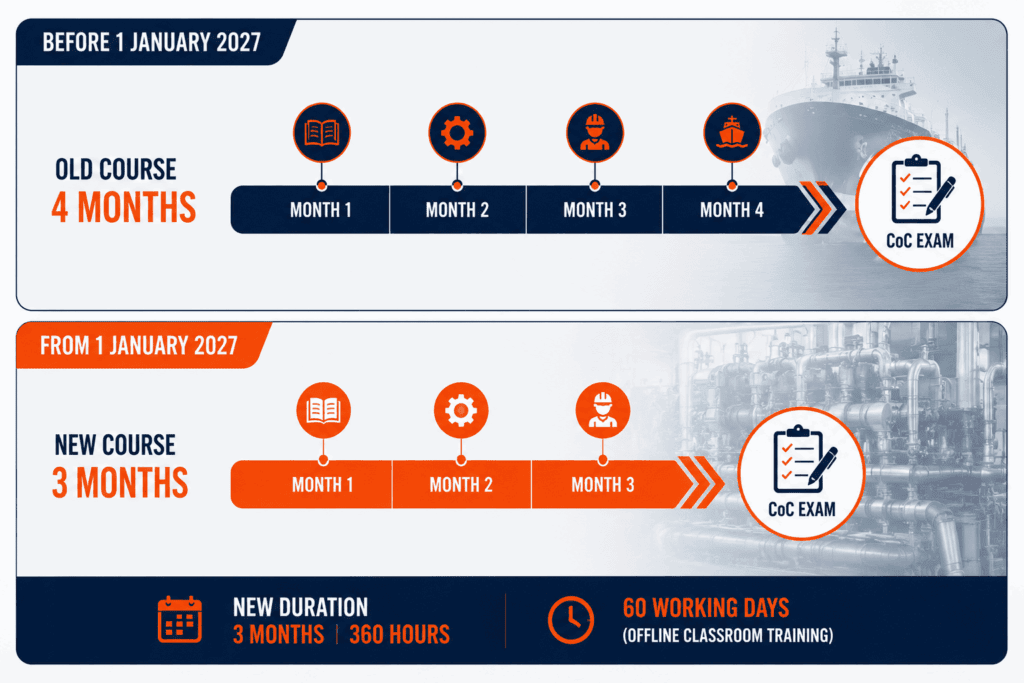
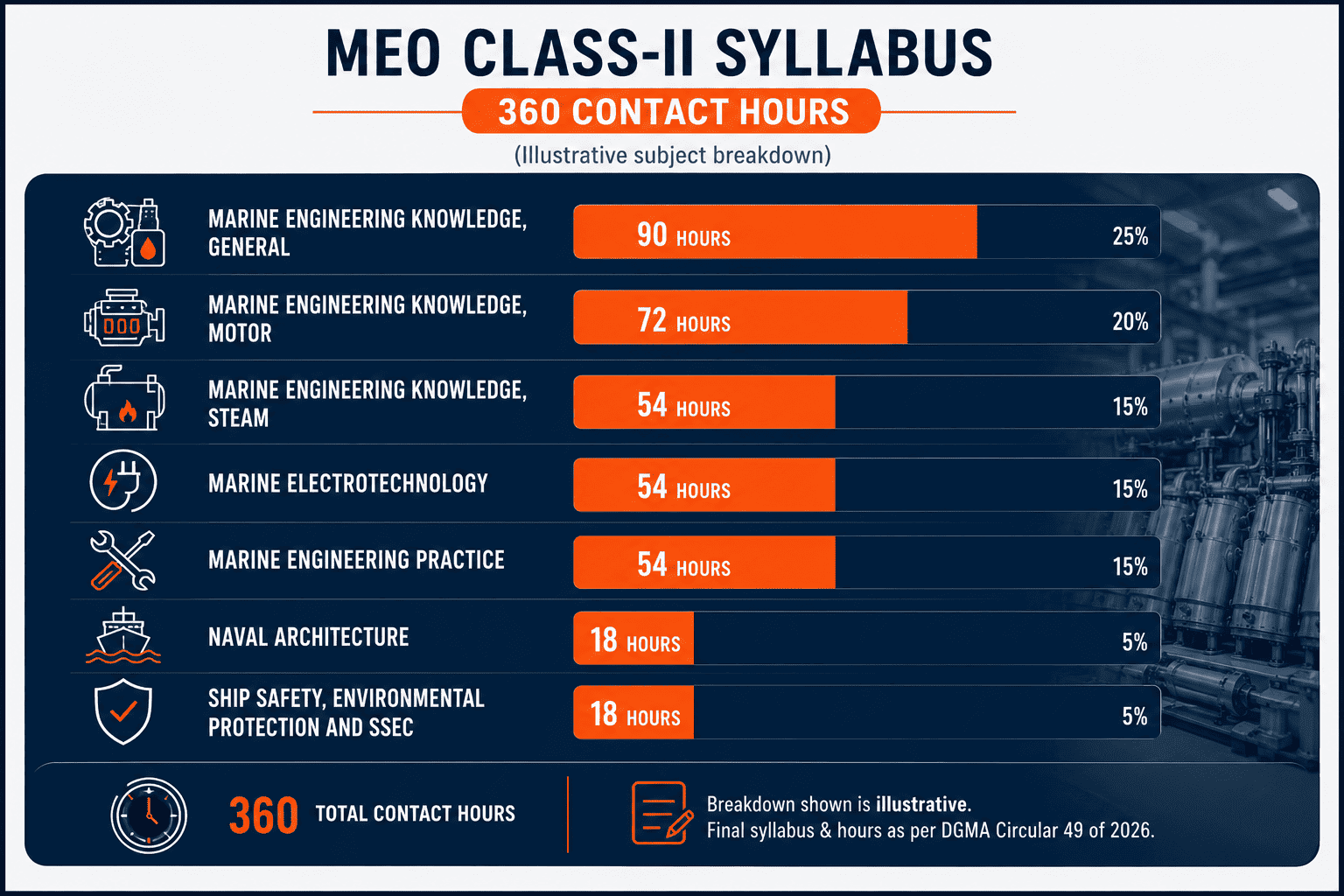
DGMA’s revised MEO Class-II preparatory course syllabus, laid out in Annexure II of Circular 49 of 2026, now runs three months instead of four, or 360 contact hours, for batches starting on or after 1 January 2027. It stays aligned with STCW Regulation III/2 but adds alternative fuels, autonomous ship awareness, digital maintenance and cyber-risk content.
Unlike the MEO Class-IV and ETO courses, which are entirely new requirements, MEO Class-II was already a mandatory preparatory course. What changed here is the duration and the depth of the syllabus, not whether you need to attend one at all. For the eligibility rules and how this fits with the other three courses, our MEO and ETO preparatory course requirements guide has the full picture.
Who Is the MEO Class-II Preparatory Course For?
This course prepares candidates for the Second Engineer Officer Certificate of Competency on ships powered by main propulsion machinery of 3000 kW and above. That power threshold matters. It’s what separates MEO Class-II from the lower-tonnage engineering tickets, and it’s why the syllabus sits at management level rather than the operational level content taught in the MEO Class-IV preparatory course syllabus.
The syllabus is built around STCW Regulation III/2 and Section A-III/2, plus the associated Tables of Competence for management-level engineers.
What’s Changed in the Revised MEO Class-II Syllabus?
Here’s the duration shift in one table.
| Aspect | Before This Revision | From 1 January 2027 |
| Duration | 4 months | 3 months |
| Contact hours | Not specified in the earlier framework | 360 hours |
| Working days | Not specified in the earlier framework | 60 working days |
| Applies to | Candidates already admitted to a batch before 1 January 2027 | Batches starting on or after 1 January 2027 |
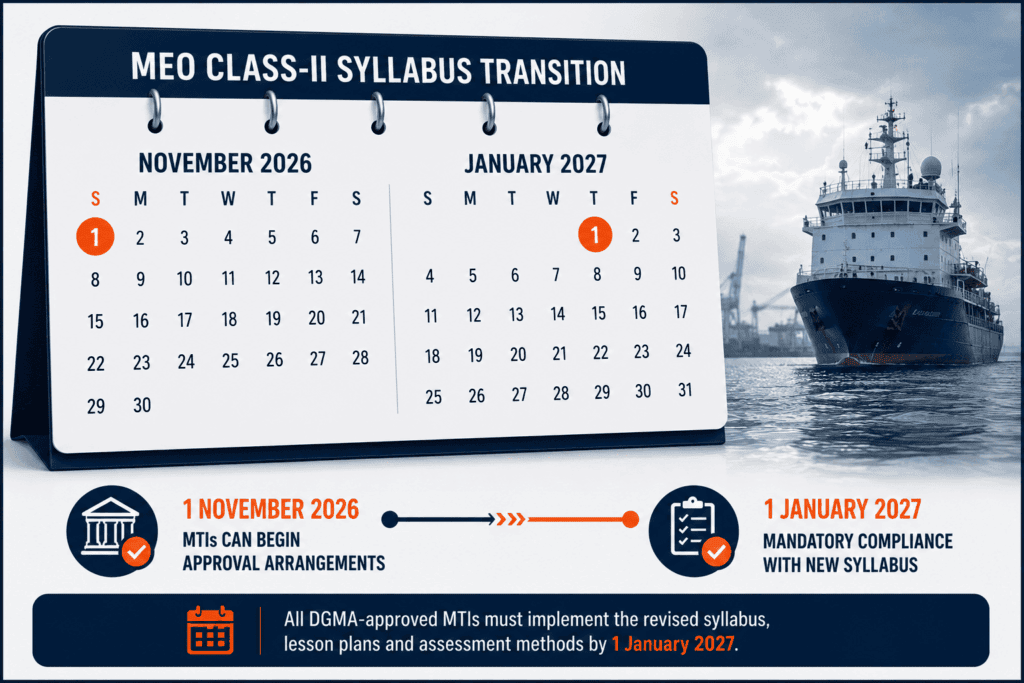
If you’re already partway through a four-month batch when the new date arrives, nothing changes for you. You finish under the syllabus and duration you started on. The compressed three-month format only kicks in for batches that begin on or after 1 January 2027, and every DGMA-approved MTI running this course has to switch its curriculum, lesson plans and internal assessment methods over by that date.
What New Topics Did DGMA Add to the MEO Class-II Syllabus?
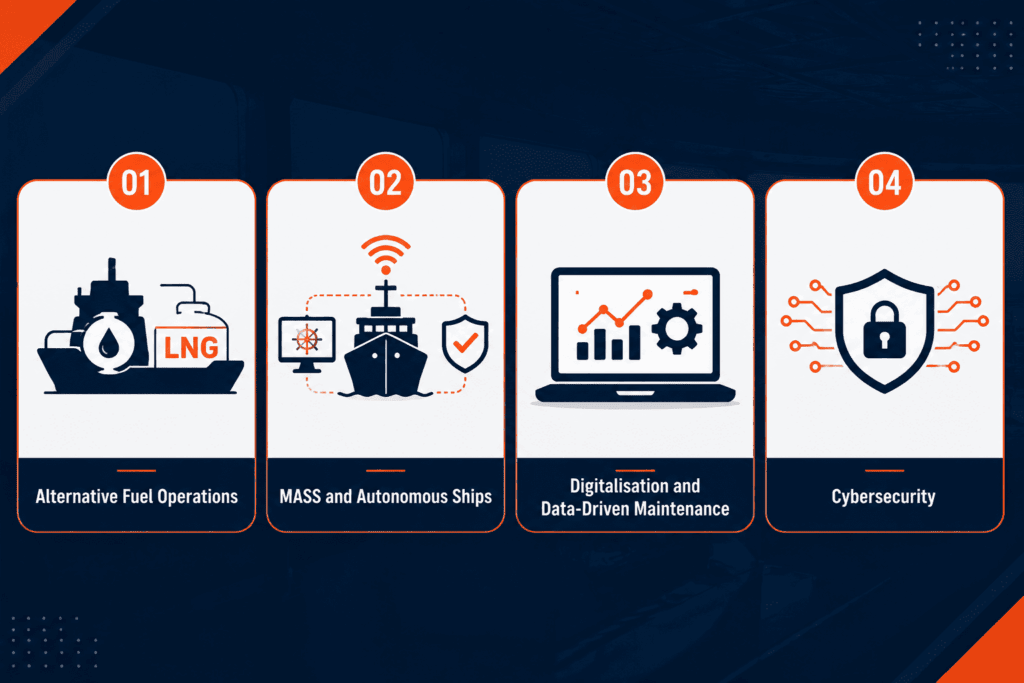
Four subjects are genuinely new additions rather than expansions of existing content, and they’re worth knowing about even if you sat the old syllabus once before and are returning for a repeat attempt.
| New Topic | Where It Sits | What It Covers |
| Alternative Fuel Operations | Marine Engineering Knowledge, General | System-level understanding, bunkering procedures, hazards and safety layers for methanol, ethanol, ammonia and hydrogen |
| MASS and Autonomous Ships | Marine Engineering Knowledge, General | Remote monitoring and fail-safe considerations for autonomous and remotely operated machinery |
| Digitalisation and Data-Driven Maintenance | Marine Engineering Practice | Predictive analytics, digital twins and electronic logbooks |
| Cybersecurity | Marine Electrotechnology | Shipboard cyber-risk assessment, control system vulnerabilities and incident response |
What Does the Marine Engineering Knowledge (General) Section Cover?
This is the largest section of the syllabus, and candidates should expect examiners to ask for freehand sketches here more than anywhere else in the paper.
- Materials technology: metallurgy of steel and cast iron, ferrous and non-ferrous material properties, destructive and non-destructive testing, welding processes
- Fuel and lubricant chemistry: properties and characteristics, shore and shipboard sampling, contamination including microbiological infection, storage, centrifuging and blending
- Alternative fuel operations, as covered above
- Instrumentation: construction, principles and performance assessment of gauges, meters and monitoring devices used throughout the engine room
- Auxiliary machinery: pumps, piping systems, air compressors, waste heat recovery, purifiers and oily water separators
- Shafting and propulsion hardware: thrust blocks, bearings, stern tubes, propellers, shipside fittings
- Steering gear and stabilisers
- Refrigeration, air conditioning and deck machinery
- Auxiliary boilers, steam plant and auxiliary compression ignition engines
- Turbo-electric, diesel-electric and gas turbine drives
- Start-up and shutdown procedures for auxiliary machinery, including air compressors, hydraulic systems, boiler water testing and treatment, and evaporators
- Automatic control mechanisms for generator distribution, oil purifiers, refrigeration, pumping systems, steering gear and cargo-handling equipment
- Shipboard personnel and resource management, plus emergency preparedness
- MASS and autonomous ships, as covered above
What Does the Motor Engineering Section Cover?
For candidates sailing on motor vessels, this section goes deep into the design and diagnostic side of diesel machinery, well beyond the operational knowledge tested at Class-IV level.
- Design features and operating mechanisms of diesel engines, gas turbines and marine steam boilers
- Propulsive characteristics: speed, output, fuel consumption and operating limits
- Safe operation and surveillance of the main propulsion plant, including shaft power determination
- Engine component stresses and fabrication methods, including welding, forging and use of composite materials
- Balancing, torsional vibration and critical speed management
- Wear-pattern calibration of pistons, liners, bearings and crankshafts
- Lubrication distribution, contamination sources and testing methods
- Fuel injection systems, including common rail technology, dual-fuel operation, and SOx and NOx reduction methods
- Scavenging, supercharging and turbocharger fault diagnosis
- Starting, reversing and maneuvering systems, including diesel-electric drive
- Cooling water treatment, contamination control and thermal load management
- Diesel engine control, safety systems, emergency operation and multi-engine propulsion arrangements
What Does the Steam Engineering Section Cover?
Steam plant content stays in the syllabus for candidates on steam-powered tonnage, and it goes further than the operational-level version taught at Class-IV.
- Steam turbine design: nozzles, blades, casings, glands, astern turbines and reduction gearing
- Turbine operating mechanism: alarms, trips, warming through, resonance and vibration control
- Marine boiler design: construction, water and gas circulation, superheaters, economisers and safety valves
- Feed water systems: condensers, air ejectors, vacuum pumps, deaerators and feed pumps
- Propulsive characteristics: propeller curve, fouled hull effects and continuous service rating
- Performance assessment: sea trial data, enthalpy drop testing and stage efficiency losses
- Operational theory: feed water testing, chemical treatment, superheat temperature control, warming and cooling procedures
- Repair and maintenance of refractory, water tubes, safety valves and burner systems
- Automatic combustion control, burner management and gas burning monitoring systems
What Does the Marine Electrotechnology Section Cover?
Function 5 at management level builds directly on the operational-level basics and adds a serious control-engineering layer.
- Automatic control fundamentals: open and closed loops, sensors, transmitters and final control elements
- Controller theory: two-step, proportional, integral and derivative control actions
- Control loop analysis for temperature, level and pressure systems, including cascade control
- Governors: hydraulic, digital and power-sharing systems
- Main engine control theory: tuning methods, signal transmission, PID controllers and Unattended Machinery Space (UMS) systems
- Generator and distribution system instrumentation and safety
- Steam boiler alarm, display and automatic shutdown logic
- Electrical motors: three-phase AC and synchronous motors, starting and speed control, IGBT and Variable Frequency Drive applications
- Generators, transformers and distribution: switchboard construction, short-circuit protection and emergency power arrangements
- Electronics and power electronics: semiconductor devices, integrated circuits and electronic fault diagnosis
- High-voltage systems: design features, safety requirements, switching and isolation procedures
- Control system troubleshooting and software version control for PLCs and microcontrollers
- Cybersecurity, as covered above
What Does the Marine Engineering Practice Section Cover?
This section moves beyond the hands-on tool skills tested at Class-IV level into managing maintenance programmes and handling major breakdowns.
- Theory of maintenance: wear and tear, alignment correction, malfunction detection
- Temporary and permanent repair procedures for specific breakdowns, including crosshead bearing failure, chain drive breakage, turbocharger failure and boiler tube collapse
- Planned and preventive maintenance under the ISM Code, condition monitoring theory and tribology
- Dry-docking planning, risk assessment, and destructive and non-destructive testing
- Handling major lubricating oil sump contamination and severe engine room bilge flooding
- Classification society surveys and statutory certification
- Digitalisation and data-driven maintenance, as covered above
What Does the Naval Architecture Section Cover?
This is Function 3 content, and it introduces calculation-heavy stability and resistance topics that don’t appear at the Class-IV level at all.
- Structural strength: pressure on bulkheads, shear force and bending moment diagrams
- Transverse stability: free surface effects, angle of loll, stability during dry-docking and grounding
- Longitudinal stability: centre of flotation, trim changes from fuel, ballast and cargo shifts
- Resistance and propulsion: propeller geometry, model test correlation, cavitation and propeller efficiency
- Ship construction: hydrostatics, coefficients of form, structural fire protection and tonnage measurement
What Does the Ship Safety, Environmental Protection and Personnel Care Section Cover?
The final block combines legislative knowledge with leadership skills, and it’s noticeably broader than the SSEP content taught at Class-IV level.
- Legislative frameworks: Merchant Shipping Act, UNCLOS, IMO conventions, SOLAS, MARPOL and Load Lines responsibilities
- International instruments: MLC 2006, COLREG, Salvage Convention, Hague-Visby Rules and marine insurance basics
- Pollution prevention across all six MARPOL annexes, plus the Ballast Water Management and Anti-Fouling Systems Conventions
- Safety and security: life-saving appliance regulations, fire and abandon-ship drills, man-overboard procedures
- Emergency and damage control planning
- Leadership skills: personnel management, task and workload management, decision-making techniques, and standard operating procedure development
- Mental health, psychological safety, and anti-harassment and bullying prevention
How Should Candidates Approach the Freehand Sketch Questions?
The syllabus document itself flags this directly: candidates may be asked to illustrate their answers with clear freehand sketches wherever appropriate. That’s not a throwaway line. At management level, examiners lean on sketches to check whether a candidate genuinely understands a system’s layout, not just its name.
A few things help here:
- Practice sketching under time pressure, not just copying diagrams from a textbook at leisure. A boiler mounting arrangement or a governor linkage looks very different when you’re drawing it from memory in an exam hall.
- Label as you draw. Examiners often care more about correct labelling of flow direction and component names than artistic accuracy.
- Keep a sketch log during your course. Redrawing the same five or six recurring diagrams, fuel injection systems, steering gear layouts, automatic control loops, builds the kind of muscle memory that holds up under exam stress.
What Happens If You’re Already Enrolled in a Four-Month Batch?
Nothing changes for you mid-course. The circular is explicit that candidates admitted before 1 January 2027 continue under the existing four-month duration and syllabus right through to completion. The three-month, 360-hour format applies only to batches that start on or after that date. If your MTI tries to shift you onto the new syllabus partway through an existing batch, that’s worth raising with them directly, since it isn’t what the circular provides for.
Where Can You Take the Revised MEO Class-II Course?
Only a DGMA-approved Maritime Training Institute can run this course, and from 1 January 2027 that approval has to cover the revised syllabus specifically. DGMA has been tightening how it monitors institute quality generally, including through a mandatory inspection regime that all approved maritime training institutes now sit under, so it’s worth asking your shortlisted institute when they last went through that process. You can also check the list of DGMA-approved maritime training courses directly.
Frequently Asked Questions
Why did DGMA shorten the MEO Class-II preparatory course from four months to three?
The circular doesn’t give a single stated reason for the specific reduction, but it comes alongside a broader syllabus revision driven by STCW updates, new engine technology, alternative fuels and digitalisation, suggesting the course content was restructured for efficiency rather than simply cut down.
Does the three-month MEO Class-II course apply to candidates already mid-course?
No. Candidates admitted to a batch before 1 January 2027 finish under the existing four-month duration and syllabus. Only batches starting on or after that date follow the new three-month format.
What tonnage or power threshold does the MEO Class-II certificate cover?
It covers Second Engineer Officers on ships powered by main propulsion machinery of 3000 kW and above.
What new topics were added to the MEO Class-II syllabus?
Four notable additions: Alternative Fuel Operations, MASS and autonomous ship awareness, digitalisation and data-driven maintenance, and cybersecurity for shipboard systems.
Is the MEO Class-II syllabus the same across motor and steam ships?
No, though candidates study both. The syllabus has separate Motor and Steam engineering knowledge sections, each with its own detailed content, alongside a shared General knowledge section.
Do MEO Class-II candidates need to know alternative fuels even if they’ve never sailed on one?
Yes. The syllabus covers system-level understanding, bunkering procedures and safety layers for methanol, ethanol, ammonia and hydrogen regardless of a candidate’s prior sea-service experience with these fuels.
What’s the difference between the MEO Class-II and MEO Class-I syllabus?
MEO Class-II covers management-level engineering knowledge across all the STCW functions. MEO Class-I, unchanged in duration at two months, adds a heavier layer of regulatory, legal, managerial and cost-control content on top of that engineering base.
Are freehand sketches actually part of the MEO Class-II exam?
Yes. The official syllabus notes that candidates may be required to illustrate their answers with clear freehand sketches, particularly in the Marine Engineering Knowledge sections.
Which STCW regulation governs the MEO Class-II syllabus?
Regulation III/2 and Section A-III/2 of the STCW Convention and Code, along with the associated Tables of Competence for management-level engineer officers.