
DGMA Circular No. 51 of 2026 defines the NCV Engine Cadet Scheme as a structured pathway that lets General Purpose (GP) Rating holders qualify for the Marine Engineer Officer Class-IV (NCV) Certificate of Competency. Candidates need a qualifying education, a completed GP rating course, and 6 to 12 months of approved seagoing service as an engine cadet.
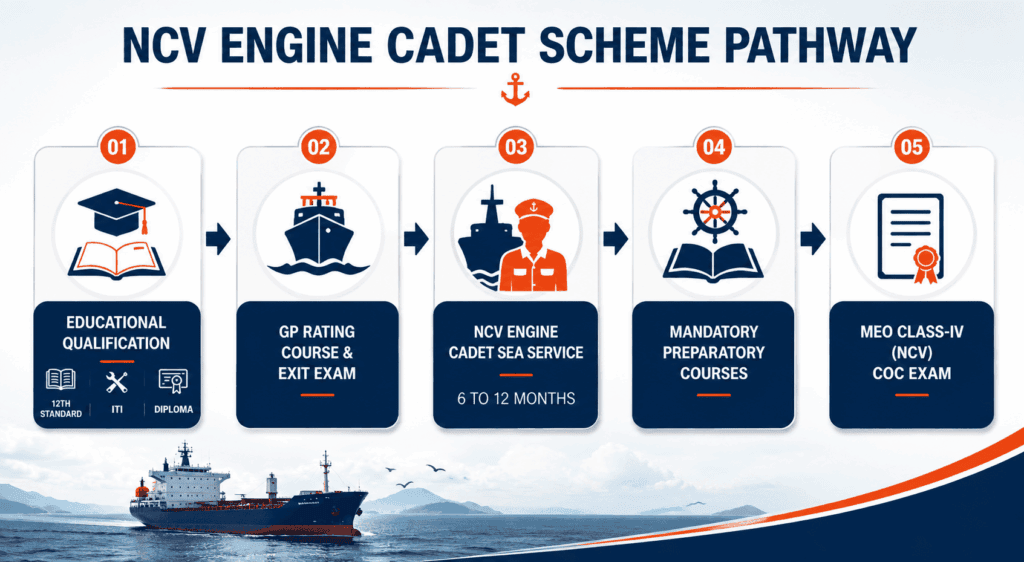
If you are a GP rating candidate, an MTI counsellor, or a shipping company planning cadet intake, this circular changes how you plan an engine department career. It opens a direct route from a 12th standard certificate to a Marine Engineer Officer Class IV (NCV) CoC, without requiring a specialised diploma or ITI background first. This guide walks through exactly how DGMA structured that route.
What Is DGMA Circular No. 51 of 2026?
DGMA Circular No. 51 of 2026 is the EAC Branch Circular the Directorate General of Maritime Administration (DGMA) issued on 21 August 2026, titled “Near Coastal Voyages (NCV) Engine Cadet Scheme for General Purpose (GP) Rating to Marine Engineer Officer Class IV, NCV Certification”.
Praveen Nair, Dy. Chief Surveyor cum Sr DDG (Tech.), signed the circular, and DGMA sent it to Principal Officers and Surveyors-in-Charge at Mercantile Marine Departments across the country, the Indian National Shipowners’ Association, the Indian Coastal Conference Shipping Association, and the Institute of Marine Engineers (India). That distribution list tells you this is squarely an engine department document, aimed at surveyors, shipowners, and the professional body that represents marine engineers. The circular took effect immediately on issue, so every provision covered in this guide is already live.
The circular builds on four earlier references: MS Notice No. 14 of 2007, MS Notice No. 14 of 2008, MS Notice No. 16 of 2008, and DGMA Order No. 9 of 2024. It amends the eligibility and sea service criteria that DGMA Order No. 9 of 2024 had set out, rather than replacing that framework entirely.
Why Did DGMA Introduce This Engine Cadet Scheme?
The background section of the circular points to two separate pressures building over several years.
First, the IMO amended the STCW Convention and STCW Code through the 2010 Manila amendments, which brought more clarity to the requirements governing Near Coastal Voyage (NCV) Certificates of Competency. Our guide to maritime conventions for Indian seafarers covers how STCW and other IMO instruments feed into Indian seafarer certification more broadly. DGMA has been widening the intake criteria for the NCV stream ever since, aiming for larger participation from Indian seafarers.
Second, DGMA received representations from industry stakeholders asking for two specific things: a review of the existing training and certification framework and a structured career progression pathway that would let GP Rating candidates become eligible for the MEO Class-IV (NCV) CoC exam. DGMA, acting under powers set out in the Merchant Shipping Act, 2025, constituted a technical committee, combining its own officers with domain experts from industry organisations and professional bodies, to work through the STCW Code’s knowledge and proficiency requirements section by section. This circular is the output of that committee’s recommendations.
Picture a GP Rating candidate who finished a standard pre-sea course and has no ITI or diploma background. Before this circular, that candidate’s route into the engine department’s officer ranks was far less direct. Now, a defined pathway exists specifically for them, provided they meet the education and training conditions set out below.
Who Is Eligible for the NCV Engine Cadet Scheme?
Eligibility rests on two things happening in sequence: the right prior education, followed by a completed GP Rating course.
What Four Educational Routes Qualify a Candidate?
DGMA accepts any one of four educational backgrounds as the entry condition.
| Reference | Educational Qualification | English Requirement |
| Para III.1.1 | Higher Secondary Certificate (12th standard) with Physics, Chemistry, and Maths as core subjects | 40% in English at Class 10 or 12 |
| Para III.1.2 | Higher Secondary Certificate (12th standard) with vocational training in engineering subjects | 40% in English at Class 10 or 12 |
| Para III.1.3 | Pass in a 2 year ITI course from a government recognised institute, with at least 50% aggregate marks in the final year | 40% in English at Class 10 |
| Para III.1.4 | Diploma in Mechanical or Electrical Engineering, or a diploma in streams covered under TEAP A, Section III/1, Rule 35 | Not separately specified |
What Must a Candidate Complete Before Sailing as a Cadet?
Meeting one of the four routes above only opens the door. Before a candidate can join a ship as an NCV Engine Cadet, DGMA requires two more steps. The candidate must complete a GP Rating course at a DGMA approved Maritime Training Institute and pass the Exit examination there. Our GP Rating course guide covers what that six month pre-sea programme actually involves, including fees and scholarships, and our CDC application guide walks through the Continuous Discharge Certificate a candidate needs before joining a ship at all.
The candidate must also finish every mandatory STCW basic safety training course and meet the medical fitness standard under the Merchant Shipping (Medical Examination) Rules, 2000. Skipping either step means a candidate cannot legally join as an engine cadet, whatever their educational qualification says on paper.
How Long Is the Required Seagoing Service?
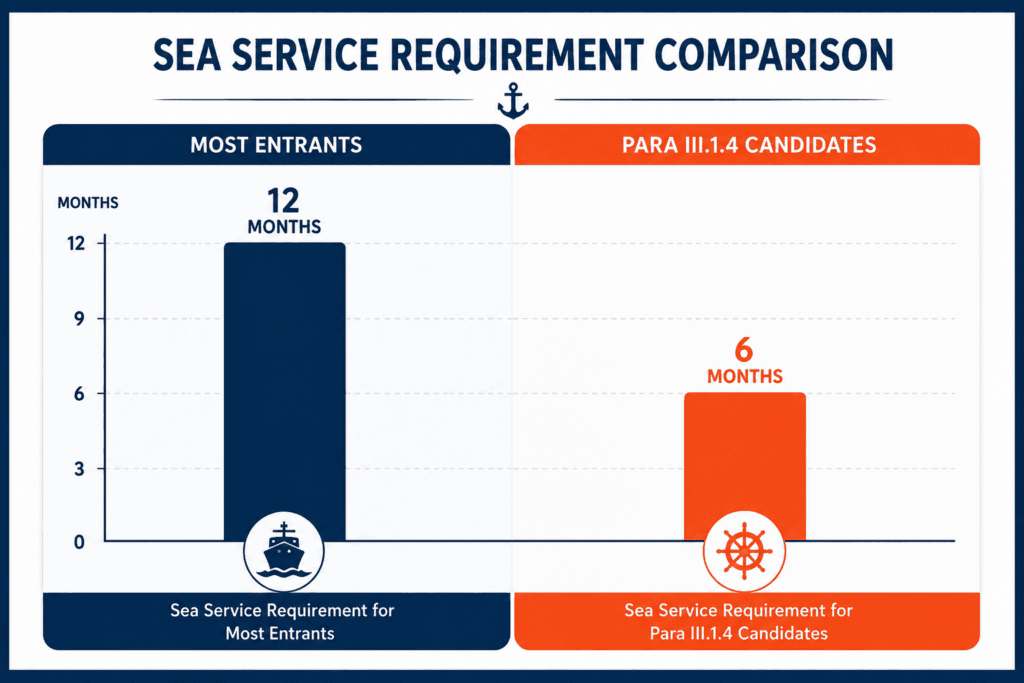
The standard requirement is 12 months of approved seagoing service as an Engine Cadet, served in the engine department onboard NCV ships, Indian Coastal Vessel (ICV) notification ships or River-Sea Vessel (RSV) notification ships.
Why Does the Circular Cut This to Six Months for Some Candidates?
Candidates who qualify through Para III.1.4, meaning they hold a diploma in Mechanical or Electrical Engineering or an equivalent TEAP A stream, only need six months of approved seagoing service as an Engine Cadet. DGMA’s reasoning here is straightforward once you think about it. A diploma holder has already covered mechanical and electrical fundamentals in a classroom setting that a 12th standard entrant has not, so the onboard component of their training can reasonably run shorter.
This is worth a specific clarification, since it is easy to misread. The six month reduction applies to candidates using the Engine Cadet Scheme route itself. It runs alongside, not in place of, other longer sea service tracks that diploma holders and ITI candidates have historically used to reach officer rank through general watchkeeping service. A candidate weighing both options should confirm with their MTI or MMD which track fits their specific documentation before committing to one path.
Within that seagoing service, at least six months must involve engine-room watchkeeping duties performed under the supervision of the Chief Engineer or a qualified Engineer Officer. The candidate serves in a defined role during this period, which the next section covers.
What Does an NCV Engine Cadet Actually Do Onboard?
An NCV Engine Cadet does not simply observe. The circular assigns a specific working role and a specific paper trail.
The First Assistant Role
The candidate serves as First Assistant to a Senior Engineer Officer in Full Charge. That Senior Engineer Officer certifies the candidate’s watchkeeping duties through a sea-service Testimonial once the training period ends. This is a working, supervised role on the watch rota, not a supernumerary trainee position.
The TAR Book Record
Every task, assessment, and watchkeeping duty gets recorded in an approved Training and Assessment Record (TAR) Book, following the vessel’s approved Structured Shipboard Training Programme (STP). The Chief Engineer must complete, endorse, and authenticate this TAR Book. It exists to track the cadet’s progress, document which skills they have actually completed, and prove they meet the standard DGMA prescribes, so an incomplete or unsigned TAR Book can hold up a candidate’s entire application later.
What Are the Different Entry Routes Into NCV Engine Certification?
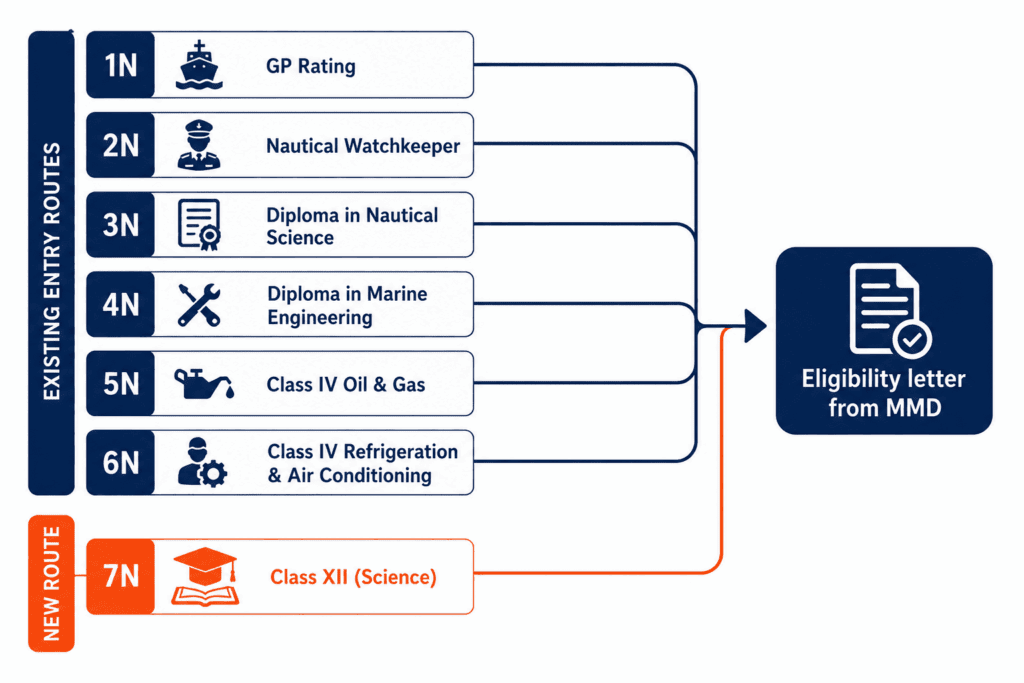
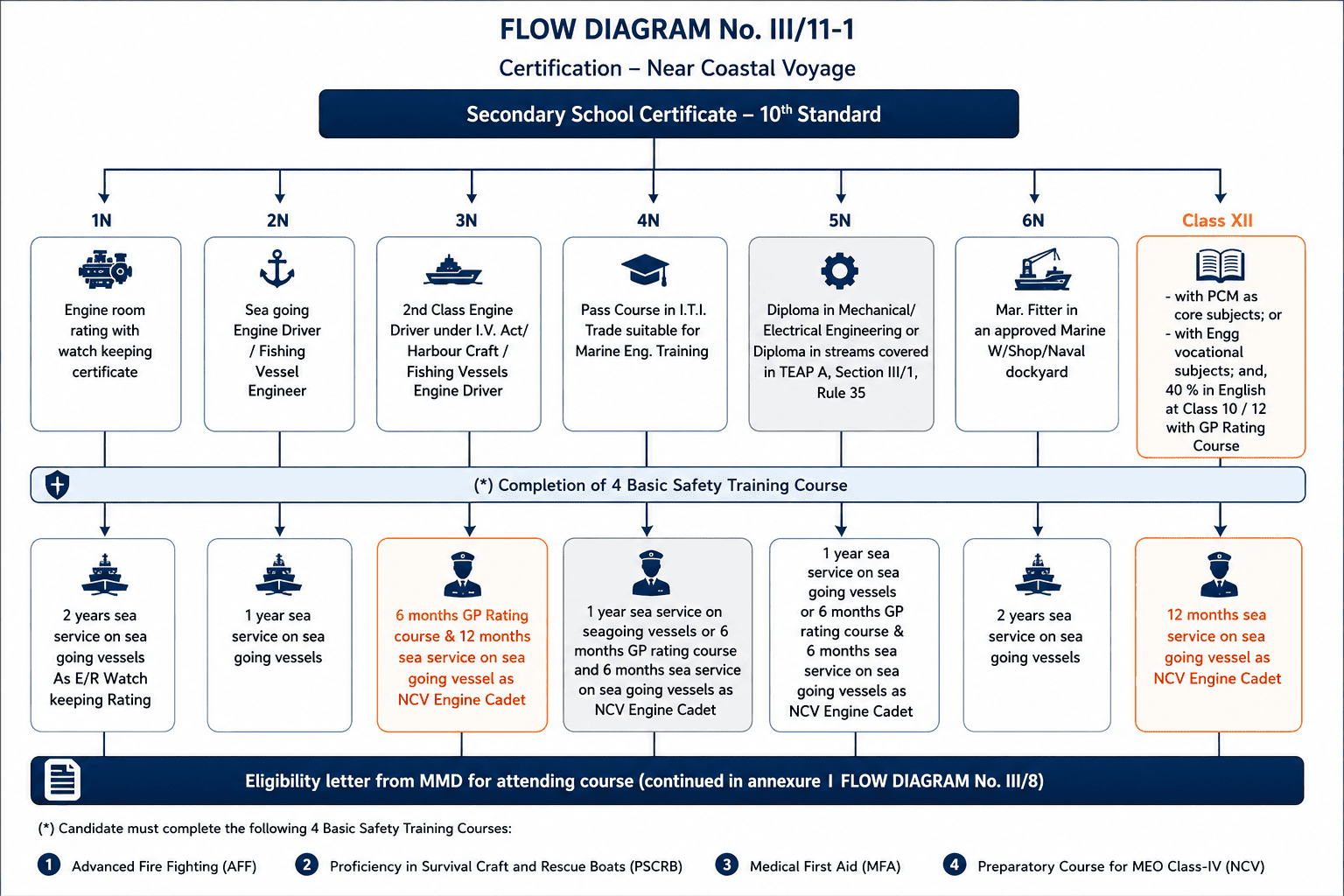
DGMA’s annexed flow diagram, Flow Diagram III/11-1, maps seven separate entry categories into NCV engine certification, based on a candidate’s background before they even start.
| Category | Prior Background | Sea Service Route Shown in the Flow Diagram |
| 1N | Engine room rating with a watchkeeping certificate | 2 years sea service as an E/R watchkeeping rating |
| 2N | Sea going Engine Driver or Fishing Vessel Engineer | 1 year sea service |
| 3N | 2nd Class Engine Driver under the I.V. Act, or Harbour Craft or Fishing Vessel Engine Driver | 6 months GP Rating course plus 12 months sea service as an NCV Engine Cadet |
| 4N | Pass course in an ITI trade suitable for marine engineering training | 1 year sea service, or 6 months GP Rating course plus 6 months sea service as an NCV Engine Cadet |
| 5N | Diploma in Mechanical or Electrical Engineering, or TEAP A Section III/1 Rule 35 streams | 2 years sea service, shown as the general route in the diagram |
| 6N | Marine Fitter in an approved marine workshop or naval dockyard | 2 years sea service |
| Class XII (new) | 12th standard with PCM or engineering vocational subjects, plus 40% English, combined with a GP Rating course | 12 months sea service as an NCV Engine Cadet |
Six Categories Carried Over From the Earlier Order
Categories 1N through 6N largely reflect entry paths that already existed under DGMA Order No. 9 of 2024. A quick note on 5N specifically, since the diagram and the circular text can look inconsistent at first glance. The diagram shows a 2 year general sea service route for diploma holders, and separately, the circular’s own operative text confirms these same candidates can alternatively use the Engine Cadet Scheme route with seagoing service cut to 6 months, as covered earlier in this guide. Both routes exist for that category. A diploma holder is not limited to the 2 year path shown in the chart.
One New Category for Class XII Entrants
The Class XII route is the genuinely new addition this circular makes. It gives a 12th standard candidate, with no prior ITI, diploma, or engine-driver background, a direct route into NCV engine certification through a GP Rating course alone. Every category, regardless of entry route, must also complete four Basic Safety Training courses before proceeding, and every candidate’s route ends at the same point: an eligibility letter from the MMD to attend further courses.
What Courses Must a Candidate Complete Before the MEO Class-IV (NCV) Exam?
Sea service alone does not qualify a candidate to sit the exam. DGMA requires a defined set of preparatory and modular courses first.
| Course | What It Covers |
| Preparatory Course for MEO Class-IV (NCV) | Four months of structured academic preparation ahead of the written and oral CoC exam |
| Advanced Fire Fighting (AFF) | Fire prevention, firefighting techniques, and fire organisation onboard |
| Proficiency in Survival Craft and Rescue Boats (PSCRB) | Launching, handling, and operating survival craft and rescue boats |
| Medical First Aid (MFA) | Shipboard first aid and medical care competency |
DGMA can also prescribe any other course or training programme from time to time, so this list is a floor, not a permanently fixed set.
How Does a Candidate Get Certified as MEO Class-IV (NCV)?
Completing sea service and courses still leaves a documentation step before a candidate can sit the exam.
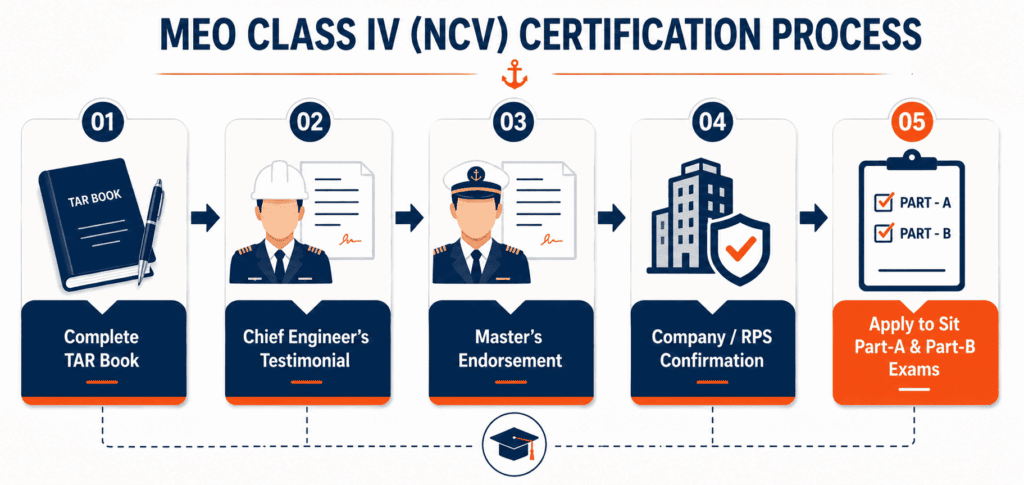
- The candidate completes the approved seagoing service and the TAR book, duly endorsed and authenticated by the chief engineer.
- The candidate obtains a testimonial from the chief engineer, certifying the nature of duties performed and the candidate’s standard of competence.
- The master endorses that testimonial.
- The Company, or the Recruitment and Placement Service (RPS) where applicable, confirms it. A crewing agency handling this confirmation needs a valid RPSL license, the same licence that governs how Indian seafarers get placed on ships in the first place.
- Once every mandatory preparatory and modular course is complete, the candidate applies for assessment to appear for the written and oral examinations, known as Part-A and Part-B, leading to the MEO Class-IV (NCV) CoC.
What Happens If a Candidate Delays the Exam?
DGMA builds in a real deadline here, and it catches candidates who assume their preparatory course stays valid indefinitely. A candidate who does not appear for the written exam, the oral exam, or both, within two years of successfully completing the preparatory course must redo that preparatory course before they can apply for the MEO Class-IV (NCV) CoC exams again.
This two-year window is longer than it sounds when a candidate is between contracts or waiting on a specific vessel assignment, but it is not indefinite. A candidate who finishes the four-month preparatory course and then spends over two years focused purely on sea time, without booking an exam slot, ends up repeating four months of coursework they had already completed. Booking the exam attempt well within that window is the simplest way to avoid this.
How Is This Different From the Deck Department’s NCV Pathway?
The NCV Engine Cadet Scheme sits entirely within the engine department. It has no connection to the ranks and crew numbers that govern deck officers and ratings, which come from a separate framework issued by DGMA’s Nautical Wing.
That distinction matters in practice. A ship’s Minimum Safe Manning Document combines a nautical scale, covering master, chief officer, and deck ratings, with a separate engine scale covering Chief Engineer, marine engineer officers, and engine ratings. Deck-side candidates following a comparable ratings-to-officer route can compare notes with our Second Mate FG course guide or our overview of the DNS course, which covers the equivalent direct-entry officer pathway on the deck side.
FAQs
What is DGMA Circular No. 51 of 2026?
It is the EAC Branch Circular DGMA issued on 21 August 2026, setting out a structured pathway for GP Rating candidates to become eligible for the Marine Engineer Officer Class-IV (NCV) Certificate of Competency, through a defined NCV Engine Cadet Scheme.
Who is eligible for the NCV Engine Cadet Scheme?
Candidates who hold one of four qualifications, a 12th standard certificate with PCM or engineering vocational subjects, a 2 year ITI course, or a diploma in Mechanical or Electrical Engineering, and who have completed a GP Rating course and Exit exam at a DGMA approved MTI.
How long is the seagoing service required under the NCV Engine Cadet Scheme?
Twelve months as an Engine Cadet, reduced to six months for candidates who qualify through the diploma route under Para III.1.4.
Does a GP Rating course automatically qualify a candidate for the NCV Engine Cadet Scheme?
No. The GP Rating course and Exit exam are necessary steps, but a candidate also needs one of the four qualifying educational backgrounds, completed STCW basic safety training, and medical fitness clearance before joining as an Engine Cadet.
What role does an NCV Engine Cadet actually perform onboard?
The candidate serves as First Assistant to a Senior Engineer Officer in Full Charge, performing supervised engine-room watchkeeping duties for at least six months of the seagoing service period.
What is a TAR Book, and why does it matter for this scheme?
The Training and Assessment Record Book documents every task, assessment, and watchkeeping duty the cadet completes, following the approved Structured Shipboard Training Programme. The Chief Engineer must endorse and authenticate it, and an incomplete TAR Book can delay a candidate’s certification.
Is the 4-month preparatory course for MEO Class-IV (NCV) the same as the general MEO Class-IV preparatory course?
No. A separate circular made a 1-month preparatory course compulsory for the general MEO Class-IV CoC exam. The NCV Engine Cadet Scheme’s own preparatory course runs four months, reflecting that its candidates enter through GP Rating rather than prior specialised engineering education.
What happens if a candidate does not appear for the exam within 2 years?
They must redo the Preparatory Course afresh before they can apply again for the MEO Class-IV (NCV) CoC written and oral examinations.
Who confirms a candidate’s sea service Testimonial?
The Chief Engineer issues it, the Master endorses it, and the Company or the Recruitment and Placement Service confirms it, depending on which one manages the candidate’s placement.
Does this scheme cover deck department candidates too?
No. It is an engine department scheme, issued for Engine Cadets working toward MEO Class-IV (NCV). Deck ratings and officers follow a separate certification pathway under DGMA’s Nautical Wing framework.