
The MEO Class-I preparatory course syllabus, revised in Annexure III of DGMA Circular 49 of 2026, keeps its two-month, 240-hour format but updates the content for chief engineer officer candidates. Unlike the other three courses, it leans heavily on maritime law, classification society oversight, leadership and decarbonisation topics rather than hands-on engineering.
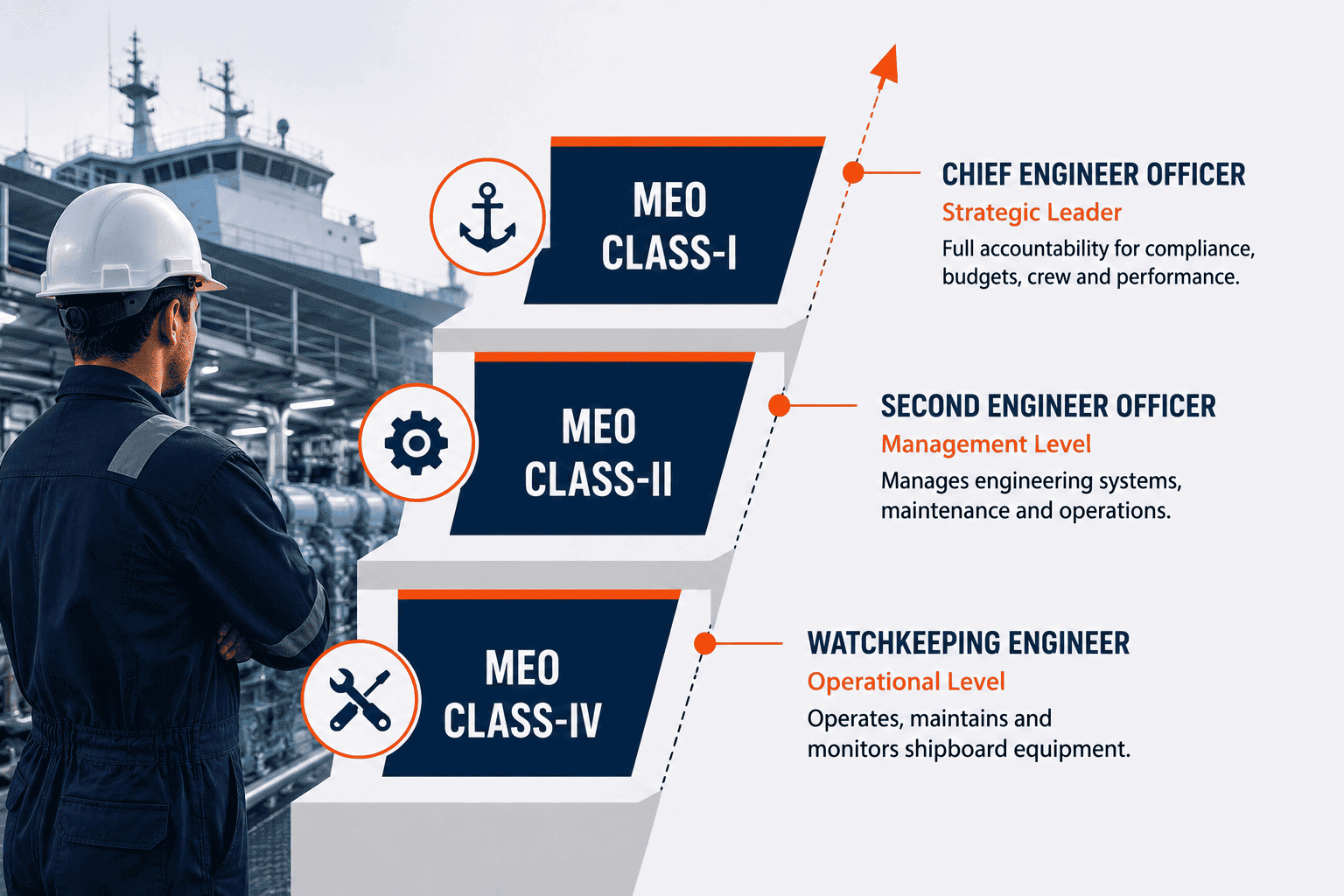
This is the top rung of the marine engineering ladder, and the syllabus reads that way. Where MEO Class-II tests deep engineering diagnostics, MEO Class-I assumes you already have that and shifts toward running an engine department as a business function, with all the compliance, budgeting and people-management responsibility that comes with commanding it. For how this course fits alongside the other three, check our MEO and ETO preparatory course requirements guide.
Who Is the MEO Class-I Preparatory Course Syllabus for?
MEO Class-I prepares candidates for the Chief Engineer Officer Certificate of Competency on ships powered by main propulsion machinery of 3000 kW and above, the same tonnage threshold that applies to MEO Class-II. The difference between the two isn’t the size of ship you’re qualified for. It’s the seniority and scope of responsibility, from hands-on engineering management at Class-II to full accountability for compliance, budgets and crew at Class-I.
Both courses are built on STCW Regulation III/2 and Section A-III/2. That surprises some candidates who assume a more senior certificate must sit under a different regulation number. It doesn’t. The regulation stays the same; what changes is the depth and breadth of competence expected at each level.
Here are the quick facts.
| Attribute | Detail |
| Duration | 2 months (8 weeks) |
| Working days | 40 |
| Contact hours | 240 |
| Delivery mode | Fully offline, classroom-based |
| Governing regulation | STCW Regulation III/2, Section A-III/2 |
| Certificate threshold | Ships with main propulsion machinery of 3000 kW and above |
| Revised syllabus effective | 1 January 2027 (duration itself is unchanged) |
What Makes the MEO Class-I Syllabus Different From the Other Three?
Worth seeing side by side, since the four courses aren’t just different lengths of the same content.
| Course | Duration | Level | Content Emphasis |
| MEO Class-IV | 1 month, 120 hours | Operational | Watchkeeping and hands-on engineering basics |
| MEO Class-II | 3 months, 360 hours | Management | Engineering design, diagnostics and system oversight |
| MEO Class-I | 2 months, 240 hours | Management | Maritime law, compliance, leadership and fleet management |
| ETO | 1 month, 120 hours | Operational | Electrical, electronic and automation systems |
One structural quirk worth flagging: Annexures I, II and IV each label their subjects against a specific STCW function, function 3, 4, 5 or 6. Annexure III doesn’t. It’s written as 25 numbered subject areas without function tags, which fits its nature as a broad management and compliance syllabus rather than a function-specific technical one.
What Legal and Regulatory Knowledge Does the Syllabus Cover?
This is the backbone of the course, and it’s where the syllabus differs most sharply from the engineering-heavy papers below Class-I.
- National and international maritime law: the Merchant Shipping Act, 2025, UNCLOS 1982, and the role of the IMO
- Quality, safety and energy management systems: the ISM Code, ISO 9001:2008, links to ISO 14001 and ISO 50001, internal auditing, and DOC and SMC certification
- Classification societies: their role as Recognized Organizations, survey types, class suspension and withdrawal procedures, and ship inspection requirements for first entry into the Indian flag under the Merchant Shipping (Registration of Indian Ships) Rules, 2026
- Compliance monitoring: statutory certificates under SOLAS, MARPOL and the Load Lines Convention, plus the Chief Engineer’s role in tanker vetting programmes like SIRE, TMSA and RightShip
- Ship security: the ISPS Code, SOLAS Chapter XI-2, and current anti-piracy practice
- Port State Control and Flag State duties: PSC inspection procedures, the IMO Member State Audit Scheme, regional MoU regimes, and detention and appeal processes
- Ship survey and certification: the Harmonized System of Survey and Certification and the statutory surveys that fall under it
What Does the Syllabus Cover on Ship Stability?
A narrower section than in the engineering-focused courses, but it’s here for a reason: a Chief Engineer signs off on operational decisions that affect stability, even without doing the calculations personally.
- Stability during dry-docking and damage stability in flooding or grounding scenarios
- SOLAS Convention Chapter II-1 requirements on subdivision, stability and structural stress
- The International Code on Intact Stability 2008 (2008 IS Code)
- Basic probabilistic damage stability assessment, including how ship speed, collision angle and displacement factor into the analysis
What Documentation and Record-Keeping Topics Are Included?
- Official Log Books: their statutory significance, legal admissibility, and requirements for accurate upkeep under the Merchant Shipping Act, 2025
- Engine room record management: the Chief Engineer’s standing orders, the night order book, and statutory records like the Oil Record Book under MARPOL
What Insurance, Liability and Public Health Topics Are Covered?
- WHO and public health: International Health Regulations (2005), Ship Sanitation Control Certificates, and the Maritime Declaration of Health
- ILO and labour compliance: MLC 2006 requirements, the Maritime Labour Certificate, and the Declaration of Maritime Labour Compliance
- Marine insurance: Hull and Machinery cover, Protection and Indemnity Clubs, and the principles of indemnity and mutuality
- Charter party concepts across time, voyage and bareboat arrangements, and the Chief Engineer’s role in meeting charter party fuel and maintenance obligations
- Marine salvage under the 1989 Salvage Convention and the Lloyd’s Standard Form of Salvage Agreement
What Emergency Preparedness and Casualty Investigation Topics Are Included?
- Emergency response for oil spills, fire, flooding, collision and grounding
- Damage control systems: emergency power, pumping, fire main and drainage arrangements
- Risk assessment principles, including ALARP, under the ISM Code and TMSA practice
- Detection and handling of major machinery failures: main engine bearing failure, turbocharger breakdown, boiler tube failure and severe engine room bilge flooding
- Classic maritime casualty case studies and IMO casualty investigation procedures
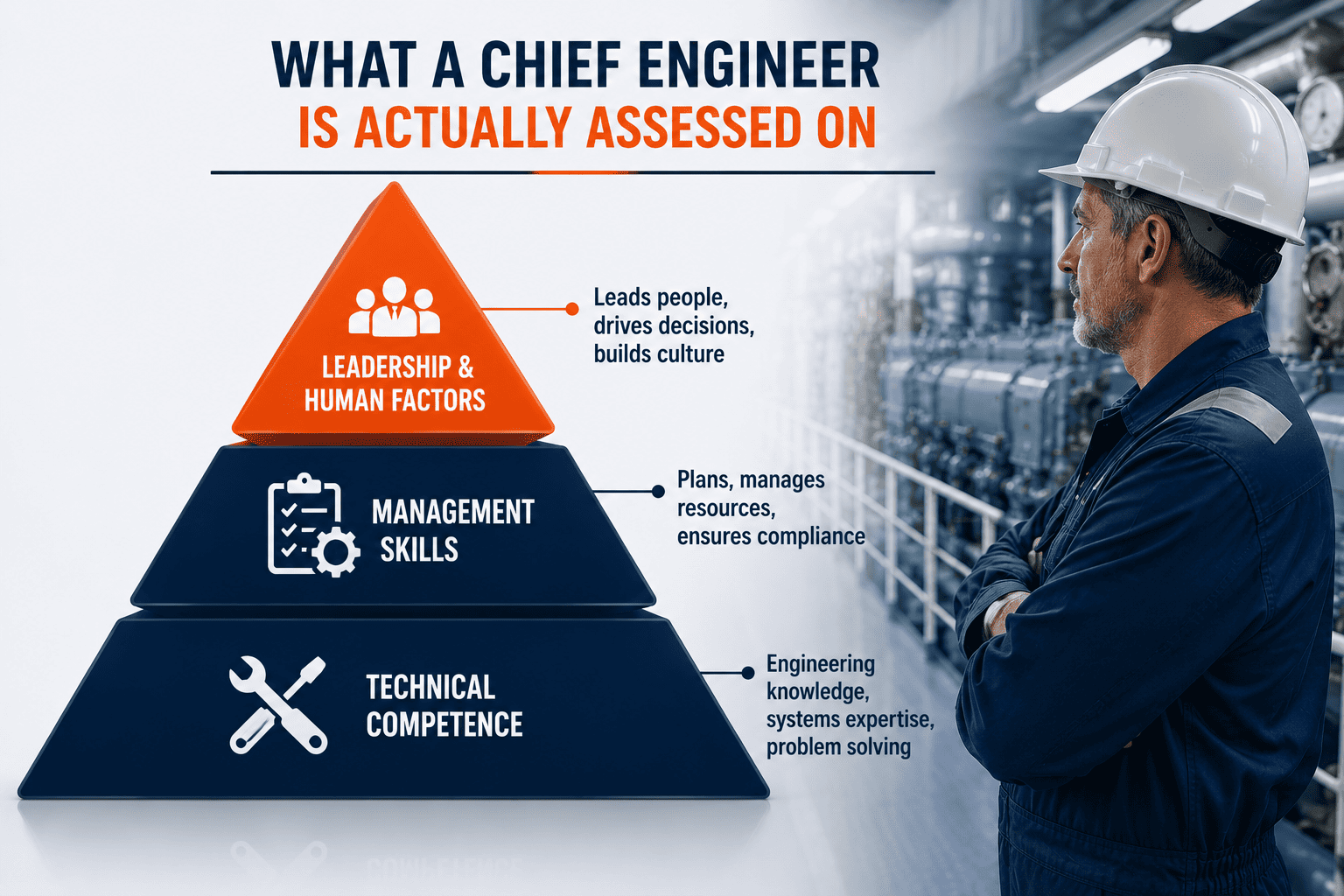
What Leadership, Training and Human Element Topics Does the Syllabus Cover?
Roughly a fifth of the numbered subject list sits here, which tells you how much weight DGMA now puts on people management at Chief Engineer level.
- Organisational behaviour, communication flow and conflict management on board
- Cross-cultural crew management, workload planning and effective resource management
- Decision-making techniques, situational awareness and prevention of human error
- Psychological safety leadership, anti-harassment procedures and fatigue-risk management
- Training responsibilities: designing and delivering technical training for engine room personnel, mentoring, and conducting training needs analysis
What Fleet and Ship Management Topics Are Covered?
This block turns the chief engineer into a budget-holder and inventory manager as much as an engineer.
- Inventory management: spares and stores planning, safety stock levels, and the Re-Order Point (ROP) concept for lead-time-sensitive parts
- Bunker fuel inventory and quality management, including low-BN cylinder oil considerations for low-sulphur fuels
- Management Information Systems: Decision Support Systems, Expert Systems, and oversight of MASS trials and remote operations
- Fuel economy: power balancing, fuel change-over procedures, and interpretation of engine load diagrams against the ISO 8217 fuel standard
- Budgeting and cost control: voyage expense analysis, dry-docking cost evaluation, and methods for reducing operational downtime
What Electrical and Engine Technology Topics Are Covered?
Less hands-on than the Class II motor syllabus, but broader in scope, since a chief engineer needs to evaluate new technology rather than just operate it.
- High-voltage systems: busbar arrangements, insulation, and protection using SF6 and vacuum circuit breakers
- Electrical propulsion: synchronous motor drives, Azipod systems, and speed control using Pulse Width Modulation
- Recent engine developments: camshaft-less engines, electronic governors, and control systems for electronically controlled engines
- Tribology advances: alpha cylinder lubricator systems, fuel dilution prevention, and hydrodynamic seal lubrication
- Propulsion innovations: contra-rotating propellers, wake-equalising ducts and PTO/PTI arrangements
- Supervisory responsibilities for alternative fuel systems, including integrating fuel-risk assessments into the Safety Management System and overseeing bunkering for low-flashpoint fuels
What Sustainability and Digitalisation Topics Are Covered?
The newest ground in the syllabus and, arguably, the section most likely to expand further in future revisions.
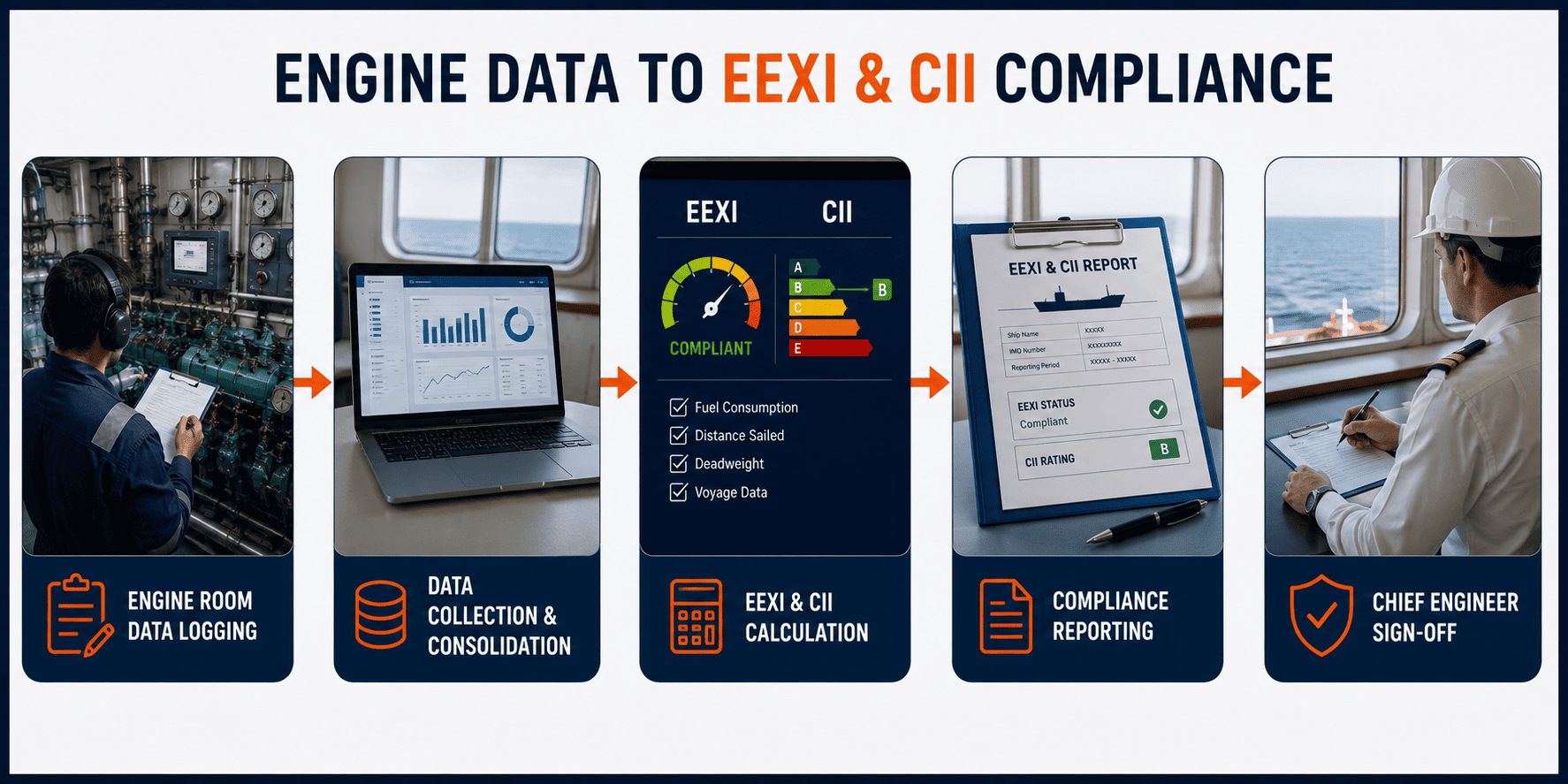
- Greenhouse gas compliance: MARPOL Annex VI, EEXI, CII, and the IMO Strategy for reducing GHG emissions from ships
- Hull and coating optimisation to reduce frictional resistance and fouling
- Artificial intelligence applications: predictive maintenance, fuel efficiency optimisation, voyage planning and autonomous shipping concepts
- Blockchain basics: secure record-keeping, electronic bills of lading, and supply chain transparency
- Management-level cyber-risk oversight under the ISM Code, including incorporating cyber-risk controls into the Safety Management System
- Underwater noise: ship design and operational measures to reduce it
What Happens If You’re Mid-Batch When the Revised Syllabus Takes Effect?
Here’s a gap worth flagging honestly. The circular spells out, in explicit terms, that candidates already admitted to a MEO Class-II batch before 1 January 2027 finish under the old syllabus. It doesn’t repeat that same explicit continuation clause for MEO Class-I. Since the Class-I duration isn’t changing, the practical impact is smaller, but if you’re partway through a Class-I batch when the new date arrives, it’s worth confirming directly with your MTI which version of the syllabus you’ll be examined against, rather than assuming it works the same way as Class-II.
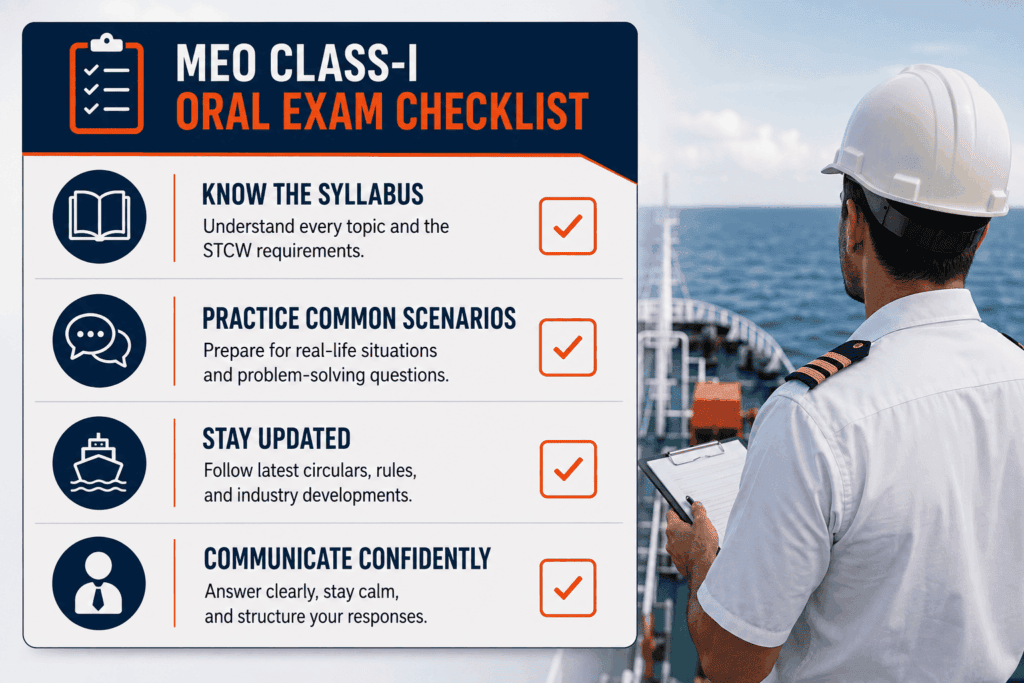
How Should Candidates Prepare for the MEO Class-I Oral Exam?
The oral panel at this level tests judgement as much as knowledge, since a chief engineer’s job is largely about making calls under pressure.
- Practice explaining compliance processes out loud, not just naming them. Knowing what SIRE or TMSA stands for isn’t the same as being able to walk an examiner through how a vetting inspection actually plays out.
- Keep current on GHG figures. CII ratings and EEXI thresholds get referenced in real fleet operations, and examiners notice candidates who only know the acronyms.
- Prepare an opinion on AI and digitalisation topics, not just a definition. This section rewards candidates who can discuss trade-offs, not just list buzzwords.
- Rehearse a leadership scenario or two. Questions on handling a difficult crew situation or a fatigue-related safety concern are common, and a rehearsed, structured answer holds up far better than an improvised one.
Where Can You Take the MEO Class-I Course?
Only a DGMA-approved Maritime Training Institute authorised for the MEO Class-I course can deliver it, and that approval now has to reflect the revised syllabus from 1 January 2027 onward. Given how much of this course concerns classification society oversight and formal quality systems, it’s worth understanding how DGMA verifies institute quality in the first place. A good starting point is this breakdown of the inspection regime DGMA-approved training institutes are now required to sit under. You can also check the list of DGMA-approved maritime training courses before committing to a batch.
Frequently Asked Questions
Does the MEO Class-I preparatory course duration change under Circular 49 of 2026?
No. It stays at two months, or 240 contact hours. Only the syllabus content has been revised, with the updated version taking effect from 1 January 2027.
What STCW regulation governs the MEO Class-I syllabus?
Regulation III/2 and Section A-III/2 of the STCW Convention and Code, the same regulation that governs MEO Class-II. The difference between the two courses lies in scope and seniority, not the underlying regulation.
What’s new in the revised MEO Class-I syllabus?
Notable additions include artificial intelligence and digitalisation topics, blockchain basics, management-level cyber-risk oversight, greenhouse gas and decarbonization compliance, and oversight responsibilities for alternative fuel systems.
Does MEO Class-I cover hands-on engineering topics?
Only lightly, and mostly at a technology-evaluation level rather than operational detail. The heavy hands-on and diagnostic engineering content sits in the MEO Class-II Preparatory Course syllabus.
What tonnage or power threshold applies to the MEO Class-I certificate?
Ships with main propulsion machinery of 3000 kW and above, the same threshold that applies to MEO Class-II.
Is the ISM Code part of the MEO Class-I syllabus?
Yes, covered in depth alongside ISO 9001:2008 quality management systems, internal auditing principles, and DOC and SMC certification requirements.
Does the syllabus cover greenhouse gas and decarbonization rules?
Yes. It includes MARPOL Annex VI, EEXI and CII compliance, hull and coating optimisation, and the IMO’s wider strategy for reducing shipping emissions.
Are AI and digitalisation topics part of the MEO Class-I exam?
Yes. The syllabus covers AI applications in predictive maintenance and voyage planning, blockchain fundamentals, and management-level cyber-risk responsibilities under the ISM Code.
What happens to candidates already enrolled when the revised syllabus takes effect?
The circular explicitly protects candidates already admitted to a MEO Class-II batch before 1 January 2027. It doesn’t spell out the same clause for MEO Class-I, so candidates mid-batch around that date should confirm directly with their MTI.