For seafarers, building a career at sea often means meeting separate training, sea-service and competency requirements for different shipboard duties. This can make the certification process confusing, particularly for those seeking experience across both deck and engine-room functions.
To address this need, DGMA Circular No. 53 of 2026 sets out an alternative pathway for eligible ratings to obtain certification covering both navigational and engine-room watchkeeping functions. It introduces DGMA dual certification for seafarers, allowing them to obtain recognised certification for both navigational and engine-room watchkeeping functions. Knowing about these new changes is a must for seafarers, RPSL companies, shipping companies and maritime training institutes (MTIs).
Let’s explore this in detail!
What is DGMA Circular 53 of 2026?
DGMA Circular No. 53 of 2026 introduces an alternative pathway for dual certification of seafarers performing navigational and engine-room watchkeeping functions. Issued under Rule 68 of the Merchant Shipping (STCW) Rules, 2014, as amended, the circular sets out requirements for standard maritime training, seagoing service, practical experience and competency assessment.
It provides a structured route for eligible ratings to obtain certification covering both Rating Forming Part of a Navigational Watch (II/4) and Rating Forming Part of an Engine-Room Watch (III/4). The circular also includes specimen certificates for dual certification at the rating and able seafarer levels.
Key Highlights of DGMA Circular 53 of 2026
| Circular Number | DGMA Circular No. 53 of 2026 |
| Issuing Authority | Directorate General of Maritime Administration (DGMA), |
| Ministry | Ministry of Ports, Shipping and Waterways, Government of India |
| Issue Date | 31 August 2026 |
| Circular Title | Alternative/Dual Certification for Seafarers (Ratings and Able Seafarer) |
| Regulatory Provision | Rule 68 of the Merchant Shipping (STCW) Rules, 2014 |
| Purpose | Provides an alternative/dual certification pathway covering navigational and engine-room watchkeeping functions |
What is a Dual Certificate for Seafarers under DGMA Circular 53 of 2026?
A Dual Certificate is a certification issued by the Directorate General of Maritime Administration (DGMA) that allows eligible seafarers to hold two recognised competency or qualification certificates under one certificate of proficiency.
It is intended to provide greater flexibility in career opportunities by enabling qualified seafarers to perform duties associated with both certifications, subject to meeting the prescribed eligibility, training, examination and documentation requirements.
What Are the Two Pathways for DGMA Dual Certification Under Rule 68?
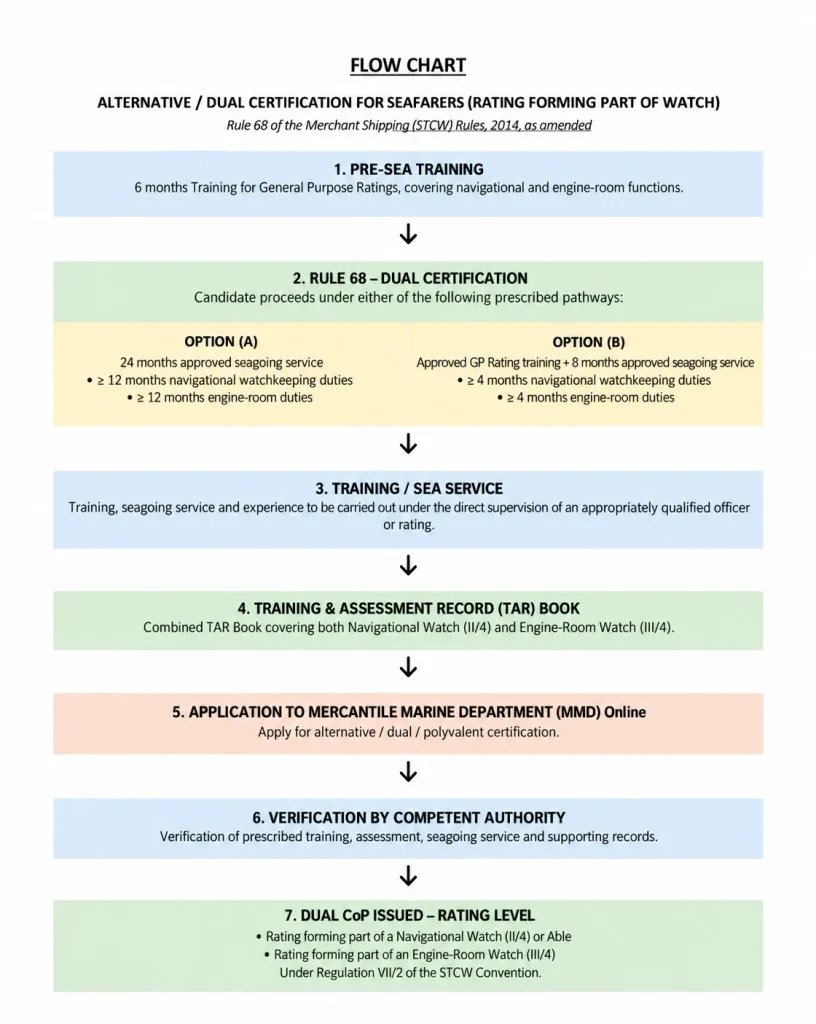
Under Rule 68, as provided in DGMA Circular No. 53 of 2026, there are two pathways through which eligible seafarers can obtain dual certification for both Rating Forming Part of a Navigational Watch (RFPNW – II/4) and Rating Forming Part of an Engine-Room Watch (RFPEW – III/4). The applicable pathway depends on the seafarer’s training and qualifying sea-service experience.
| Requirement | Option A (No Pre-Sea Required) | Option B (With Approved GP Rating Training) |
| Pre-Sea Training | None required | Must complete the 6-month General Purpose (GP) Rating training course |
| Total Sea Service | Minimum 24 months of approved seagoing service | Minimum 8 months of approved seagoing service |
| Navigational Watch Duties | ≥ 12 months deck/navigational watchkeeping | ≥ 4 months deck/navigational watchkeeping |
| Engine-Room Duties | ≥ 12 months engine-room watchkeeping | ≥ 4 months engine-room watchkeeping |
Who is Eligible for DGMA Dual Certification?
As per DGMA Circular No. 53 of 2026, seafarers who meet the prescribed training and seagoing service requirements under Rule 68 of the Merchant Shipping (STCW) Rules, 2014, as amended, are eligible for dual certification of proficiency.
Eligibility includes:
- Candidates completing 24 months of approved seagoing service, including the required service in both navigational and engine-room duties.
- GP Rating candidates completing 8 months of approved seagoing service, with the prescribed service in both functions.
- Candidates whose training and seagoing service are completed under appropriate supervision and properly recorded in the combined TAR Book.
What are the Different Levels of DGMA Dual Certification?
DGMA Circular 53 of 2026 provides for dual certification at the rating level and able seafarer level, covering both navigational and engine-room functions.
| Certification Level | Navigational Certification | Engine-Room Certification |
| Rating Level | Rating Forming Part of a Navigational Watch (II/4) | Rating Forming Part of an Engine-Room Watch (III/4) |
| Able Seafarer Level | Able Seafarer – Deck (II/5) | Able Seafarer – Engine (III/5) |
What Is the Dual CoP Under DGMA Circular 53 of 2026?
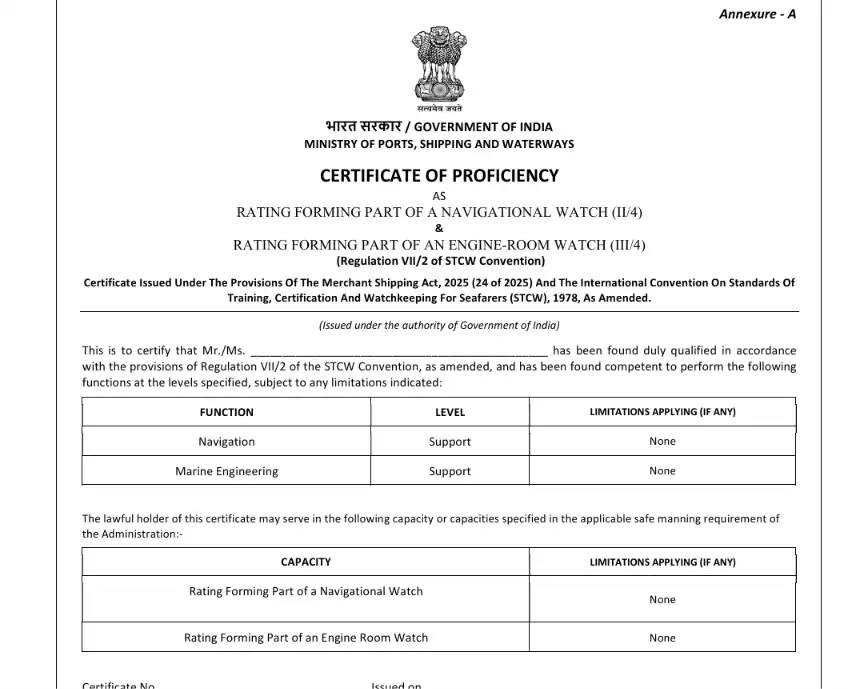
The Dual Certificate of Proficiency (CoP) under DGMA Circular 53 of 2026 recognises a seafarer’s competency in both navigational and engine-room watchkeeping functions.
Depending on the applicable certification level, the certificate may cover Rating Forming Part of a Navigational Watch (II/4) and Rating Forming Part of an Engine-Room Watch (III/4), or the corresponding Able Seafarer levels under II/5 and III/5.
Dual CoP at Rating Level
At the rating level, the Dual CoP covers:
- Rating Forming Part of a Navigational Watch (II/4)
- Rating Forming Part of an Engine-Room Watch (III/4)
Dual CoP at Able Seafarer Level
At this level, Dual CoP includes:
- Able Seafarer – Deck (II/5)
- Able Seafarer – Engine (III/5)
What Is the Training and Assessment Record (TAR) Book?
The Training and Assessment Record (TAR) Book is the prescribed record used to document a seafarer’s training, practical experience and competency assessment during the training and seagoing service required for DGMA Dual Certification.
Under DGMA Circular No. 53 of 2026, a combined TAR Book is required for candidates following the dual-certification route. It covers the competencies and training requirements for both Navigational Watch under Regulation II/4 and Engine-Room Watch under Regulation III/4.
RPSL companies, shipping companies and Maritime Training Institutes (MTIs) involved in the candidate’s training and seagoing service must ensure that the relevant training and competency requirements are properly recorded. The completed TAR Book forms part of the supporting records verified by the competent authority before the Dual Certificate of Proficiency is issued.
What Are the Training Requirements for DGMA Dual Certification?
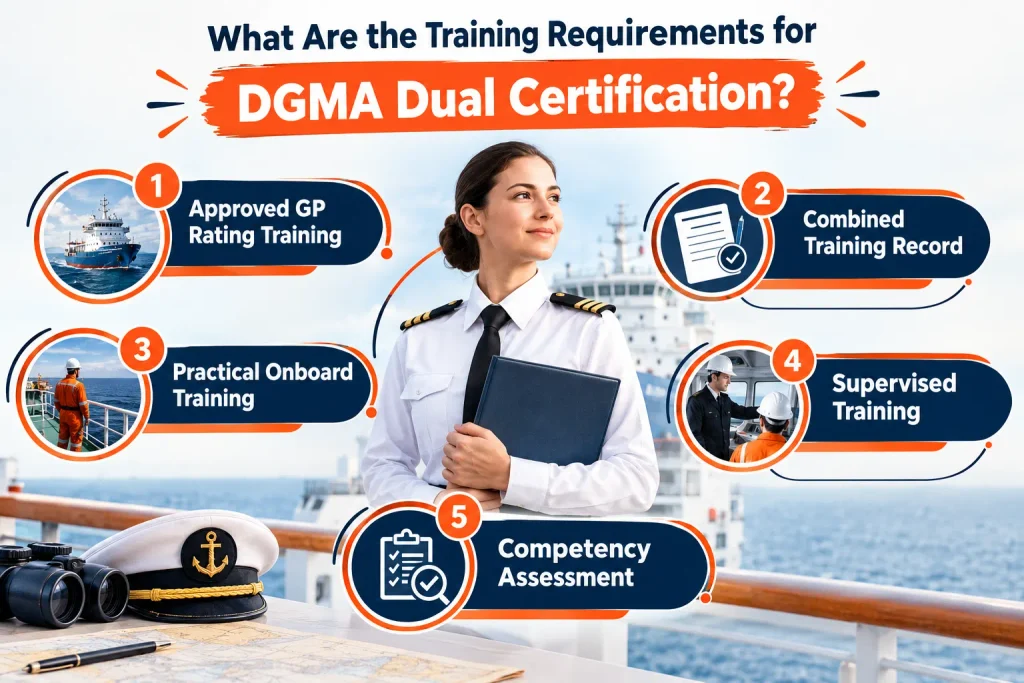
The DGMA Dual Certification requires training that prepares a seafarer to perform duties in both the navigational watch and engine-room watch. The maritime training must cover the competencies required for both functions and be supported by the prescribed training records and sea-service experience.
The key training requirements include:
- Approved GP Rating Training: Candidates should complete the prescribed 6-month pre-sea GP Rating training, covering both navigational and engine-room duties.
- Combined Training Record: Training and onboard tasks should be recorded in the combined TAR Book for Navigational Watch (II/4) and Engine-Room Watch (III/4).
- Practical Onboard Training: The candidate must obtain practical experience in both navigational watchkeeping and engine-room duties.
- Supervised Training: The required training and onboard duties must be carried out under the direct supervision of an appropriately qualified officer/rating.
- Competency Assessment: The candidate must demonstrate the required competencies for both functions through the prescribed assessment process.
Depending on the applicable route, the candidate must also fulfil the required approved sea-service period in both navigational and engine-room functions before applying for the Dual Certificate of Proficiency (CoP).
What Are the Seagoing Service Requirements for Alternative Dual Certification of Seafarers?
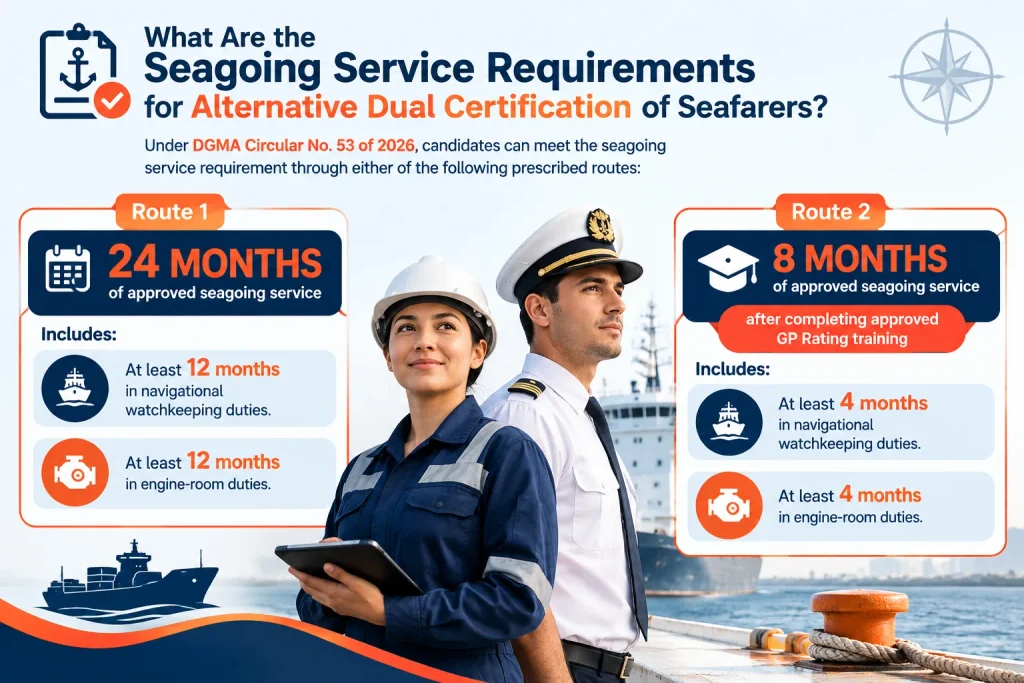
Under DGMA Circular No. 53 of 2026, candidates can meet the seagoing service requirement through either of the following prescribed routes:
- 24 months of approved seagoing service, including:
- At least 12 months in navigational watchkeeping duties.
- At least 12 months in engine-room duties.
- 8 months of approved seagoing service after completing approved GP Rating training, including:
- At least 4 months in navigational watchkeeping duties.
- At least 4 months in engine-room duties.
The required seagoing service and experience must be carried out under the direct supervision of an appropriately qualified officer or rating.
How to Submit Application for DGMA Dual Certification with MMD?
To apply for alternative or dual certification as per the newly issued DGMA Circular No. 53 of 2026, you must process your application through the e-Governance portal and submit it to your respective Mercantile Marine Department (MMD).
The step-by-step procedure to apply online and complete the process is detailed below:
Step 1: Update Your Seafarer Profile
Before initiating any new online application, you must ensure your master profile contains your combined competencies:
- Go to the official DGMA Shipping Website.
- Click on E-Governance and log in using your INDoS number and password.
- Navigate to your Seafarer Profile and ensure all entries for sea service, pre-sea training, and modular courses are completely updated and accurate.
Step 2: Submit the Online Application
- Once logged into your e-Governance account, go to the Examination section.
- Click on Application for Eligibility Assessment.
- Choose your concerned MMD branch (e.g., Mumbai, Chennai, Noida, Kolkata) where you want your file evaluated.
- Select the appropriate Grade and Stream tailored for alternative/dual certification pathways.
- Fill out the application carefully. Upon submission, the portal will generate Form 29.
- Save and print Form 29 for physical submission.
Step 3: Online Fee Payment
- Navigate to the Pay Assessment and Seat Booking Fees Online option on the home portal screen.
- Pay the required regulatory assessment fees.
- Download, take a screenshot, and print the online fee payment receipt.
Step 4: Upload Required Documents Online
Go to View Application Status in your profile, where an Upload Now option will appear. Upload clean PDF copies of the following:
- Printed & signed Form 29
- Combined Training Assessment Record (TAR) Book or Training Record Book (TRB) covering both Navigational and Engine Watchkeeping
- Relevant CDC (Continuous Discharge Certificate) pages reflecting sea service duties
- Valid Passport and Seafarer Identity Document (SID)
- Valid Medical Fitness Certificate from a DG Shipping-approved doctor
- Pre-sea and modular course certificates
Step 5: Physical Document Verification at MMD
After completing the online process, you must go to your chosen MMD branch for physical document verification:
- Check the specific MMD rules
- Carry Form 29, the fee receipt, your TAR book, and photocopies plus originals of all uploaded documents.
- After the surveyor cross-checks the files, your application status in the portal will shift to “Verified and Forwarded to Assessor”. Once approved, you will receive your dual CoP.
What Documents Are Required for DGMA Dual Certification Verification?
The following documents are required for DGMA dual certification verification:
- Valid Passport
- Indian CDC (Continuous Discharge Certificate)
- GP Rating Training Certificate
- Combined Training and Assessment Record (TAR) Book
- Approved Seagoing Service Records
- Navigational Watchkeeping Training Records
- Engine-Room Watchkeeping Training Records
- Competency Assessment Records
- Medical Fitness Certificate from a DGMA-approved doctor
- Existing Certificate of Proficiency (CoP), if applicable
- Other supporting documents prescribed by DGMA/MMD
What Are the Benefits of Dual Certification for Seafarers?
DGMA Dual Certification provides seafarers with recognised competency in both navigational watchkeeping and engine-room watchkeeping. This broader certification can support greater flexibility in performing shipboard duties, subject to the applicable requirements.
Key benefits of DGMA Dual Certification:
1. Dual Skill Recognition: Recognises competency in both navigational and engine-room watchkeeping functions under the applicable STCW standards.
2. Greater Job Flexibility: Enables qualified seafarers to serve in either relevant watchkeeping capacity, subject to their CoP.
3. Wider Career Opportunities: Provides certification covering two shipboard functions, potentially expanding the range of suitable assignments.
4. Practical Versatility: Develops practical knowledge and experience across both deck and engine-room operations.
5. Regulatory Compliance: Helps seafarers meet the prescribed competency requirements for recognised watchkeeping duties.
6. Improved Employability: A broader competency profile may provide seafarers with additional employment opportunities within applicable maritime roles.
Frequently Asked Questions
What is the validity period for DGMA dual certification?
The DGMA Dual Certificate is issued without a specified expiry period and is intended to remain valid throughout the seafarer’s service, subject to compliance with the applicable STCW requirements.
What Information Is Mentioned on the Dual Certificate?
DGMA dual certification mentions the seafarer’s identity, certification capacity, applicable STCW regulations, certificate number, issuing authority, and other prescribed certification details.
What is the purpose of DGMA dual certification for seafarers?
It certifies seafarers to perform recognised watchkeeping duties in both navigational and engine-room functions, subject to applicable requirements.
What is the difference between single and dual certification?
Single certification covers one watchkeeping function, while dual certification recognises competency for both navigational and engine-room watchkeeping functions.
Is GP Rating training mandatory for DGMA dual certification?
GP Rating training is required for the prescribed 8-month alternative route, while another route permits qualification through 24 months of approved seagoing service.
What are the STCW Regulations applicable to alternative dual certification for seafarers?
STCW Regulations applicable to alternative dual certification for seafarers include STCW Regulation II/4 for navigational watch and Regulation III/4 for engine-room watch.
Flow Chart to Understand Alternative/Dual Certification for Seafarers under DGMA Circular 53 of 2026