
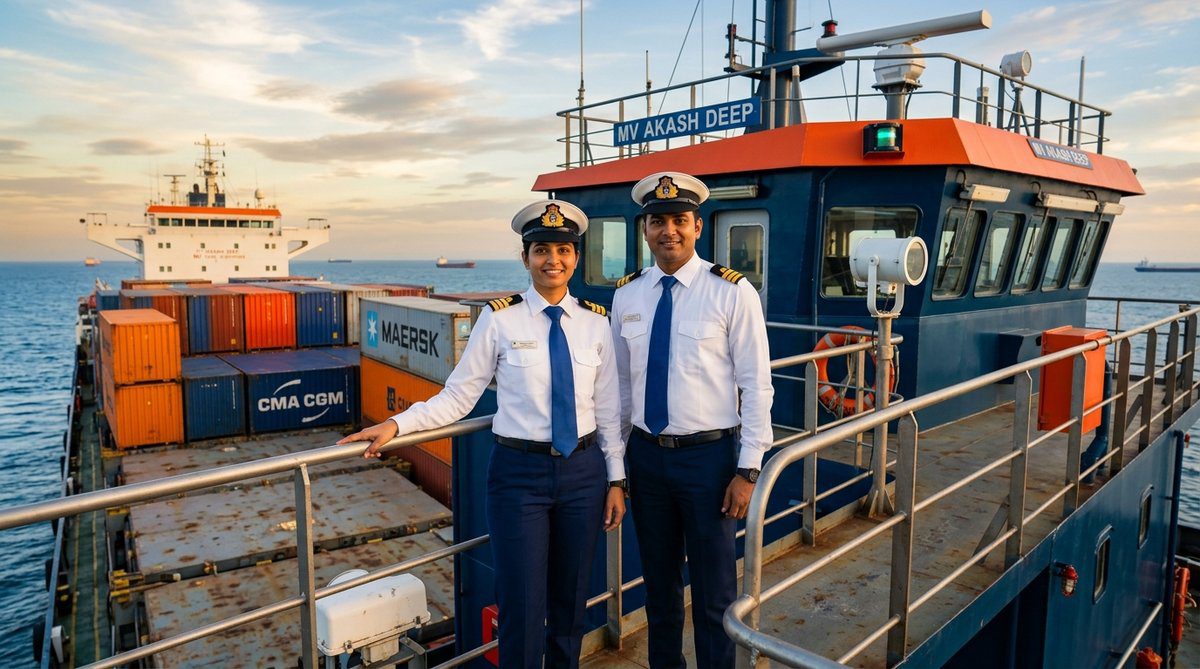
If you passed Class 10th and want to join the Merchant Navy without spending 3 or 4 years on a degree, the GP Rating Course is your fastest 6-month ticket to a life at sea.
This guide gives you the straight facts before you apply—covering entry requirements, realistic course fees (₹1.5L to ₹2.5L), starting salaries ($300 to $600 / ₹25k to ₹50k per month), promotion paths to officer ranks, and how to select DGMA approved maritime institutes.
What is a GP Rating Course?
The General Purpose (GP) Rating Course is a 6-month pre-sea residential training program approved by the Directorate General of Maritime Administration (DGMA).
Unlike specialized officer programs that train you only for navigation or engine engineering, GP Rating teaches you both Deck and Engine department work. This combined training makes you a versatile seafarer eligible to work as support crew on container ships, oil tankers, bulk carriers, and gas vessels across the world.
Once you pass your 6-month training and clear the exit exam conducted by the Board of Examinations for Seafarers (BES), DGMA issues your Continuous Discharge Certificate (CDC) so you can board commercial ships.
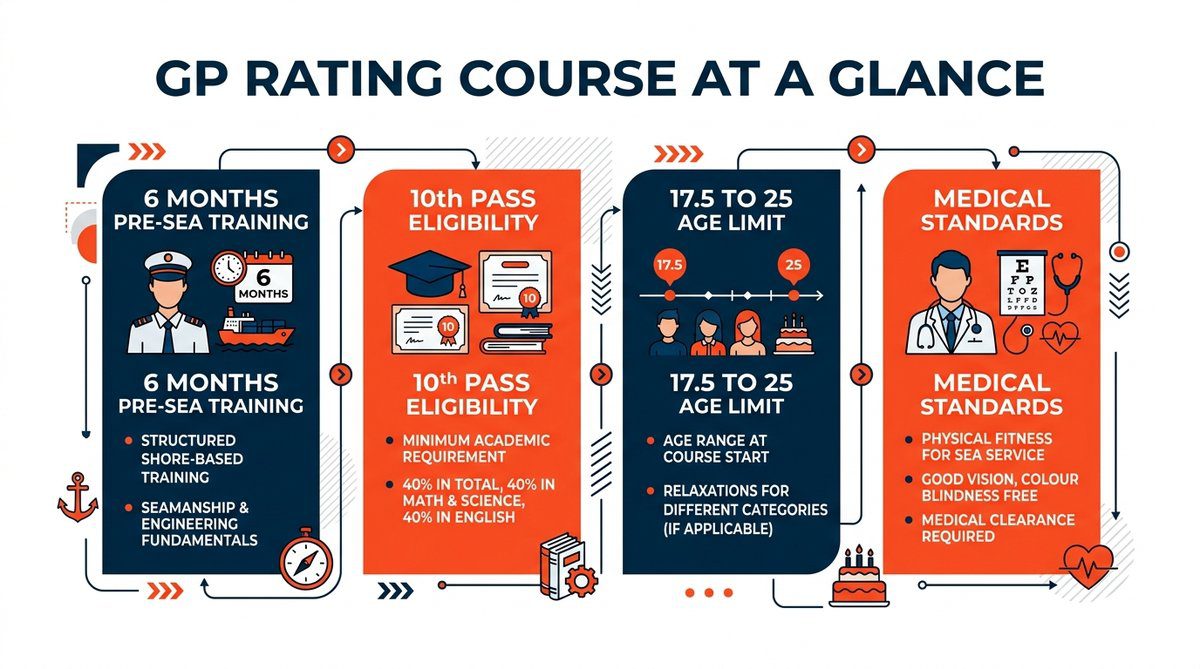
GP Rating Course at a Glance
| Key Feature | Quick Details |
|---|---|
| Course Name | General Purpose (GP) Rating Course |
| Training Duration | 6 Months (Residential Pre-Sea Training) |
| Department | Merchant Navy Support Rating (Deck & Engine) |
| Minimum Qualification | 10th Pass with 40% aggregate and 40% in English |
| IMU CET Required? | No (IMU CET is NOT required for GP Rating) |
| Age Criteria | 17.5 to 25 Years (SC/ST & OBC age relaxations apply) |
| Total Course Fee | ₹1.5 Lakhs – ₹2.5 Lakhs (Includes Food & Hostel) |
| Medical Standard | 6/6 Vision, No Color Blindness (Certified by a DGMA-approved doctor) |
| Starting Salary | Trainee Rating: $300 – $600 (₹25,000 – ₹50,000/mo) |
What Does a GP Rating Seafarer Do Onboard?
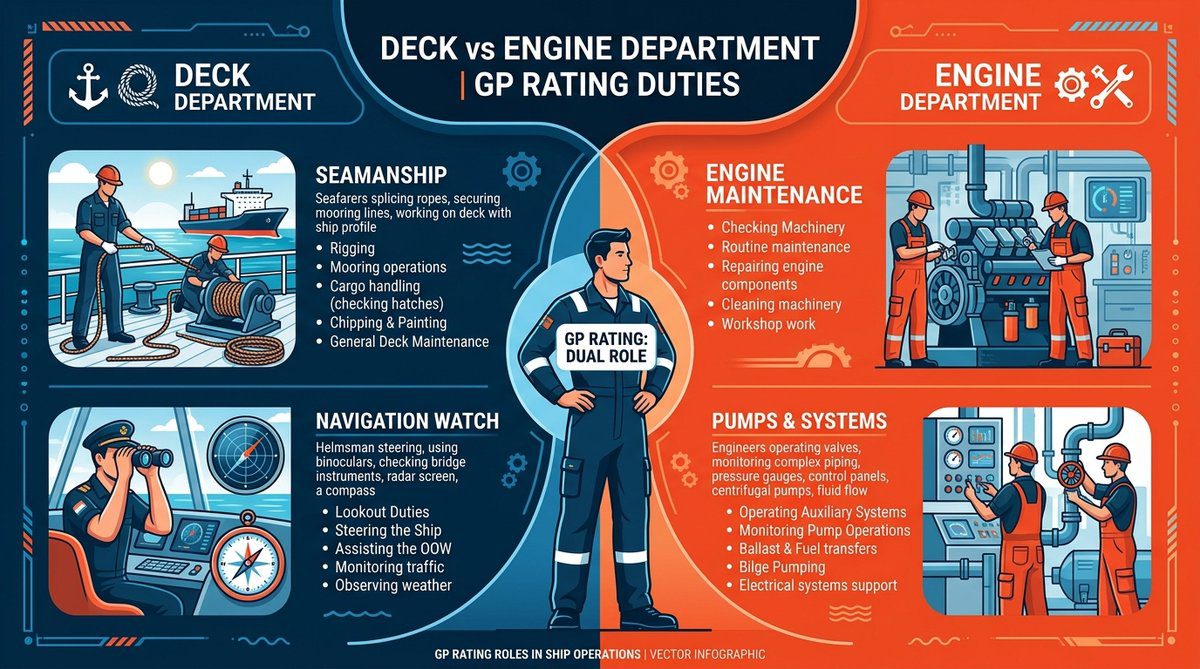
As a GP Rating, you work on ship maintenance, bridge watchkeeping, and engine operations alongside officers and engineers.
Deck Department Duties
- Steering the ship during sea navigation under officer supervision
- Standing watch on the bridge to keep a lookout for other vessels
- Handling ropes and winches during ship mooring and unmooring at ports
- Cleaning cargo holds, chipping off rust, and painting deck structures
- Operating deck cranes, cargo gear, and safety equipment
- Checking lifeboats, life rafts, and firefighting equipment regularly
Engine Department Duties
- Assisting marine engineers during main engine and auxiliary engine overhauls
- Reading engine room gauges, pressure meters, and oil temperatures
- Cleaning, oiling, and lubricating moving engine parts
- Running bilge pumps, fuel transfer systems, and air compressors
- Helping with workshop fitting, welding, and pipe repairs
- Keeping the engine room clean and free of oil leaks
Eligibility Criteria for GP Rating Course
Make sure you meet these official requirements set by DGMA before booking your admission:
1. Educational Qualification
- You must pass Class 10th (SSC) from a recognized state or central board.
- Minimum aggregate score of 40% in Class 10th.
- Minimum 40% in English in Class 10th or Class 12th.
- ITI holders (2-year trade), Diploma holders, and Graduates can also apply if their 10th marks meet the 40% criteria.
2. Age Criteria & Relaxations
- Minimum Age: 17.5 years on the course start date.
- Maximum Age: 25 years on the course start date.
- Age Relaxations: Up to 5 years for SC/ST applicants and up to 3 years for OBC applicants under DGMA Approved Maritime Courses.
3. Medical & Physical Standards
- Good physical health with no physical deformities.
- Normal hearing and clear speech.
- Eyesight: 6/6 vision in both eyes without glasses, with zero color blindness.
- You need a fitness certificate signed by an authorized DGMA-approved doctor.
- A valid Indian Passport is mandatory for course admission and CDC processing.
Key Identity Documents: INDOS Number & CDC
During your 6-month course, your academy registers you for two official documents issued under DGMA authority:
- INDOS Number (Indian National Database of Seafarers): An 8-digit unique ID assigned to every Indian seafarer on the DGMA portal.
- CDC (Continuous Discharge Certificate / Seaman Book): The official seafarer passport and sea service record book needed to work on ships worldwide.
Is IMU CET Exam Required for GP Rating?
Many students wonder if they have to write the IMU CET entrance exam for GP Rating.
No, IMU CET is NOT required for GP Rating.
IMU CET is mandatory only for officer courses like DNS (Diploma in Nautical Science) and B.Sc Nautical Science. For GP Rating, colleges admit students directly based on 10th marks, their own entrance tests, physical interviews, and medical fitness.
Admission Guidelines for Female Candidates
Women are welcome to join the Merchant Navy through the GP Rating course.
- Eligibility: Female candidates must meet the same academic marks and medical standards as male applicants.
- Scholarships: DGMA, NUSI Trust, and top colleges offer fee discounts and grants for female seafarers.
- Living Facilities: Modern cargo ships provide private, secure cabins and facilities for female crew members.
Pre-Sea Training & Mandatory STCW Courses
During your 6 months at a recognized maritime training institute, you get practical workshop experience and complete 5 mandatory STCW safety courses, including the Basic Safety Training Course (BST):
- Personal Survival Techniques (PST): Launching lifeboats, sea survival skills, and life jacket drills.
- Fire Prevention & Fire Fighting (FPFF): Fighting live fires using extinguishers, fire hoses, and breathing gear.
- Elementary First Aid (EFA): CPR, bandaging, and emergency medical aid.
- Personal Safety & Social Responsibilities (PSSR): Shipboard safety rules and team discipline.
- Security Awareness Training (STSDSD): Anti-piracy procedures and vessel security.
You also get hands-on practice in seamanship, rope splicing, fitting, arc welding, and lathe machine work.
GP Rating Course Fees & Cost Breakdown
A 6-month residential GP Rating Course costs between ₹1,50,000 and ₹2,50,000 depending on the academy’s infrastructure, workshop gear, and placement record.
Detailed Fee Breakdown
| Expense Head | Estimated Cost (INR) | What You Pay For |
|---|---|---|
| Tuition & Workshop Fee | ₹1,00,000 – ₹1,60,000 | Classroom teaching, simulator practice, workshop training |
| Hostel & Fooding Charges | ₹35,000 – ₹55,000 | Mandatory 6-month residential stay and 3 daily meals |
| Uniform & Books Kit | ₹10,000 – ₹18,000 | Uniforms, boilersuits, safety boots, and study material |
| STCW Safety Courses | Included in Package | PST, FPFF, EFA, PSSR & STSDSD certifications |
| Medical & CDC Fees | ₹5,000 – ₹8,000 | DGMA medical exam and government CDC application fees |
Always confirm the full fee structure directly with DGMA Approved Maritime Institutes before paying any booking amount.
Scholarships & Financial Assistance
If you need financial aid for your pre-sea training, check these avenues:
- NUSI / ITF Seafarers Welfare Trust: Educational grants for children of seafarers and deserving students.
- State Government Scholarships: Fee welfare schemes for SC, ST, OBC, and EWS candidates.
- Bank Education Loans: Leading public and private banks offer education loans for DGMA-approved pre-sea courses once you show your admission letter.
What Happens After Course Completion?
After passing your exit exams conducted by the Board of Examinations for Seafarers (BES), you receive your course certificate and apply for your Continuous Discharge Certificate (CDC) from DGMA.
Once your CDC arrives, you can apply for ship placements through verified RPSL companies to complete your mandatory sea service.
Watch Out for Fake Placement Agents: Never pay money to unauthorized agents promising instant CDCs or guaranteed ship jobs. Take admission only through recognized DGMA approved institutes and get placed via licensed RPSL companies.
Career Progression & Promotion Pathway
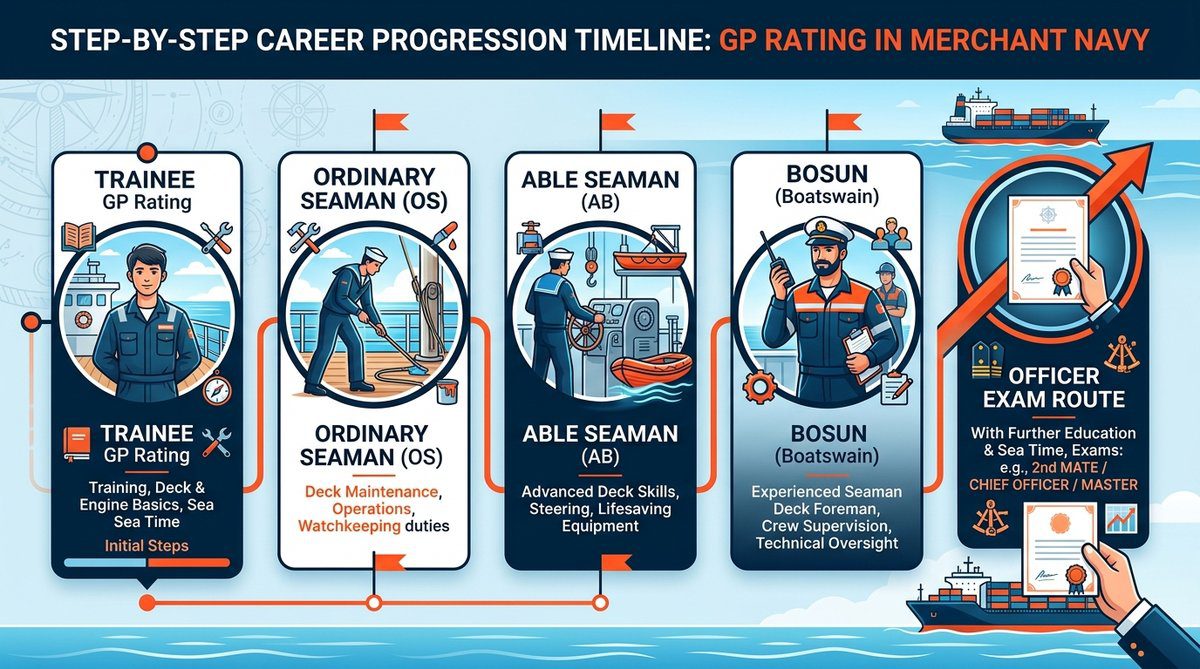
Here is how you grow from a trainee rating to higher ranks or officer roles:
Deck Department Career Path
- Trainee GP Rating / OS: Initial sea service phase (6 to 9 months).
- Ordinary Seaman (OS): Qualified deck rating assisting in watchkeeping and deck maintenance.
- Able Seaman (AB): Earned after 12 to 18 months of sea service and getting your Able Seafarer Deck COP.
- Bosun (Boatswain): The senior deck rating supervising all deck work.
- Third Officer (Officer Route): By passing Second Mate NCV / FG exams after required sea time.
Engine Department Career Path
- Trainee Engine Rating / Wiper: Initial engine room sea service phase.
- Wiper / Trainee Oiler: Assisting engineers in engine maintenance.
- Oiler / Motorman: Qualified engine rating monitoring main machinery.
- Fitter / Pumpman / Electrician: Specialized technical rating roles.
- Fourth Engineer (Officer Route): By passing Class IV Engineer exams after required sea service.
Salary After GP Rating Course (USD & INR Breakdown)
Merchant Navy seafarer wages are contracted in US Dollars (USD) as per ITF and DGMA agreements, but seafarers receive their salary in Indian Rupees (INR) or foreign currency.
Here is the rank-wise monthly salary breakdown in USD and INR:
| Rank / Position | Monthly Salary (USD) | Equivalent Monthly Salary (INR) | Primary Job Duties |
|---|---|---|---|
| Trainee GP Rating | $300 – $600 | ₹25,000 – ₹50,000 | Ship orientation, basic maintenance, and training |
| Ordinary Seaman (OS) | $700 – $1,200 | ₹58,000 – ₹1,00,000 (₹1 Lakh) | Deck watchkeeping, chipping, painting, and mooring |
| Wiper / Trainee Oiler | $700 – $1,200 | ₹58,000 – ₹1,00,000 (₹1 Lakh) | Engine room cleaning, oiling, and pump support |
| Able Seaman (AB) | $1,200 – $2,000 | ₹1,00,000 – ₹1,65,000 | Bridge steering, navigation watch, seamanship |
| Oiler / Motorman | $1,200 – $2,000 | ₹1,00,000 – ₹1,65,000 | Main engine watchkeeping, auxiliary machinery repair |
| Bosun / Pumpman | $2,000 – $3,200 | ₹1,65,000 – ₹2,65,000 | Leading deck rating, cargo pump operations |
Note: Salaries on specialized ships (such as oil/chemical tankers, gas carriers LNG/LPG, and offshore supply vessels) are higher. Earnings during international sea service qualify for NRI tax exemption under Indian tax laws.
Key Benefits of Joining GP Rating
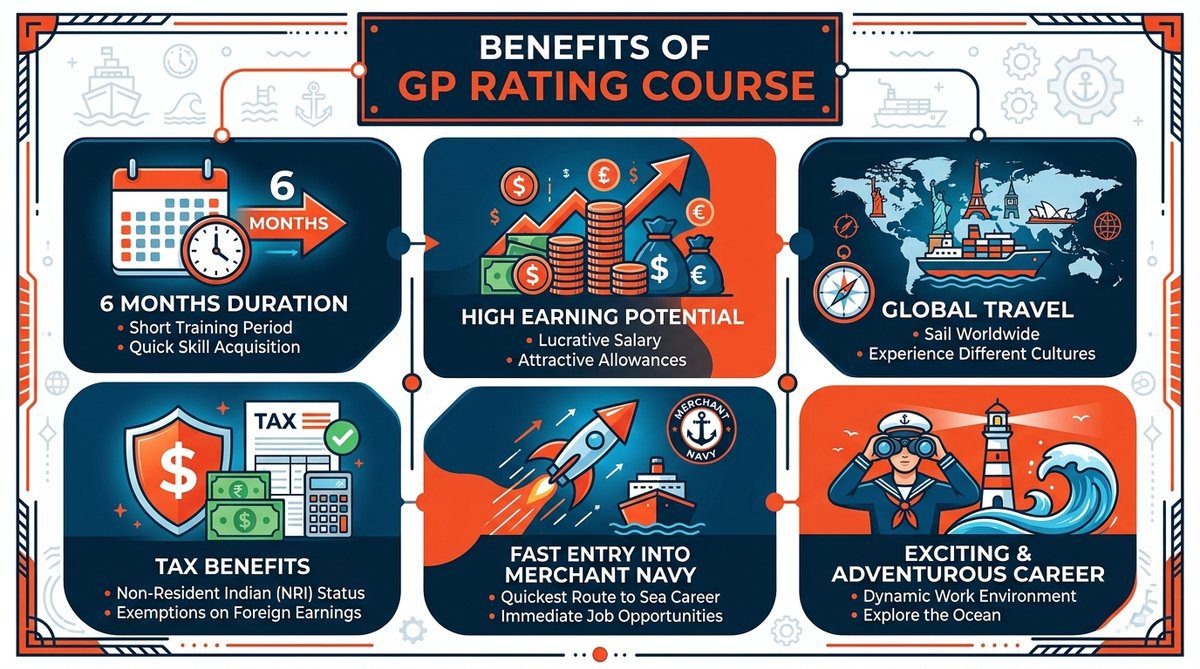
- Short 6-Month Course: Fastest entry into the Merchant Navy without spending years in college.
- Dual Department Skills: Training in both deck and engine doubles your job options onboard.
- Good Starting Pay: Opportunity to earn tax-free wages in foreign currency early in life.
- Free Stay & Meals: Free lodging, food, and medical care while working on ships.
- Officer Promotion Pathway: Clear route to appear for officer competency exams after acquiring sea time.
Top DGMA Approved GP Rating Institutes
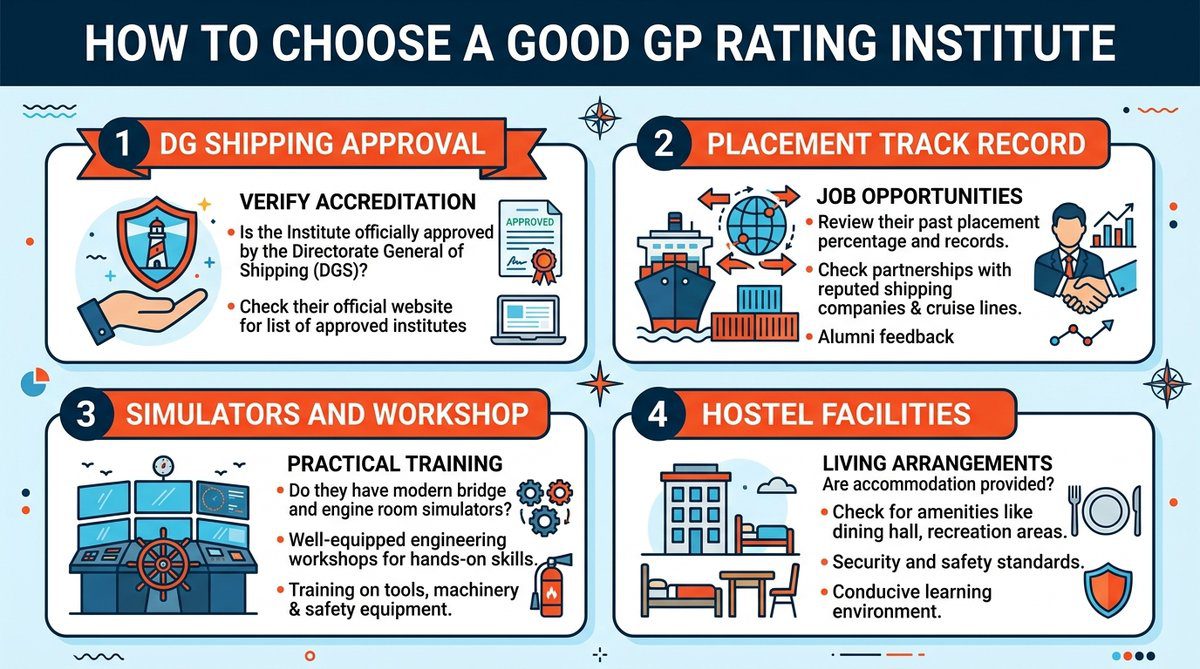
Always make sure your academy holds valid approval from DGMA before applying.
Top DGMA-approved academies offering the GP Rating Course in India include:
- NUSI Maritime Academy (Goa)
- Great Eastern Institute of Maritime Studies (GEIMS)
- T.S. Rahaman (Mumbai)
- AQUA-MARITIME Training Institute
- CMC Maritime Academy (Chennai)
- Mumbai Maritime Training Institute (MMTI)
Explore regional listings such as Maritime Training Institutes in Mumbai and Maritime Training Institutes in Tamil Nadu.
Course Comparison: GP Rating vs DNS vs CCMC
Here is a side-by-side comparison of popular Merchant Navy pre-sea courses to help you pick the right route:
| Parameter | GP Rating Course | DNS Course | CCMC Course |
|---|---|---|---|
| Full Form | General Purpose Rating | Diploma in Nautical Science | Certificate Course in Maritime Catering |
| Duration | 6 Months | 1 Year (Pre-Sea) | 6 Months |
| Eligibility | 10th Pass (40% PCM/Eng) | 12th PCM (60% aggregate) | 10th Pass (40% English) |
| IMU CET Exam | Not Required | Mandatory | Not Required |
| Department | Deck & Engine Support | Deck Officer Cadetship | Saloon / Catering |
| Starting Rank | Trainee Rating / OS / Wiper | Deck Cadet | Trainee Steward / Cook |
| Starting Salary | $300 – $600 (₹25k – ₹50k) | $300 – $800 (₹25k – ₹65k) | $300 – $500 (₹25k – ₹42k) |
5-Step Admission Checklist for Students
Follow this simple 5-step checklist before paying fees to any academy:
- Verify DGMA Approval: Check if the academy is listed under DGMA approved institutes.
- Medical Fitness Test: Get examined by a doctor to confirm 6/6 vision and zero color blindness under DGMA approved medical standards.
- Passport Application: Keep your Indian Passport ready for INDOS registration.
- Pass College Test & Interview: Clear the institute’s internal written test and physical interview.
- Check RPSL Placements: Ensure the academy has active tie-ups with licensed RPSL companies.
Frequently Asked Questions
What is the full form of GP Rating?
GP Rating stands for General Purpose Rating.
What is the duration of the GP Rating Course?
The GP Rating Course consists of 6 months of pre-sea residential classroom and practical workshop training.
Can a 10th pass student join the GP Rating Course?
Yes. Students who have passed 10th Standard with minimum 40% aggregate marks and 40% in English are eligible.
Is IMU CET exam required for GP Rating?
No. IMU CET is NOT required for GP Rating admissions. Selections are based on 10th marks, institute entrance tests, and medical fitness tests.
Can a GP Rating become an Officer in the Merchant Navy?
Yes. Ratings can appear for Officer Competency Examinations (Second Mate NCV/FG or Class IV Engineer) after acquiring mandatory sea time service and completing modular courses.
Is a passport mandatory for GP Rating admission?
Yes. A valid Indian Passport is mandatory for joining pre-sea training and obtaining the Continuous Discharge Certificate (CDC).
What is the average course fee for GP Rating in India?
The fee generally ranges between ₹1.5 Lakhs and ₹2.5 Lakhs for the 6-month residential pre-sea course.
Can female candidates apply for the GP Rating Course?
Yes. Eligible female candidates meeting 10th marks and medical standards can apply and receive special scholarships and concessions.
Are scholarships available for GP Rating students?
Yes. NUSI Welfare Trust grants, state government scholarships, and bank education loans are available for GP Rating students at approved institutes.
What is the starting salary of a GP Rating seafarer?
Trainee GP Ratings earn between $300 and $600 per month (₹25,000 – ₹50,000), which increases to $1,200 – $2,000+ per month upon promotion to Able Seaman (AB) or Oiler.