
DGMA approval for the MEO Class IV course requires a Maritime Training Institute to meet the infrastructure, faculty and quality-system standards in DGMA Training Circular No. 62 of 2026, pay a ₹75,000 processing fee, and clear an inspection by the jurisdictional MMD before running any batch of the newly mandatory MEO Class-IV Preparatory Course.
DGMA issued this circular on 23 September 2026, and it exists because of an earlier decision. Under DGMA EAC Branch Circular No. 49 of 2026, the MEO Class-IV Preparatory Course became compulsory for candidates appearing on or after 1 January 2027. Once a course becomes mandatory, every institute that wants to teach it needs its own separate sign-off, and Circular 62 spells out exactly what that sign-off demands.
If you run a maritime training institute, or you’re deciding where to enrol once this course opens, here’s what actually matters in the guidelines.
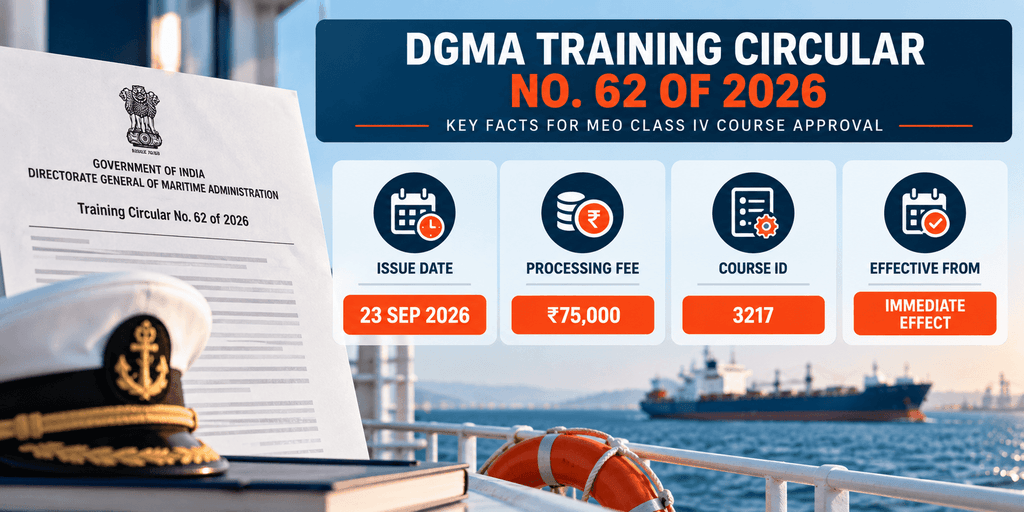
What Is DGMA Training Circular No. 62 of 2026?
| Detail | Information |
| Circular Number | DGMA Training Circular No. 62 of 2026 |
| File Number | F.No.20/1/2020-O/o TRG-DGS (C.No.1865) |
| Issuing Authority | Directorate General of Maritime Administration (DGMA) |
| Ministry | Ministry of Ports, Shipping and Waterways, Government of India |
| Issue Date | 23 September 2026 |
| Subject | Guidelines for the conduct of the MEO Class-IV Preparatory Course |
| Course ID | 3217 |
| Processing Fee | ₹75,000 |
| Effective From | Immediate effect, from date of issue |
| Signed By | Mugilrajan D., Engineer & Ship Surveyor-cum DDG (Tech.), Training Branch, DGMA Mumbai |
The circular itself is short. The real substance sits in Annexure A, the actual guidelines document, plus Annexure B (a reading list for the institute library) and Annexure C (a declaration form for institutes applying under the fast-track route). Everything below works through Annexure A section by section.
Why Do MTIs Need Separate DGMA Approval for the MEO Class-IV Course?
Holding a general MEO course approval doesn’t cover this one. DGMA treats MEO Class-IV as a brand new course requiring its own approval, even for institutes that already run MEO Class-I or Class-II batches.
That’s consistent with how DGMA rolled out the underlying mandate. Circular 49 of 2026 made this course a hard prerequisite for the MEO Class-IV exam, and DGMA made clear at the time that institutes would need to apply separately before running batches. Circular 62 is that separate approval process, published to make sure institutes have somewhere to send their paperwork before the January 2027 compliance date arrives.
Which MTIs Are Eligible to Apply for MEO Class-IV Course Approval?
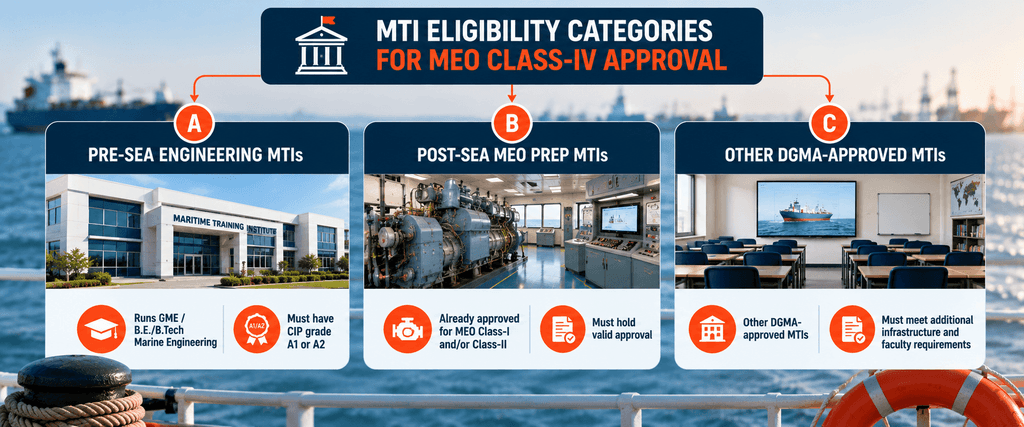
The guidelines split applicant institutes into three categories, and which one you fall into decides how fast your approval can move.
| Category | Who Qualifies | Extra Condition |
| A: Pre-Sea Engineering MTIs | Institutes running the Graduate Marine Engineering (GME) course or a B.E./B.Tech Marine Engineering course | Must hold a Comprehensive Inspection Programme (CIP) grade of A1 or A2 |
| B: Post-Sea MEO Prep MTIs | Institutes already DGMA-approved for MEO Class-I and/or Class-II Preparatory Courses | Must fulfil every Annexure A requirement for the new course |
| C: Other Eligible MTIs | Any other institute conducting DGMA-approved maritime training courses | Applies online to the Training Branch; gets no automatic interim approval |
Every institute, regardless of category, has to comply with the full set of infrastructure, faculty, training-delivery, quality-assurance, assessment, inspection and reporting requirements in Annexure A, plus anything else DGMA prescribes later.
Important: qualifying under Category A, B or C doesn’t guarantee approval. It just means you’re allowed to apply. No MTI can legally start or continue running the MEO Class-IV course without a permission that DGMA has actually granted.
What Entry Standards and Attendance Rules Apply to Candidates?
The MTI carries the job of verifying two things before admitting anyone: the candidate has completed the qualifying sea service needed for the MEO Class-IV exam, backed by proper documentary proof, and the detailed eligibility criteria match what’s laid out in DGMA Circular 49 of 2026, Part B (IV).
Attendance rules follow DGMA’s standard for any post-sea course longer than five days: a minimum of 90%. Fall below that and the candidate doesn’t get a Course Completion Certificate. There’s no partial credit either. A candidate who misses too many classes has to sit through the entire course again from the start.
Batch size matters too. Intake can’t exceed 40 candidates per batch, and it has to stay within whatever capacity DGMA has actually approved for that institute, with a hard ceiling of three candidates per desk.
What Infrastructure Does DGMA Require From the MTI?
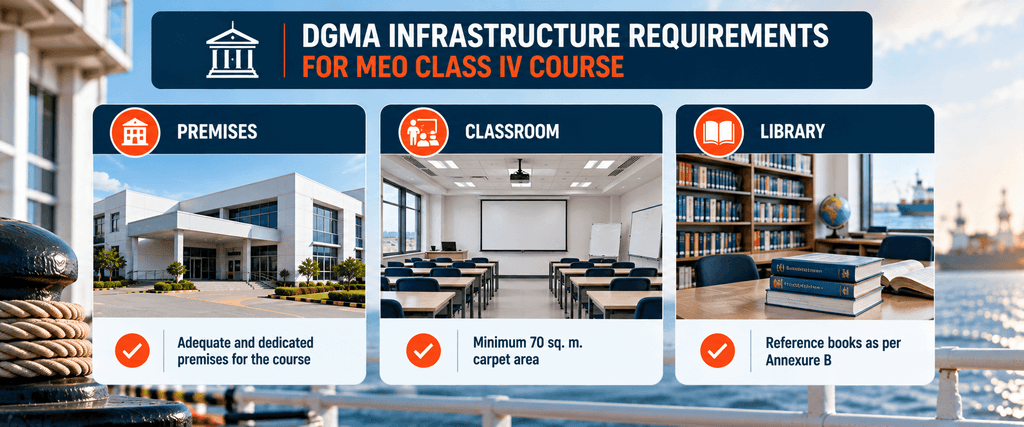
Premises need to be held on a lease of at least three years, with a renewal option for another three, or owned outright by the institute. Construction has to be pucca, with air-conditioning wherever classroom temperatures can cross 30°C and heating wherever they can drop below 15°C. Toilet facilities need to work out to at least one unit per 40 candidates.
Classroom space scales with your approved intake, on this fixed scale:
| Approved Batch Intake | Minimum Classroom Carpet Area |
| 20 candidates | 30 sq. m |
| 24 candidates | 36 sq. m |
| 40 candidates | 50 sq. m |
A separate library-cum-reading room is mandatory too, at least 36 sq. m, with a minimum of three internet-connected workstations running standard office software, and stocked with the reference titles listed in Annexure B (a mix of marine engineering, electro-technology, ship construction and STCW reference works).
How Long Is the Course, and Where Is the Full Syllabus?
The course runs entirely in person. No online or hybrid delivery is allowed. It covers four weeks, 20 working days and 120 contact hours, and every batch has to start on the first working day of the month.
The syllabus itself isn’t reprinted inside Circular 62. It lives in Annexure I of the earlier Circular 49 of 2026, and we’ve broken that syllabus down subject by subject, including the ship construction, engineering knowledge, electro-technology and workshop practice blocks, in our MEO Class-IV Preparatory Course syllabus guide.
What Faculty Qualifications Does DGMA Require?
Your Course-in-Charge has to be a permanent employee of the institute, holding a Chief Engineer Officer (MEO Class-I) CoC, with at least five years’ sea service, a minimum of one year served as Chief Engineer or Second Engineer, and at least three years of teaching experience across pre-sea or post-sea courses. They also need to have completed the Assessment, Examination and Certification of Seafarers (AECES) course, since they’re the one responsible for internal assessment and examination.
Regular faculty need qualifications that match what they’re actually teaching:
| Subject Area | Minimum Faculty Qualification |
| Marine engineering subjects | MEO Class-I CoC |
| Electrical, electronic and control engineering subjects | MEO Class I |
| Navigation, seamanship, safety and related subjects | MEO Class I or Master Mariner (FG) CoC |
| Naval architecture, ship construction and related subjects | MEO Class I, Master (FG), or a degree/professional qualification in Naval Architecture |
Every faculty member, full-time or visiting, needs a minimum of five years’ relevant sea-going experience and at least one year teaching pre-sea or post-sea courses. Visiting faculty are held to the exact same bar as regular faculty, not a lighter one.
Two more conditions apply across the board. Everyone teaching this course, including the Course-in-Charge, must have completed either the Training of Trainers and Assessors (TOTA) course or the Vertical Integration Course for Trainers (VICT). And the institute needs at least three faculty members in total, with half or more engaged full-time.
One thing worth flagging honestly: Annexure A doesn’t specify an exact maximum age for faculty in this circular. It just points institutes toward whatever age limits are set in the applicable DGMA circulars, orders and guidelines as amended from time to time, so check the current version rather than assuming a fixed number.
What Are the Holiday and Course-Completion Rules?
Sundays are holidays. Independence Day and Republic Day are compulsory holidays. State government holidays applicable to where the institute sits are normally observed too.
None of that shrinks the course, though. Because the 20 working days and 120 contact hours are both fixed, any holiday that falls during a batch has to be made up with an extra working day. Candidates can’t sit their final assessment until the full 120 hours are actually delivered.
What Quality Standards Must the MTI Maintain?
Institutes have to comply with the existing quality-standards framework for maritime training institutes, set out in DGS Order No. 05 of 2016 and DGS Circular No. 23 of 2020 (“Quality Standards System of Maritime Training Institutes”), as amended.
There’s a specific deadline attached to the MEO Class-IV course: within six months of running the first DGMA-approved batch, the institute must have a quality-management system in place that conforms to the latest applicable ISO standard, or an approved equivalent, with documented procedures covering delivery, attendance, assessment, candidate-eligibility checks and record-keeping.
How Is the Course Assessed, and What Happens If a Candidate Fails?
Every batch ends with a final assessment combining written and oral components, built around the approved syllabus and the competencies expected at MEO Class-IV level. The written paper tests theoretical understanding. The oral component checks whether a candidate can actually explain and apply what they’ve learned, not just recall it.
Institutes have to keep proper records of every candidate’s results. A candidate who doesn’t clear the final assessment has to reappear and pass before a Course Completion Certificate gets issued. There’s no fallback route around that.
What Happens During DGMA Inspection?
Inspections, whether scheduled or a surprise visit, follow the disciplinary framework in DGS Order No. 05 of 2016. Deficiencies get sorted into major or minor categories under that same order, and any withdrawal of approval, whether temporary, course-specific, institute-wide, or immediate, follows a formal show-cause process before it’s confirmed. The Director General is the final authority on that decision.
Here’s a detail institutes sometimes miss when budgeting for approval: every inspection cost, scheduled or unscheduled, is billed to the institute. DGMA doesn’t absorb any of it.
What Fees Does an MTI Pay for MEO Class-IV Course Approval?
| Fee Type | Amount | When It’s Due |
| Course approval processing fee | ₹75,000 | With the initial application |
| Annual government contribution | 1% of the previous financial year’s total fees collected, minimum ₹10,000 | On or before 31 May each year |
| Penal interest on late payment | 18% per annum | Applies once the 31 May deadline passes |
| Risk of suspension | Approval can be suspended | If the contribution stays unpaid past 31 July |
| Inspection costs | Full cost, every time | Borne entirely by the institute |
The ₹75,000 processing fee is specific to getting MEO Class-IV approval in the first place. The annual 1% contribution is a separate, ongoing obligation that applies under DGS Order No. 05 of 2016 regardless of which courses an institute runs.
How Can Category A or B Institutes Get Interim Approval?
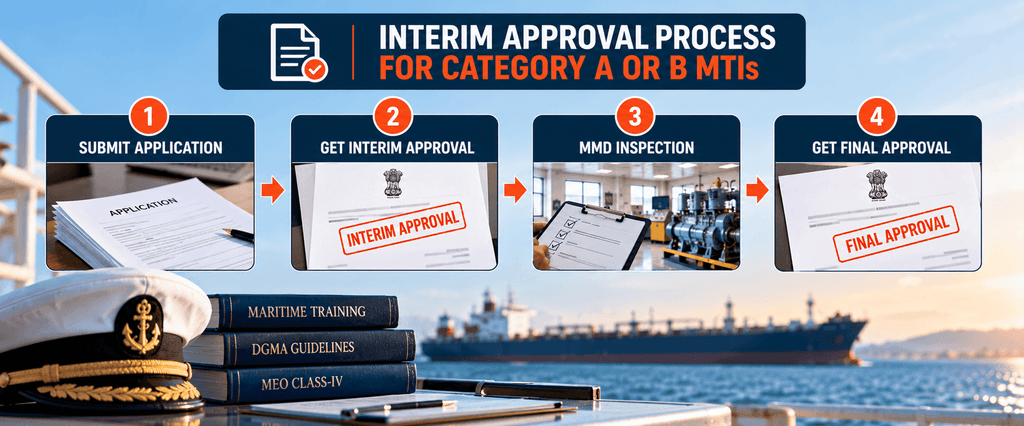
If your institute already holds valid DGMA approval for a Category A or Category B course, you don’t have to wait for a full inspection before starting your first MEO Class-IV batch. Here’s the sequence:
- Confirm your existing approval fits Category A or B. That means either a pre-sea GME/B.E./B.Tech Marine Engineering course with an A1 or A2 CIP grade, or an existing MEO Class-I/Class-II Preparatory Course approval.
- Complete the Annexure C declaration. Your Principal signs it, listing every course the MTI currently holds approval for, along with the institute’s CIP grading for both pre-sea and post-sea competency courses.
- Submit the declaration to the Training Branch, along with the ₹75,000 processing fee.
- Receive interim permission to start running MEO Class-IV batches while the formal approval process continues in the background.
- Present the institute to the jurisdictional MMD for the mandatory inspection, within six months of your application date.
- Clear the inspection to convert interim permission into full approval. Miss that six-month window, and the institute can’t run any further batches until it does.
In practice, institutes that already run MEO Class-I or Class-II batches tend to move through this route faster, mainly because their faculty records and library documentation are already on file with the Training Branch.
How Should Category C Institutes Apply?
If your institute doesn’t fall under Category A or B, but you already conduct other DGMA-approved maritime training courses, you apply online to the Training Branch directly. There’s no interim or conditional permission available on this route. You follow DGMA’s regular new-course approval procedure in full, inspection included, before you’re allowed to run your first batch.
Annexure A doesn’t spell out a fixed processing timeline for Category C applications, so it’s worth budgeting extra lead time if your institute is going in fresh rather than building on an existing MEO approval.
Checklist: Is Your MTI Ready to Apply for DGMA MEO Class-IV Course Approval?
- Course-in-Charge holds an MEO Class-I CoC, five years’ sea service, at least one year as Chief or Second Engineer, three years’ teaching experience, and a completed AECES course
- At least three faculty members on record, with 50% or more engaged full-time
- Every faculty member holds the qualification matching their subject, plus five years’ sea experience and one year’s teaching experience
- All faculty, including the Course-in-Charge, have completed TOTA or VICT
- Classroom carpet area matches your intended batch intake
- Dedicated library-cum-reading room of at least 36 sq. m, with three internet-connected workstations and the Annexure B reading list
- Premises held on a qualifying lease or ownership, with air-conditioning and heating arrangements as needed
- A plan to establish an ISO-equivalent quality-management system within six months of your first batch
- ₹75,000 processing fee ready, along with the correct application route for your category
- Annexure C declaration prepared and signed, if applying under the Category A or B interim route
Where Can Candidates Take the DGMA-Approved MEO Class-IV Course?
Only institutes holding current, specific DGMA approval for this course can run it. Before enrolling, cross-check the institute against DGMA’s own approved list, or use Indo Search’s directory of DGMA-approved maritime training institutes and the list of DGMA-approved maritime training courses.
One mix-up worth clearing up here: this Preparatory Course is not the same as the ETO to MEO Class IV CoC transition pathway. That route, covered under a separate circular, is a three-month bridging course built specifically for certified ETOs crossing over from Regulation III/6 to III/1, and it follows its own bridging course syllabus. If you’re a direct-entry candidate rather than an ETO transitioning across, the one-month Preparatory Course covered in this guide is the one that applies to you.
Since Circular 62 was only issued on 23 September 2026, DGMA hadn’t yet published a dedicated online application form for this specific approval at the time of writing. Institutes should check the DGMA website directly for the current submission process before assuming the standard e-Governance course-approval flow applies unchanged.
FAQs
How much does DGMA charge to approve the MEO Class-IV Preparatory Course?
₹75,000, paid as a one-time processing fee with the application. That’s separate from the annual 1% government contribution every DGMA-approved institute already pays under DGS Order No. 05 of 2016.
What is the course ID for the MEO Class-IV Preparatory Course?
3217. Institutes will need this ID on their application and in their e-Governance records once approved.
Can an MTI run the MEO Class-IV course online or in a hybrid format?
No. Annexure A requires the course to run entirely in person, classroom-based, across 20 working days and 120 contact hours. There’s no provision for remote or blended delivery.
Does an existing MEO Class-I or Class-II approval automatically cover MEO Class-IV?
No. Even institutes already approved for the MEO Class-II or MEO Class-I Preparatory Courses fall under Category B and still need to apply separately for MEO Class-IV approval, though they can use the faster interim-approval route.
What happens if an institute misses the six-month inspection deadline after getting interim approval?
It can’t conduct any further MEO Class-IV batches beyond that six-month window until the inspection is completed and full approval is granted.
Who pays for DGMA’s inspection of the institute?
The institute does, in full, whether the inspection is scheduled in advance or turns up unannounced.
Does an MTI need ISO certification before applying?
Not before applying, no. But the institute has to establish an ISO-equivalent quality-management system within six months of running its first DGMA-approved MEO Class-IV batch.
Can a pre-sea GME or B.E./B.Tech Marine Engineering institute apply for this approval?
Yes, under Category A, provided the institute has already completed its Comprehensive Inspection Programme (CIP) inspection with an A1 or A2 grade.
Is the MEO Class-IV Preparatory Course the same as the ETO to MEO Class-IV Bridging Course?
No. They run under different circulars, serve different candidates, and differ in length. The Preparatory Course is one month for direct-entry candidates; the Bridging Course is three months, built specifically for certified ETOs.
How can I check if a specific institute is approved to run the MEO Class-IV course?
Check DGMA’s own published list of approved institutes and courses, or search Indo Search’s directory of DGMA-approved maritime training institutes before enrolling or paying any fees.