
The ETO to MEO Class IV bridging course syllabus, set out in Annexure I of DGMA Circular No. 50 of 2026, covers 15 subjects across 360 contact hours over three months. It covers 15 subjects, from Marine Engineering Practice to Workshop Skills through Videos, Case Studies and Practical Demonstrations, with assessment through written examinations, tutorials, assignments, engineering calculations, case-study analysis and viva-voce.
That is the shape of it. If you already know you are eligible for the transition and just want to know what you will actually be studying, this is the article for the syllabus itself. For the eligibility rules, sea service, and exam pathway around it. For the complete eligibility rules, sea service requirements, and examination pathway, see our ETO to MEO Class IV CoC pathway.
What Is Annexure I of DGMA Circular No. 50 of 2026?
Annexure I is the part of the circular that spells out exactly what the Bridging Course has to teach. The course itself runs for three months, structured as 12 weeks, 60 working days, and 360 contact hours.
The course is classroom based. DGMA requires it to be delivered through multimedia presentations, machinery operation videos, technical animations, case studies, engineering calculations, tutorials, and interactive discussion, rather than pure lecture time. One line in the circular is easy to miss but important: the Engine Room Simulator (Operational Level) course is not part of this syllabus. We come back to why later in this guide.
How Many Subjects and Hours Does the Syllabus Cover?
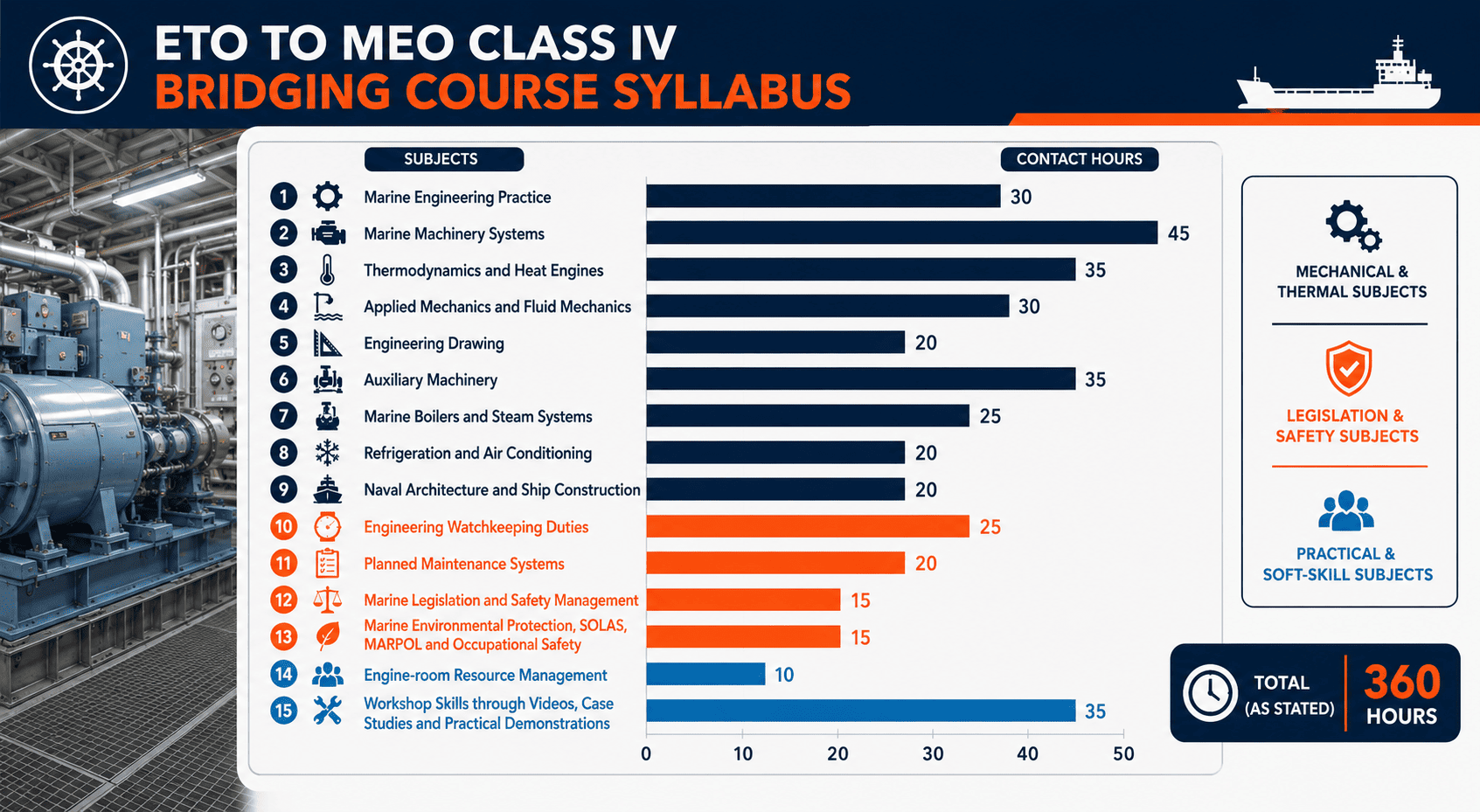
Here is the full subject list exactly as it appears in Annexure I.
| No. | Subject | Hours |
| 1 | Marine Engineering Practice | 30 |
| 2 | Marine Machinery Systems | 45 |
| 3 | Thermodynamics and Heat Engines | 35 |
| 4 | Applied Mechanics and Fluid Mechanics | 30 |
| 5 | Engineering Drawing | 20 |
| 6 | Auxiliary Machinery | 35 |
| 7 | Marine Boilers and Steam Systems | 25 |
| 8 | Refrigeration and Air Conditioning | 20 |
| 9 | Naval Architecture and Ship Construction | 20 |
| 10 | Engineering Watchkeeping Duties | 25 |
| 11 | Planned Maintenance Systems | 20 |
| 12 | Marine Legislation and Safety Management | 15 |
| 13 | Marine Environmental Protection, SOLAS, MARPOL and Occupational Safety | 15 |
| 14 | Engine-room Resource Management | 10 |
| 15 | Workshop Skills through Videos, Case Studies and Practical Demonstrations | 35 |
| Total (as stated in the circular) | 360 |
A discrepancy appears in Annexure I. The individual subject hours add up to 380 hours, while the Annexure expressly states a total of 360 contact hours. The circular does not explain the difference, so the discrepancy should be confirmed with DGMA or the approved MTI before relying on the subject-wise total for course planning.
What Does Each Subject in the Syllabus Actually Cover?
Each subject below carries its own contact hours and its own mix of theory and video-based practical demonstration. Here is what each one actually includes.
Marine Engineering Practice (30 Hours)
This is your introduction to how a modern engine room is organised. It covers engine-room layout, propulsion arrangements, shafting, bearings, couplings, propellers, stern tube arrangements, piping systems, engineering terminology, materials, fasteners, seals, gaskets, and maintenance philosophy. Videos cover engine-room layouts and maintenance procedures.
Marine Machinery Systems (45 Hours)
At 45 hours, this is the single biggest subject in the syllabus, and it is also the subject furthest from typical ETO training. It covers two-stroke and four-stroke diesel engines, fuel injection, combustion, scavenging, turbochargers, starting air systems, crankshafts, bearings, pistons, cylinder liners, lubrication, cooling, exhaust systems, and propulsion shafting. Video demonstrations cover engine overhauls, piston withdrawal, and turbocharger maintenance.
Why This Subject Gets the Most Hours
An ETO’s original training barely touches diesel engine mechanics. Marine Machinery Systems is where most of that gap gets closed, which is exactly why it carries more hours than any other subject on the list.
Thermodynamics and Heat Engines (35 Hours)
This subject covers gas laws, properties of steam, and the First and Second Laws of Thermodynamics. It also covers the Diesel, Otto, Dual, and Rankine Cycles, heat transfer, combustion, heat exchangers, condensers, evaporators, and thermal efficiency. Videos cover combustion processes and steam plant operation.
Applied Mechanics and Fluid Mechanics (30 Hours)
Here you cover engineering mechanics, statics, dynamics, stress, strain, torsion, bending moments, vibration, and balancing. You also cover shaft alignment, Bernoulli’s equation, fluid flow, cavitation, centrifugal and positive displacement pumps, valves, bilge systems, and ballast systems. Classroom time includes engineering calculations and problem-solving exercises.
Engineering Drawing (20 Hours)
This covers drawing principles, orthographic projection, sectional and assembly drawings, piping diagrams, hydraulic schematics, engineering symbols, and tolerances. The practical component is interpretation, reading and understanding manufacturers’ machinery drawings and piping layouts, rather than producing your own drawings from scratch.
Auxiliary Machinery (35 Hours)
This subject covers pumps, compressors, air bottles, purifiers, freshwater generators, oily water separators, sewage treatment plants, incinerators, steering gear, deck machinery, windlasses, mooring winches, and heat exchangers. Videos cover dismantling, overhaul, inspection, and testing procedures for this equipment.
Marine Boilers and Steam Systems (25 Hours)
This covers auxiliary and exhaust gas boilers, steam generation, boiler mountings, water treatment, combustion control, steam distribution, feed water systems, steam traps, safety devices, and boiler surveys. Videos cover lighting-up, steam raising, soot blowing, and shutdown procedures. If your onboard training later gives you no boiler watchkeeping experience, this subject becomes the foundation for a separate mandatory boiler course before your exams.
Refrigeration and Air Conditioning (20 Hours)
This subject covers refrigeration principles, refrigerants, compressors, condensers, evaporators, thermostatic controls, provision plants, air-conditioning, ventilation, humidity control, and fault diagnosis. Videos cover compressor overhaul, leak detection, and charging procedures.
Naval Architecture and Ship Construction (20 Hours)
This covers ship terminology, hydrostatics, stability, trim, subdivision, watertight integrity, framing systems, bulkheads, double bottom construction, shaft tunnels, rudders, dry docking, and corrosion. Ship construction animations and videos support classroom discussion throughout.
Engineering Watchkeeping Duties (25 Hours)
This subject teaches the actual duties and responsibilities of an Officer in Charge of an Engineering Watch under STCW Regulation III/1. It covers watchkeeping principles, Unattended Machinery Spaces, machinery monitoring, engine-room rounds, logbook entries, alarm management, emergency procedures, and watch handover. Videos cover both normal and emergency watchkeeping situations.
How This Ties Into Your Onboard Training
This is the classroom half of a skill you will then practise for real during your 6 or 9 months of supervised onboard training. What you learn here is what your Chief Engineer will actually be assessing once you are onboard.
Planned Maintenance Systems (20 Hours)
This covers PMS philosophy, maintenance scheduling, condition monitoring, machinery history records, spare parts management, vibration monitoring, lubrication management, dry-docking preparation, and defect reporting. You also get an introduction to computerised PMS platforms used on modern ships.
Marine Legislation and Safety Management (15 Hours)
This subject covers the Merchant Shipping Act, the STCW Convention, the ISM Code, the ISPS Code, and MLC, 2006. It also covers statutory surveys, flag State and classification society requirements, safety management systems, permit-to-work procedures, risk assessment, and enclosed space entry. It is compliance-heavy and legislation-focused rather than hands-on.
Marine Environmental Protection, SOLAS, MARPOL and Occupational Safety (15 Hours)
This covers SOLAS requirements for machinery spaces, MARPOL Annexes I to VI, the Ballast Water Management Convention, and the Anti-Fouling Systems Convention. It also covers the Oil Record Book, garbage and sewage management, emission control, and occupational health and safety, including permit-to-work and lock-out and tag-out procedures. Videos of real machinery accidents and environmental incidents are used for group discussion.
Engine-room Resource Management (10 Hours)
At just 10 hours, this is the shortest subject, but it is not filler. It covers leadership, communication, teamwork, situational awareness, workload management, decision making, fatigue management, and bridge-to-engine-room communication, built around case studies of real marine casualties.
Workshop Skills through Videos, Case Studies and Practical Demonstrations (35 Hours)
This is the second-largest subject by hours. It covers bench fitting, measuring instruments, shaft alignment, bearing inspection, valve overhaul, pump maintenance, gasket making, and pipe fitting. It also covers mechanical seals, coupling alignment, welding awareness, turbocharger overhaul, purifier maintenance, and boiler maintenance.
How Do You Learn Workshop Skills Without a Workshop?
Since the Bridging Course is classroom based, DGMA delivers this subject through high-definition instructional videos, 3D animations, and manufacturer maintenance videos rather than hands-on bench time. It is a reasonable trade-off given the course’s compressed three-month format. It also means the real test of your workshop competence still comes later, through your onboard training and your TAR Book, not through the classroom alone.
How Is the Bridging Course Assessed?
Assessment runs continuously through the course rather than sitting at the very end. It combines written examinations, tutorials, assignments, engineering calculations, case-study analysis, and viva-voce.
| Assessment Requirement | Minimum Needed |
| Written examination score | 60% |
| Overall aggregate score across all assessment components | 60% |
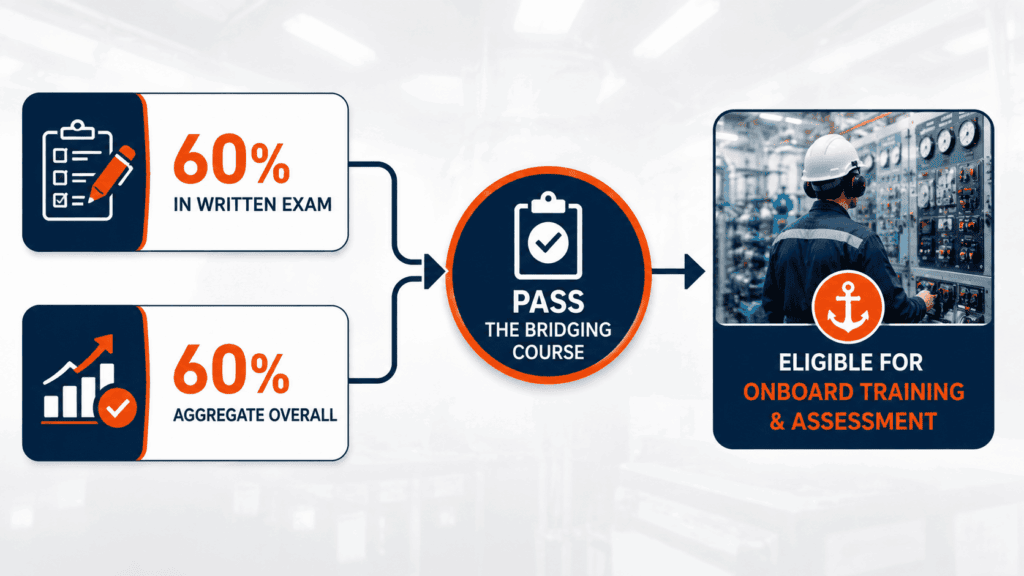
Miss either threshold and you have not completed the course, regardless of how well you did on the parts you did pass. Both numbers matter independently.
What Happens After You Pass?
Passing the Bridging Course does not hand you a MEO Class IV CoC on its own. It opens the door to the next stage: 6 or 9 months of supervised onboard training, recorded in your TAR Book, followed by your Part-A and Part-B examinations. We walk through that entire sequence, including the sea service math behind the 6-month and 9-month tracks.
Why Isn’t the Engine Room Simulator Course Part of This Syllabus?
This confuses a lot of candidates, so it is worth being direct about it. The Engine Room Simulator (Operational Level) course is a separate, standalone requirement under the main circular. It is not counted inside the 360 contact hours above, and it does not appear anywhere in the Annexure I subject list.
There is also a timing rule attached to it that has nothing to do with the syllabus itself. You can only take the Engine Room Simulator course after you finish your mandatory sea service. You cannot take it during the Bridging Course, and you cannot take it before either one. Budget for it as a fourth, separate box to tick, alongside the syllabus, your sea service, and your onboard training.
Why Does the Syllabus Focus So Heavily on Mechanical and Thermal Subjects?
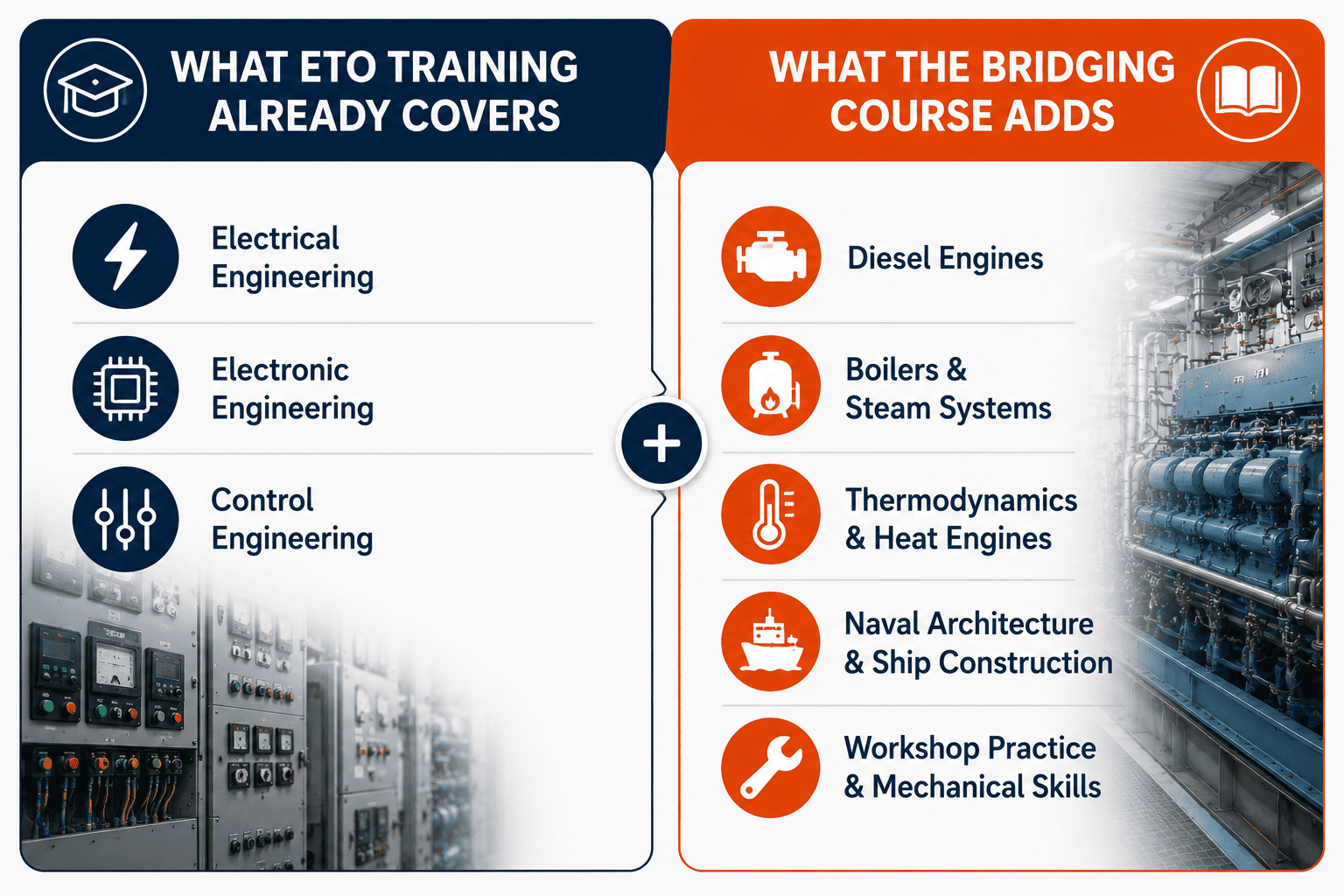
If you already work as an ETO, this syllabus can look strange at first glance. There is no dedicated subject for AC and DC circuit theory, no module on switchboards, no deep dive into automation, none of the electro-technical territory you already know cold. That is not an oversight.
The Bridging Course exists to close a specific, narrow gap: everything an ETO has not already studied on the way to a Regulation III/6 certificate, but that a Regulation III/1 watchkeeper needs. That is diesel engines, boilers, thermodynamics, naval architecture, workshop mechanics, and engine-room legislation, subjects that barely feature in ETO training at all. Your existing electro-technical knowledge is assumed, credited, and left alone. The 360 hours go almost entirely toward the mechanical and thermal ground you have not covered yet.
Where Can You Take This Course?
The Bridging Course has to be run by a DGMA-approved Maritime Training Institute, not any general marine training provider. Before you enrol, confirm three things:
- The institute is currently on the approved list.
- It is approved specifically for the ETO to MEO Class IV Bridging Course, not only for the standard MEO Class IV Preparatory Course.
- Its current batch dates fit around your sea service and contract plans.
If you are weighing this against the standard route into MEO Class IV, our guide to the DGMA MEO and ETO Preparatory Courses and our MEO Class IV Preparatory Course syllabus breakdown cover the direct-entry syllabus side by side, so you can see exactly how the two paths differ subject by subject.
Frequently Asked Questions
What is the ETO to MEO Class IV bridging course syllabus?
It is the subject-wise study plan set out in Annexure I of DGMA Circular No. 50 of 2026, covering 15 subjects over three months of classroom-based instruction for ETOs transitioning to MEO Class IV.
How many hours is the ETO to MEO Class IV Bridging Course?
The circular states a total of 360 contact hours over 12 weeks and 60 working days. Note that the individual subject hours listed in Annexure I actually add up to 380, so it is worth confirming the exact figure with your MTI.
How many subjects are in the ETO to MEO Class IV Bridging Course?
15 subjects, ranging from Marine Engineering Practice and Marine Machinery Systems through to Engine-room Resource Management and Workshop Skills.
Is the Engine Room Simulator course included in the Bridging Course syllabus?
No. It is a separate requirement under the main circular, not part of the 360-hour syllabus, and it can only be taken after your mandatory sea service is complete.
What is the passing percentage for the Bridging Course?
You need at least 60% in the written examination and at least 60% aggregate across all assessment components, including tutorials, assignments, and viva-voce.
Which subject has the most contact hours in the syllabus?
Marine Machinery Systems, at 45 hours, covering diesel engine construction, fuel injection, turbochargers, and propulsion shafting.
Does the syllabus cover mathematics or electrical engineering?
No dedicated subject covers either. Mathematics is tested separately in the MEO Class IV Part-A exam, and electro-technical subjects are assumed to already be covered by your ETO training.
How is the Bridging Course taught if it doesn’t include hands-on workshop time?
Through high-definition videos, 3D animations, manufacturer maintenance videos, and case-study discussion. DGMA treats hands-on competence as something your later onboard training and TAR Book confirm, not something the classroom syllabus alone can certify.
What happens after I finish the Bridging Course?
You move into 6 or 9 months of supervised onboard training and watchkeeping, then sit the MEO Class IV Part-A and Part-B examinations.
Where can I find DGMA-approved institutes offering this course?
Check the current list of DGMA-approved Maritime Training Institutes and confirm the specific institute is approved for the ETO to MEO Class IV Bridging Course before enrolling.