
The MEO Class-IV preparatory course syllabus, set out in Annexure I of DGMA Circular 49 of 2026, runs for one month across 120 contact hours. It covers ship construction and safety, marine engineering knowledge across general, motor and steam plant, electro-technology, and workshop practice, preparing candidates for the MEO Class-IV Certificate of Competency exam.
This is the syllabus for the brand new mandatory course covering Officer in Charge of an Engineering Watch, the first CoC most marine engineers sit after their mandatory sea service. If you want the eligibility rules and effective dates first, our MEO and ETO preparatory course requirements guide covers that. This article stays on the syllabus itself: what’s taught, how it’s grouped, and where candidates typically lose marks.
What Does the MEO Class-IV Preparatory Course Prepare You For?
The course exists to bridge two very different things: the practical, hands-on exposure a cadet gets during sea service, and the structured theory an examiner expects in a written and oral CoC exam. It’s built around STCW Regulation III/1, which sets the competence standard for an Officer in Charge of an Engineering Watch, and Section A-III/1 of the STCW Code, which spells out exactly what that officer needs to know, understand, and be able to do.
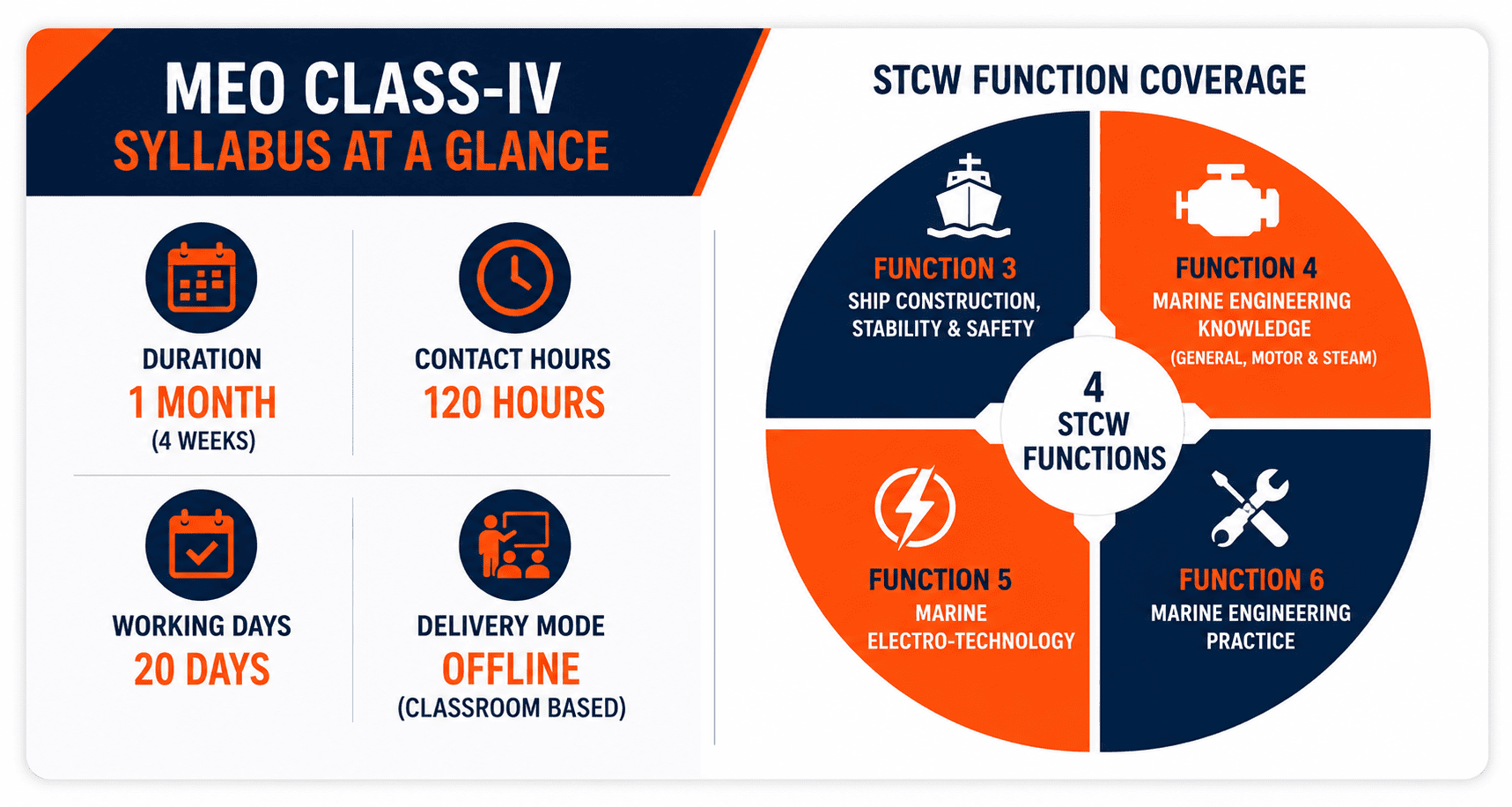
Here are the quick facts before we go section by section.
| Attribute | Detail |
| Duration | 1 month (4 weeks) |
| Working days | 20 |
| Contact hours | 120 |
| Delivery mode | Fully offline, classroom-based |
| Governing regulation | STCW Regulation III/1, Section A-III/1 |
| Leads to | MEO Class-IV Certificate of Competency exam |
| Mandatory for | Candidates appearing for the first time, or returning after sitting no function in 2026, on or after 1 January 2027 |
How Is the MEO Class-IV Syllabus Structured?
The syllabus groups its content under four STCW functions. Ship construction and safety sits under Function 3, engineering knowledge under Function 4, electro-technology under Function 5, and workshop practice under Function 6. Here’s the topic map before we unpack each one.
| STCW Function | Subject Block | Core Focus |
| Function 3 | Ship Construction, Stability and Safety | Hull structure, stability, damage control, firefighting, life-saving appliances, pollution prevention |
| Function 4 | Marine Engineering Knowledge, General | Boilers, steam auxiliaries, alternative fuel awareness, pumping and auxiliary systems, watchkeeping |
| Function 4 | Marine Engineering Knowledge, Motor | Diesel engine construction, fuel injection, turbochargers, maneuvering, fault diagnosis |
| Function 4 | Marine Engineering Knowledge, Steam | Thermodynamics, boiler and turbine design, feed systems, watchkeeping and safety |
| Function 5 | Marine Electro-Technology | Electrical fundamentals, machines, distribution, electronics, automation, cyber hygiene |
| Function 6 | Marine Engineering Practice | Hand tools, machine tools, materials, welding, planned maintenance, tribology |
A candidate serving on a motor vessel will lean harder on the motor block in practice, and one from a steam-powered fleet on the steam block, but the syllabus as written covers both. That’s worth knowing before you assume your course will skip whichever one doesn’t match your last ship.
What Does the Ship Construction, Stability and Safety Module Cover?
This is Function 3 territory, and it’s where a lot of theory-heavy candidates get caught out, because examiners like to test it through scenarios rather than definitions.
Hull construction and structural strength
- Types of ships and general hull layout
- Framing systems, longitudinal and transverse
- Decks, bulkheads, double bottom tanks and other structural members
- Longitudinal strength, shear forces and bending moments
Stability fundamentals
- Buoyancy, centre of gravity and centre of buoyancy
- Metacentric height and righting moments
- Free surface effects and the impact of shifting weights
- Damage stability and the effects of flooding
Damage control
- Causes of flooding and structural damage
- Use of pumps and watertight closures
- Emergency and temporary repair procedures
Fire prevention and firefighting
- Causes and prevention of machinery space fires
- Fire classification and choosing the right extinguishing medium
- Fixed firefighting systems: CO2, foam, water mist, dry powder
- Fire detection and alarm systems
Life-saving appliances
- Lifeboats, life rafts and rescue boats
- Personal LSA: lifejackets and immersion suits
- Radio LSA: SART and EPIRB
- Launching appliances and abandon-ship procedures
Pollution prevention and emergency management
- Oily water separators and oil discharge monitoring
- Sewage treatment and garbage management
- Ballast Water Management System (BWMS) operation, maintenance and logging
- Engine room emergencies, blackout recovery and emergency steering drills
The module closes with an overview of the conventions an engineer needs working knowledge of: SOLAS, MARPOL, STCW, the ISM Code, and the Maritime Labour Convention, including its more recent amendments. It also touches mental health, fatigue and workplace conduct, which is a newer addition and reflects DGMA’s wider push on the human element across all four courses.
What Does the Marine Engineering Knowledge Module Cover?
This is the biggest single chunk of the syllabus, split across general knowledge, motor engines, and steam plants.
What Do the General Marine Engineering Topics Include?
- Boiler types, construction, mountings, burners and safety devices
- Automatic combustion control systems
- Boiler feed arrangements, deaerators and water treatment
- Steam turbine principles, distribution and auxiliary steam services
- Condensers, vacuum maintenance and condensate recovery
- Basic awareness of alternative fuels: methanol, ethanol, ammonia and hydrogen, including hazards and bunkering precautions
- Auxiliary machinery: pumping systems, fuel oil treatment, lubricating oil systems
- Fresh water generation: evaporators and reverse osmosis plants
- Refrigeration and air conditioning systems
- Watchkeeping duties in manned engine rooms and Unattended Machinery Spaces (UMS), including log-keeping and watch handover
What Do the Motor (Diesel Engine) Topics Include?
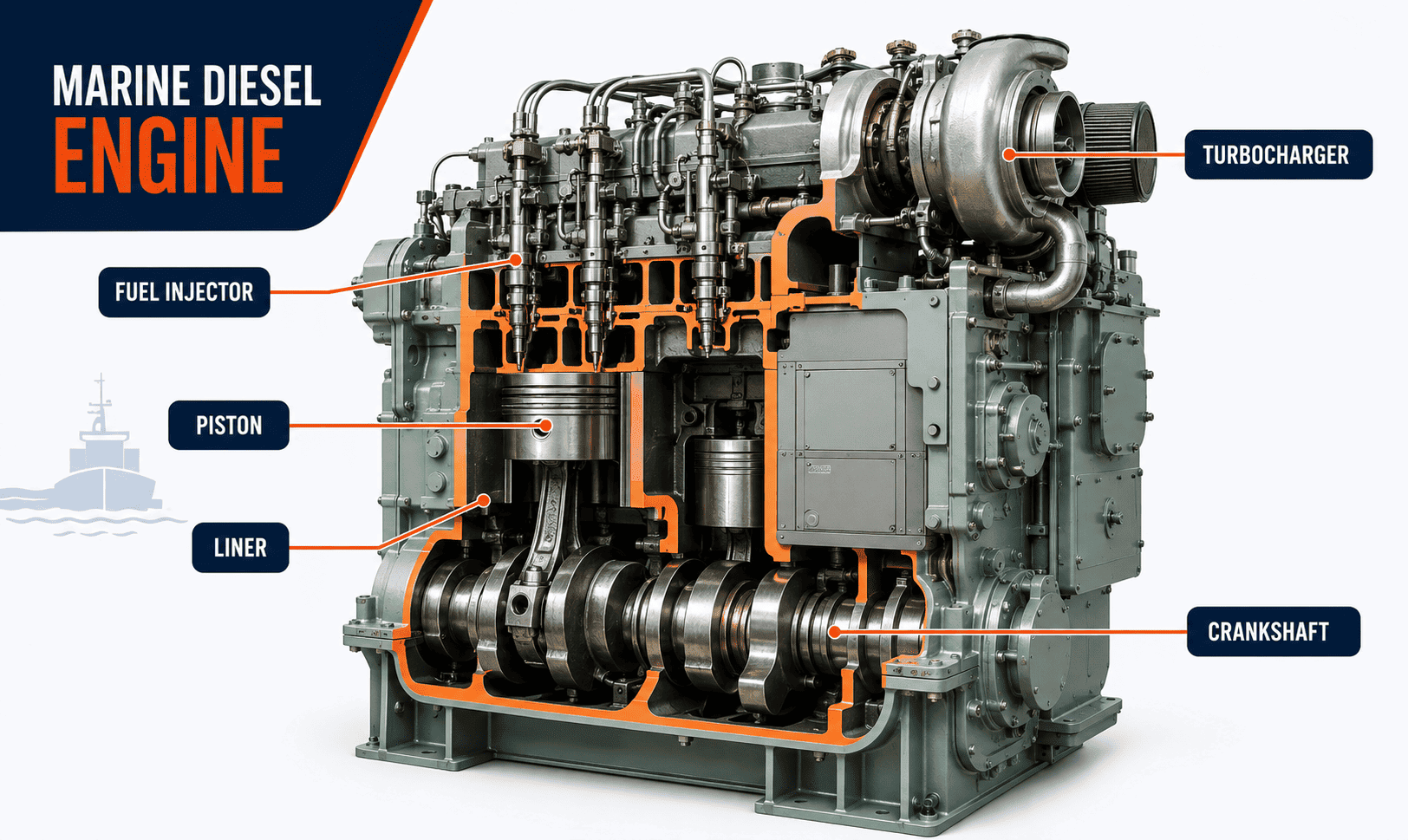
- Two-stroke and four-stroke operating principles
- Major components: pistons, cylinder liners, crankshafts, camshafts, connecting rods, bearings
- Fuel injection: conventional pumps and common rail systems, plus engine governors
- Turbochargers, scavenging and air supply
- Engine performance analysis, including indicator diagrams
- Starting, reversing and maneuvering procedures
- Safety devices: alarms, trips and automatic shutdowns
- Fault diagnosis and routine preventive maintenance
What Do the Steam Plant Topics Include?
- Steam generation, thermodynamics and the Rankine cycle
- Boiler types (water-tube and fire-tube), superheaters, economisers and air preheaters
- Steam turbine construction, reduction gearing and lubrication
- Feed-water and condensate systems, deaerators and pumps
- Boiler water treatment, corrosion prevention and blow-down procedures
- Start-up, shutdown and emergency operating procedures
- Pressure vessel safety and safety valve requirements
One thing worth flagging for anyone self-studying: the steam block is smaller in real-world relevance for most of today’s fleet, since the overwhelming majority of newbuilds run on diesel or dual-fuel engines. That doesn’t mean it’s skippable. Gas carriers and a chunk of the older tanker fleet still run steam plant, and examiners don’t drop it from the oral panel just because it’s less common on paper.
What Does the Marine Electro-Technology Module Cover?
Function 5 has grown heavier over the last few syllabus revisions, and MEO Class-IV candidates now need a working grip on topics that used to sit further up the ranks.
- Basic electrical principles: voltage, current, resistance, power, Ohm’s law and Kirchhoff’s laws
- AC and DC circuit characteristics
- Electrical machines: generators, alternators, AC and DC motors, starting methods
- Power distribution: main and emergency switchboards, circuit breakers, relays and protection devices
- Emergency generators, batteries and uninterruptible power supply systems
- Basic electronics: diodes, transistors, sensors and transducers
- Engine monitoring and automation systems, including Programmable Logic Controllers (PLCs)
- Cyber-risk awareness: basic hygiene and common vulnerabilities in automation and engine control systems
That last point is new territory for a Class-IV syllabus, and it’s a direct response to how much of a modern engine room now runs through networked control systems rather than standalone gauges.
What Does the Marine Engineering Practice Module Cover?
Function 6 is the hands-on half of the course, and it’s where the 20 working days matter most, since a lot of this genuinely needs a workshop rather than a classroom.
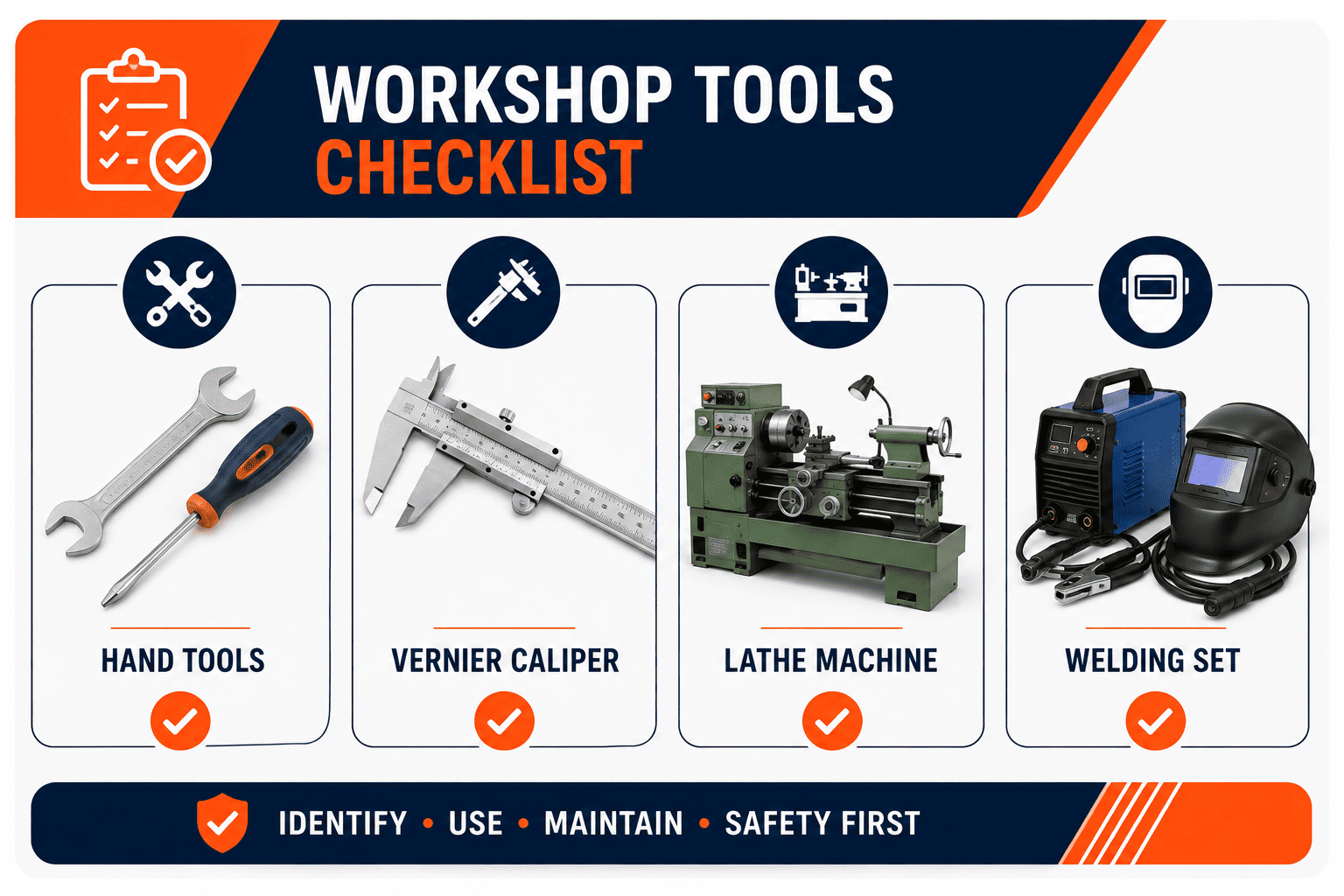
- Safe use of hand tools and precision instruments: micrometers, vernier calipers, dial gauges, feeler gauges
- Machine tools: lathes, drilling machines, milling machines, grinding machines
- Basic fitting and machining techniques
- Materials: metals, alloys and composites, and their suitability for marine use
- Heat treatment: annealing, normalising, hardening and tempering
- Welding and thermal cutting: gas and arc welding, defect inspection, safety precautions
- Planned Maintenance Systems (PMS) and condition monitoring
- Lubrication systems and basic tribology principles
Institutes that skimp on workshop time here tend to produce candidates who can describe a lathe operation on paper but freeze when an examiner hands them a micrometer and asks for a reading. That’s exactly the gap this course is meant to close.
How Should Candidates Prepare for the MEO Class-IV Oral Exam?
The written paper rewards memorisation. The oral round doesn’t, and it’s usually where repeat attempts happen. A few habits genuinely help:
- Practice sketching, not just describing. Fuel injection systems, boiler mountings and switchboard layouts come up as freehand sketch questions, and a candidate who can only recite the parts list struggles the moment they’re asked to draw it.
- Say it out loud before the exam, not just write it down. Explaining a watchkeeping handover procedure to a colleague surfaces gaps that silent revision doesn’t.
- Get real workshop hours in, not just observed ones. Handling a vernier caliper yourself sticks better than watching an instructor demonstrate it once.
- Treat the pollution prevention and BWMS topics as operational, not theoretical. Examiners often frame these as “what would you log, and when,” not “define BWMS.”
- Revisit alternative fuels even if your last ship never carried any. It’s new to the syllabus specifically because DGMA expects officers to know it before they encounter it, not after.
Where Can Candidates Take the MEO Class-IV Preparatory Course?
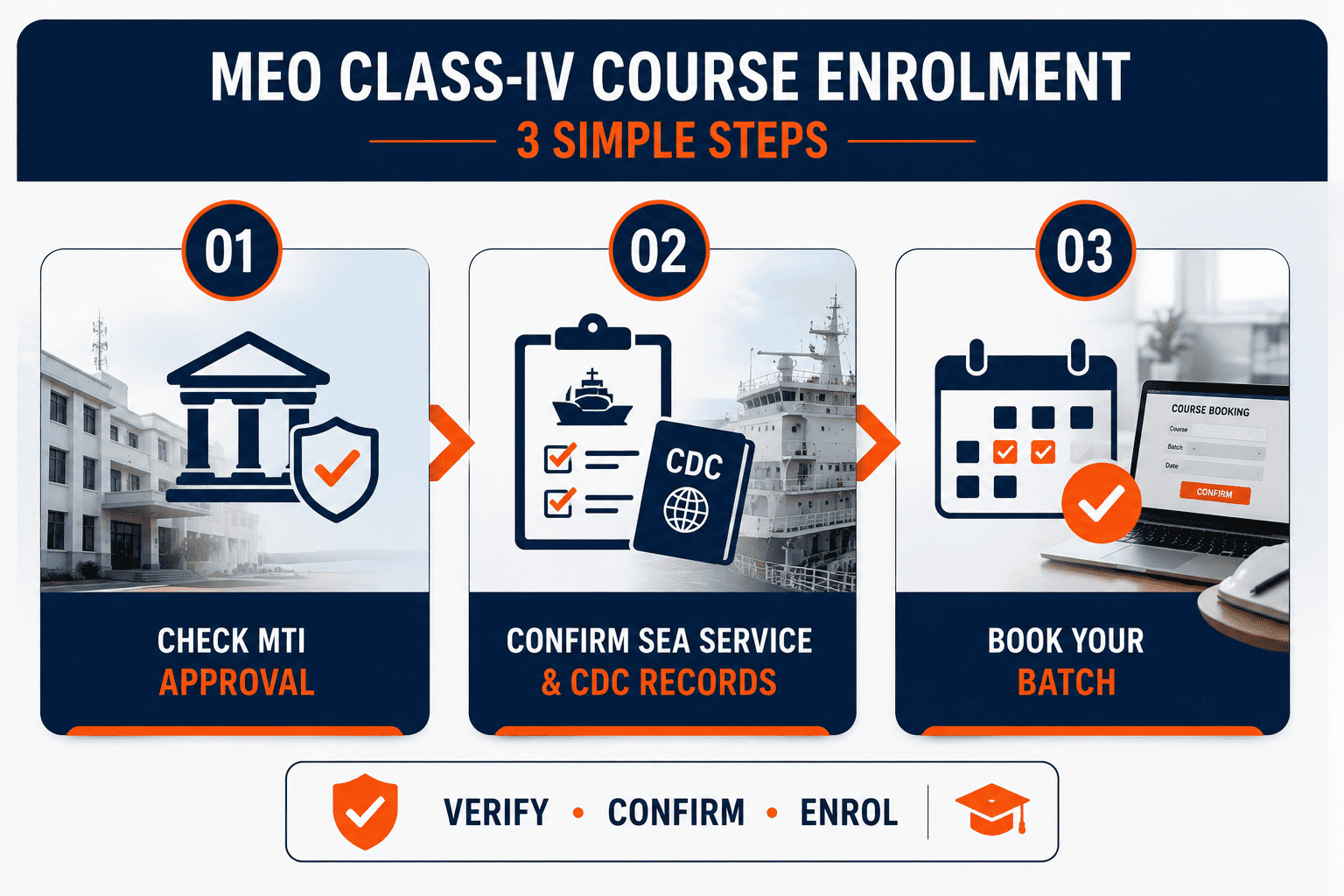
Only DGMA-approved Maritime Training Institutes can run this course, and MTIs need separate approval for the MEO Class-IV batch specifically, not just their general MEO course approval. Cross-check any institute against the list of DGMA-approved maritime training courses before enrolling, and confirm your sea service and INDOS records are current using our guide to applying for a CDC online if you haven’t checked recently.
Frequently Asked Questions
What is the MEO Class-IV preparatory course syllabus based on?
It’s based on Annexure I of DGMA Circular 49 of 2026, built around STCW Regulation III/1 and Section A-III/1, which set the competence standard for an Officer in Charge of an Engineering Watch.
How many contact hours does the MEO Class-IV course cover?
120 contact hours over 20 working days, delivered as a fully offline, one-month classroom programme.
Is the MEO Class-IV syllabus the same for motor and steam ships?
The syllabus covers both motor and steam engineering knowledge as separate blocks. Candidates study both regardless of which propulsion type they last sailed on.
Does the MEO Class-IV syllabus include practical workshop training?
Yes, under the Marine Engineering Practice module, covering hand tools, machine tools, welding, materials and planned maintenance systems.
What STCW regulation governs the MEO Class-IV syllabus?
Regulation III/1 and Section A-III/1 of the STCW Convention and Code, which cover the standard of competence for Officers in Charge of an Engineering Watch.
Do candidates need to complete this course before their written exam, their oral exam, or both?
Completion of the course is a prerequisite for eligibility to appear in the MEO Class-IV exam overall, covering both the written and oral components.
Does the MEO Class-IV syllabus cover alternative fuels?
Yes, at an awareness level. Candidates learn the characteristics, hazards and bunkering precautions for methanol, ethanol, ammonia and hydrogen under the general marine engineering knowledge block.
How does the MEO Class-IV syllabus differ from the MEO Class-II syllabus?
MEO Class-IV covers the same broad functions at an operational level, focused on watchkeeping and hands-on knowledge. MEO Class-II covers the same functions at management level, with added design-stage and system-oversight depth.
Is cyber security part of the MEO Class-IV syllabus?
Yes, at a basic awareness level covering cyber hygiene and common vulnerabilities in engine automation and control systems, under the Marine Electro-Technology module.