
Ask any Deck Rating who has spent three years at sea what comes next, and you’ll usually hear some version of the same answer: a long, expensive detour overseas. For as long as most Indian seafarers can remember, moving from rating to officer meant boarding a flight to a foreign training academy, paying tuition in foreign currency, and hoping the certification would translate smoothly back home. That quiet cost never shows up in a brochure — and it’s exactly the gap DGMA’s new Second Mate FG course for Deck Ratings has been designed to close.
DGMA Circular 26 of 2026 isn’t just another line added to India’s maritime training calendar. It addresses a career bottleneck that has existed for years: sea-going Deck Ratings had, in practice, one dependable route to officer rank — NWKO (NCV) — and even that often meant training abroad. From July 2026, they get a second option: a structured, India-based, STCW-compliant six-month course that leads to the same Second Mate (FG) examination, minus the passport stamps and the foreign tuition bill.
Who actually stands to benefit? Mainly, Deck Ratings and Deck Cadets who have already logged their sea time and are ready to move up but were priced out of the overseas route. Indirectly, it benefits Indian MTIs, who now have a new course to offer, and the wider shipping industry, which gains a faster, more predictable pipeline of homegrown navigating officers. This guide walks through exactly who qualifies, what the six months actually involve, how the route compares with NWKO, which documents and steps stand between you and admission, and — because paperwork trips up more candidates than the syllabus ever does — how to avoid the mistakes that cost people an entire training cycle.
Why This Course Matters for Indian Seafarers
Every regulatory circular has a story behind it, and this one isn’t hard to read. For years, a Deck Rating aiming for officer rank had one dependable path: NWKO (NCV), historically pursued through institutes abroad. It worked, but it wasn’t cheap or quick — flights, visas, foreign tuition, and unfamiliar exam boards all added friction to what should have been a straightforward next career step.
DGMA‘s own reasoning, laid out in the circular, points to exactly this: a meaningful number of Indian Deck Ratings were spending heavily to train overseas for certification that Indian training infrastructure is now fully capable of delivering. That’s a quiet but significant acknowledgment — India’s maritime training sector has matured enough to bring this pathway home, and DGMA is betting that domestic MTIs can deliver the same STCW-standard outcome without the overseas price tag.
There’s a bigger industry story here too. India already supplies close to 12% of the world’s seafarers, with the government publicly targeting a 20% share in the years ahead. Officers, not ratings, are where career security and long-term earning potential really sit — so any bottleneck that keeps capable Deck Ratings from crossing into officer roles is, in effect, a bottleneck on India’s entire maritime workforce ambitions. A faster, India-based route to Second Mate (FG) status feeds directly into that push.
| Old Reality (NWKO abroad only) | What Changes With This Course |
| Training tied to foreign institutes and exam boards | Training conducted at Indian MTIs under direct DGMA oversight |
| Overseas travel, visa, and tuition costs upfront | No foreign travel required for this specific pathway |
| Course quality and pacing vary by country/institute | Fixed, STCW A-II/1-aligned syllabus with defined hours |
| Capable Deck Ratings priced out of officer progression | A realistically affordable route for a much wider pool of candidates |
Who Should Apply?
Not everyone reading about this course is at the same stage of their career. Here’s a practical breakdown of where different candidates stand:
| Candidate Type | Why This Course Fits Them |
| GP Ratings who’ve completed 36 months of foreign-going sea service (incl. 6 months bridge watchkeeping) | Fully eligible to formalise officer-track progression without leaving India |
| Deck Ratings currently sailing, approaching or past the 36-month mark | Should start planning post-sea education now — timing PCME and this course sensibly |
| Deck Cadets who completed sea time and hold an approved TAR book | Can reuse the existing TRB — just complete the bridge-watchkeeping section |
| Experienced seafarers who considered NWKO (NCV) but were deterred by cost | Now have a domestic, generally more affordable alternative worth comparing |
Who Should Not Apply Yet
Just as important as knowing who qualifies is being honest about who doesn’t — yet. Applying before you’re ready usually costs more time than waiting a few months and doing it right.
- Candidates with less than 36 months of sea service — complete your sea time first; partial service doesn’t count toward eligibility, no matter how close you are
- Candidates missing STCW Basic Safety Training modules (PST, FP&FF, EFA, PS&SR, STSDSD) — these are baseline requirements, not optional add-ons, and should be completed early in your career.
- Candidates without a current, valid medical fitness certificate — medical certificates expire; check validity well before you plan to apply, not after
- Candidates without a properly maintained Training Record Book — if your bridge-watchkeeping hours aren’t being logged and countersigned by the Master in real time, sort this out immediately; retrospective entries are a common cause of eligibility disputes
- Candidates who’ve completed general sea service but not the specific 6 months of supervised bridge watchkeeping — this is a distinct sub-requirement many candidates assume is automatically covered by total sea time; it isn’t
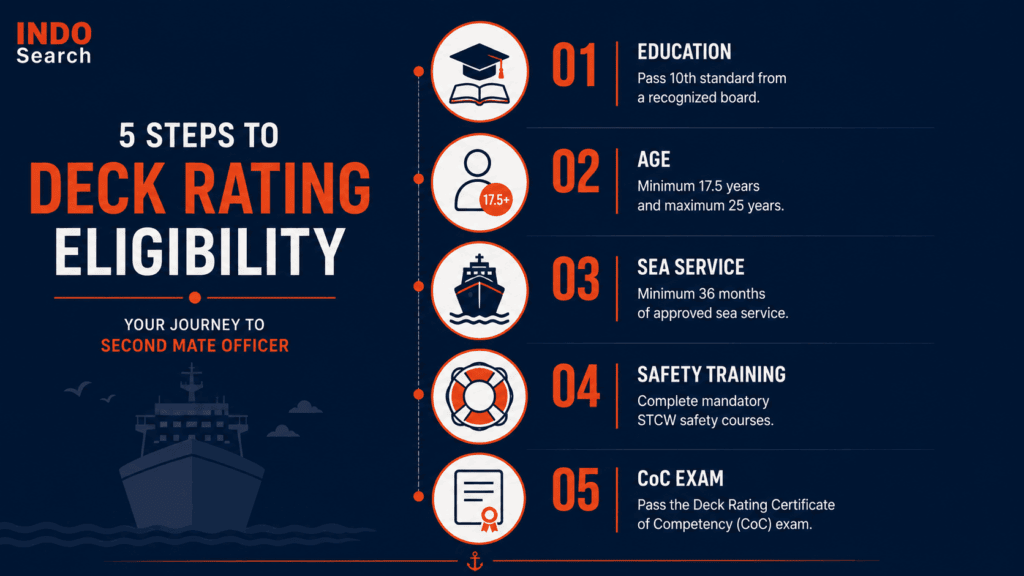
Second Mate FG Course Eligibility Criteria for Deck Ratings
Eligibility is set out in Annexure-I of the circular (Flow Diagram II/1-1 (B)) and applies to both Deck Ratings and Deck Cadets with foreign-going sea service:
| Requirement | Details |
| Educational Qualification | 12th (HSC, any stream) OR any graduation/diploma OR SSC 10th + ITI Trade Course certificate |
| Age | 18 years or above |
| Pre-Sea Training | Approved GP Rating Course or Deck Cadet Course |
| Medical Fitness | As per prescribed DGMA medical standards |
| Basic Safety Training (STCW) | PST, FP&FF, EFA, PS&SR, STSDSD (STCW Code A-VI series) |
| Sea-Going Service | Minimum 36 months on foreign-going ships, including at least 6 months of supervised bridge watchkeeping recorded in an approved Training Record Book (TRB) |
| Examination | Written and oral Second Mate (FG) CoC Examination |
Notice how specific these requirements are — they’re not a loose checklist but a sequence in which each item depends on the last. Sea service has to be foreign-going specifically; safety training has to be complete before you can seriously plan the next stage; and the bridge-watchkeeping clock only starts once it’s actually being logged correctly. Treat this table as your personal readiness audit, not just background reading.
Post-Sea Courses Required Before the CoC Exam
Beyond the six-month course itself, the circular lists a full set of post-sea courses candidates must complete before appearing for the exam:
| # | Course |
| a | PCME Foundation Course (approx. 2 months — can be started after 18 months of sea service) |
| b | Six-Month Competency Course for Second Mate (FG) |
| c | Radar Observer Simulator Course |
| d | ARPA Course |
| e | ECDIS Course |
| f | GMDSS GOC (A-IV/2) |
| g | PSC & RB (A-VI/2-1) |
| h | AFF (A-VI/3) |
| i | MFA (A-VI/4-1) |
| j | STSDSD (A-VI/6-2, if not completed earlier) |
| k | SSO (A-VI/5) — optional |
A practical way to read this list: the six-month course builds your navigational and watchkeeping competence, while the supporting courses (ARPA, ECDIS, GMDSS GOC, Radar Observer) certify you on the specific equipment and systems you’ll actually operate on the bridge. Skipping ahead to the CoC exam without these is not possible — plan your calendar around all of them, not just the headline course.
Documents Required
Institutes reject or delay far more applications over missing paperwork than over eligibility gaps. Assemble these well before you plan to apply — some, like your CDC or medical certificate, take time to obtain or renew:
| Document | Why It’s Needed |
| Passport | Identity and travel document; needed for CDC-linked records and exam registration |
| CDC (Continuous Discharge Certificate) | Your official seafarer identity and service record issued by DGMA |
| Sea Service Certificate(s) | Proof of the 36 months of foreign-going sea service |
| Training Record Book (TRB / TAR Book) | Records your supervised bridge-watchkeeping hours, verified by the ship’s Master |
| Medical Fitness Certificate | Proof of current medical fitness per DGMA-prescribed standards |
| GP Rating / Deck Cadet Course Certificate | Proof of approved pre-sea training |
| Educational Certificates (10th / 12th / Diploma / Degree) | Proof of meeting the minimum educational eligibility |
| STCW Basic Safety Training Certificates | Proof of completed PST, FP&FF, EFA, PS&SR, STSDSD modules |
| Passport-size Photographs | Standard requirement for institute admission and exam registration |
| Any prior CoC / certification (if applicable) | Relevant if you already hold any certification tied to career progression |
Admission Process
Here’s how the journey from “I’m eligible” to “I’m enrolled” actually plays out, step by step:
| Step | What Happens | What You Should Do |
| 1. Confirm Eligibility | Verify your sea service, safety training, and medical status against the eligibility table above | Cross-check every requirement before approaching any institute |
| 2. Gather Documents | Compile the full document set listed above | Start early — CDC and medical renewals can take time |
| 3. Identify a DGMA-Approved Institute | Shortlist MTIs and verify approval specifically for this six-month course | Don’t rely on general MTI reputation alone — ask for course-specific approval |
| 4. Apply for Admission | Submit documents to your chosen institute and complete enrolment formalities | Get admission terms, fees, and batch dates confirmed in writing |
| 5. Attend the Six-Month Training | Complete lectures, exercises, and practicals across all syllabus modules | Treat attendance and internal assessments seriously — they build the foundation for your CoC exam |
| 6. Internal Assessment | Clear the institute’s internal tests as required before CoC exam eligibility | Use this stage to identify weak topics before the real exam |
| 7. Appear for the CoC Examination | Sit the written and oral Second Mate (FG) exam conducted by DGMA | Revise systematically across all seven syllabus modules |
| 8. Certification | On passing, receive your Second Mate (FG) Certificate of Competency | You’re now eligible to serve as Officer in Charge of a Navigational Watch |
Second Mate FG Course Syllabus: What Will You Study?
The detailed syllabus (Annexure-II) mirrors the competencies required for an Officer in Charge of a Navigational Watch under STCW Code Table A-II/1:
| Module | Approx. Hours |
| 1. Terrestrial and Coastal Navigation | 112 hrs |
| 2. Celestial Navigation | 46 hrs |
| 3. Meteorology | 50 hrs |
| 4. Bridge Equipment | 44 hrs |
| 5. Bridge Watchkeeping & Emergencies | 139 hrs |
| 6. Ship Construction, Stability & Cargo Work | As per Annexure-II |
| 7. Environmental Protection & Legislative Compliance | As per Annexure-II |
Terrestrial and Celestial Navigation
This module matters because it’s the foundation of independent position-fixing — the core skill that separates a rating from an officer. Chart work, tides, passage planning, great circle sailing, and celestial fixing using the sun, moon, planets, and stars all feed directly into real bridge duties: plotting a safe course, confirming the ship’s position without relying solely on GPS, and planning a passage from berth to berth. It’s also, unsurprisingly, the most heavily tested area in both the written and oral Second Mate (FG) exams — examiners routinely probe candidates on chart work and sight reduction because it demonstrates genuine navigational competence, not memorization.
Meteorology and Bridge Equipment
Weather and electronics might seem like separate topics, but onboard they’re deeply connected — a Second Mate reading a synoptic chart needs to translate that into a practical passage-planning decision using GPS, ECDIS, and AIS. This module covers shipborne instruments, weather systems and forecasting, plus the electronic navigation stack you’ll use every watch: GPS, ECDIS, AIS, LRIT, VDR, echo sounders, speed logs, gyro and magnetic compasses, autopilot, and steering systems. In the exam, this shows up as scenario-based questions — “given this weather system and this equipment reading, what’s your next action” — rather than pure definitions.
Bridge Watchkeeping, Emergencies & Ship Handling
At 139 hours, this is the single largest module, and for good reason — it’s where theory meets the responsibility of actually keeping a ship and its crew safe. COLREGs, safe navigational watchkeeping, bridge resource management, and contingency planning for collision, stranding, fire, and abandon-ship scenarios all live here, along with man-overboard response and ship-handling effects like squat and shallow-water interaction. Examiners weight this module heavily because it’s the most direct test of whether a candidate can actually be trusted alone on a bridge watch — which is, after all, the entire point of the Second Mate (FG) certificate.
Ship Construction, Stability, Environment & Law
This module rounds out the syllabus with the “why the ship behaves the way it does” knowledge: hull construction and stresses, stability calculations (GM, GZ, curves of statical stability), MARPOL Annexes, ballast water management, and the legislative framework — SOLAS, ISM Code, ISPS Code, STCW 2010, IGF Code, and the Polar Code. Onboard, this knowledge underpins decisions like safe loading, stability monitoring, and compliance with pollution-prevention rules — the kind of judgment calls that separate an officer who understands the ship from one who’s only memorized a checklist.
Six-Month Course vs NWKO (NCV): Which Route Should You Choose?
The new course doesn’t replace NWKO (NCV) — it runs alongside it. Here’s a direct, side-by-side comparison:
| Factor | Six-Month Competency Course (New) | NWKO (NCV) (Existing) |
| Where conducted | India, at DGMA-approved MTIs | Historically pursued abroad by many candidates |
| Typical cost | Lower — no foreign travel, visa or overseas tuition | Higher — travel, visa and overseas institute fees add up |
| Duration | 6 months, fixed structured syllabus | Varies by country and institute |
| Regulatory basis | DGMA Circular 26 of 2026, aligned to IMO 7.03 & STCW A-II/1 | TEAP Manual-A, Para 5.5, Section II/1, Chapter II |
| CoC exam at the end | Second Mate (FG) CoC Examination | Second Mate (FG) CoC Examination |
| Best suited for | Candidates who want to train and get certified without leaving India | Candidates already committed to an overseas institute or programme |
Numbers aside, the real decision usually comes down to three practical questions. First, timing: if your sea service just crossed 36 months and you want to start training soon, check realistic batch availability for both routes — the six-month course is brand new, so early batches may be limited, while NWKO providers abroad often have more established, predictable schedules. Second, cost tolerance: if minimizing total spend is the priority, the domestic route has an obvious structural advantage simply by removing travel and foreign tuition. Third, existing commitments: if you’ve already been in touch with, or are partially enrolled with, an overseas NWKO provider, switching now may not make sense purely to save money — factor in any non-refundable costs already incurred.
As a rule of thumb: candidates who haven’t yet committed to any provider, and who value cost predictability and staying close to home during training, are the clearest fit for the new six-month course. Candidates who’ve already built a relationship with a specific overseas institute, or who have personal reasons to train abroad, may still reasonably prefer NWKO (NCV) — this circular gives you a choice, not an instruction.
Career Pathway: From Deck Rating to Second Mate (FG) Officer
- Complete an approved GP Rating Course or Deck Cadet Course (pre-sea training)
- Complete STCW Basic Safety Training modules (A-VI/1-1 to 1-4, A-VI/6-2)
- Serve a minimum of 36 months on foreign-going ships, including 6 months of supervised bridge watchkeeping in an approved TRB.
- Complete the PCME Foundation Course (can start after 18 months of sea service)
- Enrol in and complete the Six-Month Competency Course for Second Mate (FG) at a DGMA-approved MTI
- Complete supporting courses: Radar Observer Simulator, ARPA, ECDIS, GMDSS GOC, PSC&RB, AFF, MFA
- Appear for the written and oral Second Mate (Foreign Going) CoC Examination.
- On passing, obtain the Certificate of Competency as Officer in Charge of a Navigational Watch (Second Mate, Foreign Going ship)
- After certification, many officers begin exploring opportunities through Registered RPSL Companies for placements on foreign-going vessels.
Career Opportunities: Life After Second Mate
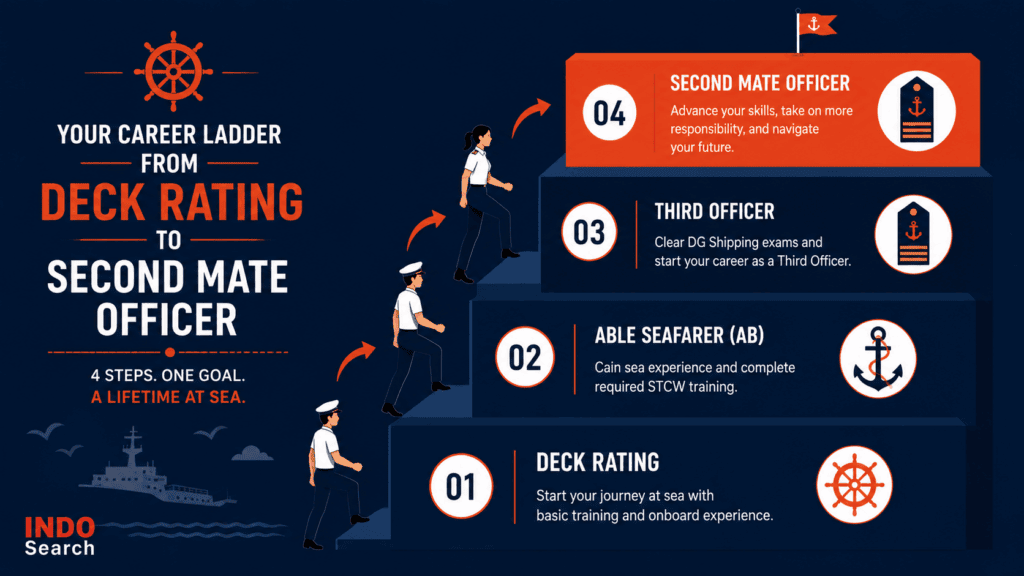
Getting your Second Mate (FG) certificate is a genuine milestone, but it’s worth understanding upfront that it’s the first rung on a longer ladder, not the ceiling. Most navigating officers who stay at sea continue progressing through further sea service and competency courses:
| Rank | Typical Path to Get There | What Changes |
| Second Mate (FG) | This six-month course (or NWKO) + Second Mate CoC exam | First officer rank; independent navigational watchkeeping responsibility |
| Chief Mate | Further qualifying sea service as Second Mate + Chief Mate CoC course and exam | Second-in-command; cargo operations and stability responsibility |
| Master | Further qualifying sea service as Chief Mate + Master CoC course and exam | Overall command and legal responsibility for the vessel |
In practical terms, this means the six months you’re about to invest aren’t just about passing one exam — they’re the entry point into a career trajectory that, with continued sea service and further certification, can lead all the way to command. Keep that longer arc in mind when you’re weighing the short-term cost and effort of this course against what it opens up over the next decade.
DGMA-Approved Institutes: What We Can (and Can’t) Tell You
This is the part most guides either skip or get wrong, so let’s be direct about it. As of this writing, there is no publicly published, official DGMA list naming which specific institutes are approved to conduct this six-month course. That’s not an oversight on our part — it reflects where things genuinely stand: the circular requires each MTI to separately apply to DGMA for approval to run this course, and since the course only commences from July 2026, that approval process is still working its way through the system. Any article claiming to give you a definitive institute list right now would be making it up, and we’re not going to do that.
What we can tell you is how DGMA approval actually works, and how to verify it yourself rather than relying on an institute’s own marketing claims:
- DGMA approval operates at two levels — general MTI recognition, and separate, course-specific approval for this six-month programme. Holding one does not automatically mean an institute holds the other.
- Always ask an institute directly for its DGMA approval specific to the Second Mate (FG) six-month course, by name — not just its general MTI licence.
- Cross-check the institute’s overall MTI status (active, cancelled, or suspended) independently, rather than taking a sales brochure at face value.
- Watch for updates on DGMA’s own official notifications, since approvals for this course are expected to be announced progressively through 2026.
Indosearch maintains a live, searchable directory of DGMA-approved Maritime Training Institutes in India — filterable by state, city, rating, and approval status. As of this writing, it lists 220 MTIs in total: 169 active, 40 cancelled, and 11 suspended. That gap between “active” and the rest is exactly why checking status before paying any fee is worth the two minutes it takes.
- Search the full list of DGMA-approved Maritime Training Institutes and filter by state, city or approval status.
- Browse institutes by location: Delhi NCR, Mumbai, Navi Mumbai, West Bengal, Tamil Nadu, Kerala.
- Check 5-star rated Maritime Training Institutes if reputation is a deciding factor for you.
- Before paying any fee, cross-check the cancelled institute list and the suspended institute list — both are updated as DGMA takes action.
- See the full DGMA-approved maritime training course list to check where the Second Mate (FG) course specifically is offered.
Once you’ve identified a candidate institute, call and ask them directly whether they hold approval for this six-month course by name. If they can’t produce that approval, treat it as a red flag, not a formality.
Common Mistakes Deck Ratings Make While Choosing This Pathway
- Assuming any currently operating MTI can teach this course without separate DGMA approval for it
- Enrolling before confirming the institute isn’t on the cancelled or suspended list
- Submitting incomplete documents at the time of application, which delays admission or forces a missed batch
- Joining a non-approved or informally run institute purely on the basis of proximity or price
- Miscounting sea service — including non-foreign-going time, or time that doesn’t meet the supervised-bridge-watchkeeping requirement
- TRB errors — retrospective entries, missing Master countersignatures, or using an unapproved training record book
- Forgetting that supporting certificates (ARPA, ECDIS, GMDSS GOC, Radar Observer) are separate requirements, not part of the six-month course itself
- Starting the PCME Foundation Course too early or too late relative to the 18-month sea-service marker
Expert Tips Before Joining
- Call the institute and ask specifically: “Are you DGMA-approved for the Second Mate (FG) six-month competency course, not just general MTI recognition?” — get the answer in writing if possible.
- Get admission terms, fee structure, refund policy, and batch start dates confirmed in writing before you pay anything.
- Start assembling your documents — CDC, TRB, medical certificate — well before your sea service technically completes, not after
- Time your PCME Foundation Course sensibly; it can start after 18 months of sea service, and many candidates leave it too late in their timeline.
- Don’t assume all supporting courses (ARPA, ECDIS, GMDSS GOC) can be clubbed into one continuous stretch — plan realistic gaps between them.
- Cross-check your shortlisted institute against Indosearch’s active, cancelled, and suspended MTI lists before paying any fee.
When Does the Course Start?
The course commences from July 2026, as notified in the circular. Since institute-level approvals for this specific course are still being processed by DGMA through 2026, expect batch availability to expand gradually rather than all at once — another reason to verify directly with a shortlisted institute rather than assuming immediate availability everywhere.
Key Takeaways
- DGMA has introduced a new 6-month, India-based competency course for Deck Ratings targeting the Second Mate (FG) CoC — an addition to, not a replacement of, NWKO (NCV)
- Minimum 36 months of foreign-going sea service, including 6 months of supervised bridge watchkeeping, is mandatory.
- The syllabus is STCW A-II/1 and IMO Model Course 7.03 compliant.
- Course commences July 2026; only MTIs with course-specific DGMA approval can conduct it — general MTI recognition isn’t enough.
- Candidates still need supporting certificates like ARPA, ECDIS, GMDSS GOC and Radar Observer before the CoC exam.
- Always verify an institute’s active/cancelled/suspended status before enrolling or paying fees.
- Second Mate (FG) is the first step of a longer career ladder toward Chief Mate and Master.
Frequently Asked Questions
1. What is the Second Mate FG course for Deck Ratings?
It’s a new six-month competency course introduced by DGMA under Circular 26 of 2026, giving Deck Ratings and Deck Cadets an additional, India-based pathway to become eligible for the Second Mate (Foreign Going) Certificate of Competency examination.
2. When will the six-month competency course start?
The course commences in July 2026, as stated in the circular.
3. Is this course compulsory for all Deck Ratings seeking officer rank?
No. It’s an additional option alongside the existing NWKO (NCV) route — candidates can choose whichever pathway suits them, subject to meeting eligibility.
4. How much sea service is required before enrolling?
A minimum of 36 months of approved sea-going service on foreign-going ships, including at least 6 months of supervised bridge watchkeeping duties recorded in an approved Training Record Book.
5. Can Deck Cadets also apply for this course, or only Deck Ratings?
Both Deck Ratings and Deck Cadets with the requisite foreign-going sea service and approved pre-sea training are eligible.
6. What is the difference between this course and NWKO (NCV)?
Both lead to the same Second Mate (FG) CoC examination. The new six-month course is conducted in India at DGMA-approved MTIs and is generally more cost-effective than pursuing NWKO (NCV) certification abroad.
7. Which authority issues this certificate — DGS or DGMA?
DGS was renamed DGMA (Directorate General of Maritime Administration). The circular was issued under the earlier name, DGS, but DGMA is the current authority overseeing this course and the Second Mate (FG) examination.
8. What subjects are covered in the six-month course?
Terrestrial and celestial navigation, meteorology, bridge equipment and electronic navigation systems, bridge watchkeeping and emergency procedures, ship construction and stability, and environmental and legislative compliance (MARPOL, SOLAS, STCW 2010, and related codes).
9. Do I still need Radar, ARPA, ECDIS and GMDSS GOC courses separately?
Yes. Per Annexure-I of the circular, these remain separate post-sea courses required alongside the six-month competency course before appearing for the CoC exam.
10. How do I know if an institute is actually approved to conduct this course?
Ask the institute directly for its DGMA approval specific to the Second Mate (FG) six-month course, and cross-check its status on Indosearch’s active, cancelled, and suspended MTI lists before enrolling.
11. What exam do I appear for after completing the course?
Candidates appear for the Second Mate (Foreign Going) Certificate of Competency Examination, consisting of written and oral assessments.
12. Is the six-month course recognized under STCW?
Yes. It’s structured in line with STCW Code Table A-II/1 and aligned with IMO Model Course 7.03, keeping it consistent with India’s STCW Convention obligations.
13. What documents do I need to apply for this course?
Passport, CDC, sea service certificates, Training Record Book, medical fitness certificate, GP Rating/Deck Cadet course certificate, educational certificates, and STCW basic safety training certificates — the full list is detailed earlier in this guide.
14. Is there an official list of institutes offering this course yet?
Not a publicly confirmed one at the time of writing. Each MTI must separately apply to DGMA for course-specific approval, and this process is still ongoing. Verify directly with any institute you’re considering, and cross-check its general MTI status on Indosearch before enrolling.
15. How long does the full admission process take?
Timelines vary by institute, but candidates should allow several weeks to gather documents (especially CDC and medical renewals) before the six-month training itself begins.
Conclusion
The Second Mate FG course for Deck Ratings isn’t just a new line item in a government circular — it’s a legitimate shortcut to officer rank for seafarers who’ve already earned it through years at sea, without the added burden of an overseas training bill. If you’ve logged your 36 months, hold a clean Training Record Book, and are ready for the next step, this route deserves serious consideration alongside NWKO (NCV).
What matters most from here isn’t the syllabus — Indian MTIs are well equipped to teach it. It’s the due diligence on your end: confirm that the institute you choose actually holds DGMA approval for this specific course, keep your documents in order well before you apply, and time your supporting certifications sensibly. Get those basics right, and the six months ahead of you become a clear, well-marked path to your Second Mate (FG) stripes — and the first step toward Chief Mate and, eventually, command — rather than another bureaucratic maze.
Ready to take the next step? Search the full list of DGMA-approved Maritime Training Institutes on Indosearch, filter by your state or city, and verify approval status before you enrol.