
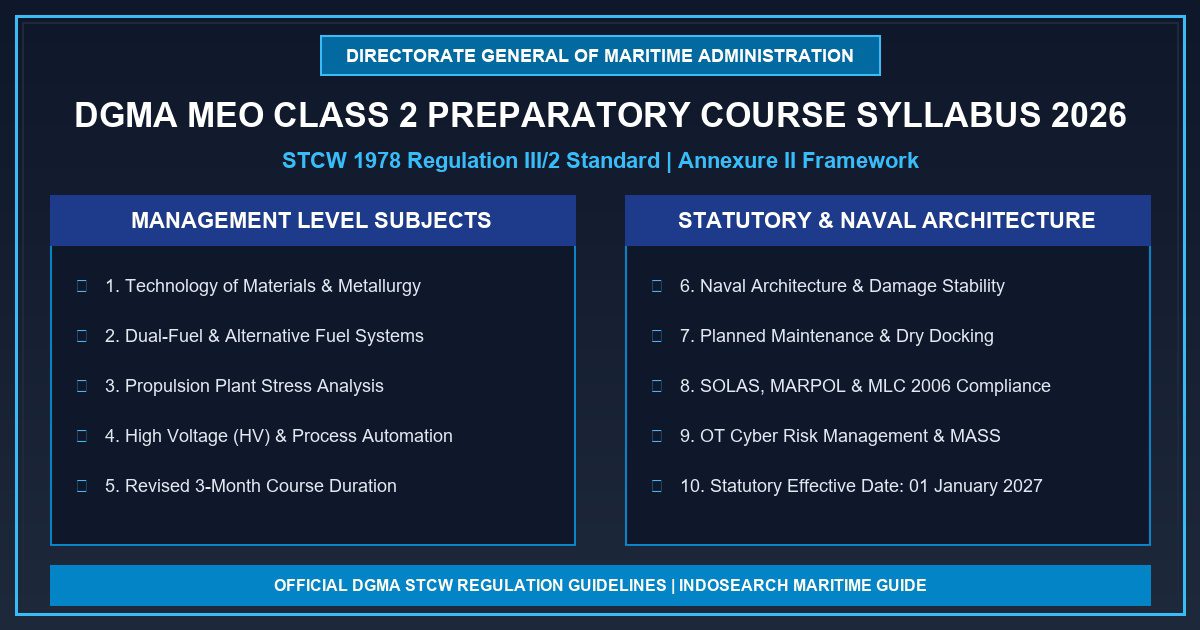
Under EAC Branch Circular No. 49 of 2026, the Directorate General of Maritime Administration (DGMA) has restructured the MEO Class-II preparatory course, reducing its duration from 4 months to 3 months (360 contact hours), effective 01 January 2027 on the official DGMA portal.
This detailed guide outlines the management-level MEO Class II Preparatory Course Syllabus under Annexure II of the circular, covering advanced engineering knowledge, metallurgy, dual-fuel engines, high-voltage automation, naval architecture, and STCW Regulation III/2 compliance at accredited recognized maritime training institute centers across India.
For complete circular policy details and effective dates, consult our master guide on DGMA MEO & ETO Preparatory Course 2026: Best Guide.
MEO Class II Course Framework & Summary (Annexure II)
| Parameter | Regulatory Requirement |
|---|---|
| Existing Duration | 4 Months |
| Revised Duration | 3 Months (12 Weeks / 60 Working Days / 360 Contact Hours) |
| Effective Date | 01 January 2027 for all new batches |
| Grandfathering Protection | Batches admitted prior to Jan 1, 2027 continue under existing 4-month syllabus |
| STCW Standard | [STCW 1978 Regulation III/2](https://www.legalbabu.com/learn/stcw-convention-maritime-rules/) (Management Level Second Engineer) |
| Course Format | 100% Mandatory Offline classroom instruction and case studies |
Streamlined Course Duration & Grandfathering Rules
The Technical Committee constituted by DGMA reviewed the training duration for Second Engineer Officers on vessels powered by main propulsion machinery of 3000 kW or above. Following feedback from examiners and maritime institutes, DGMA streamlined the MEO Class-II course duration down to 3 months (360 contact hours) while updating the technical syllabus to incorporate modern vessel technologies.
Key implementation rules specified under Part V of the circular include:
- Applicability: The 3-month course duration applies to all MEO Class-II batches commencing on or after 01 January 2027.
- Grandfathering Clause: Candidates admitted to the MEO Class-II course prior to 01 January 2027 will complete their training under the existing 4-month duration and syllabus without disruption.
- MTI Adoption: All approved MTIs must adopt the revised syllabus with effect from 01 January 2027.
Marine Engineering Knowledge – General (Management Level)
Management-level general engineering competencies required for Second Engineer Officers:
- Technology of Materials: Metallurgy of steel and cast iron, properties of ferrous and non-ferrous alloys, destructive and non-destructive testing (NDT methods like ultrasonic, radiographic, magnetic particle, dye penetrant), and advanced welding processes.
- Fuels, Lubricants & Alternative Fuels: Physical and chemical properties of marine fuels and lubricants, shore-side/shipboard sampling, lab test interpretation, microbiological contamination treatment, and system-level bunkering/safety procedures for alternative fuels (LNG, Methanol, Ethanol, Ammonia, Hydrogen).
- Auxiliary Machinery Management: Operational surveillance and troubleshooting of pumps, compressors, waste heat recovery systems, purifiers, oily water separators, thrust blocks, stern tubes, propellers, steering gears, stabilizers, refrigeration, air conditioning, and auxiliary boilers.
- Autonomous Ships (MASS): Remote monitoring, fail-safe considerations, sensor integration, and oversight of Maritime Autonomous Surface Ships.
Marine Engineering Knowledge – Motor & Steam (Management Level)
Advanced propulsion machinery design and operation:
- Propulsion Plant Design & Operation: Propulsive characteristics of diesel engines and gas turbines, fuel consumption optimization, shaft power determination, operating limits, and technical communications for design.
- Component Stress & Structural Load Analysis: Evaluating static and dynamic loads on crankshafts, bedplates, foundations, crossheads, cylinder liners, pistons, connecting rods, and bearings; torsional vibration analysis; and alignment criteria.
- Fuel Injection & Combustion Technology: Common rail electronic fuel injection control, rate shaping, dual-fuel engine operation in economy/emission modes, and SOx/NOx atmospheric pollution reduction systems.
- Marine Steam Propulsion: Design features of impulse/reaction turbines, reduction gearboxes, boiler water treatment chemistry, feed water systems, deaerators, and emergency steam plant operation.
Marine Electro-Technology (Management Level)
Management-level electrical, electronic, and control engineering:
- Automatic Control Systems: Open and closed-loop process control, sensors, transmitters, pneumatic/electronic PID controllers, Ziegler-Nichols tuning, digital communication buses, fiber optics, PLCs, and SCADA systems.
- High Voltage & Power Distribution: Design and safety requirements of marine HV systems (1kV to 11kV), switchboard protection relays, generator synchronizing, Insulated Gate Bipolar Transistors (IGBTs), Variable Frequency Drives (VFDs), and Battery Energy Storage Systems (BESS).
- Cyber Risk Management: Managing shipboard OT cyber risks under the [ISM Code](https://www.legalbabu.com/learn/ism-isps-code-maritime-safety-guide/), system vulnerabilities, software version control, and digital logbook security.
Marine Engineering Practice & Naval Architecture (Management Level)
Maintenance management and vessel stability under STCW Regulation III/2:
- Maintenance & Repair Strategy: Planned Maintenance Systems (PMS) under the [ISM Code](https://www.legalbabu.com/learn/ism-isps-code-maritime-safety-guide/), condition-based predictive analytics, dry-docking planning, emergency breakdown repairs (bearing failures, chain breakage, turbocharger breakdown, boiler tube failure), and risk assessment.
- Naval Architecture & Damage Stability: Transverse and longitudinal stability, Simpson’s rules, center of flotation, moment to change trim (MCT 1cm), angle of loll correction, dry-docking stability, damage stability, [SOLAS Chapter II-1](https://www.legalbabu.com/learn/solas-convention-guide/), and 2008 IS Code compliance.
- Maritime Legislation & Human Element: Merchant Shipping Act, SOLAS, MARPOL Annex I-VI, MLC 2006, STCW 2010, leadership, managerial skills, workload management, fatigue prevention, and workplace psychological safety.
Frequently Asked Questions
What is the revised duration of the MEO Class-II preparatory course?
The course duration has been reduced from 4 months down to 3 months (360 contact hours), effective 01 January 2027.
What happens to candidates enrolled before 01 January 2027?
Candidates admitted prior to 01 January 2027 will complete their training under the existing 4-month course duration and syllabus.