
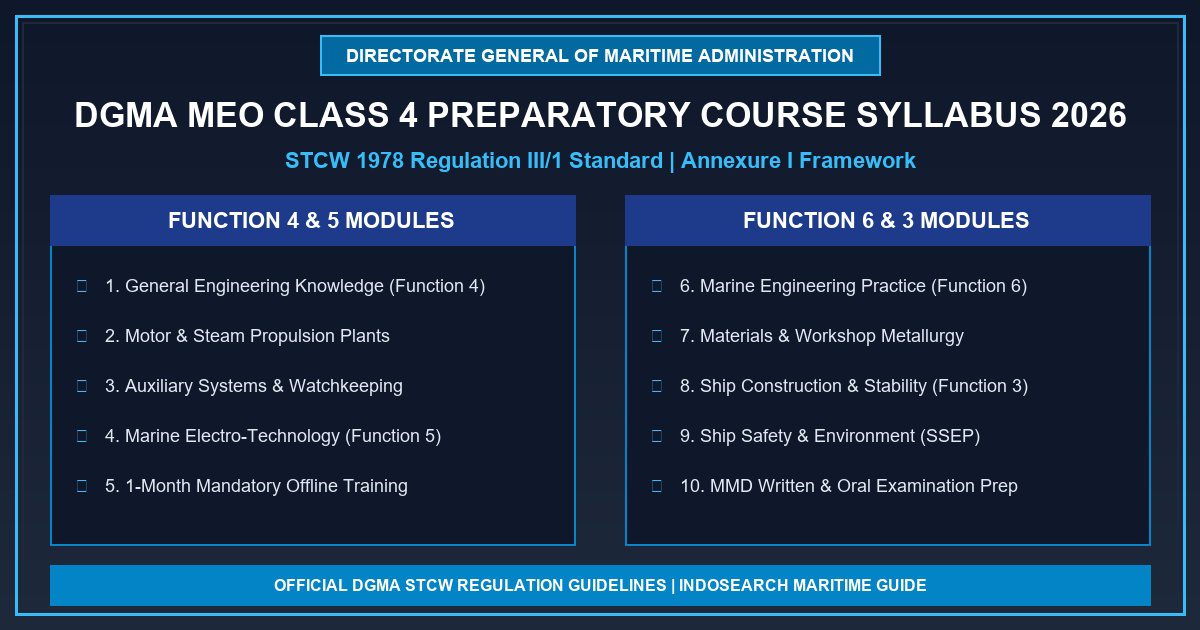
Under EAC Branch Circular No. 49 of 2026, the Directorate General of Maritime Administration (DGMA) has established a mandatory 1-month offline preparatory course for Marine Engineer Officers (MEO) Class-IV appearing for STCW Regulation III/1 Certificate of Competency (CoC) examinations on the official DGMA portal.
This comprehensive guide details the full MEO Class IV Preparatory Course Syllabus under Annexure I of the circular, covering operational-level Marine Engineering Knowledge (General, Motor, Steam), Marine Electro-Technology, Marine Engineering Practice, and Ship Construction, Stability & Safety at accredited recognized maritime training institute centers across India.
For full circular policy details and effective dates, consult our master guide on DGMA MEO & ETO Preparatory Course 2026: Best Guide.
MEO Class IV Course Framework & Summary (Annexure I)
| Parameter | Regulatory Requirement |
|---|---|
| Course Duration | 1 Month (4 Weeks / 20 Working Days / 120 Contact Hours) |
| Training Mode | 100% Mandatory Offline classroom and workshop practicals |
| Applicable Candidates | Initial MEO Class-IV CoC candidates and candidates with >1 year exam break |
| STCW Standard | [STCW 1978 Regulation III/1](https://www.legalbabu.com/learn/stcw-convention-maritime-rules/) (Operational Level) |
| Target Assessment | MMD Written & Oral Examination Preparedness |
Mandatory Regulatory Background & Candidate Categories
Following feedback from CoC examination boards, MTIs, and ship owners, DGMA conducted a comprehensive review of candidate examination performance. The committee observed that entry-level engineering candidates appearing for initial MEO Class-IV CoC examinations after sea service often lacked structured academic revision, leading to high failure rates in oral viva assessments where fundamental comprehension is tested.
To bridge this gap, DGMA Circular No. 49 of 2026 makes the 1-month MEO Class-IV preparatory course compulsory for:
- All candidates applying for eligibility assessment or intending to appear for MEO Class-IV written/oral CoC examinations for the first time on or after 01 January 2027.
- Candidates who have not appeared for written or oral examinations in any function of the MEO Class-IV grade in the calendar year 2026 and intend to appear on or after 01 January 2027.
Candidates completing pre-sea training can refer to our detailed GP Rating Course Guide to see how structured pre-sea preparation lays the groundwork for engineering officer progression.
Function 4: Marine Engineering Knowledge – General (Operational Level)
This module delivers deep operational knowledge of shipboard auxiliary systems and machinery:
- Marine Boilers & Auxiliary Steam: Constructional features of water-tube and fire-tube boilers, mountings, safety valves, automatic combustion control systems, feed water arrangements, feed pumps, deaerators, boiler water chemical treatment, scale prevention, corrosion control, and blowdown procedures.
- Steam Plants & Auxiliary Systems: Principles of marine steam turbines, reduction gearing, condensers, vacuum generation, condensate recovery, and basic operational awareness of alternative fuels (methanol, ethanol, ammonia, hydrogen).
- Auxiliary Machinery & Pumping Systems: Pumping arrangements, fuel oil treatment systems (heaters, filters, purifiers), lubricating oil circuits, fresh water generators (evaporators and reverse osmosis), refrigeration, and air conditioning.
- Engine Room Watchkeeping Practices: Operational duties of the engineering officer in charge of a watch in manned engine rooms and Unattended Machinery Spaces (UMS), machinery monitoring, alarm responses, logkeeping, and safe watch handover procedures.
Function 4: Marine Engineering Knowledge – Motor & Steam (Operational Level)
This module focuses on main propulsion marine diesel engines and steam plants:
- Diesel Engine Operation & Construction: Thermodynamic cycles of 2-stroke and 4-stroke engines, construction of major components (pistons, cylinder liners, piston rings, crankshafts, camshafts, connecting rods, bearings), materials, and maintenance requirements.
- Fuel Injection & Engine Performance: Conventional fuel pumps, modern common rail fuel injection, electronic governors, turbocharging principles, scavenging arrangements, indicator diagram interpretation, and engine performance analysis.
- Engine Maneuvering & Emergency Procedures: Starting, reversing, and maneuvering procedures for direct-coupled and geared diesel engines, engine safety trips, auto-shutdowns, fault diagnosis, routine maintenance, and condition monitoring.
Function 5: Marine Electro-Technology (Operational Level)
Operational-level electrical and electronic engineering competencies:
- Electrical Fundamentals & Machinery: Ohm’s law, Kirchhoff’s laws in AC/DC circuits, AC alternators, DC generators, 3-phase induction motors, Star-Delta starting methods, and motor protective devices.
- Power Distribution & Safety: Main and emergency switchboards, electrical distribution networks, circuit breakers, protective relays, emergency generators, UPS installations, and battery maintenance.
- Electronics & Automation: Diodes, transistors, sensors, transducers, Programmable Logic Controllers (PLCs) in engine control, integrated automation systems, and basic shipboard cyber hygiene awareness.
Function 6: Marine Engineering Practice (Operational Level)
Practical maintenance, repair, and workshop skills:
- Workshop Tools & Machining: Safe use of hand tools, precision measuring instruments (micrometers, vernier calipers, dial gauges, feeler gauges), machine tools (lathes, drilling, milling, grinding), and fitting techniques.
- Materials & Welding Metallurgy: Metallurgy of steel and cast iron, heat treatment (annealing, normalizing, hardening, tempering), gas/arc welding, thermal cutting, welding defects, and quality control.
- Planned Maintenance Systems (PMS): Maintenance management software, condition monitoring, overhauling major marine machinery, lubrication principles, and tribology.
Function 3: Ship Construction, Stability & Safety (Operational Level)
Controlling ship operations and care for persons on board:
- Hull Construction & Structural Strength: Framing systems (longitudinal and transverse), bulkheads, double bottom tanks, shear forces, bending moments, and structural stresses.
- Ship Stability & Damage Control: Buoyancy, center of gravity, metacentric height, free surface effects, damage stability, compartmentalization, flooding control, watertight closures, and emergency repairs.
- Ship Safety & Environmental Protection (SSEP): Machinery space fire prevention, fixed firefighting systems (CO2, water mist, dry powder), life-saving appliances (lifeboats, life rafts, SART, EPIRB), pollution prevention equipment (Oily Water Separators, Sewage Treatment Plants, BWMS), SOLAS, MARPOL, STCW compliance, and modular safety courses like Basic Safety Training (BST).
Candidates can view MEO Class IV Course schedules across accredited DGMA approved maritime institutes.
Frequently Asked Questions
Is the MEO Class-IV preparatory course mandatory for all candidates?
Yes. Completing the 1-month offline MEO Class-IV prep course is compulsory before appearing for written or oral CoC examinations.
What is the duration of the MEO Class-IV preparatory course?
The course is 1 month long (4 weeks / 20 working days / 120 contact hours).
Are e-learning modules mandatory for MEO Class-IV candidates?
No. While offline classroom attendance is mandatory, DGMA e-learning modules remain optional for self-study and revision.