
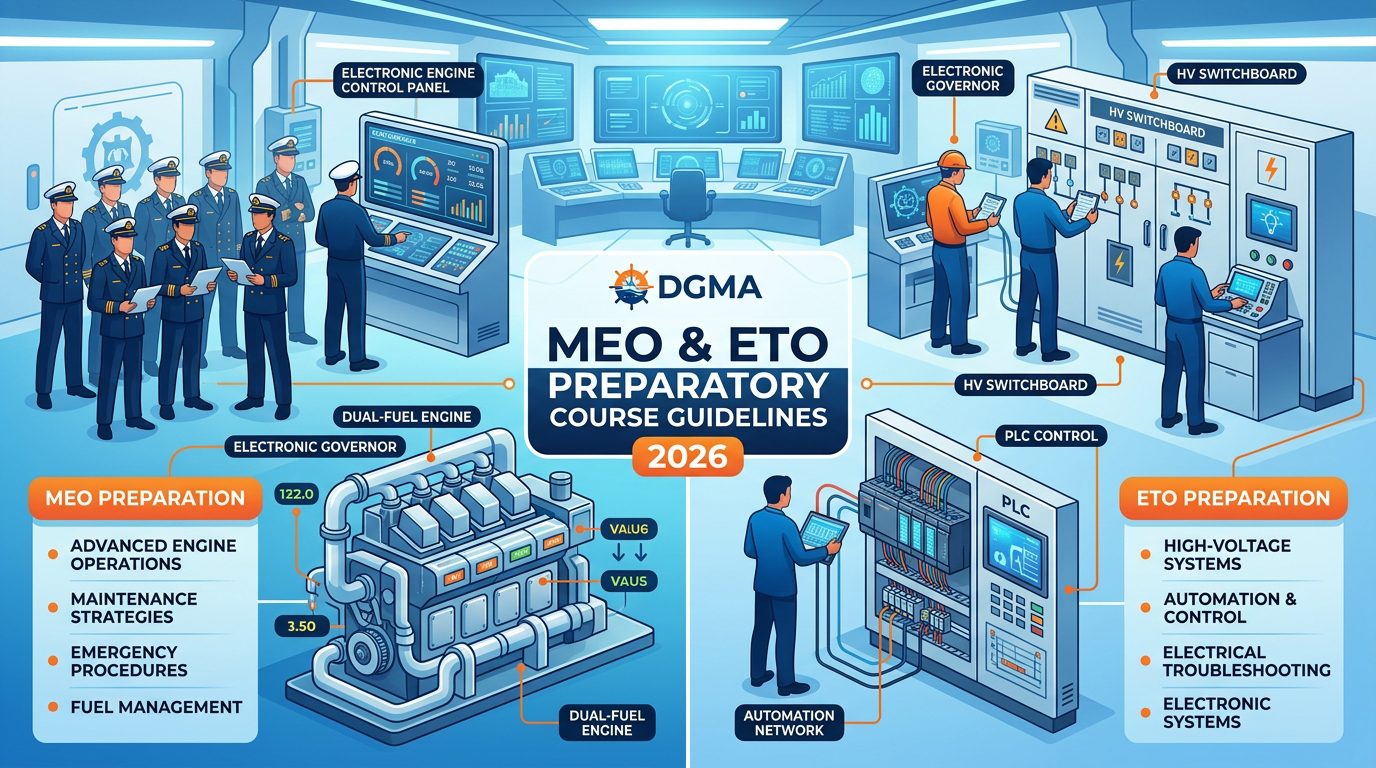
The Directorate General of Maritime Administration (DGMA) has issued EAC Branch Circular No. 49 of 2026, establishing mandatory MEO & ETO Preparatory Course rules and revised training frameworks for Marine Engineer Officers (MEO) and Electro-Technical Officers (ETO) appearing for Certificate of Competency (CoC) examinations on the official DGMA portal.
Whether you are preparing for your MEO Class-IV, MEO Class-II, MEO Class-I, or ETO CoC examinations, this best guide provides a complete breakdown of the mandatory MEO & ETO Preparatory Course structure, revised course durations, expanded technical syllabi, practical lab requirements, and compliance guidelines at accredited recognized maritime training institute centers across India.
Key Updates Under DGMA MEO & ETO Preparatory Course Circular No. 49
Following feedback from CoC examination boards, maritime training institutes, ship management companies, and sailing engineering officers, DGMA conducted a comprehensive review of candidate examination performance.
Addressing Candidate Performance Gaps
The technical committee observed that entry-level engineering and electro-technical candidates frequently struggled during CoC written and oral examinations due to several factors:
- Post-Sea Academic Disconnect: Candidates appearing for initial CoC examinations after completing mandatory sea service often lacked structured academic revision offered by the MEO & ETO Preparatory Course.
- Over-Reliance on Rote Learning: Memorizing static question banks failed candidates during in-depth oral assessments, where examiners test fundamental engineering comprehension taught in the revised MEO & ETO Preparatory Course.
- Modern Technology Gaps: Emerging developments in dual-fuel engines, high-voltage systems, shipboard automation, cybersecurity, and environmental decarbonization were incorporated into the updated MEO & ETO Preparatory Course curriculum.
- Need for Standardized STCW Compliance: Aligning shore-based preparatory training under the MEO & ETO Preparatory Course with updated STCW 1978 Regulation I/6, Regulation I/11, Regulation III/1, Regulation III/2, and Regulation III/6 requirements.
To bridge the gap between practical sailing experience and CoC competence standards, DGMA has introduced mandatory structured preparatory courses for MEO Class-IV and ETO grades, while streamlining the MEO Class-II course duration. Candidates completing pre-sea training can refer to our detailed GP Rating Course Guide to see how structured pre-sea preparation lays the groundwork for officer promotions. Enrolling in an official MEO & ETO Preparatory Course batch ensures full compliance before booking exam dates.
Summary of Preparatory Course Duration & Effective Dates
| Course Name | Existing Duration | Revised Duration | Effective Date | Detailed Syllabus Guide |
|---|---|---|---|---|
| MEO Class-IV Preparatory Course | Non-Mandatory | 1 Month (Mandatory) | Immediate | MEO Class 4 Syllabus Guide |
| MEO Class-II Preparatory Course | 4 Months | 3 Months | 01 January 2027 | MEO Class 2 Syllabus Guide |
| MEO Class-I Preparatory Course | 2 Months | No Change (2 Months) | 01 January 2027 | MEO Class 1 Syllabus Guide |
| ETO Preparatory Course | Non-Mandatory | 1 Month (Mandatory) | Immediate | ETO Syllabus Guide |
Key Implementation & Effective Date Rules (W.e.f. 01 January 2027)
As prescribed under Section V of the DGMA Circular, the following implementation rules apply for Class-II and Class-I courses:
- Batches Commencing On or After 01 January 2027: The revised MEO Class-II Preparatory Course duration of 3 months shall apply to all batches starting on or after 01 January 2027.
- Protection for Existing Enrolled Batches: Candidates admitted to the MEO Class-II Preparatory Course prior to 01 January 2027 will continue under the existing 4-month course duration and syllabus without disruption.
- Mandatory MTI Adoption: All Maritime Training Institutes (MTIs) approved by DGMA conducting MEO Class-I and Class-II courses must adopt the revised syllabi with effect from 01 January 2027.
Approved training institutes across India are updating their lesson plans and laboratory facilities for the MEO & ETO Preparatory Course, enabling candidates to complete mandatory prep classes before booking their CoC examination slots.
Mandatory 1-Month MEO Class-IV Preparatory Course
Under Part B of DGMA Circular No. 49, completing a 1-month offline MEO & ETO Preparatory Course module is now a compulsory prerequisite before applying for eligibility assessment or appearing for MEO Class-IV written or oral CoC examinations.
Target Candidate Categories
The 1-month MEO & ETO Preparatory Course for Class-IV candidates is mandatory for:
- All candidates applying for eligibility assessment or intending to appear for the MEO Class-IV CoC written and/or oral examination for the first time.
- Candidates who have not appeared for written or oral examinations in any function of the MEO Class-IV grade in the preceding calendar year.
Detailed Syllabus Breakdown for MEO Class-IV (Annexure I)
For an in-depth breakdown of all operational modules, view our dedicated DGMA MEO Class 4 Preparatory Course Syllabus 2026 article. The 1-month MEO & ETO Preparatory Course curriculum covers 120 contact hours across key operational functions prescribed under STCW Regulation III/1:
1. Marine Engineering Knowledge – General (Function 4)
- Marine Boilers & Auxiliary Steam: Boiler types, constructional features, mountings, safety devices, automatic combustion controls, feed water pumps, deaerators, and boiler water chemical treatment covered in the MEO & ETO Preparatory Course.
- Steam Plants & Auxiliary Systems: Steam turbines, reduction gearing, condensers, vacuum maintenance, condensate recovery, and basic operational awareness of alternative fuels including methanol, ethanol, ammonia, and hydrogen.
- Pumping & Auxiliary Machinery: Marine pumping systems, fuel oil treatment systems (heaters, filters, purifiers), lubricating oil circuits, fresh water generators (evaporators and reverse osmosis), refrigeration, and air conditioning.
- Engineering Watchkeeping Practices: Watchkeeping duties in manned engine rooms and Unattended Machinery Spaces (UMS), monitoring machinery parameters, alarm response, logkeeping, and safe watch handover procedures.
2. Marine Engineering Knowledge – Motor & Steam (Function 4)
- Diesel Engine Construction & Operation: Principles of two-stroke and four-stroke marine diesel engines, thermodynamic cycles, construction of major engine components (pistons, liners, crankshafts, camshafts, bearings), and materials analyzed during the MEO & ETO Preparatory Course.
- Fuel Injection & Performance: Conventional fuel pumps and modern common rail fuel injection systems, electronic governors, turbocharging, scavenging arrangements, indicator diagram interpretation, and engine condition monitoring.
- Engine Maneuvering & Emergency Procedures: Starting, reversing, and maneuvering procedures for direct-coupled and geared diesel engines, engine safety trips, auto-shutdowns, fault diagnosis, and routine preventive maintenance.
3. Marine Electro-Technology (Function 5)
- Basic Electrical Principles: Application of Ohm’s law and Kirchhoff’s laws in AC and DC circuits, characteristics of shipboard AC/DC machinery, alternators, motors, and Star-Delta starting methods.
- Power Distribution & Safety: High-voltage and low-voltage distribution, main and emergency switchboards, circuit breakers, protective relays, emergency generators, uninterruptible power supply (UPS) systems, and battery installations taught in the MEO & ETO Preparatory Course.
- Electronics & Automation: Diodes, transistors, sensors, transducers, Programmable Logic Controllers (PLCs), integrated engine monitoring systems, and basic shipboard cyber hygiene awareness.
4. Marine Engineering Practice (Function 6)
- Tools & Workshop Operations: Safe use of hand tools, precision measuring instruments (micrometers, vernier calipers, dial gauges, feeler gauges), machine tools (lathes, drilling, milling, grinding), and basic fitting techniques.
- Materials & Welding: Metallurgy of steel and cast iron, heat treatment processes (annealing, hardening, tempering), gas and arc welding techniques, thermal cutting, welding defects, and quality inspection.
- Maintenance Management: Planned Maintenance Systems (PMS), condition monitoring, systematically overhauling major marine machinery, lubrication principles, and tribology in the MEO & ETO Preparatory Course.
5. Ship Construction, Stability & Safety (Function 3)
- Hull Construction & Structural Strength: Framing systems (longitudinal and transverse), bulkheads, double bottom tanks, shear forces, bending moments, and structural stresses.
- Ship Stability & Damage Control: Concepts of buoyancy, center of gravity, metacentric height, free surface effects, damage stability, compartmentalization, flooding control, watertight closures, and temporary emergency repairs.
- Ship Safety & Environmental Protection (SSEP): Machinery space fire prevention, fixed firefighting systems (CO2, water mist, dry powder), life-saving appliances (lifeboats, life rafts, immersion suits, SART, EPIRB), pollution prevention equipment (Oily Water Separators, Sewage Treatment Plants, Garbage Management, BWMS), and emergency drills along with mandatory modular safety training like the Basic Safety Training (BST) course.
Candidates can view MEO Class IV Course schedules and fee details across approved institutions.
MEO Class-II Preparatory Course Streamlined to 3 Months
For Marine Engineer Officers upgrading to Second Engineer rank on vessels powered by main propulsion engines of 3000 kW or above, DGMA has restructured the course framework under Part V of the circular.
Course Duration Adjustment
- MEO Class-II Preparatory Course: Reduced from 4 months down to 3 months (12 weeks / 60 working days / 360 contact hours), effective 01 January 2027.
- MEO Class-I Preparatory Course: Retained at 2 months (8 weeks / 40 working days / 240 contact hours), effective 01 January 2027.
- Grandfathering Provision: Candidates admitted to the MEO Class-II course prior to 01 January 2027 will continue under the existing 4-month course duration and syllabus.
Advanced Technical Syllabus Highlights (Annexure II & III)
Read our full guide on DGMA MEO Class 2 Preparatory Course Syllabus 2026 and DGMA MEO Class 1 Preparatory Course Syllabus 2026. The revised management-level syllabi for the MEO & ETO Preparatory Course incorporate advanced engineering and managerial competencies prescribed under STCW Regulation III/2:
- Advanced Metallurgy & Fuel Tribology: Destructive and non-destructive testing (NDT), fuel/lubricant sampling, interpretation of laboratory test results, fuel contamination treatment, and safety layers for low-flashpoint alternative fuels.
- Autonomous Ships & MASS Technology: Remote monitoring considerations, fail-safe architecture, sensor technologies, and oversight of Maritime Autonomous Surface Ships (MASS) trials.
- Digitalization & Data-Driven Maintenance: Predictive analytics, digital twin modeling, e-logbooks, and Management Information Systems (MIS) for shipboard decision support.
- Statutory Compliance & Vetting Programs: Ship inspections under SIRE, Tanker Management and Self-Assessment (TMSA), RightShip inspection frameworks, ISO 9001/14001/50001 audit principles, DOC/SMC certification, and open registry implications.
Mandatory 1-Month ETO Preparatory Course
Under Part VI of DGMA Circular No. 49, Electro-Technical Officers (ETOs) appearing for their [STCW Regulation III/6](https://www.legalbabu.com/learn/stcw-convention-maritime-rules/) CoC examinations must complete a mandatory 1-month offline preparatory course as part of their MEO & ETO Preparatory Course training. For complete subject hours and practical lab details, view our dedicated DGMA ETO Preparatory Course Syllabus 2026 guide.
Supervised Practical Training Requirement
The ETO MEO & ETO Preparatory Course program delivers 120 contact hours over 4 weeks, with a strict mandate that at least 2 hours of supervised practical laboratory training must be conducted every working day.
ETO Subject & Hours Distribution (Annexure IV)
| Subject Module | Allocated Hours | Detailed Curriculum Coverage |
|---|---|---|
| 1. Marine Electrical Engineering | 28 Hours | DC/AC circuits, 3-phase systems, generators, switchboards, synchronizing, load sharing, power management, battery UPS, deck machinery electricals, GMDSS power, intrinsically safe (Ex-i) and explosion-proof (Ex-d) gear |
| 2. Marine Electronics | 16 Hours | Power electronics, analogue/digital circuits, microcontrollers, navigation/communication interfaces, digital ship sensors, electronic data loggers, VDR interfaces, networked equipment |
| 3. Automation & Control Engineering | 18 Hours | Sensors, transmitters, actuators, PLCs, main engine automation, boiler automation, Integrated Automation Systems (IAS), Power Management Systems (PMS), Operational Technology (OT) architecture, Modbus/Profibus troubleshooting, VFD drives |
| 4. High Voltage Technology | 12 Hours | HV generation/distribution, HV safety PPE, isolation procedures, Permit-to-Work (PTW) systems, electrical safety for methanol/ammonia fuels, hydrogen fuel cells, Battery Energy Storage Systems (BESS) |
| 5. Instrumentation & Control Systems | 10 Hours | Marine instrumentation, pressure/temp/flow sensing, Continuous Emission Monitoring Systems (CEMS), cryogenic sensors, cargo automation, decarbonization automation |
| 6. Electrical Maintenance & Troubleshooting | 18 Hours | Electrical drawing interpretation, insulation testing, motor/generator maintenance, VFD commissioning, OT network fault diagnosis, sensor loop calibration, fault simulation |
| 7. Safety, Environment & Regulations | 10 Hours | Safe working practices, Lock-Out/Tag-Out (LOTO), electrical firefighting, SOLAS, MARPOL, ISM, ISPS, cyber risk management, workplace culture, anti-harassment |
| 8. Written & Oral Examination Preparation | 8 Hours | Numerical problem solving, past exam papers, mock writtens, mock oral viva scenarios, fault-finding case studies |
Integrated Practical Laboratory Training
Practical laboratory training in the MEO & ETO Preparatory Course is integrated using dedicated equipment and simulators:
- Electrical measurement and insulation resistance testing.
- VFD parameter setting, switchboard operations, and protection relay testing.
- PLC familiarization, ladder logic programming, and OT network troubleshooting.
- GMDSS power testing, VDR communication testing, and CEMS sensor calibration.
- Where actual equipment is unavailable, AI-enabled visual demonstrations, virtual simulations, and interactive instructional videos may be utilized.
Engineers can review Electro-Technical Officer (ETO) Course guidelines.
Cutting-Edge Technical Syllabus Topics
To align Indian marine engineers and electro-technical officers with international maritime technological shifts, DGMA has integrated four modern technical pillars across all MEO & ETO Preparatory Course modules:
1. Alternative Marine Fuels & Bunkering Safety
Detailed operational guidelines and safety protocols for low-flashpoint alternative fuels in the MEO & ETO Preparatory Course:
- Liquefied Natural Gas (LNG), Methanol, Ethanol, Ammonia, and Biofuels.
- Hydrogen fuel cell installations and Battery Energy Storage Systems (BESS).
- Integrating alternative fuel risk assessments into the shipboard Safety Management System (SMS).
2. Decarbonization & Environmental Compliance
- [MARPOL Annex VI](https://www.legalbabu.com/learn/marpol-annex-vi-decarbonization-guide/) Standards: Operational compliance for Energy Efficiency Existing Ship Index (EEXI) and Carbon Intensity Indicator (CII) regulations.
- Emissions Reduction Technology: Carbon capture systems, SOx/NOx scrubbers, and Continuous Emission Monitoring Systems (CEMS).
- Ballast Water Management: BWMS commissioning testing, operational logging, and alarm management.
3. Shipboard Cyber Security & Operational Technology (OT)
- Managing maritime cyber risks under the [ISM Code](https://www.legalbabu.com/learn/ism-isps-code-maritime-safety-guide/) covered in the MEO & ETO Preparatory Course.
- Cyber hygiene for integrated bridge systems, engine room control networks, and digital logbooks.
- Physical OT network isolation, PLC diagnostics, and standalone system recovery procedures.
4. Human Element & Psychological Safety
- Resource management, workload planning, leadership, assertiveness, and decision-making under stress.
- Mental health awareness, psychological safety, fatigue-risk management, and prevention of workplace harassment or bullying.
Preparatory Course Fee Structure in India
Fees for the MEO & ETO Preparatory Course across India are structured transparently in Indian Rupees (INR) across DGMA approved training institutes.
Fee Breakdown Overview
| Course Grade | Estimated Fee Range (INR) | What You Pay For |
|---|---|---|
| MEO Class-IV Prep Course (1 Month) | ₹15,000 – ₹25,000 | Classroom tuition, workshop practice, study notes, simulator access |
| MEO Class-II Prep Course (3 Months) | ₹35,000 – ₹55,000 | 3 months of comprehensive tuition, internal assessments, technical library access |
| MEO Class-I Prep Course (2 Months) | ₹25,000 – ₹40,000 | Management-level lectures, case study analysis, audit preparation |
| ETO Prep Course (1 Month) | ₹18,000 – ₹28,000 | Electronics lab access, PLC/VFD troubleshooting practice, HV safety demos |
Candidates should confirm approved fee schedules for the MEO & ETO Preparatory Course directly with DGMA approved maritime institutes before booking their training seats.
Verification Checklist for CoC Candidates
Before enrolling in any preparatory batch, candidates should complete these verification steps:
- Verify Institute Approval: Confirm the training center holds active DGMA accreditation for conducting the specific MEO & ETO Preparatory Course.
- Utilize DGMA E-Learning: Access official DGMA e-learning facilities for self-assessment and knowledge tracking alongside mandatory offline classes.
- Ensure Full Attendance: Maintain 100% attendance during mandatory offline classroom contact hours and practical laboratory sessions.
- Complete Sea Time Assessment: Verify that sea service records, testimonials, and INDOS details are updated on the DGMA portal prior to booking written or oral examination seats.
Seafarers can explore top-rated academies conducting the MEO & ETO Preparatory Course such as Mumbai Maritime Training Institute (MMTI), NUSI Maritime Academy (Goa), T.S. Rahaman (Mumbai), Great Eastern Institute of Maritime Studies (GEIMS), CMC Maritime Academy (Chennai), and AQUA-MARITIME Training Institute listed under DGMA Approved Maritime Courses.
For regional choices, check Maritime Training Institutes in Mumbai, Maritime Training Institutes in Tamil Nadu, and Maritime Training Institutes in Delhi NCR. Once qualified, engineers can secure sailing contracts through verified licensed RPSL companies.
Frequently Asked Questions
What is DGMA EAC Branch Circular No. 49 of 2026?
It is an official circular issued by DGMA establishing mandatory 1-month preparatory courses for MEO Class-IV and ETO CoC exams, and reducing the MEO Class-II prep course duration to 3 months.
Is the MEO Class-IV preparatory course mandatory for all candidates?
Yes. Completing the 1-month offline MEO Class-IV prep course is compulsory before a candidate can appear for written or oral CoC examinations. Read the full MEO Class 4 Syllabus Guide.
What is the revised duration of the MEO Class-II preparatory course?
The MEO Class-II prep course duration has been reduced from 4 months down to 3 months (360 contact hours), effective 01 January 2027. Read the full MEO Class 2 Syllabus Guide.
Is the ETO preparatory course compulsory for Electro-Technical Officers?
Yes. ETO candidates must complete the 1-month offline prep course with mandatory daily practical lab work before appearing for ETO CoC exams. Read the full ETO Syllabus Guide.
Has the duration of the MEO Class-I preparatory course changed?
No. The MEO Class-I prep course remains 2 months long (240 contact hours), though the syllabus has been updated to include modern technologies. Read the full MEO Class 1 Syllabus Guide.
Are e-learning modules mandatory for MEO Class-IV candidates?
No. While offline classroom attendance is mandatory, DGMA e-learning modules remain optional for self-study and revision.
What new technical subjects are included in the revised MEO and ETO syllabi?
The updated syllabi cover alternative fuels (LNG, methanol, ammonia), maritime cybersecurity, [MARPOL Annex VI](https://www.legalbabu.com/learn/marpol-annex-vi-decarbonization-guide/) decarbonization (EEXI, CII), high-voltage systems, and mental health awareness.
Where can seafarers attend these mandatory preparatory courses?
Courses must be completed at DGMA-approved Maritime Training Institutes (MTIs) authorized to conduct engineering CoC prep programs.
What is the average fee for MEO Class-IV and ETO prep courses in India?
Course fees range between ₹15,000 and ₹28,000 depending on the academy’s lab infrastructure and practical simulator facilities.
Does this rule apply to seafarers appearing for CoC exams after sailing?
Yes. It applies to all candidates preparing for initial CoC exams or returning to complete pending written and oral functions after sea service.