
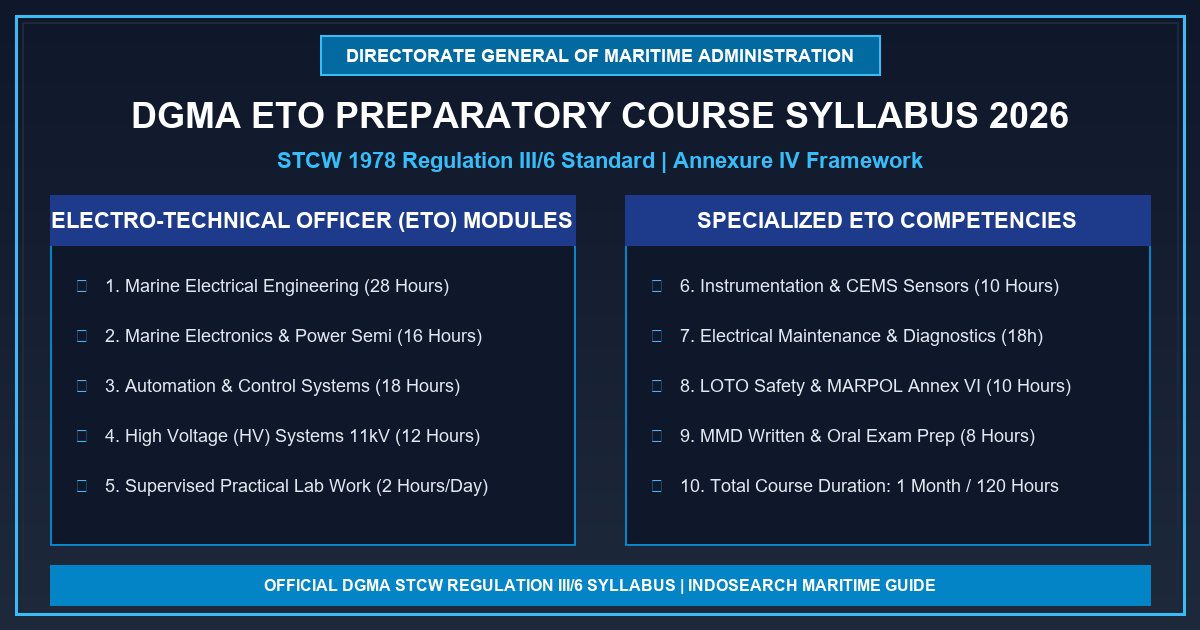
Under EAC Branch Circular No. 49 of 2026, the Directorate General of Maritime Administration (DGMA) has established a mandatory 1-month offline preparatory course for Electro-Technical Officers (ETOs) appearing for [STCW Regulation III/6](https://www.legalbabu.com/learn/stcw-convention-maritime-rules/) Certificate of Competency (CoC) examinations on the official DGMA portal.
This comprehensive guide provides an exhaustive breakdown of the official ETO Preparatory Course Syllabus under Annexure IV of the circular, detailing module-wise contact hours, core theoretical competencies, mandatory practical laboratory exercises, high-voltage safety rules, and examination preparation strategies at accredited recognized maritime training institute centers across India.
For complete regulatory guidelines and effective dates, refer to the complete guidelines in the DGMA MEO & ETO Preparatory Course 2026: Best Guide.
ETO Course Framework & Summary (Annexure IV)
| Parameter | Regulatory Requirement |
|---|---|
| Course Duration | 1 Month (4 Weeks / 20 Working Days / 120 Contact Hours) |
| Daily Practical Mandate | Minimum 2 Hours of Supervised Practical Lab Work every working day |
| Applicable Candidates | Initial ETO CoC candidates and candidates with >1 year exam break |
| STCW Standard | STCW 1978 Regulation III/6 (Electro-Technical Officer) |
| Target Assessment | MMD Written & Oral Examination Preparedness |
Mandatory Regulatory Requirements & Implementation Schedule
The Technical Committee constituted by DGMA reviewed the training framework for Electro-Technical Officers under [STCW Regulation III/6](https://www.legalbabu.com/learn/stcw-convention-maritime-rules/) and the Merchant Shipping (STCW) Rules 2014. The committee observed that entry-level ETO candidates frequently struggled during oral CoC assessments due to a lack of post-sea academic revision and hands-on practical troubleshooting orientation.
To address these gaps, DGMA Circular No. 49 of 2026 mandates that:
- Completing this 1-month preparatory course is a compulsory prerequisite before applying for eligibility assessment or appearing for ETO CoC written/oral examinations.
- Approved Maritime Training Institutes (MTIs) must conduct at least 2 hours of supervised practical laboratory training every working day, directly linked to the theoretical subjects covered on that day.
- Seafarers can check authorized academies conducting this course, such as Mumbai Maritime Training Institute (MMTI), NUSI Maritime Academy, and T.S. Rahaman.
Module 1: Marine Electrical Engineering (28 Contact Hours)
The Marine Electrical Engineering module forms the foundation of shipboard electrical power generation, distribution, and safety management. ETO candidates receive 28 hours of specialized instruction covering:
- Fundamentals of Electrical Engineering: DC and AC circuit theory, three-phase systems, electrical measurements, star and delta transformer/motor connections, and power factor correction.
- Electrical Machinery: Operational design and characteristics of AC alternators, main propulsion motors, auxiliary motors, transformers, and Star-Delta/Direct-On-Line (DOL) starters.
- Power Generation & Distribution: Main and emergency switchboards, busbar arrangements, generator synchronizing procedures, automatic load sharing, and Power Management Systems (PMS).
- Protective Devices & Electrical Safety: Air Circuit Breakers (ACBs), Molded Case Circuit Breakers (MCCBs), thermal/magnetic protection relays, reverse power protection, preferential trips, and earth fault monitoring.
- Emergency Systems & Deck Machinery: Battery charging installations, Uninterruptible Power Supply (UPS) systems, deck machinery electrical circuits (mooring winches, windlasses, cranes), GMDSS emergency power supplies, sound-powered telephones, public address (PA) systems, and intrinsically safe (Ex-i) and explosion-proof (Ex-d) equipment for hazardous cargo zones on tankers and gas carriers.
Module 2: Marine Electronics (16 Contact Hours)
Modern merchant vessels rely heavily on sophisticated solid-state electronics for power conversion, navigation, and monitoring. This 16-hour module covers:
- Semiconductor Devices & Power Electronics: Diodes, Zener diodes, Bipolar Junction Transistors (BJTs), Field Effect Transistors (FETs), Thyristors (SCRs), DIACs, TRIACs, and Insulated Gate Bipolar Transistors (IGBTs).
- Electronic Control Circuits: Operational amplifiers (Op-Amps), active filters, signal conditioning circuits, analogue-to-digital (A/D) converters, microprocessors, and microcontrollers.
- Navigation & Communication Interfaces: Interfacing electronic equipment with integrated bridge systems, digital ship sensors, electronic data loggers, Voyage Data Recorder (VDR) NMEA interfaces, and networked electronic bridge equipment.
- Electronic Fault Diagnosis: Oscilloscope (CRO) testing, digital multimeter (DMM) signal tracing, printed circuit board (PCB) component testing, and electronic system fault rectification techniques.
Module 3: Automation & Control Engineering (18 Contact Hours)
Automation is central to modern Unattended Machinery Spaces (UMS). This 18-hour module delivers rigorous training on:
- Control System Principles: Closed-loop control systems, sensors, transmitters (4-20mA, 20-100 kPa pneumatic), electro-pneumatic converters, and actuators.
- Programmable Logic Controllers (PLCs): PLC hardware architecture, digital/analogue I/O modules, ladder logic programming, timers, counters, relay logic translation, and advanced PLC diagnostics.
- Shipboard Automation Systems: Main engine maneuvering automation, auxiliary boiler automatic combustion control, Integrated Automation Systems (IAS), Power Management Systems (PMS), and Operational Technology (OT) network architecture.
- Troubleshooting & Network Isolation: Modbus and Profibus industrial communication protocol fault finding, Variable Frequency Drives (VFDs), harmonic distortion analysis, physical network isolation, and standalone OT recovery procedures following automation failures.
Module 4: High Voltage (HV) Technology (12 Contact Hours)
With modern container ships, cruise liners, and LNG carriers operating high-voltage electrical plants, this 12-hour module addresses critical HV safety and technology:
- HV Generation & Distribution: High-voltage system design (1 kV to 11 kV), HV switchboard construction, vacuum circuit breakers, and SF6 gas circuit breakers.
- High Voltage Safety & PPE: HV safety rules, Personal Protective Equipment (PPE) selection, insulation resistance testing, earthing procedures, isolation protocols, and Permit-to-Work (PTW) safety management.
- Alternative Fuels & Energy Storage: Electrical safety considerations for low-flashpoint alternative fuels (LNG, methanol, ethanol, ammonia), hydrogen fuel cell systems, Battery Energy Storage Systems (BESS), and hybrid propulsion electrical safety.
Module 5: Instrumentation & Control Systems (10 Contact Hours)
Accurate sensing is vital for environmental compliance and machinery protection. This 10-hour module focuses on:
- Marine Instrumentation: Temperature sensors (RTDs, thermocouples), pressure transducers, magnetic/ultrasonic flowmeters, level sensors (radar, hydrostatic, differential pressure), and viscosity control systems.
- Continuous Emission Monitoring Systems (CEMS): Principles, calibration, and troubleshooting of shipboard CEMS for [MARPOL Annex VI](https://www.legalbabu.com/learn/marpol-annex-vi-decarbonization-guide/) NOx/SOx monitoring.
- Cryogenic & Cargo Automation: Cryogenic temperature sensors for LNG/LPG cargo tanks, inert gas automation, cargo pumping automation, and decarbonization monitoring systems.
Module 6: Electrical Maintenance & Troubleshooting (18 Contact Hours)
Practical fault-finding skills are tested rigorously during MMD oral examinations. This 18-hour module builds hands-on maintenance competence:
- Schematic Reading: Interpreting complex marine electrical drawings, single-line diagrams, control circuit schematics, and automation loop sheets.
- Testing Equipment & Insulation Resistance: Insulation resistance (meggering) testing protocols, continuity testing, thermal imaging, and motor winding resistance measurement.
- Machinery Overhauling & Commissioning: Overhauling AC generators, alternators, motors, and transformers; VFD commissioning and parameterization; sensor loop calibration; electrical fault simulation; and integrated automation system troubleshooting.
Module 7: Shipboard Safety, Environment & Regulations (10 Contact Hours)
This 10-hour module emphasizes regulatory compliance and human element safety:
- Electrical Safety & LOTO: Safe working practices, Lock-Out/Tag-Out (LOTO) procedures, electrical fire prevention, and specialized firefighting media for electrical spaces.
- Statutory Conventions: [SOLAS Chapter II-1](https://www.legalbabu.com/learn/solas-convention-guide/), MARPOL Annex I-VI, STCW 1978, [ISM Code](https://www.legalbabu.com/learn/ism-isps-code-maritime-safety-guide/), [ISPS Code](https://www.legalbabu.com/learn/ism-isps-code-maritime-safety-guide/), and occupational health and safety requirements.
- Cyber Security & Human Element: Managing OT cyber risks under the [ISM Code](https://www.legalbabu.com/learn/ism-isps-code-maritime-safety-guide/), preventing harassment, workload management, fatigue prevention, and psychological safety.
Module 8: Written & Oral Examination Preparation (8 Contact Hours)
The final 8 hours are dedicated to intensive CoC examination coaching:
- Numerical Problem Solving: Solving electrical calculations on AC/DC circuits, power factor, motor torque, transformer ratios, and cable sizing.
- Mock Written & Viva Sessions: Analyzing past MMD examination question papers, participating in mock oral viva voce scenarios, and studying real-world shipboard electrical casualty case studies.
Supervised Practical Laboratory Training Requirements
DGMA Circular No. 49 mandates at least 2 hours of supervised practical lab training every working day. Practical exercises cover:
- Electrical measurements and insulation testing on marine equipment.
- VFD parameter setting, switchboard synchronizing, and protection relay testing.
- PLC ladder logic programming and OT network fault diagnosis.
- GMDSS emergency power testing, VDR communication checks, and CEMS sensor calibration.
- Where actual equipment is unavailable, MTIs utilize AI-enabled visual demonstrations, virtual simulators, and interactive instructional videos.
Engineers can review Electro-Technical Rating (ETR) COP guidelines for support-level career pathways.
Frequently Asked Questions
Is the ETO preparatory course mandatory for Electro-Technical Officers?
Yes. Completing the 1-month offline ETO prep course is compulsory before a candidate can apply for eligibility assessment or appear for ETO CoC written/oral examinations.
How many hours of practical lab work are required daily in the ETO course?
DGMA mandates at least 2 hours of supervised practical laboratory training every working day, totaling at least 40 hours of practical work over the 1-month course.
What is the total duration and contact hours of the ETO course?
The course duration is 1 month (4 weeks / 20 working days / 120 contact hours).
Does this syllabus cover High Voltage (HV) technology?
Yes. Module 4 allocates 12 hours specifically to High Voltage systems, HV PPE safety, isolation procedures, and Permit-to-Work (PTW) protocols.
Are seafarers required to complete e-learning modules for ETO?
While offline classroom and lab attendance is mandatory, DGMA e-learning modules are recommended for self-assessment and continuous revision onboard.
Official Effective Date: The mandatory ETO Preparatory Course guidelines under DGMA Circular No. 49 of 2026 take effect on 01 January 2027 across all approved MTIs.
## Official Circular PDF Document