
A certified ETO can complete the ETO to MEO Class IV CoC transition under DGMA Circular No. 50 of 2026 by finishing 24 months of sea service, a 3-month DGMA-approved bridging course, an engine room simulator course, and 6 to 9 months of onboard engineering watchkeeping before sitting the MEO Class IV exams.
That is the short version. Maybe you are an ETO wondering whether your years on the electrical side of the engine room can lead somewhere new. This guide walks through every requirement in the order you will actually meet them.
What Is the ETO to MEO Class IV Transition Pathway?
For years, ETOs asked a simple question. If a second engineer needs a mix of mechanical and electrical knowledge anyway, why can’t an experienced ETO cross over to a MEO Class IV CoC without starting from zero?
DGMA heard that question from seafarers’ unions, shipping companies, maritime training institutes, and ETOs themselves. It set up a technical committee with DGMA representatives, industry experts, and approved MTIs to look at eligibility, training, and syllabi for both trades. The result is DGMA EAC Branch Circular No. 50 of 2026, dated August 21, 2026, issued under the Merchant Shipping Act, 2025.
The circular applies to anyone who:
- Holds a valid ETO Certificate of Competency issued by the Government of India under STCW Regulation III/6, and
- Wants a MEO Class IV (unlimited propulsion power) CoC under STCW Regulation III/1.
One thing worth flagging early: DGMA built this as a recognised, structured route. It credits the engineering knowledge you already have. It still requires you to prove every skill that Regulation III/1 sets out, in full, before your CoC is issued.
Why Can’t an ETO CoC Alone Qualify You for MEO Class IV?
This trips up a lot of ETOs, so it is worth explaining properly. STCW sets out separate standards of competence for an Officer in Charge of an Engineering Watch (Regulation III/1) and for an Electro-Technical Officer (Regulation III/6). These are two different jobs with two different skill sets, certified separately.
An ETO is trained deeply in electrical, electronic, and control engineering. A MEO Class IV watchkeeper needs that too, but also needs hands-on command of diesel engines, boilers, pumps, auxiliary machinery, and the full mechanical side of the engine room. Holding an ETO CoC proves the first skill set. It does not automatically prove the second. That gap is exactly what the Bridging Course, the sea training, and the exams are designed to close.
Who Is Eligible for the ETO to MEO Class IV Bridging Pathway?
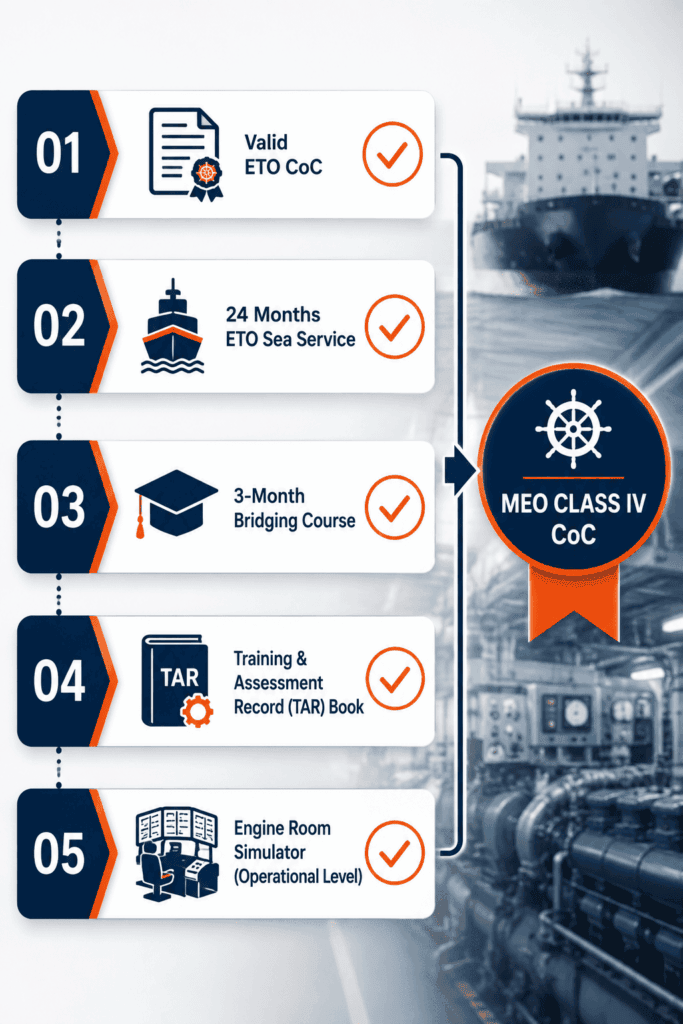
To be admitted, you need to tick every box below, in this order.
| Requirement | What It Means |
| Valid ETO CoC | Issued by the Government of India under STCW Regulation III/6 |
| 24 months of ETO sea service | On ships with 750 kW propulsion power or more, completed after getting your ETO CoC |
| DGMA-approved Bridging Course | 3-month transition course, completed successfully |
| Training & Assessment Record (TAR) Book | Approved format, fully completed and authenticated |
| Engine Room Simulator (Operational Level) course | Completed at a DGMA-approved MTI |
How Much ETO Sea Service Do You Need Before the Bridging Course?
You need at least 24 months of approved seagoing service as an ETO, on ships of 750 kW propulsion power or above, completed after you already hold your ETO CoC. This service gets logged the same way all your other sea time does, through your Continuous Discharge Certificate. Keep your CDC updated at every sign-off. MMD examiners will check it against your TAR Book later, and gaps are much easier to fix while they are recent.
What Does the DGMA-Approved Bridging Course Cover?
The Bridging Course runs for a minimum of three months and mixes theory, practical training, and assessment. At minimum, it must cover 15 subjects:
- Marine Engineering Practice
- Marine Machinery Systems
- Thermodynamics and Heat Engines
- Applied Mechanics and Fluid Mechanics
- Engineering Drawing
- Auxiliary Machinery
- Marine Boilers and Steam Systems
- Refrigeration and Air Conditioning
- Naval Architecture and Ship Construction
- Engineering Watchkeeping Duties
- Planned Maintenance Systems
- Marine Legislation and Safety Management
- Marine Environmental Protection, SOLAS, MARPOL and Occupational Safety
- Engine-room Resource Management
- Workshop Skills and Practical Training
Annexure I of the circular breaks each of these down into contact hours, learning outcomes, and assessment weightage. We cover that full breakdown, subject by subject, in a companion guide on the ETO to MEO Class IV Bridging Course Syllabus, so this article sticks to the pathway itself.
One detail catches people out: the Engine Room Simulator course is not part of the Bridging Course. It is a separate requirement, and you can only take it after finishing your mandatory sea service, not before.
What Is the TAR Book and Why Does It Matter?
Your Training & Assessment Record Book is the paper trail that proves you actually did the work. It tracks the skills you complete, gets authenticated by your supervising officers, and becomes the evidence an MMD examiner relies on before signing off your CoC. Once you finish the Bridging Course, you can get your TAR Book directly from the Institute of Marine Engineers (India), IME(I), or through the MTI where you did the course.
A practical tip worth knowing: keep the TAR Book with you onboard, not filed away in your cabin drawer. Officers get busy, and testimonials are far easier to collect the same week you complete a task than three months later when your supervising engineer has signed off the ship.
How Long Is Onboard Training After the Bridging Course?
Once you pass the Bridging Course, you move into supervised onboard training and engine-room watchkeeping. How long that lasts depends on how much ETO sea time you already had before you started the course.
| Your ETO Sea Service Before the Bridging Course | Onboard Training Required After |
| 24 to 35 months on ships of 750 kW or more | 9 months |
| 36 months or more on ships of 750 kW or more | 6 months |
This is where a bit of forward planning pays off. Say you are a few months short of 36 months of sea service when you decide when to enrol. Ask yourself if waiting a little longer is worth trading three months off your onboard training later. For some candidates, it is. For others, starting sooner and doing the longer nine-month track works out faster overall. There is no single right answer, only the one that fits your contract cycle.
During this training, you must serve under a certificated Chief Engineer Officer or Second Engineer Officer holding a CoC under STCW Regulation III/2. Everything gets recorded in your TAR Book. At the end, the Chief Engineer and the Master jointly sign a testimonial. It confirms you served as First Assistant to Senior in Full Charge, on regular watch, on main engines and boilers together, for the full six or nine months required.
Here is something many ETOs do not realise. This training does not require you to sign off as ETO and rejoin purely as a trainee. The circular lets you complete the onboard training and watchkeeping while still serving as ETO, under your Chief Engineer’s supervision and in line with your TAR Book. Your company still has to keep the extra watchkeeping within the hours of work and rest limits set by MLC, 2006 and STCW. This needs proper planning with your Chief Engineer, not just extra duty piled on top of an already full workload.
What Watchkeeping Duties Must You Perform During Training?
The watchkeeping you do has to match the standards of competence in STCW Regulation III/1, not just general engine-room familiarity. That means real engineering watch duties: monitoring machinery, responding to alarms, keeping logs, and handling both main engines and boilers, not one or the other.
If your onboard training period does not give you any boiler-related duties, you simply pick up one extra step. You will need to complete the Marine Boiler and Steam Engineering Course (Operational Level) at a DGMA-approved MTI before you can move ahead with your examinations.
What Exams Must You Pass for the MEO Class IV CoC?
Once your training is complete, you sit the standard MEO Class IV examinations, split into two parts.
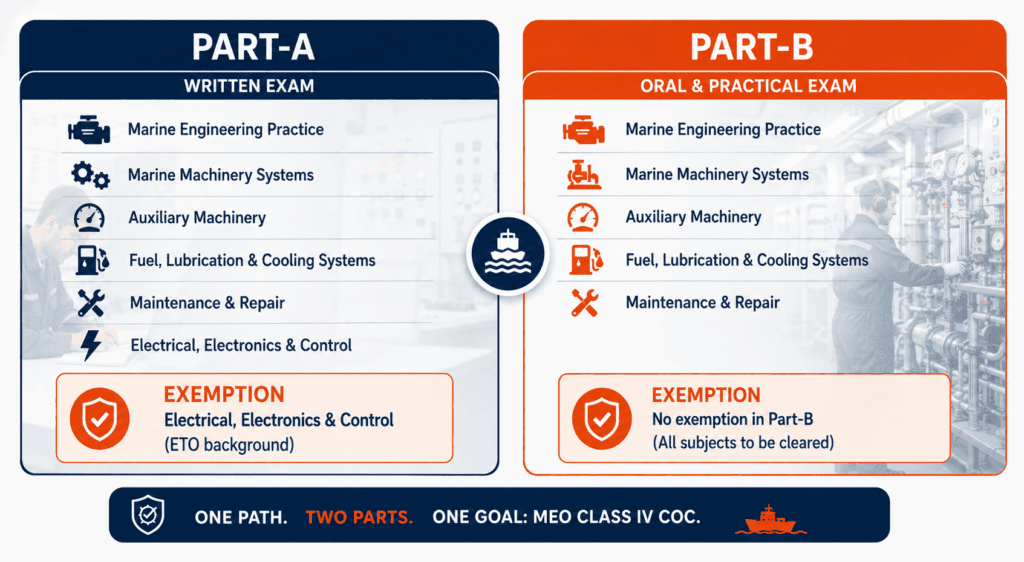
| Exam | Subjects Covered | Exemptions |
| Part-A (written) | Heat Engines, Applied Mechanics, Mathematics, Engineering Drawing | Mathematics exempted for candidates with a B.E./B.Tech degree that meets the ETO entry standard |
| Part-B (written and oral) | All MEO Class IV Functions | Function 5 (Electrical, Electronic and Control Engineering, Operational Level) exempted for the same B.E./B.Tech candidates |
What Is Covered in MEO Class IV Part-A?
Part-A is a written exam covering Heat Engines, Applied Mechanics, Mathematics, and Engineering Drawing. You can attempt it at any time after you finish the Bridging Course. You do not need to wait for your onboard training to be over. You must, however, clear every applicable Part-A paper before you can apply for Part-B.
Who Is Exempt From the Mathematics Paper?
Only candidates who entered the ETO course through a B.E. or B.Tech degree that met the prescribed educational entry standard. If you entered through a diploma or a different route, do not assume this exemption applies. Check with your MTI first.
What Is Covered in MEO Class IV Part-B?
Part-B is both written and oral, and it covers all MEO Class IV Functions at the Operational Level. This is the assessment that confirms your practical readiness to stand an engineering watch.
Who Is Exempt From Function 5?
The same B.E./B.Tech candidates described above are exempt from both the written and oral components of Function 5, Electrical, Electronic and Control Engineering. Everyone else sits the full Part-B, Function 5 included.
Can Your Electrician or Electrical Officer Service Count Too?
Many ETOs spent time onboard as an Electrician or Electrical Officer before formal ETO certification became common. The circular does not ignore that experience. If you hold a valid ETO CoC now, service in those earlier ranks can count toward the transition requirements, provided you meet three conditions:
- You independently performed the duties and responsibilities of an Electro-Technical Officer, not just assisted one.
- A certificate or testimonial from the vessel’s Chief Engineer confirms exactly what duties you carried out.
- Your RPS company or shipping company authenticates that service, and it is verifiable online.
That third point deserves real attention. Sea service claims that cannot be verified against a properly licensed manning company tend to get rejected outright. Sort this paperwork out early, while your old employer’s records are still easy to reach. Do not wait until an MMD examiner asks for it.
What Happens If You Delay Your Exams?
The Bridging Course is not something you can finish and then sit on for years. Say you do not appear for the written exam, the oral exam, or both, within two years of finishing the Bridging Course. Then you must complete the standard MEO Class IV Preparatory Course before you can apply for the MEO Class IV exams again.
In practice, this means the clock starts the day you finish the Bridging Course, not the day you finish your onboard training. If your training is running toward the nine-month end of the scale, plan your exam attempts with that two-year window in mind well before it becomes tight.
What Are the Conditions for Getting the MEO Class IV CoC?
Put together, here is the full sequence from a valid ETO CoC to a MEO Class IV CoC:
- Hold a valid ETO CoC under STCW Regulation III/6.
- Complete 24 months of approved ETO sea service on ships of 750 kW or more.
- Complete the DGMA-approved 3-month Bridging Course.
- Maintain and complete your TAR Book throughout training.
- Complete 6 or 9 months of supervised onboard training and watchkeeping, depending on your prior sea service.
- Complete the Marine Boiler and Steam Engineering Course if you did not get boiler watchkeeping experience.
- Complete the Engine Room Simulator (Operational Level) course after your sea service is done.
- Pass all applicable MEO Class IV Part-A papers.
- Pass MEO Class IV Part-B, written and oral, claiming your Function 5 exemption if it applies.
- Demonstrate competence against STCW Section A-III/1 throughout the process.
Complete all ten, and you become eligible for a Marine Engineer Officer Class-IV Certificate of Competency under Regulation III/1 of STCW, 1978, as amended.
If any part of the circular is unclear for your case, DGMA’s Engineering Wing takes queries at engexam-dgs@nic.in. Its decision on the matter is final.
Is the Bridging Course the Same as the MEO Class IV Preparatory Course?
No, and this is worth being precise about because the names sound similar. DGMA runs two separate frameworks that both touch MEO Class IV certification:
- The MEO Class IV Preparatory Course sits under a different circular. It is a mandatory one-month exam-readiness course for candidates entering MEO Class IV through the standard direct route. We cover it in full, along with the ETO Preparatory Course, in our guide to the DGMA MEO and ETO Preparatory Courses.
- The ETO to MEO Class IV Bridging Course, covered in this article, is a three-month transition course specifically for certified ETOs moving across from Regulation III/6 to Regulation III/1.
They serve different candidates and different purposes. Circular No. 50 of 2026 does not mention the Preparatory Course anywhere in its own text. If you are transitioning under this bridging pathway, your course obligation is the three-month Bridging Course, not the one-month Preparatory Course, unless your MTI or MMD says otherwise for your case. If your exam attempt lapses past the two-year window described earlier, the Preparatory Course then applies as a separate condition for re-entry.
Before you enrol anywhere, confirm the institute is on the current list of DGMA-approved Maritime Training Institutes. Approval status changes, and a course completed at an institute that later loses its approval can create real problems when you apply for your CoC.
Frequently Asked Questions
What is the ETO to MEO Class IV CoC transition pathway?
It is a structured route, set out in DGMA EAC Branch Circular No. 50 of 2026, that lets a certified ETO earn a MEO Class IV (unlimited propulsion power) CoC through sea service, a bridging course, onboard training, and the standard MEO Class IV examinations.
Who can apply for the ETO to MEO Class IV bridging course?
Anyone holding a valid ETO CoC issued by the Government of India, who has completed at least 24 months of approved ETO sea service on ships of 750 kW propulsion power or more.
How long is the ETO to MEO Class IV Bridging Course?
A minimum of three months, structured as 12 weeks, 60 working days, and 360 contact hours across 15 subjects.
Do I need 24 months of sea service before I can start the Bridging Course?
Yes. The 24 months must be completed as an ETO, on ships of 750 kW propulsion power or above, after you already hold your ETO CoC.
What is the difference between the 6-month and 9-month onboard training tracks?
Candidates with 24 to 35 months of prior ETO sea service complete 9 months of onboard training after the Bridging Course. Candidates with 36 months or more complete 6 months instead.
Is the Engine Room Simulator course part of the Bridging Course?
No. It is a separate, standalone requirement, and it can only be completed after your mandatory sea service is finished, not during or before the Bridging Course.
Are ETOs exempt from any part of the MEO Class IV exams?
Yes, but only if your ETO course entry was through a qualifying B.E./B.Tech degree. In that case, you are exempt from the Mathematics paper in Part-A and from Function 5 (Electrical, Electronic and Control Engineering) in Part-B.
Can my time as an Electrician or Electrical Officer count toward the transition?
It can, if you can show you independently performed ETO-level duties, get a testimonial from the vessel’s Chief Engineer, and have that service authenticated by a properly licensed manning company.
What happens if I do not sit my exams within two years of finishing the Bridging Course?
You will need to complete the MEO Class IV Preparatory Course before you are allowed to apply for the MEO Class IV examinations again.
Is the ETO to MEO Class IV Bridging Course the same as the standard MEO Class IV Preparatory Course?
No. The Preparatory Course is a one-month exam-readiness course for direct-entry MEO Class IV candidates under a separate circular. The Bridging Course is a three-month transition course built specifically for certified ETOs under Circular No. 50 of 2026.