
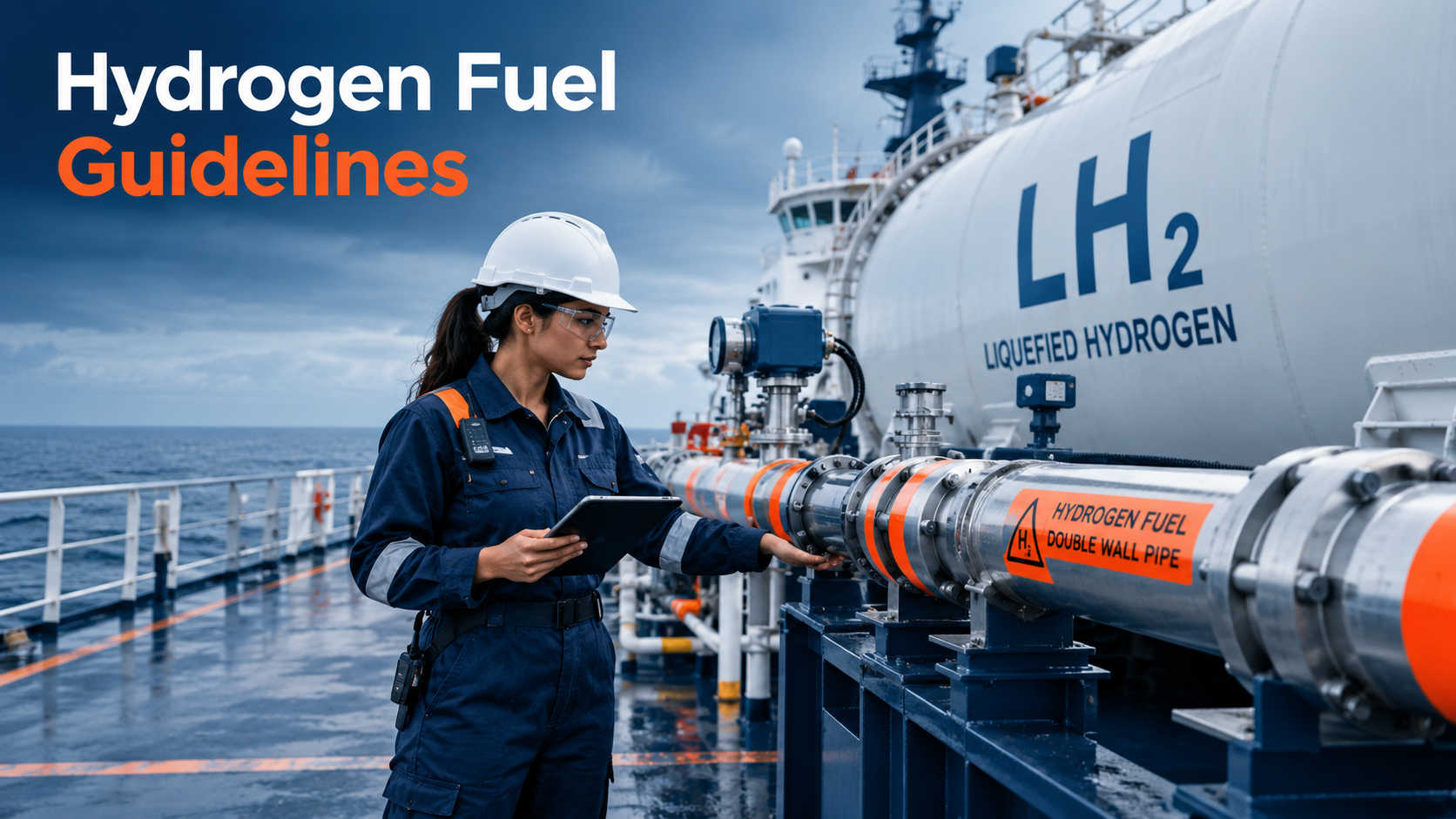
The IMO hydrogen fuel guidelines for the Safety of Ships was approved by the Maritime Safety Committee at its session, which took place from 13 to 22 May 2026. It provides shipowners and operators with a goal-based safety framework for using hydrogen as a fuel. The guidelines were finalized by the Sub-Committee on Carriage of Cargoes and Containers at its session (CCC 11) which happened in September 2025. Reaching this point took than two years of work done together by CCC and its related group, the Intersessional Working Group on Alternative Fuels (ISWG-AF).
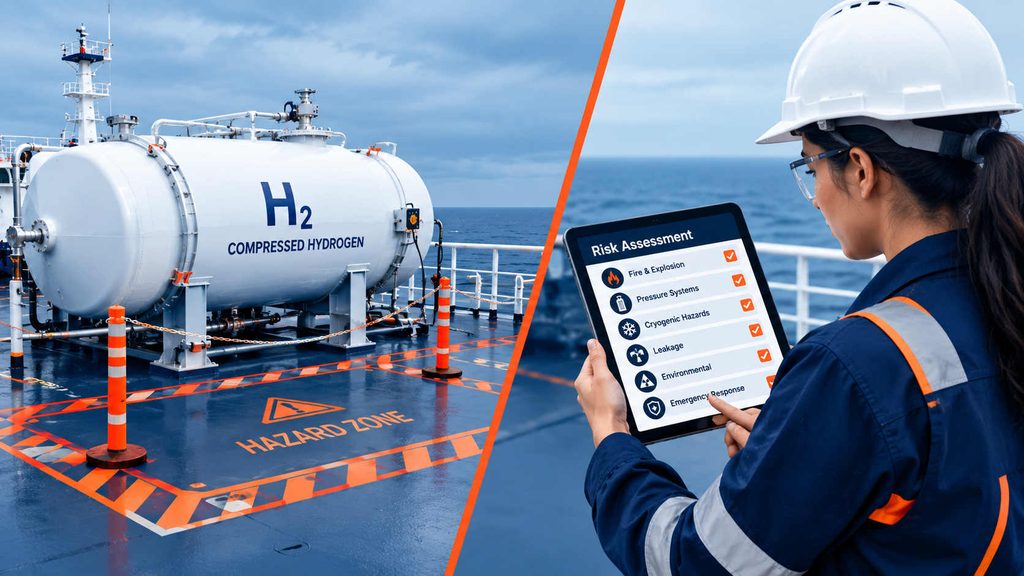
What Is MSC.1/Circ.1701?
MSC.1/Circ.1701 is the interim goal-based guidance document from the IMO for ships that use hydrogen. Not as cargo but as fuel. For main or auxiliary machinery. It was created under the working plan for alternative fuels and technologies that fall under the International Code of Safety for Ships Using Gases or Other Low-Flashpoint Fuels (IGF Code). This code does not yet have mandatory rules, for hydrogen. Until the IGF Code hydrogen is changed to include hydrogen MSC.1/Circ.1701 acts as a solution that flag Administrations, classification societies and designers can use right now.
The guidelines were structured on Goals and Functional Requirements, the same drafting philosophy the IMO already uses for the IGF Code itself, and detailed provisions were developed across all 20 chapters of the document before it went to MSC 111 for approval.
What Are the Key Safety Requirements?
MSC.1/Circ.1701 builds its safety case around a single idea: a hydrogen-fuelled ship should be no less safe than a comparable conventional oil-fuelled one. Every technical chapter works back from that goal, requiring a documented risk assessment, open-deck storage as the default, layered leak-detection and shutdown logic, and a fire-response philosophy built around cutting the fuel supply first rather than fighting the flame directly.
| Safety Area | What It Covers |
|---|---|
| Risk & Design | Holistic risk assessment for every installation; open-deck fuel storage and gas-safe machinery spaces by default. |
| Fuel Containment | Vacuum-insulated type C tanks for liquid hydrogen; type 4 composite pressure vessels for compressed hydrogen. |
| Bunkering & Supply | Dry-disconnect couplings, double block-and-bleed valves, and automatic shutdown on a detected leak. |
| Fire & Explosion Safety | Fuel-shutoff-first response, a mandatory Explosion Risk Analysis, and Zone 1 hazardous-area classification by default. |
| Ventilation & Electrical | Hazardous spaces inerted or vacuum-protected by default; electrical equipment restricted and IEC 60079-compliant. |
| Monitoring & Training | Tiered gas-detection alarms with automatic shutdown, STCW-based crew training, and dedicated protective equipment. |
A few requirements stand out for how different they are from conventional fuel systems:
- Fuel-shutoff-first firefighting — the hydrogen safety system isolates the leak automatically before any extinguishing agent is applied.
- Redundant fuel storage — single-fuel ships must split hydrogen across two or more tanks so one failure can’t cause a total loss of power.
- Tiered gas-detection alarms — an audible/visual alarm at 20% of the lower explosion limit, escalating to automatic shutdown at 40%, confirmed by two detectors.
- Zone 1 by default — tank connection spaces and fuel-piping enclosures are classified as hazardous Zone 1 regardless of arrangement, a stricter baseline than some other alternative fuels.
Taken together, these requirements give designers, class societies and flag Administrations a consistent, if still interim, benchmark to build and approve hydrogen-fuelled ships against — one that will keep tightening as more vessels enter service and real operating experience feeds back into the IGF Code.
Goal, Functional Requirements and Alternative Design
Before any technical chapter, MSC.1/Circ.1701 sets an overarching goal: hydrogen-fuelled ships should reach at least the same level of safety and reliability as a comparable conventional oil-fuelled ship. Nineteen functional requirements flow from that goal and are referenced by number throughout the rest of the document — everything from minimizing hazardous-area extent, to preventing a single failure from causing an unsafe situation, to ensuring risk-reducing safety actions never cause an unacceptable loss of propulsive power.
Two structural features matter for anyone reading the rest of the circular:
- Alternative design. Nearly every technical chapter includes a “notwithstanding” clause allowing appliances or arrangements that deviate from the prescriptive text, provided equivalence is demonstrated under SOLAS regulation II-1/55 and approved by the Administration. This is how, for example, hydrogen storage inside an enclosed space (rather than open deck) or non-vacuum-insulated tank types could eventually be approved on a case-by-case basis.
- Definitions. The guidelines add hydrogen-specific terms on top of the IGF Code’s own definitions — cold hydrogen vapour, cryo-pumping, oxygen enrichment, permeation, secondary enclosure, self-ignition and more — because several of hydrogen’s failure modes (like cryo-pumping of air into a vacuum space) don’t have LNG or LPG equivalents.
Risk Assessment and General Requirements
Every hydrogen as ship fuel installation has to be backed by a holistic risk assessment covering the ship’s structural integrity, the environment and persons on board, using recognized risk-analysis techniques and documented to the Administration’s satisfaction.
The chapter lists specific hazards every assessment must consider: hydrogen embrittlement, natural permeability through materials, leak detection, ignition sources including self-ignition, and jet-fire/flashfire/deflagration/detonation escalation — plus extra items for liquefied systems (cryo-pumping, air condensation, oxygen enrichment) and portable tanks (lifting operations, repeated connect/disconnect cycles).
The chapter also sets a hard limitation-of-consequence test: a fire or explosion from a hydrogen leak must not disrupt other spaces’ equipment, cause flooding, injure people in accommodation or work areas, disable fire-fighting equipment, or block access to life-saving appliances.
Why Did the Committee Issue These Guidelines?
Hydrogen propulsion pilot and demonstration projects were already moving ahead — on ferries, offshore support vessels and inland craft — without a single, internationally recognised safety benchmark to design against. CCC 11’s own summary describes the guidelines as deliberately kept high-level, intended to support ongoing experimental projects while more operating experience with hydrogen fuelled ships safety systems accumulates at sea. The Committee was explicit that the text is interim, pending the eventual development of mandatory hydrogen provisions under the IGF Code Hydrogen itself, in the same way LNG-as-fuel provisions started as interim guidance before being written into the Code.
The timing lines up with a broader push by classification societies to close the safety data gap around hydrogen. Korean Register (KR) has released a report on its own that looks at the risks of hydrogen. These include the fact that hydrogen burns easily the chance of explosions and the way hydrogen can make metal parts weaker over time. DNV worked on a study that took years for the European Maritime Safety Agency (EMSA). The study found that ships using hydrogen as fuel must focus on safety from the start of the design. It also says that extra protective areas should be placed around parts that carry hydrogen even if those parts are, on a deck.
Which Types of Hydrogen Fuel Do the Guidelines Cover?
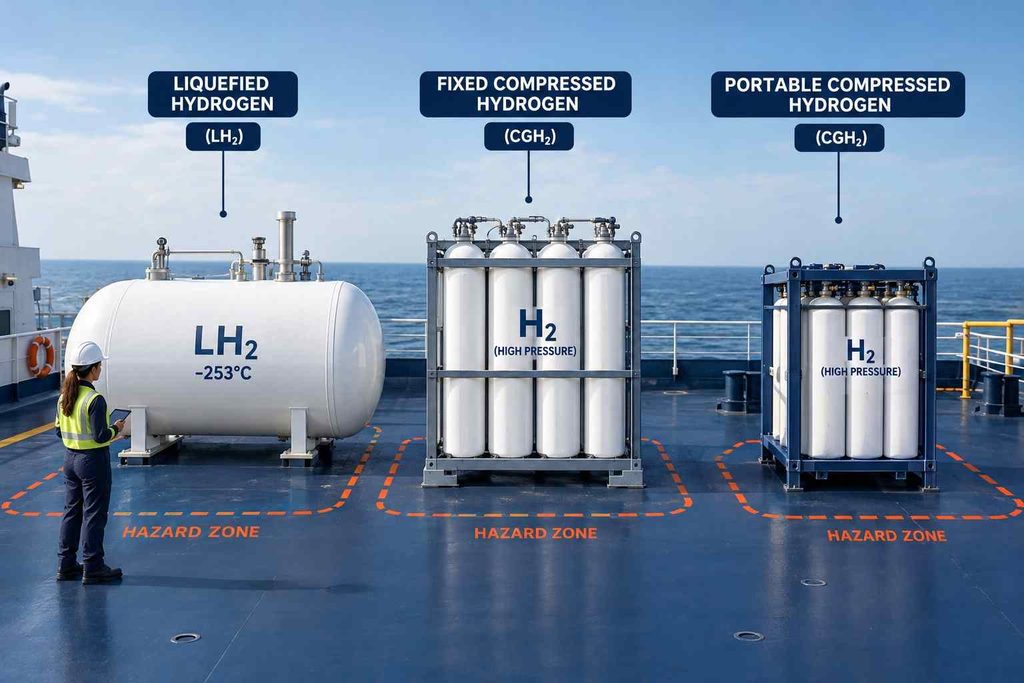
The guidelines are scoped to three specific hydrogen fuel concepts, and do not yet extend to every possible way of storing hydrogen on board.
| Hydrogen Fuel Concept | Containment | Location Requirement |
| Liquefied hydrogen (LH2) | Double-walled tank connections required | Open deck only |
| Fixed compressed hydrogen | May be single-walled | Open deck only |
| Portable compressed hydrogen | May be single-walled | Open deck only |
Hydrogen storage using Liquid Organic Hydrogen Carriers (LOHC) or metal hydrides is not covered by MSC.1/Circ.1701 — CCC 11 has flagged this as a separate item on its work plan, alongside a planned revision of the hydrogen guidelines themselves as more experience is gained. Fuel cell power installation guidelines are also being revised as a distinct, related work item, expected around 2028. For a deeper technical dive into the two storage states, DNV’s Handbook for Hydrogen-Fuelled Vessels is a useful free companion read, with risk-based design principles and a full explosion-risk study for a compressed-hydrogen concept vessel.
Ship Design and Arrangement
This is one of the longest chapters in the annex, and covers ground most summaries skip:
- Machinery spaces housing hydrogen-fuelled machinery must be inherently gas-safe — arranged so a single failure cannot release fuel gas into the space — with all internal fuel piping enclosed in a gastight secondary enclosure.
- Tank connection spaces (for liquefied hydrogen) and tank connection enclosures (for compressed hydrogen) have detailed, separate provisions: gastight boundaries, secondary enclosures around all internal piping, continuous leak detection, and bolted-hatch access through a protective entry space and airlock unless access is direct from open deck.
- Airlocks get their own dimensional and operational rules — gastight doors 1.5–2.5 m apart, self-closing without hold-back arrangements, mechanically ventilated at overpressure relative to the hazardous side, minimum 1.5 m² deck area, and audible/visual alarms if more than one door is open at once.
- Drip trays are required wherever cold hydrogen release could condense atmospheric air into liquid oxygen, since liquid oxygen pooling near hydrogen piping is its own explosion hazard; trays must be insulated from the hull, drainable, and sized against the risk assessment’s estimate of potential air condensate.
- Fuel piping location rules: piping stays at least 800 mm from the side shell (including the stern), can’t be routed through accommodation, service spaces or control stations even inside a secondary enclosure, and must be protected against mechanical damage where it crosses ro-ro or open-deck areas.
Fuel Containment Systems
For liquefied hydrogen, the guidelines currently recognise vacuum-insulated type C independent tanks only — other IGF Code hydrogen tank types would need an alternative-design case. Welded shell joints must be full-penetration butt welds, piping to the first valve needs equivalent safety to the tank itself, and thermal insulation has to resist high-oxygen-concentration exposure from condensing air as well as prevent liquefaction/solidification of ambient air on cold surfaces.
For compressed hydrogen, tanks must be built to a recognised standard for type 4 composite pressure vessels (the circular references EN 17339, ISO 11119-3 and EN 12245 as examples), fitted with an automatic fail-safe shut-off valve mounted on or within the cylinder, and equipped with thermally-activated pressure relief devices (TPRDs) sized to depressurize the tank in a fire. Portable compressed-hydrogen containment (MEGCs, tank containers) has its own sub-section: worst-case drop-scenario design for lifting, dry-disconnect connections, integration into the ship’s control and safety systems, and a minimum 20-year design life.
Redundancy matters too: single-fuel installations must split storage across two or more tanks (one tank is only acceptable for a type C tank served by two fully separate tank connection spaces), so a leak or failure in one system doesn’t force an unacceptable loss of propulsion.
Material and General Pipe Design
A chapter with no equivalent coverage in most hydrogen as ship fuel explainers: materials in contact with hydrogen must be qualified against hydrogen embrittlement, hydrogen attack, and (for cryogenic service) toughness at low temperature, with testing scope agreed by the Administration. Components exposed to potential oxygen-enriched atmospheres — a real risk once ambient air starts condensing on cold hydrogen surfaces — need separate resistance testing.
Secondary enclosure outer surfaces must not normally drop below -183°C (oxygen’s boiling point at atmospheric pressure), specifically to avoid triggering that condensation in the first place. Expansion joints and bellows are to be avoided in hydrogen piping wherever practicable, with engine-mounted bellows accepted only where justified in the engine’s own safety concept.
What Do the Fuel Storage, Supply and Distribution Provisions Require?
Section provisions on hydrogen as ship fuel storage, supply and distribution systems cover piping, materials and arrangement in detail. The core position taken by the guidelines is that fuel tanks and fuel preparation equipment must be located on open deck; enclosures are not permitted unless justified and approved through the IGF Code’s alternative design process.
Tank connection spaces and enclosures around hydrogen fuel equipment must be classified as hazardous area Zone 1, regardless of how the piping or equipment inside that space is arranged — a stricter default position than some other alternative fuels take, reflecting hydrogen’s wide flammability range and low ignition energy. ClassNK has already built these provisions into its own rule set, adding estimated hydrogen leak frequencies calculated with a Bayesian methodology to give designers workable data for the risk assessments this section demands.
Fuel Supply to Consumers
Not covered in most summaries: the guidelines set detailed valve-arrangement logic for delivering hydrogen to engines and other consumers. Each consumer’s main supply line needs a remotely-operated stop valve and an automatic master gas fuel valve in series (or combined), positioned outside the machinery space and as close to the consumer as practical. Every consumer also gets double block-and-bleed valves — two fail-to-close shut-off valves in series with a fail-to-open bleed valve vented to a safe open-air location between them — used both for routine engine stops and for automatic shutdown on a detected leak.
Specific alarm logic is defined for faulty valve states (e.g., both block valves closed with the bleed valve also closed while a downstream leak is present). On a confirmed leak and automatic master-valve shutdown, the entire downstream fuel system must depressurize and purge with inert gas automatically.
Power Generation, Propulsion and Other Fuel Consumers
Exhaust systems for hydrogen-fuelled engines must be arranged to prevent any accumulation of unburnt gas, and engine components exposed to ignitable hydrogen must be strong enough to withstand worst-case overpressure from an ignited leak. Internal combustion (piston) engines follow the existing IGF Code chapter 10 provisions where not expressly modified, plus a specific requirement that the engine’s own safety concept demonstrate a safe changeover if fuel supply is lost mid-operation (e.g., on overspeed or gas leakage).
Fuel cells fall under the separate MSC.1/Circ.1647 fuel cell guidelines; fuel reforming equipment (converting a primary fuel such as ammonia, methanol or LNG into hydrogen on board) is likewise routed to that circular when feeding fuel cells, or treated as an alternative-design case when feeding combustion engines.
What Ventilation, Detection and Emergency Systems Are Required?
The guidelines set out provisions for:
- Ventilation of spaces containing hydrogen fuel equipment
- Fixed gas detection systems
- Pressure relief arrangements for fuel tanks and piping
- Emergency shutdown systems for the fuel supply
These sit alongside the hazardous-area classification requirements above, so a designer working through a risk assessment has to size ventilation and detection capacity against Zone 1 assumptions by default, only relaxing them where a documented risk assessment supports a different arrangement.
Detailed provisions also cover duct routing (vertical, ascending, no sharp bends, separated from non-hazardous ventilation), fan redundancy (two fans at 100% capacity each on separate circuits, run in alternating cycles to confirm operability), and automatic shutdown of tank valves and master fuel valves on loss of ventilation. Air inlets to hazardous spaces sit low; extraction sits high, plus additional extraction points wherever structural beams, cable trays or pipe racks could trap a gas pocket.
Explosion Risk Analysis (ERA)
Beyond the Zone 1 default already covered above, every ship needs a documented Explosion Risk Analysis covering all reasonably foreseeable operational and failure scenarios — normal operation, start-up, shutdown, bunkering, maintenance — with minimum required inputs including leak location, size, duration, phase and ignition mechanism. The guidelines even prescribe default leakage sizes to feed into the ERA for pipes, flanges, valves, flexible hoses and couplings if better data isn’t available.
Electrical Installations
A chapter most summaries omit entirely: electrical equipment isn’t permitted in areas with potential flammable hydrogen atmosphere unless essential for safety or operations, and where it is fitted, it must comply with the IEC 60079 series (or an equivalent Administration-accepted standard) and remain functional under all normal and reasonably foreseeable abnormal conditions. Critically, de-energizing electrical equipment is not accepted as a safety barrier on its own — except specifically for spaces protected by an airlock.
Control, Monitoring and Safety Systems
The hydrogen safety system has to be independent of the gas control system (separate power supplies, separate input/output signals) to avoid common-cause failures, and arranged to avoid spurious shutdowns from something as simple as a faulty detector or a broken sensor wire. Gas detectors are mandatory in tank connection spaces, fuel preparation spaces, secondary enclosures, gas-safe machinery spaces, bunkering stations, airlocks and fuel storage hold spaces, with a defined alarm/shutdown escalation: audible/visual alarm at 20% of LEL, automatic safety-system activation at 40% of LEL confirmed on two detectors.
The guidelines include a full monitoring matrix (their Table 1) mapping roughly 20 distinct fault conditions — loss of vacuum, loss of inert gas, bilge high-level, fire detection, abnormal gas pressure, valve actuator failure and more — to specific alarm and automatic-shutdown actions.
What Do the Fire Safety Requirements Say?
Fire protection and hazardous area classification are addressed together, including explosion-prevention measures. The guidelines set out a basic philosophy that runs through the entire fire safety section: the first action to extinguish a hydrogen fire must always be shutting off the fuel supply, rather than direct extinguishing agents, which is a materially different approach from conventional oil-fuel fire response. Crews and system designers are also specifically cautioned about the risk of invisible hydrogen flames — hydrogen burns with a flame that is very difficult to see in daylight, which changes how fire detection and crew response procedures need to be designed.
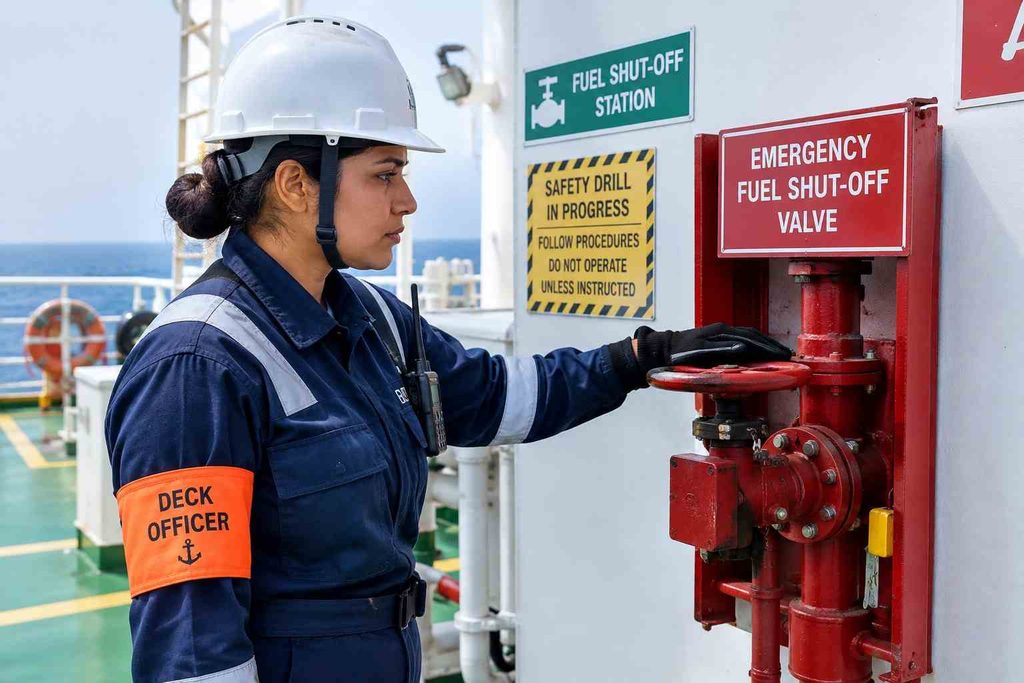
Water spray cooling for open-deck fuel containment systems is prescriptively sized — 10 L/min/m² on horizontal projected surfaces, 4 L/min/m² on vertical surfaces — with remote pump start positioned somewhere unlikely to be cut off by the fire itself, and a specific caution against spraying water into vent masts or onto pressure relief valves on liquefied hydrogen systems (freezing risk).
What Operational Requirements Apply — Bunkering, Purging and Gas Freeing?
Operational aspects covered by the guidelines include bunkering, inerting, purging and gas freeing of hydrogen as ship fuel systems. Because hydrogen has a very wide flammable range and diffuses rapidly, these operational procedures need to be built into the ship’s documentation and followed as standard sequences rather than left to crew judgement on the day — a point CCC 11 flagged specifically when finalising the text. Operators already running gas-fuelled tonnage may find it useful to compare this against our sister-site guide to LNG Bunkering Guidelines, since both fuel types share a broadly similar bunkering, purging and gas-freeing safety logic even though hydrogen’s hazard profile is more demanding.
Manufacture, Workmanship and Testing
Leak tests on hydrogen tanks and piping must use helium or a 5%-hydrogen/95%-nitrogen mixture as the tightness-test medium — ordinary air or nitrogen-only testing isn’t sufficient given hydrogen’s small molecule size and permeation behaviour. For vacuum-insulated liquefied hydrogen systems, the guidelines require the containment system’s performance to be verified during the ship’s first actual liquefied-hydrogen bunkering, once steady cryogenic conditions are reached, including an inspection for cold spots and insulation integrity — with records kept on board for the Administration.
Drills and Emergency Exercises
Hydrogen-specific exercises — tabletop scenarios, reviews of fuelling procedures against the fuel-handling manual, contingency-response tests, and equipment checks — should be run at regular intervals and can be folded into the periodic drills SOLAS already requires, rather than treated as an entirely separate programme.
What Documentation and Crew Training Are Required?
Ship-specific documentation must reflect the hydrogen as ship fuel arrangements actually fitted on board, rather than generic references to the guidelines. Crew competence and training are specifically emphasised in the text — although, unlike ammonia and methanol/ethanol, MSC 111 did not simultaneously approve a standalone hydrogen-specific seafarer training circular; that remains a gap the Sub-Committee’s work plan is expected to address as the guidelines mature.
Training for any IGF Code-covered fuel currently builds on the same STCW foundation every seafarer already completes. Engineering officers moving toward alternative-fuel and gas-fuelled vessels typically progress through the standard MEO Class IV preparatory pathway and, for electro-technical officers making the same transition, the ETO to MEO Class IV bridging course before any fuel-specific or advanced IGF Code endorsement is added to a seafarer’s certificate. Cadets starting out on the engine side can review the NCV Engine Cadet Scheme for how that entry pathway works more broadly.
Seafarers keeping their documentation current for any alternative-fuel-capable vessel should also check our guide on applying for a CDC online and the current CDC eligibility criteria, since documentation requirements are tightening across the board as new fuel types come into service.
Personnel Protection
A short but often-missed chapter: crew engaged in operating or maintaining hydrogen fuelled ships safety systems, and those responding to emergencies, must have access to protective equipment suited to hydrogen exposure risk for the specific operations they perform, plus suitable emergency treatment equipment for anyone affected by hydrogen contact. All of it has to be stored in clearly marked, readily accessible lockers.
How Does MSC.1/Circ.1701 Relate to Other IMO Alternative-Fuel Guidelines?
MSC 111 approved several interim alternative-fuel guidelines together, and it helps to see hydrogen fuel alongside the others the Committee has issued under the same IGF Code work plan.
| Fuel | IMO Circular | Status at MSC 111 (May 2026) |
| Hydrogen as fuel | MSC.1/Circ.1701 | Approved (new) |
| Ammonia cargo as fuel (gas carriers, IGC Code) | MSC.1/Circ.1702 | Approved (new) |
| LPG fuel | MSC.1/Circ.1666 | Previously approved |
| LPG cargo as fuel | MSC.1/Circ.1679 | Previously approved |
| Methyl/ethyl alcohol as fuel | MSC.1/Circ.1621 | Previously approved; revision in progress |
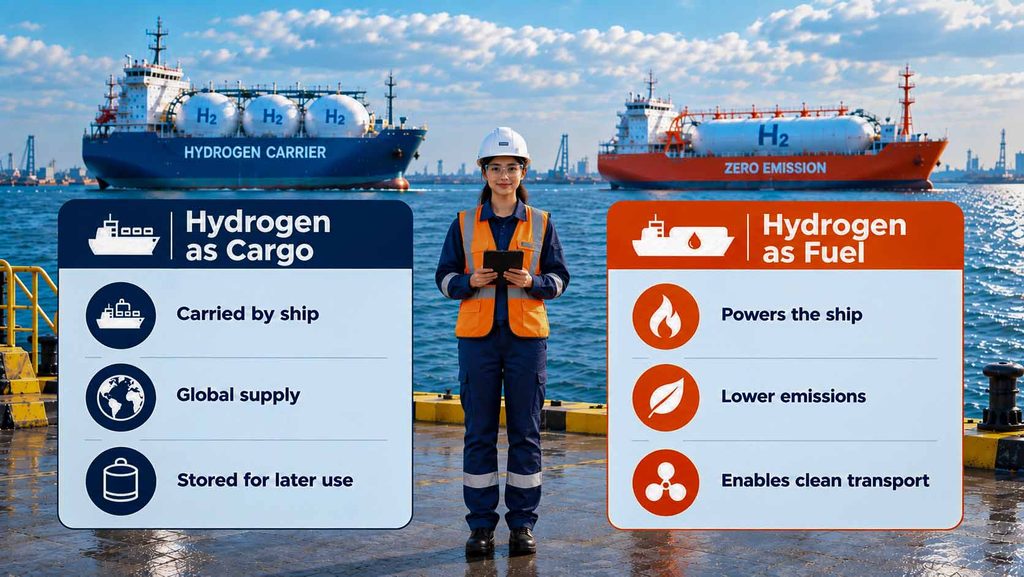
It’s worth being precise about the difference between MSC.1/Circ.1701 and the IMO’s separate rules for ships that carry liquefied hydrogen as cargo. That cargo-carriage regime sits under the IGC Code, via the Revised Interim Recommendations for the Carriage of Liquefied Hydrogen in Bulk (resolution MSC.565(108)), which MSC 111 also updated — adding a new Part D covering membrane-type cargo containment systems that keep insulation spaces under vacuum.
A liquefied-hydrogen gas carrier is governed by that cargo instrument; a ship of any type burning hydrogen in its engines for propulsion is governed by MSC.1/Circ.1701. MSC 111 also used this session to clarify, under its “one ship, one code” principle, that the IGF Code does not apply to gas carriers already governed by the IGC Code — closing a potential overlap between the two frameworks.
ClassNK’s own announcement of its Edition 3.1 alternative-fuels guidelines gives a useful independent confirmation of this scope split — its official press release covers hydrogen-as-fuel (Part D, built on MSC.1/Circ.1701) as a separate section from its methanol/ethanol fuel-tank provisions, reinforcing that each alternative fuel is being regulated through its own dedicated instrument rather than one blended code.
How Do These Guidelines Reach Indian-Flagged Ships?
As India’s maritime regulator, the Directorate General of Maritime Administration (DGMA) is the Administration referenced throughout IMO alternative-fuel guidelines wherever flag-state approval, risk-assessment sign-off or equivalence justification is required. Owners and operators looking at hydrogen propulsion for Indian-flagged tonnage should expect a corresponding DGMA implementing circular, in the same pattern DGMA has followed for other IMO alternative-fuel instruments and via the eNavik DGMA Portal it uses for seafarer and RPSL-facing communication.
Our coverage of the DGMA approved bunker supplier list is a useful starting point for how DGMA administers fuel-related approvals more broadly, and our guide to the Indian Merchant Shipping (MS) Rules and Acts, 2025 covers the underlying certification framework these circulars sit within.
Owners chartering foreign-flagged hydrogen-fuelled tonnage into India should also read our note on the chartering licence process for foreign-flagged vessels, since the vessel-type and fuel-system approvals discussed above apply regardless of flag or charter arrangement.
Classification societies have moved quickly to incorporate the new text: ClassNK, for example, has already folded MSC.1/Circ.1701 into Part D of its own Guidelines for Ships Using Alternative Fuels (Edition 3.1), adding a Bayesian-method hydrogen leak-frequency table to support the risk assessments the IMO guidelines require for Administration approval.
Conclusion
MSC.1/Circ.1701 gives hydrogen-fuelled shipping its first dedicated, IMO-recognised safety benchmark — built around open-deck fuel storage, Zone 1 hazardous-area classification by default, fuel-shutoff-first fire response, and documented risk assessment at every stage. It is explicitly interim, scoped for now to liquefied and compressed hydrogen concepts rather than LOHC or metal-hydride storage, and it will keep evolving through the Sub-Committee’s work plan as operating experience from early hydrogen-fuelled projects feeds back into the IGF Code. For owners and designers working on hydrogen propulsion today, MSC.1/Circ.1701 — not general IGF Code principles alone — is now the reference point flag Administrations and class societies will expect a design to be checked against.
IMO Hydrogen Fuel Guidelines: Frequently Asked Questions
Is hydrogen fuel actually cheaper to run a ship on than diesel or LNG right now?
No — it’s currently the most expensive option by a wide margin. Industry estimates put hydrogen at roughly 10-12 times the cost of LNG and 4-5 times costlier than ammonia or methanol on an energy-equivalent basis. Regulation solves the safety-design problem, not the price problem — hydrogen still needs to get commercially competitive before shipowners adopt it at scale.
Are hydrogen-fuelled ships actually sailing today, or is this all still on paper?
They’re sailing, just small in number. A dozen-plus vessels are already in service — Norled’s ferry MF Hydra runs on liquid hydrogen fuel cells, CMB.TECH’s Hydrotug 1 burns hydrogen in a converted combustion engine, and switch Maritime’s Sea Change operates as a passenger ferry in San Francisco. A hydrogen-fuelled cruise ship also had its keel laid in 2026. What’s missing so far is large deep-sea tonnage, not proof of concept.
How far can a hydrogen-fuelled ship actually sail before refuelling, compared to a diesel ship?
Considerably less, tank-for-tank. Even liquid hydrogen only holds about 8.5 MJ per litre versus roughly 21.6 MJ per litre for LNG, so a hydrogen ship needs a much bigger tank — or more frequent bunkering stops — for the same range. That’s the main reason hydrogen is showing up first on ferries and short-sea/coastal routes rather than on deep-sea cargo ships and tankers doing multi-week voyages.
Can Indian ports currently bunker hydrogen fuel for ships?
Not yet, in any meaningful way. India’s “Harit Sagar” green port guidelines set a target of green hydrogen bunkering facilities at all 12 major ports by 2035 — so the policy direction exists, but the infrastructure is close to a decade out. For now, hydrogen bunkering is concentrated in a handful of pilot corridors in Europe and East Asia.
Will small coastal ships and ferries get hydrogen before big cargo ships and tankers do?
Yes, and that pattern is already visible in the ships currently in service — tugboats, ferries, dredgers and inland barges make up almost the entire hydrogen-fuelled fleet so far. That’s a direct consequence of the range and tank-size problem above: short, frequent routes suit hydrogen’s lower energy density far better than a three-week deep-sea passage does.
Is it worth learning about hydrogen fuel systems if I’m just starting out in the merchant navy?
It’s a reasonable long-term bet but not an urgent one. Hydrogen-fuelled newbuilds are still a small fraction of the orderbook compared with LNG or methanol tonnage, so a cadet is far more likely to sail on a conventional or LNG-fuelled ship first. That said, IMO’s alternative-fuel training framework is being built out now, so familiarity with the goal-based safety approach in MSC.1/Circ.1701 will transfer easily once hydrogen berths become more common. If you’re still mapping out the entry route itself, our guide on how to join the Merchant Navy in India is the right starting point before any fuel-specific specialisation.
Does hydrogen boil off and get wasted the way LNG does if a ship sits still too long?
Yes — liquid hydrogen has to be stored at around -253°C, even colder than LNG’s -162°C, so it boils off faster and needs continuous insulation and pressure management. This is exactly why the guidelines require dedicated venting, pressure-relief and boil-off handling arrangements rather than leaving a hydrogen tank to just sit passively like a diesel tank would.
Why do hydrogen ship designs always put the tank up on the top deck instead of low down like a normal fuel tank?
Partly regulation, partly physics. The open-deck placement rule exists because hydrogen disperses upward and dilutes quickly in open air, which is far safer than letting a leak collect in an enclosed space below deck. It also happens to make bunkering, inspection and any future tank swap simpler than digging into a below-deck compartment.
If I’m not working on a newbuild hydrogen project, does this circular affect my current ship at all?
Not directly, no — MSC.1/Circ.1701 only applies to ships actually designed or converted to burn hydrogen as fuel. If your vessel runs on conventional fuel, LNG, methanol or any fuel other than hydrogen, this specific circular has no bearing on your ship’s certification or operations.
Is a hydrogen fuel cell the same thing as a hydrogen engine on a ship, or are they different technologies?
Different technologies, both covered by the guidelines. A fuel cell — used on MF Hydra, for instance — converts hydrogen into electricity electrochemically, with no combustion at all. A hydrogen internal combustion engine, like the one on Hydrotug 1, burns hydrogen directly the way a diesel or LNG engine burns its fuel. Ships are using both approaches right now; neither is the “standard” yet.