
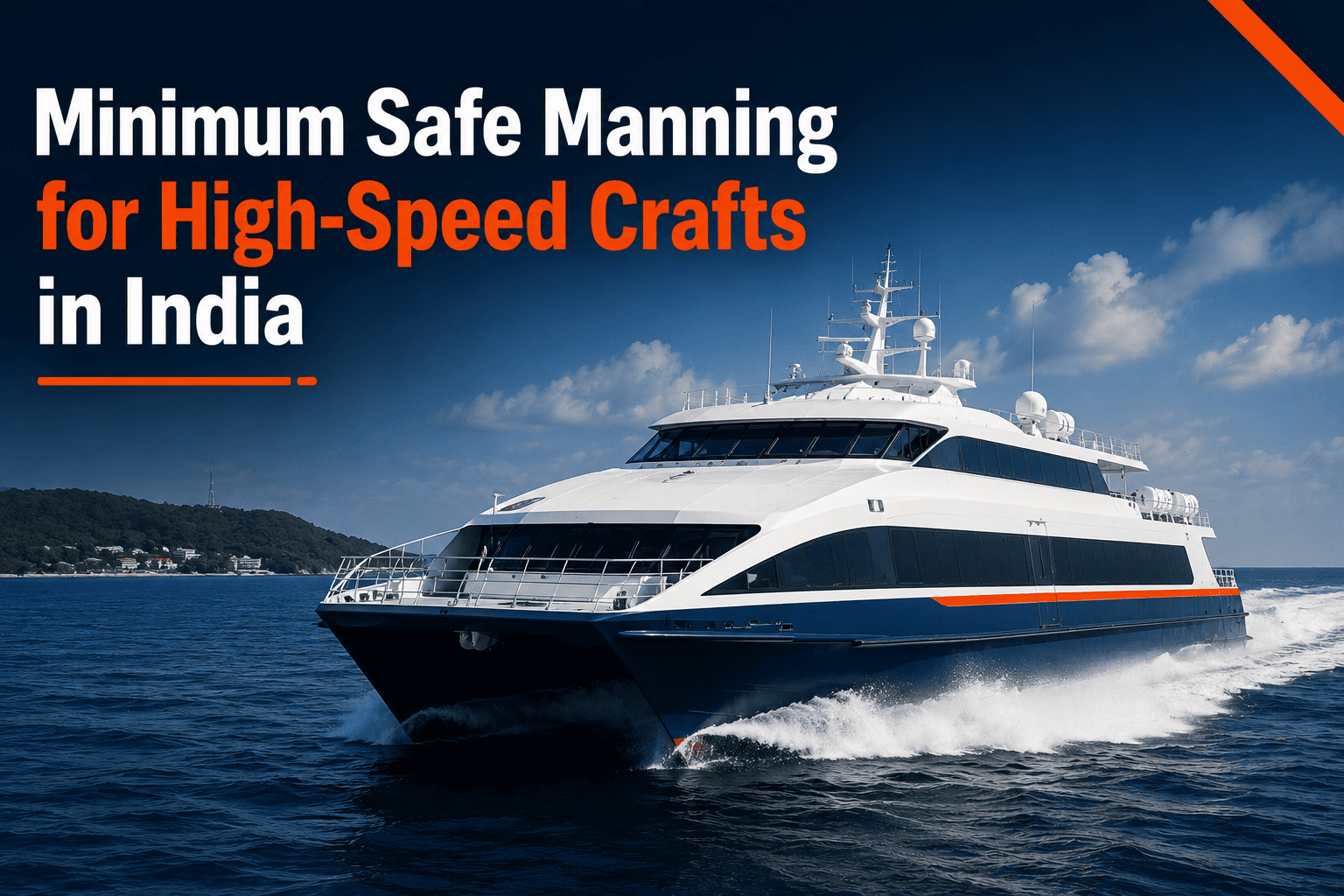
Minimum safe manning for high-speed crafts in India comes from Annexure G-7 of DGMA Circular No. 54 of 2025, and it stands apart from every other scale in the circular in one important way: it is not banded by Gross Tonnage at all. A single fixed crew of 5 nautical seafarers covers every Category A high-speed craft operating at Port Blair and in the Indian offshore region up to the Exclusive Economic Zone, regardless of how large or small the craft actually is.
If you operate a fast ferry, a catamaran, or any other Category A high-speed craft on that route, Annexure G-7 is the table that decides its Minimum Safe Manning Document (MSMD), and it works nothing like the Gross Tonnage tables covering every other vessel type in this circular.
This guide closes out our series on minimum safe manning requirements for Indian flag vessels, which maps every annexure in DGMA Circular No. 54 of 2025, and it is also the final annexure in the circular itself. It follows our guide to Annexure G-6 for Type 4 River-Sea passenger vessels, and unlike every guide before it in this series, there is no gross tonnage table to walk through here, since Annexure G-7 sets one crew for the whole craft category instead.
What Vessels Does Annexure G-7 Cover?
Annexure G-7 covers Category A high-speed craft is the term the IMO’s International Code of Safety for High-Speed Craft, generally known as the HSC Code, uses for fast catamarans, planing monohulls, hydrofoils, and similar vessels built for speeds well beyond a conventional displacement ship. In India, these are mostly fast passenger ferries, and Annexure G-7 specifically applies to those operating at Port Blair and across the Indian offshore region, up to the Exclusive Economic Zone.
What Makes a Craft “High-Speed” Under the HSC Code?
The HSC Code, adopted by the IMO in 1994 and revised in 2000, defines a high-speed craft using a formula rather than a simple speed figure: a craft capable of a maximum speed, in metres per second, equal to or exceeding 3.7 times the one-sixth power of its displacement volume in cubic metres. In practical terms, that formula sets a lower speed threshold for smaller craft and a higher one for larger craft, which is why a wide range of catamarans, monohulls, and hydrofoils of different sizes can all fall inside the same “high-speed craft” definition despite very different top speeds.
What Is the Difference Between Category A and Category B High-Speed Craft?
The HSC Code splits high-speed passenger craft into two categories. Category A craft operate on routes where evacuation and rescue can realistically happen within a limited time, generally meaning shorter, more predictable routes closer to a place of refuge, and they are built to a correspondingly lighter safety standard than Category B.
Category B craft cover routes that do not meet that rescue-time test, and they carry a higher level of built-in safety as a result, since the vessel itself, rather than external rescue, needs to keep everyone safe for longer. Annexure G-7’s restriction to Port Blair and the Indian offshore region, combined with its daylight-hours-only condition, is consistent with the kind of shorter, rescue-assured route the Category A classification is built around.
What is the complete Annexure G-7: minimum safe manning for high-speed crafts in India?
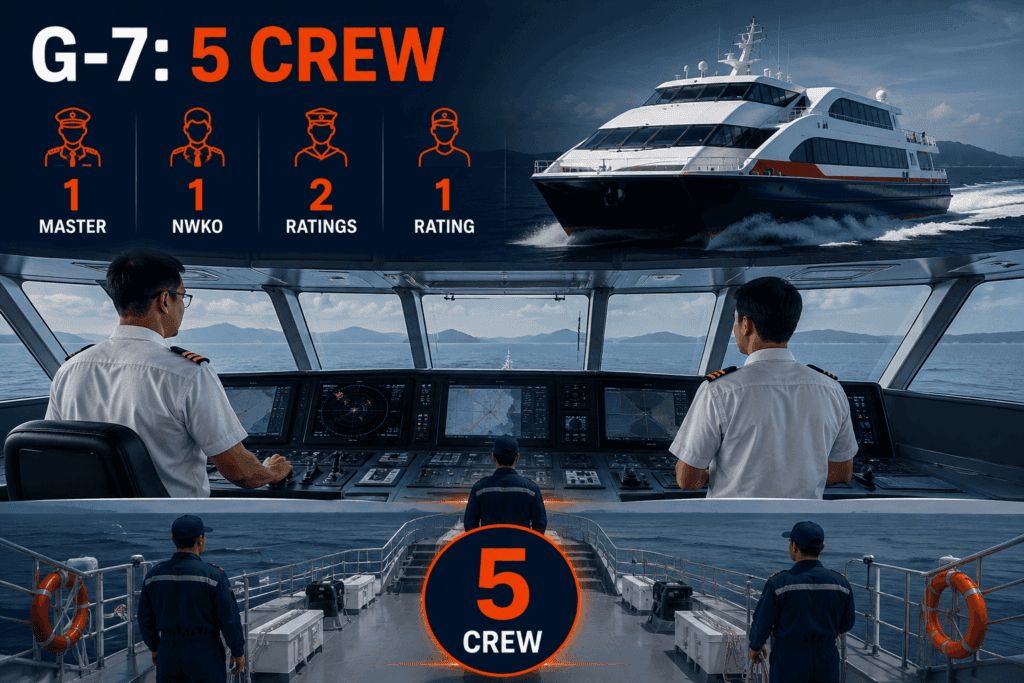
Unlike every other annexure in this series, Annexure G-7 does not run across a series of gross tonnage codes. It sets one fixed crew that applies to every qualifying Category A high-speed craft regardless of size.
| S.N. | Qualification / CoC | Number of Seafarers |
| 1 | Master (FG or NCV) with Type Rating Certificate | 1 |
| 2 | Mate (FG or NCV) with Type Rating Certificate | 0 |
| 3 | 2nd Mate or NWKO (NCV) with Type Rating Certificate | 1 |
| 4 | Able Seafarer Deck (II/5) or rating forming part of a navigational watch (II/4) | 2 |
| 5 | Rating (Deck) | 1 |
Add up the column, and the total nautical crew comes to 5, the leanest deck complement of any scale in the entire circular, cargo or passenger.
Why Does This Scale Have No Mate or Chief Officer Position?
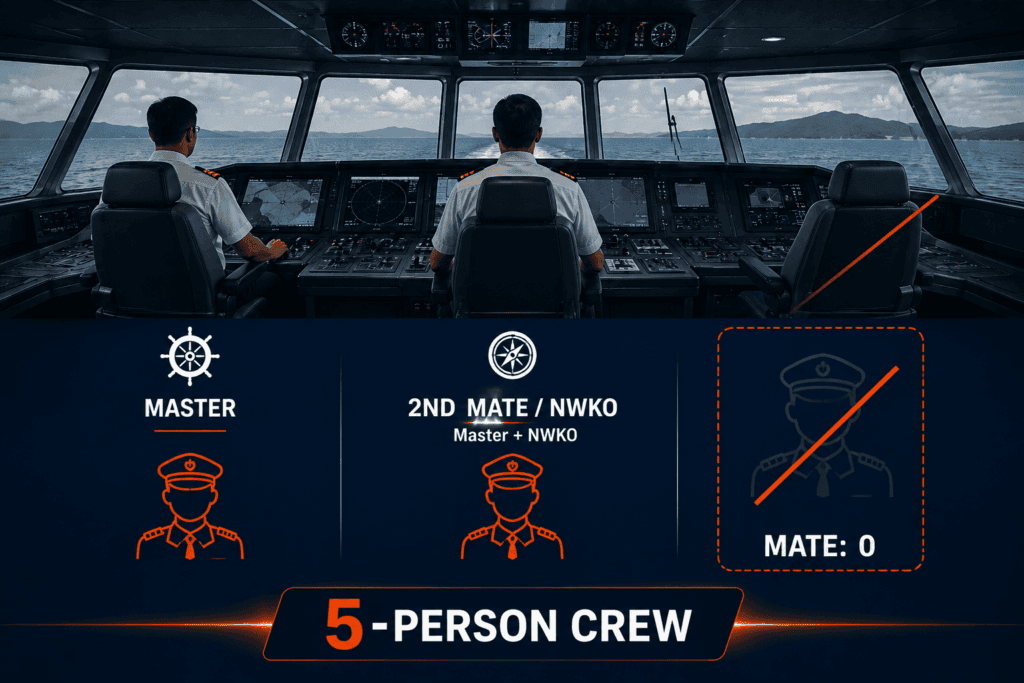
Row 2 of the table is worth pausing on. Every other passenger and cargo scale in this circular carries at least one chief officer or mate as a fixed requirement. Annexure G-7 lists a mate position with a number of seafarers of 0, meaning the role simply is not required at all. The bridge team runs on a master and a 2nd mate or NWKO instead, skipping the middle rank entirely. That structure fits the kind of trip a Category A high-speed craft actually makes: short, daylight-only, close to a place of refuge, without the multi-watch endurance that justifies a full three-tier officer hierarchy on a longer or larger vessel.
Why Is Annexure G-7 Not Banded by Gross Tonnage?
Every annexure covered elsewhere in this series, from international cargo scales down to river-sea passenger vessels, sets crews against gross tonnage bands, because a larger hull generally means more space, more systems, and more work to keep running. A high-speed craft does not scale the same way. Its safety case rests on speed, route, and rescue-time assumptions built into the Category A classification itself, not on the size of the hull, so DGMA’s manning Scale follows that same logic and sets one crew for the whole category rather than stepping it up by tonnage the way it does everywhere else in the circular.
What Certificate of Competency Rules Apply Under Annexure G-7?
Two separate certificate conditions apply to this scale, on top of the fixed headcount itself.
What Does “Type Rating Certificate” Mean?
Every certificated position on this table, Master, Mate, 2nd Mate or NWKO, must hold a Type Rating Certificate as specified under the HSC Code and any further requirement DGMA prescribes. A type rating works much like its aviation equivalent: it certifies an officer to operate a specific class or model of high-speed craft, on top of their base Certificate of Competency, since handling a fast catamaran or hydrofoil safely takes craft-specific skills that a standard deck certificate does not cover on its own.
When Does Annexure G-7 Require an Indian GMDSS CoC?
At least one officer on board must hold a valid Indian GMDSS Certificate of Competency, with no exceptions or tonnage-based tiering, since Annexure G-7 has no tonnage bands to tier against in the first place. This matches the flat, non-negotiable GMDSS rule seen across most of the rest of Annexure G.
What Is the Operating Area for Annexure G-7 Craft?
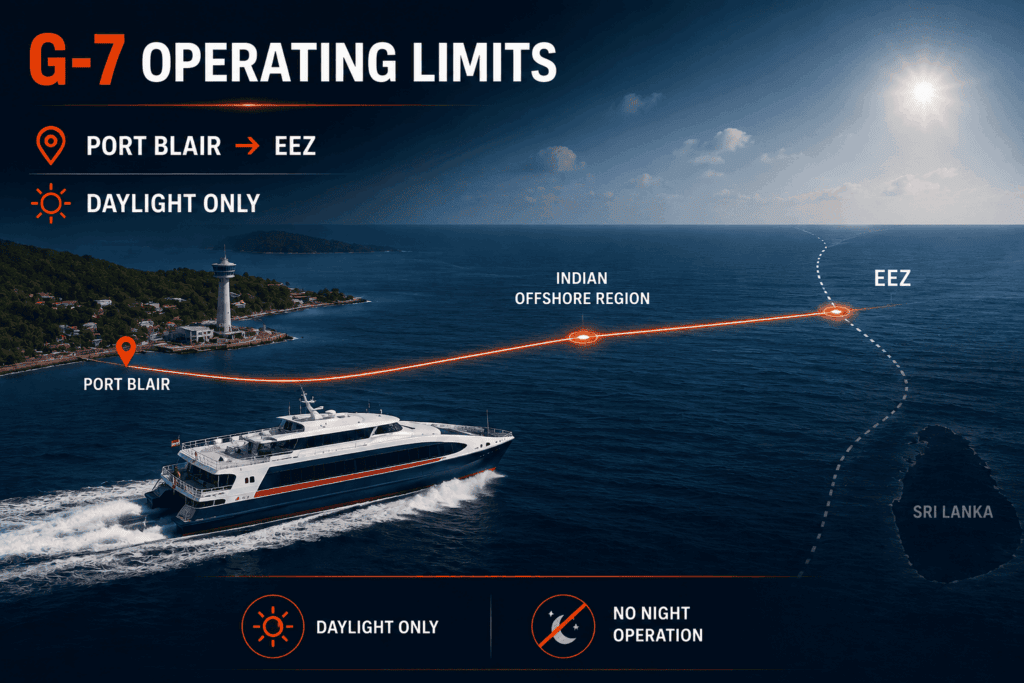
Annexure G-7 fixes both where a craft can operate and when. The core operating area is Port Blair and the Indian offshore region, up to the Exclusive Economic Zone, and operations are restricted to daylight hours only.
How Does the Sri Lankan Waters Extension Work?
The operating area can extend into Sri Lankan waters, but only subject to acceptance by Sri Lanka’s own Maritime Administration. That condition puts the decision outside DGMA’s control entirely. An Indian-flag Category A craft cannot simply sail into Sri Lankan waters on the strength of its Annexure G-7 manning scale alone. The receiving administration has to accept the arrangement first.
Why Are Operations Restricted to Daylight Hours?
Daylight-only operation is consistent with the Category A rescue-time logic running through the whole annexure. Visibility and response speed both matter more for a craft whose safety case depends on quick evacuation and rescue rather than prolonged onboard survivability, and restricting operation to daylight hours keeps that rescue assumption realistic.
What Happens in Foul Weather or on Extended Voyages?
The circular does not leave this to chance. For operations in foul weather conditions or on extended voyages, additional manning may be required, based on a risk assessment and whatever operational needs DGMA specifies at the time. In practice, that means Annexure G-7’s 5-person crew is a floor for ordinary daylight, fair-weather running, not a number a shipowner can rely on unconditionally the moment conditions or the voyage plan change.
How Does Annexure G-7 Compare With the Rest of the G-Series?
Since Annexure G-7 has no Gross Tonnage bands of its own, the fairest comparison is against the smallest code on every other G-series scale, the closest equivalent starting point each of those annexures has.
| Annexure | Smallest Code | Total Crew |
| G-1, International voyages | Under 200 GT | 7 |
| G-2, NCV and short international | Under 200 GT | 7 |
| G-3, Within 20 NM of Indian coast | Under 200 GT | 6 |
| G-4, Between Indian ports, 5 NM | Under 200 GT | 6 |
| G-5, Type 3 RSV passenger | Under 500 GT | 7 |
| G-6, Type 4 RSV passenger | Under 500 GT | 7 |
| G-7, Category A HSC | Not banded | 5 |
Annexure G-7 runs leaner than every single one of them. Even the smallest, most lightly crewed conventional passenger vessel in this circular still needs 6 nautical crew, one more than a Category A high-speed craft of any size. That gap comes directly from the rescue-time logic behind the Category A classification: a craft built and routed so that outside rescue is realistically available within a short window does not need the same onboard redundancy as a vessel that has to be more self-sufficient by design.
How Do Shipowners Get an Annexure G-7 Manning Scale Approved?
The process runs the same way it does for every other annexure in the circular. The shipowner or manager submits a safe manning proposal, together with the prescribed self-assessment checklist, to the concerned Mercantile Marine Department. The MMD checks that proposal against the Annexure G-7 minimum, including confirming the craft’s Category A classification and the Type Rating Certificates held by its officers, before issuing the approved MSMD.
Once approved, the craft must operate strictly to the crew numbers on that MSMD, and registered RPSL manning agencies build their placement and joining plans directly around it. A company that does not yet hold Recruitment and Placement Service Licence (RPSL) status needs that licence before it can place crew against an approved MSMD at all, and reviewing how an RPSL licence is registered is worth doing before a company takes on its first high-speed craft crewing contract.
The Master, Mate, and 2nd Mate or NWKO positions on this scale all need a valid Type Rating Certificate on top of their base qualification, and a directory of GMDSS training courses can point new officers toward the certificate needed to satisfy Annexure G-7’s own GMDSS rule. For the full text of Annexure G-7 alongside every other scale in the circular.
FAQs
What is Annexure G-7 of DGMA Circular No. 54 of 2025?
Annexure G-7 is the minimum safe manning scale for Category A high-speed craft operating at Port Blair and in the Indian offshore region up to the Exclusive Economic Zone. It sets one fixed crew of 5 nautical seafarers rather than a series of Gross Tonnage codes.
Which vessels does Annexure G-7 apply to?
Annexure G-7 applies to high-speed craft classified as Category A under the HSC Code, generally fast catamarans, planing monohulls, and hydrofoils operating passenger services out of Port Blair and across the Indian offshore region.
How many crew does a Category A HSC need under Annexure G-7?
Five nautical crew: 1 Master with Type Rating Certificate, 1 2nd Mate or NWKO with Type Rating Certificate, 2 Able Seafarer Deck ratings, and 1 deck rating. No Mate position is required.
Why does Annexure G-7 have no Mate or Chief Officer position?
The circular’s own table lists a Mate position with a required number of zero, meaning the role is not part of this scale at all. The bridge team runs on a Master and a 2nd Mate or NWKO instead, reflecting the short, daylight-only nature of a typical Category A high-speed craft voyage.
What is a Type Rating Certificate?
It is a craft-specific certification required on top of an officer’s base Certificate of Competency under the HSC Code and DGMA’s own requirements, confirming the officer is qualified to operate the particular class or model of high-speed craft they are assigned to.
What is the difference between Category A and Category B high-speed craft?
Category A craft operate on routes where rescue and evacuation can realistically happen within a limited time and are built to a correspondingly lighter safety standard. Category B craft cover routes that do not meet that rescue-time test and are built to a higher level of onboard safety instead.
Why is Annexure G-7 not banded by Gross Tonnage?
A high-speed craft’s safety case rests on its route, speed, and rescue-time classification rather than its size, so DGMA sets one fixed crew for the whole Category A classification instead of stepping the requirement up by tonnage the way it does for every other vessel type in the circular.
Can a Category A HSC operate in Sri Lankan waters under Annexure G-7?
Only if Sri Lanka’s own Maritime Administration accepts the arrangement. Annexure G-7’s operating area can extend into Sri Lankan waters, but that decision sits with the receiving administration, not with DGMA alone.
What happens if operations run into foul weather or an extended voyage?
Additional manning may be required, based on a risk assessment and whatever operational needs DGMA specifies at the time. The 5-person crew set out in Annexure G-7 is the floor for ordinary daylight, fair-weather operation, not a fixed number regardless of conditions.
Who approves the Minimum Safe Manning Document for a Category A HSC under Annexure G-7?
The concerned Mercantile Marine Department reviews the shipowner’s manning proposal against the Annexure G-7 minimum, including the craft’s Category A classification and its officers’ Type Rating Certificates, then issues the MSMD. The craft must operate strictly to that approved document once issued.