
Minimum safe manning requirements for Indian flag vessels are set out in DGMA Circular No. 54 of 2025, which fixes the exact number and rank of crew every Indian ship must carry, from a small harbour craft to a large tanker on international trade. The scale changes with vessel size, area of operation, and cargo type, and it applies through a document called the Minimum Safe Manning Document.
If you manage an Indian flag vessel, train for a deck rank, or run crewing for a shipping company, this number is not something you estimate. It comes from a fixed regulatory scale, and getting it wrong holds up port clearance, delays a ship’s Minimum Safe Manning Document, and can ground a vessel during a port state control inspection. This guide walks through the entire framework behind minimum safe manning requirements for Indian flag vessels, the annexures that set the numbers, and the process for getting a ship’s manning approved. Each vessel category has its own detailed guide with the full rank-by-rank table, linked throughout this page.
What Is Minimum Safe Manning?
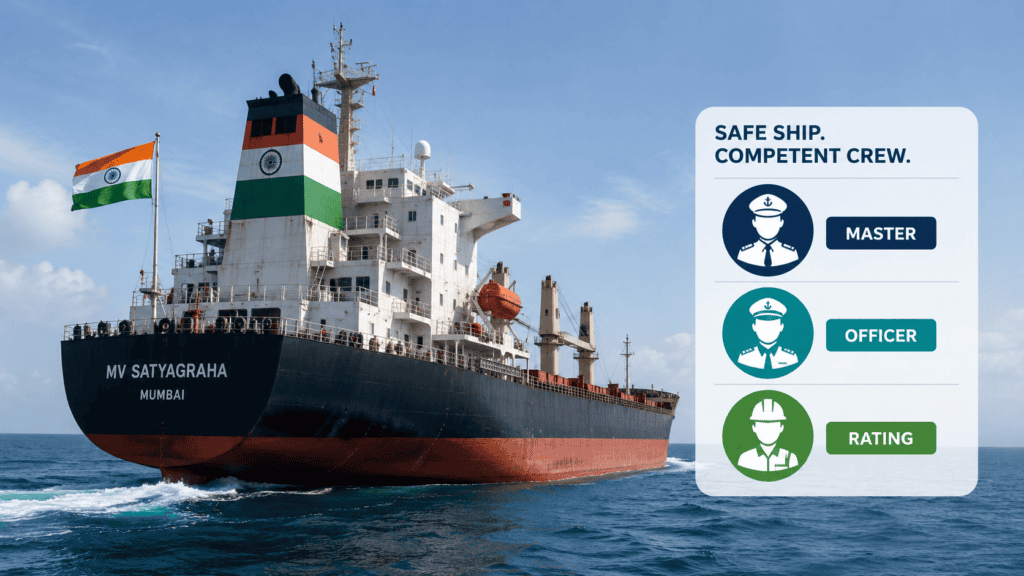
Minimum safe manning is the lowest number of qualified crew a ship can legally carry and still operate safely. It is not a suggestion or an industry norm. It is a regulatory floor, tied to a ship’s Gross Tonnage (GT), its trading area, and the type of cargo or passengers it carries.
The idea did not start in India. The International Maritime Organization built the global thinking behind it through Resolution A.1047(27), Principles of Minimum Safe Manning, which lays out how a flag administration should decide crew size for a given ship. Regulation 14 of Chapter V of SOLAS then makes safe manning mandatory, requiring every flag administration to issue a document confirming the number.
India folds this into domestic law through the Merchant Shipping Act. Every ship, at sea or in port, must carry the number and qualification of crew prescribed by the Directorate, and that number is not left to guesswork by the ship’s owner or master. It is fixed in advance, checked by a government surveyor, and printed on a certificate the ship must carry.
What Is a Minimum Safe Manning Document (MSMD)?
The Minimum Safe Manning Document (MSMD), sometimes called the Safe Manning Certificate, is the official paper confirming exactly how many crew, at what rank, and holding what certificate, a specific ship must carry. Rule 14 of the Merchant Shipping (Safety of Navigation) Rules, 1997, requires every ship to hold one.
An MSMD is ship-specific, not fleet-wide. A sister ship of identical design gets its own MSMD, based on its own trading pattern, since two ships of the same tonnage can still end up with different manning. if one trades internationally and the other stays on the Indian coast. Port State Control officers and Flag State surveyors check this document during inspections, and a ship sailing with fewer or less qualified crew than its MSMD allows is treated as a compliance failure, not a paperwork gap.
Who Determines Minimum Safe Manning Requirements in India?
Three layers decide the final number on any Indian ship.
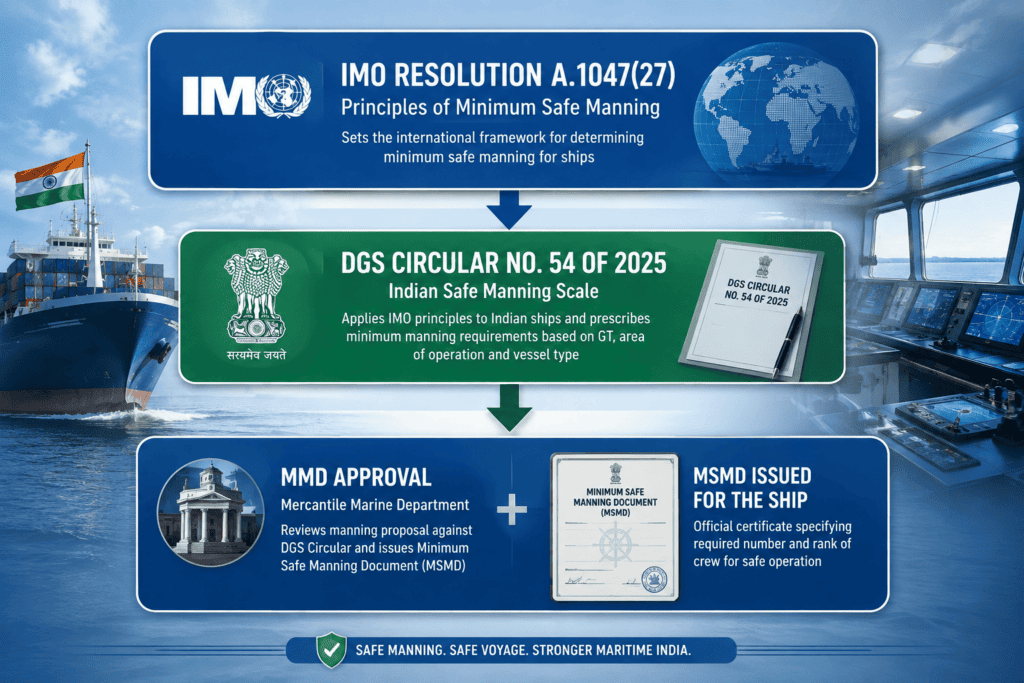
At the top, the International Maritime Organization sets the global framework through Resolution A.1047(27). This gives every flag state a consistent method for deciding crew size, based on factors like watchkeeping arrangements, cargo handling, and emergency response.
In the middle, India’s maritime regulator translates that framework into fixed scales for Indian ships. That regulator issued DGMA Circular No. 54 of 2025 on 8 December 2025, File No. 25/10/2025-NT-DGMA, signed by Capt Ravi Singh Sikarwar, Nautical Surveyor-cum-DDG (Tech.). One naming detail matters here: the regulator, long known as the Directorate General of Shipping, was renamed the Directorate General of Maritime Administration (DGMA) in June 2026, under Section 7 of the Merchant Shipping Act, 2025. The circular itself still carries its original DGMA numbering, and the industry still refers to it by that number.
At the ground level, the concerned Mercantile Marine Department (MMD) applies the scale to each individual ship. The MMD reviews the shipowner’s manning proposal against the circular’s minimum, checks the Merchant Shipping Act, 2025 framework it operates under, and issues the MSMD that the ship then sails under.
What Does DGMA Circular No. 54 of 2025 Cover?
DGMA Circular No. 54 of 2025, titled “Consolidated requirements for Minimum Safe Manning for Indian Ships (Nautical),” is a single reference document that sets nautical, meaning deck department, manning scales for the entire Indian fleet. It runs to 33 pages and carries eight annexures, labelled A, B, C, D, E1 to E2, F1 to F7, and G1 to G7.
The circular rests on four legal pillars: IMO Resolution A.1047(27) for the framework, SOLAS Chapter V Regulation 14 for the mandatory requirement, Section 76 of the Merchant Shipping Act, 1958 (now Sections 45 and 69 of the Merchant Shipping Act, 2025) for the statutory power, and Rule 14 of the Merchant Shipping (Safety of Navigation) Rules, 1997, for the requirement to issue an MSMD. It was circulated to INSA, ICCSA, Maritime Unions, Mercantile Marine Departments, Indian Seafarers, and Indian shipowners, managers, and RPSL agencies, so the scale reaches every stakeholder involved in crewing a ship.
Why Was the Safe Manning Framework Consolidated?
Before this circular, India’s manning rules sat scattered across roughly a dozen separate instruments issued between 2007 and 2022. Each one added a vessel category, tweaked a tonnage band, or updated a certificate requirement, and a shipping company had to cross-reference several documents just to confirm one crew list. That inconsistency, differing formats, differing vessel categories, and differing manning scales across circulars are exactly what the Directorate set out to fix.
The circular explicitly lists the instruments it folds into one reference.
| Instrument | Date Issued |
|---|---|
| Circular No. MSL-1(2)/95-II | 27.12.2007 |
| MSL Branch Circular No. 3 of 2008 | 02.09.2008 |
| MSL Branch Circular No. 1 of 2010 | 29.06.2010 |
| Nautical Wing Circular NT/RADIO/01/2011 | 05.12.2011 |
| NT Wing Circular (NT/Safe Manning/Dredge) No. 01 of 2011 | 13.05.2011 |
| Circular No. MSL-1(2)/95-III | 10.04.2012 |
| MSL Circular No. 01 of 2013 | 05.07.2013 |
| RSV Notification 2013, annexed to DGMA Order 18 of 2013 | 2013 |
| Coastal Vessel Rules Notification 2014, annexed to DGMA Order 01 of 2014 | 2014 |
| MS Notice Nautical 01 of 2022 | 28.01.2022 |
The Directorate ran extensive stakeholder consultations before issuing the new circular, and the stated goals were clarity, uniform interpretation, and consistent application across the Indian fleet, alongside closer alignment with the IMO’s own framework.
Who Does DGMA Circular No. 54 of 2025 Apply To?
Annexures A through F apply to every type of self-propelled vessel registered under the Merchant Shipping Act, with one major exception: passenger vessels. That covers general cargo ships, tankers, offshore support vessels, tugs, dredgers, Indian Coastal Vessels, and River-Sea Vessels.
Passenger ships, Ro-Ro and Ro-Pax vessels, special trade passenger vessels, RSV passenger vessels, and High-Speed Craft (HSC) follow a separate set of scales under Annexures G1 to G7, since passenger safety duties change the crew mix needed on board.
Two categories sit outside this circular for now. Vessels below 15 GT and non-self-propelled vessels, such as barges without their own propulsion, will get their manning requirements through a separate notification.
How Do GT and Operating Area Affect Minimum Safe Manning?
Two variables drive every number in this circular, and they work independently of each other.
Gross Tonnage (GT) decides headcount. As a ship gets bigger, it needs more watchkeeping officers and more ratings simply to run three shifts around the clock and handle more deck work. A 190 GT coaster and a 6000 GT bulk carrier are not going to sail with the same crew, even on an identical route.
Operating area decides certificate grade. A ship trading only along the Indian coast can often crew its bridge with Near Coastal Voyage (NCV) certificate holders, which cost less and train faster than Foreign-Going (FG) certificates. The moment that same ship crosses into international waters, every certificate on the bridge has to step up to FG standard, regardless of GT.
| Area of Operation | Annexure | Entry-Level Master Certificate | Certificate at Highest GT Tier |
|---|---|---|---|
| International voyages | A | Master (FG) | Master (FG) |
| Near coastal voyages | B | Master NCV (500 GT) or Mate NCV | Master (FG) above 6000 GT |
| Indian coast, incl. A&N and Lakshadweep | C | Master NCV (500 GT) or Mate NCV | Master (FG) above 6000 GT |
| Harbour operations | D | 1st Class IV Master | Master (FG) above 10000 GT |
| Indian offshore areas (20 NM to EEZ) | E1 | Master NCV (500 GT) or Mate NCV | Master (FG) above 6000 GT |
| Foreign offshore areas (outside NCV area) | E2 | Master (FG) | Master (FG) |
The two variables also stack. A large vessel trading internationally needs both a bigger crew and higher grade certificates on every rank, which is why Annexure A’s top tier, Code A-4, carries close to double the crew of its entry tier, Code A-1.
What Do Annexures A to G Cover?
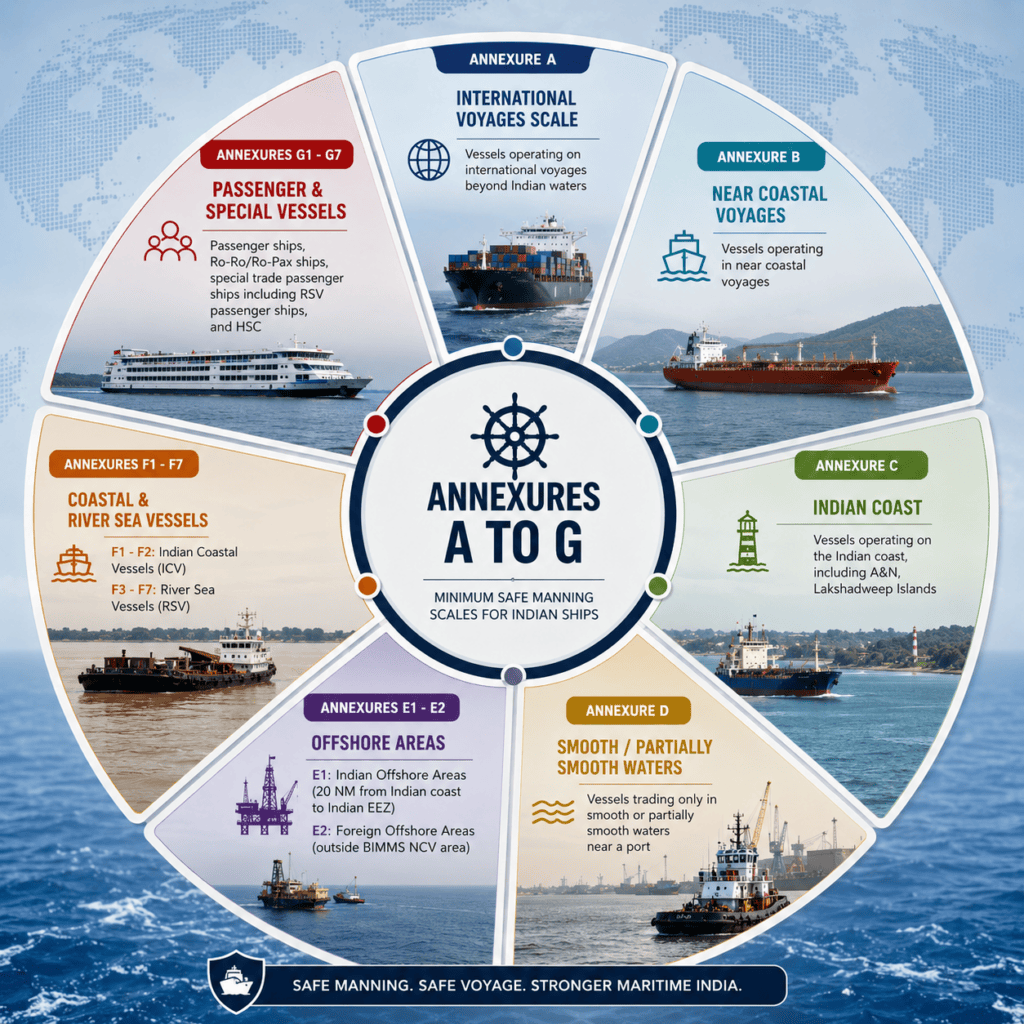
The circular states plainly that Annexures A, B, C, D, E1 to E2, F1 to F7, and G1 to G7 contain the applicable minimum safe manning scales, based on vessel type, nature of operation, and area of operation. Each annexure is a standalone scale with its own gross tonnage bands, so a ship only ever falls under one annexure at a time, based on what it is and where it sails.
| Annexure | Covers | Area of Operation | Full Manning Scale |
|---|---|---|---|
| A | Self-propelled cargo and non-passenger vessels | International voyages | International voyages guide |
| B | Self-propelled cargo and non-passenger vessels | Near coastal voyages | Near coastal voyages guide |
| C | Self-propelled cargo and non-passenger vessels | Indian coast, incl. A&N Islands and Lakshadweep | Indian coastal operations guide |
| D | All vessel types in port limits | Harbour operations | Harbour operations guide |
| E1 | Self-propelled cargo and non-passenger vessels | Indian offshore areas (20 NM to EEZ) | Indian offshore areas guide |
| E2 | Self-propelled cargo and non-passenger vessels | Foreign offshore areas, outside NCV area | Foreign offshore areas guide |
| F1 to F2 | Indian Coastal Vessels (ICV) | Harbour operations and Indian coast | Indian Coastal Vessels guide |
| F3 to F7 | River-Sea Vessels (RSV) | Harbour, daylight, coastal, and unrestricted operation | River-Sea Vessels guide |
| G1 to G6 | Passenger, Ro-Ro, Ro-Pax, and RSV passenger vessels | International to Indian coastal and river-sea | Passenger and Ro-Ro/Ro-Pax guide |
| G7 | High-Speed Craft, Category A | Port Blair and Indian offshore/EEZ | High-speed crafts guide |
What Is the Minimum Safe Manning Scale for International Voyages?
Annexure A sets the deck crew scale for self-propelled cargo and non-passenger vessels trading worldwide in four tonnage-based codes, A-1 through A-4, running from under 200 GT up to 3000 GT and above. Every rank carries a Foreign-Going (FG) certificate at every tonnage level, since there is no lighter certificate option once a ship leaves near-coastal waters. A 450 GT general cargo ship under Code A-2 sails with just six nautical crew, while a bulk carrier above 3000 GT under Code A-4 needs eleven before anyone in the engine room is counted.
Every code also carries either a dedicated Radio Officer with a valid GMDSS Certificate of Competency, or two deck officers who each hold one, and tankers need a Certificate of Proficiency in Tanker Operation on top of the base scale.
For the complete rank-by-rank table, see the minimum safe manning scale for international voyages.
What Is the Minimum Safe Manning Scale for Near Coastal Voyages?
Annexure B covers vessels trading within India’s near coastal zone across five codes, B-1 through B-5, from under 200 GT up to 6000 GT and above. Certification runs on the NCV track for most of the scale, with Master NCV (500 GT) or Mate NCV acceptable at the smallest tier, and only steps up to Master (FG) once a vessel reaches 6000 GT.
A notable exception applies to tugs. A tug below 500 GT can extend its NCV manning to cover the Persian Gulf and the Singapore Straits, subject to acceptance by the relevant foreign maritime administration, which lets smaller Indian tugs take on regional towage work without upgrading every officer to FG level.
What Is the Minimum Safe Manning Scale for Indian Coastal Operations?
Annexure C governs vessels operating on the Indian coast, including the Andaman and Nicobar Islands and Lakshadweep, across six codes, C-1 through C-6, spanning under 200 GT to 6000 GT and above. This is the most granular of the cargo scales, with tonnage bands set closer together than Annexure A or B, and the entry certificate is again Master NCV (500 GT), stepping up to Master (FG) only at the top tier.
One detail worth knowing: on cargo ships other than tankers, a cook is not required for voyages of less than 12 hours, which reflects how much of this trade happens on short island and coastal hops rather than multi-day passages.
What Is the Minimum Safe Manning Scale for Harbour Operations?
Annexure D applies to vessels working within notified port limits, and it is the largest scale in the circular by tonnage range, with seven codes, D-1 through D-7, running from under 200 GT up to 10,000 GT and above. Harbour operation, by the circular’s own definition, means activity within notified port limits throughout the year, plus operation in smooth or partially smooth waters near a port in fair weather.
A vessel under 500 GT that stays in continuous service at a Single Point Mooring (SPM) facility inside the port limits must still carry at least one officer holding a valid STCW certificate of competency, even though the rest of the scale for that tonnage is lighter than a coastal or international counterpart.
What Is the Minimum Safe Manning Scale for Indian Offshore Areas?
Annexure E1 covers vessels working in Indian offshore areas, a term the circular defines precisely as the zone between 20 nautical miles from the Indian coast and the Indian Exclusive Economic Zone (EEZ). This scale, common for OSVs, PSVs, and AHTS vessels serving offshore platforms, runs across six codes, E1-a through E1-f, from under 200 GT to 6000 GT and above, with certification again moving from NCV at the smallest tier to FG at the largest.
What Is the Minimum Safe Manning Scale for Foreign Offshore Areas?
Annexure E2 applies outside the NCV area entirely, subject to acceptance by the concerned foreign maritime administration, and it is one of only two scales in the circular where every rank carries an FG certificate at every tonnage band. Five codes, E2-a through E2-e, cover vessels from under 200 GT to 6000 GT and above, and there is no lighter NCV option at any point on this scale, which reflects the fact that E2 vessels are, by definition, working beyond the reach of India’s near-coastal certification system.
What Is the Minimum Safe Manning Scale for Indian Coastal Vessels (ICV)?
Annexures F1 and F2 set the scale for Indian Coastal Vessels, a distinct registration category from ordinary cargo ships, split into harbour operation (F1) and operation along the Indian coast (F2). Both run across five codes from under 200 GT to 6000 GT.
The GT ceiling for what counts as an ICV depends on the vessel’s purpose: tankers are capped at 3000 GT, cargo vessels at 6000 GT, and dredgers at 10,000 GT, so a vessel’s classification as an ICV is itself a function of tonnage and role, not just registration paperwork.
What Is the Minimum Safe Manning Scale for River-Sea Vessels (RSV)?
Annexures F3 to F7 cover River-Sea Vessels, a category built for craft that move between river systems and coastal sea routes, split into five separate scales depending on operation: harbour operation for Type 1 RSVs (F3), harbour operation for other RSV types (F4), daylight voyages between nearby ports for Types 2, 3, and 4 (F5), coastal voyages under 48 hours for Types 3 and 4 (F6), and unrestricted operation for Type 4 (F7).
RSVs of 3000 GT and above trigger an extra requirement: one additional 1st Class I/V Master or NWKO (NCV), whichever the scale calls for, when a voyage or a dredging operation runs beyond 72 hours. F7 stands out as the only RSV scale cleared for genuinely unrestricted operation, which makes it the closest RSV equivalent to a coastal cargo scale.
What Is the Minimum Safe Manning Scale for Passenger, Ro-Ro and Ro-Pax Ships?
Annexures G1 to G6 set the manning scale for passenger ships, Ro-Ro and Ro-Pax vessels, and special trade passenger vessels, mirroring the cargo vessel logic of FG certification for international trade stepping down to NCV for coastal and river-sea work. G1 covers international voyages, G2 covers NCV and short international voyages, G3 covers operations on the Indian coast within 20 nautical miles, G4 covers operations between two Indian ports within 5 nautical miles in fair weather, G5 covers Type 3 River-Sea passenger vessels, including Ro-Ro/Ro-Pax, and G6 covers Type 4 River-Sea passenger vessels of the same kind, capped at carrying between 12 and 400 passengers.
Every code in this group carries a heavier rating complement than an equivalent cargo scale, since passenger vessels need more hands for evacuation and passenger safety duties, not just navigation and cargo work.
What Is the Minimum Safe Manning Scale for High-Speed Crafts?
Annexure G7 stands apart from every other scale in the circular because it is not banded by Gross Tonnage at all. It sets one fixed crew for Category A High-Speed Craft operating at Port Blair and in the Indian offshore region up to the EEZ: a Master with Type Rating Certificate, an Officer of the Navigational Watch or NWKO with Type Rating Certificate, two Able Seafarer Deck ratings, and one deck rating, five nautical crew in total.
Operation under this scale is restricted to daylight hours, though the operating area can extend into Sri Lankan waters, subject to acceptance by Sri Lanka’s own maritime administration.
What Are the GMDSS Requirements Under the Safe Manning Circular?
GMDSS, the Global Maritime Distress and Safety System, sets the radio and distress communication standard every ship’s bridge team has to meet, and the circular applies it at two different intensities depending on where a ship trades.
On international, near coastal, and offshore scales (Annexures A, B, E1, and E2), the requirement is either one dedicated Radio Officer holding a valid Indian GMDSS Certificate of Competency, or two deck officers who each hold one. This dual-path rule lets a smaller ship satisfy the requirement without carrying a separate Radio Officer, as long as two watchkeeping officers are GMDSS qualified.
On the Indian coast, harbour, ICV, and RSV scales (Annexures C, D, F1 to F7), the bar is lighter: At least one officer on board must hold a valid Indian GMDSS Certificate of Competency. For the smallest vessels on some of these scales, a Restricted Operator Certificate is accepted instead of the full GMDSS CoC.
When Do Ships Need Additional Manning Beyond the Minimum Scale?
Every number in this circular is a floor, not a target. The Directorate states this directly: shipowners and managers must engage additional personnel wherever operational needs, trade practices, maintenance requirements, crew and vessel safety, or seafarer rest periods call for it. A handful of specific triggers recur across the annexures.
| Situation | What Changes | Where It Typically Applies |
|---|---|---|
| Vessel is an oil, chemical, or gas tanker | Extra AB rating required; Certificate of Proficiency in Tanker Operation mandatory for the crew | Across Annexures A to G |
| Voyage or dredging operation exceeds 72 hours | One additional OINW or NWKO qualified officer required | Annexures D, F1 to F7 |
| Cargo voyage under 12 hours, non-tanker | Cook and one AB not required | Annexure C |
| Vessel is an MSV, OSV, PSV, AHTS, SPS, tug, or dredger | Certain OINW or NWKO requirements are waived | Annexures C, F1 to F7 |
| Vessel is a dredger | Master, Mate, and NWKO-NCV certificates may be substituted with Dredge Master Grade I, Grade II, and Dredge Mate Grade I | Annexures D, F1 to F7 |
| Vessel under 500 GT in continuous service at an SPM facility | Must carry at least one officer with a valid STCW certificate of competency | Annexures D, F1 to F2 |
Ship managers who treat the printed table as the final answer, rather than the starting point, tend to run into rest-hour compliance problems on longer voyages. The scale tells you the legal minimum. Actual crewing decisions still need to account for watch rotation, leave planning, and realistic workload.
How Do Shipowners Get a Safe Manning Proposal Approved?
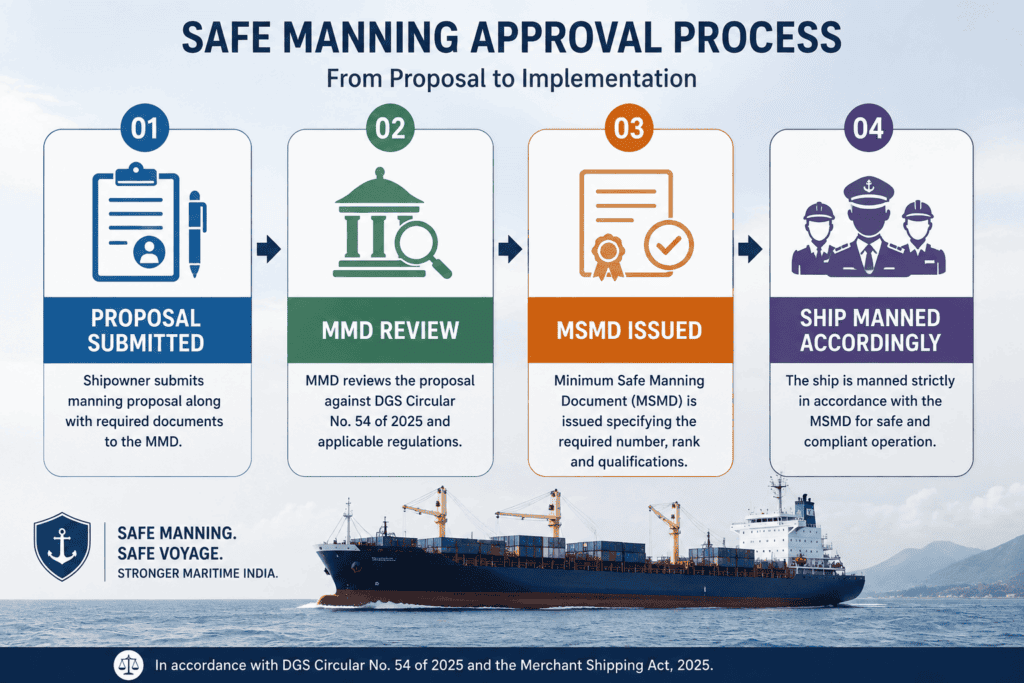
The responsibility to apply sits with the shipowner or manager, never with the crew, and the process runs entirely online.
The company submits a safe manning proposal, along with a prescribed self-assessment checklist, to the concerned Mercantile Marine Department. The MMD checks the proposal against the minimum scale set out in the relevant annexure of DGMA Circular No. 54 of 2025, and against any additional manning the company proposes to meet operational, trading, and rest-hour requirements.
Once approved, the ship must be manned strictly in accordance with the scale printed on its MSMD. There is no flexibility to sail below that scale, and registered RPSL manning agencies build their placement and joining plans directly around the approved document.
When Can a Temporary Manning Dispensation Be Granted?
Only for genuine exigencies, such as sudden illness, injury, or unavailability of a crew member, and the Directorate treats these as rare exceptions rather than a routine workaround. The circular is explicit that safe ship operation needs qualified officers in full complement, so dispensations stay narrow by design.
The process runs in two stages. First, the shipping company applies to the Nautical Wing with full factual details of the case, including the applicable Maritime Union of India wage scale for the rank concerned. Once in-principle approval is granted, the company must remit the maximum basic wage for that rank to the Directorate through a formal payment instrument, along with a declaration confirming the wage computation is correct. In urgent cases, companies can contact the designated officers of the Nautical Wing directly by phone for immediate guidance.
The wage-remittance step exists for a specific reason. It removes any financial incentive to sail short-handed and protects employment opportunities for qualified officers who would otherwise have filled that rank.
When Do Fair-Weather Restrictions Apply to Minimum Manning?
Across nearly every annexure in this circular, vessels under 200 GT carry a standard restriction: the prescribed minimum manning applies only to operation against fair-weather forecast and conditions, unless the Directorate specifically authorises otherwise. This restriction recurs at the smallest tonnage tier of Annexures A, B, C, D, E1, E2, F, and G.
The logic is straightforward. A small vessel crewed to the bare minimum has less redundancy if weather turns, fewer hands for emergency response, and less margin for fatigue management. Once a vessel above 200 GT enters the picture, the scale assumes a fuller crew capable of handling a wider range of sea conditions, so the fair-weather limitation drops away.
FAQs
What is minimum safe manning for Indian ships?
It is the minimum number and rank of qualified crew every Indian ship must carry to operate safely, fixed by DGMA Circular No. 54 of 2025 based on a vessel’s Gross Tonnage, area of operation, and vessel type.
What is DGMA Circular No. 54 of 2025?
It is the consolidated circular, issued 8 December 2025, that combines roughly a dozen earlier manning instruments issued since 2007 into one reference, covering Annexures A through G for nautical crew scales on Indian ships.
How many annexures does the safe manning circular have?
Eight main annexures: A, B, C, D, E1 to E2, F1 to F7, and G1 to G7, each covering a specific combination of vessel type, tonnage band, and area of operation.
Is DGS now called DGMA?
Yes. The Directorate General of Shipping (DGS) was renamed the Directorate General of Maritime Administration (DGMA) in June 2026, under Section 7 of the Merchant Shipping Act, 2025. DGS Circular No. 54 of 2025 still carries its original DGS numbering.
What is the difference between an FG and an NCV certificate?
Foreign-Going (FG) certificates are required for international trade and cost more time and money to obtain. Near Coastal Voyage (NCV) certificates cover Indian coastal and near-coastal trade and are accepted at lower tonnage bands on scales like Annexures B, C, and E1.
Who approves a ship’s Minimum Safe Manning Document?
The concerned Mercantile Marine Department (MMD) reviews the shipowner’s manning proposal against the relevant annexure and issues the MSMD once satisfied it meets both the regulatory minimum and operational needs.
Can shipowners carry fewer crew than the MSMD prescribes?
No. Every ship must be manned strictly according to its approved MSMD. Sailing below that scale is a compliance failure checked during Flag State and Port State inspections, not a matter of owner discretion.
What happens if a vessel is below 15 GT?
Vessels below 15 GT are not covered by this circular. Their minimum safe manning requirements, along with those for non-self-propelled vessels, will be notified separately by the Directorate.
Does the circular apply to passenger ships the same way as cargo ships?
No. Cargo and non-passenger vessels follow Annexures A to F. Passenger ships, Ro-Ro, Ro-Pax, special trade passenger vessels, RSV passenger vessels, and High-Speed Craft follow the separate G1 to G7 scales, which carry heavier rating complements.
How is minimum safe manning different from actual crew size on board?
Minimum safe manning is the regulatory floor set by the MSMD. Actual crew size is often higher, since owners must add personnel for trade practices, maintenance, and rest-hour compliance, on top of whatever the minimum scale requires.