
Safe manning for River-Sea Vessels in harbour operations comes from Annexure F-4 of DGMA Circular No. 54 of 2025, and it is the scale that applies the moment a river-sea vessel (RSV) is confined to port limits, provided that vessel is not classed as RSV Type 1. A vessel under 200 GT needs just 3 nautical crew. A vessel between 3000 GT and 6000 GT needs 8, with a dedicated watchkeeping officer joining the bridge team for the first time.
If you manage an RSV, crew one, or handle its Minimum Safe Manning Document (MSMD) approval, Annexure F-4 is the table your ship actually sails against, not the general harbour scale under Annexure D and not the Type 1 scale under Annexure F-3.
This guide is part of our series on minimum safe manning requirements for Indian flag vessels, which maps every annexure in the circular. It pairs most closely with the general harbour operations guide for Annexure D and with the RSV overview inside our pillar guide’s River-Sea Vessels section, since Annexure F-4 sits between the two.
What Counts as a River-Sea Vessel Under DGMA Circular No. 54 of 2025?
A River-Sea Vessel is a self-propelled craft built to move between inland river systems and coastal sea routes, a hybrid category that needed its own set of annexures rather than folding into ordinary cargo scales. DGMA Circular No. 54 of 2025 gives RSVs five separate manning scales, Annexures F-3 through F-7, and which one applies depends entirely on what the vessel is doing at that moment, not just its size.
That structure only works because every RSV already carries a type classification from 1 to 4, assigned under a separate RSV notification that governs construction, load line, and freeboard standards rather than manning. Circular No. 54 of 2025 does not redefine that classification. It simply attaches a crew scale to it.
How Are RSV Types 1 to 4 Classified?
Type 1 sits at the top of the scale, closest in build standard to a conventional coastal cargo vessel, and it is the only RSV type that gets a single dedicated annexure, F-3, covering essentially all of its permitted operations in one table. Types 2, 3, and 4 step down from there, each carrying tighter construction and operating limits than the type above it, which is why they need to check a different annexure depending on whether they are in harbour, making a daylight hop between nearby ports, or running a longer coastal passage.
The type classification itself, including the construction and freeboard detail behind it, sits outside this circular. If you are unsure which type your vessel carries, that sits on the vessel’s own certificate, and it is worth confirming with your Mercantile Marine Department before applying any F-series code.
Why Does Annexure F-4 Leave Out Type 1 RSVs?
Because Type 1 RSVs already have a complete scale of their own. Annexure F-3 covers a Type 1 RSV in harbour, so folding Type 1 into F-4 as well would give the same vessel two competing tables for the same situation. DGMA’s drafting instead splits harbour operations cleanly in two: F-3 for Type 1, and F-4 for every other RSV, meaning Types 2, 3, and 4, once they are confined to port limits. That is also why Annexure F-4’s own title spells out “other than RSV Type 1” rather than leaving the scope implied.
Which Annexure Covers RSV Harbour Operations, F-3 or F-4?
The test is a single question: is the vessel certified as RSV Type 1? If yes, harbour operations run under Annexure F-3. If no, meaning the vessel is Type 2, Type 3, or Type 4, harbour operations run under Annexure F-4. Gross tonnage does not decide which annexure applies here. It only decides which code inside that annexure applies once you know the type.
Getting this wrong is not a paperwork technicality. A Type 3 RSV crewed to the Type 1 scale in Annexure F-3 would be short of crew at several gross tonnage bands, as the comparison later in this guide shows, and that gap is exactly what a flag state or port state inspector checks the minimum safe manning document against.
What Is the Complete Annexure F-4: Minimum Safe Manning for River-Sea Vessels in Harbour Operations?
Annexure F-4 runs across five codes, F4-a through F4-e, spanning under 200 GT up to 6000 GT. The table below is the nautical, meaning deck department, scale only. Engine room manning for RSVs is prescribed separately and is not part of this circular.
| Code | GT of Vessel | Master | No. | Chief Officer | No. | OINW | No. | AB | No. | OS | No. | Cook | No. |
| F4-a | Under 200 | 1st Class I/V Master, or 2nd Class I/V Master with 1 year experience | 1 | 2nd Class I/V Master | 1 | Not required | – | Able Seafarer Deck (II/5) or rating forming part of a navigational watch (II/4) | – | Rating with Basic STCW safety training | 1 | Not required | – |
| F4-b | 200 to under 500 | 1st Class I/V Master | 1 | 2nd Class I/V Master | 1 | Not required | – | (as above) | – | (as above) | 1 | Not required | – |
| F4-c | 500 to under 1600 | Mate NCV or NWKO (NCV) with 1 year experience | 1 | NWKO-NCV, 1st Class I/V Master, or 2nd Class I/V Master with 1 year experience | 1 | Not required | – | (as above) | 1 | (as above) | 2 | Basic STCW safety training and CoC as Cook, as applicable | 1 |
| F4-d | 1600 to under 3000 | Master NCV or Mate NCV with 1 year experience | 1 | NWKO-NCV or 1st Class I/V Master with 1 year experience | 1 | Not required | – | (as above) | 1 | (as above) | 2 | (as above) | 1 |
| F4-e | 3000 to under 6000 (see GT ceiling note below) | Master NCV | 1 | NWKO (NCV) with 1 year experience | 1 | NWKO (NCV), additional officer rule applies | 1 | (as above) | 2 | (as above) | 2 | (as above) | 1 |
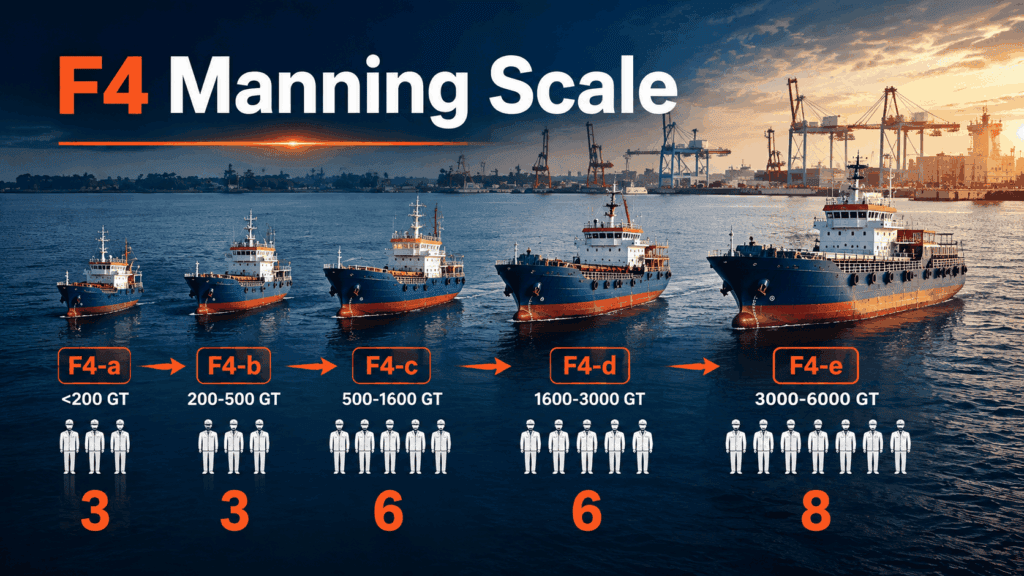
Add up each row and the total nautical crew runs 3, 3, 6, 6, and 8 across Codes F4-a to F4-e. Two rules apply across the whole table regardless of code. At least one officer on board must hold the certificate specified in the certificate of competency section below, and tankers need a valid Certificate of Proficiency in Tanker Operation on top of the base crew shown here.
How Does Crew Size Change Across the F-4 Gross Tonnage Bands?
The scale does not grow in a straight line. It holds flat, then jumps, then holds flat again, and each plateau lines up with a real change in what the vessel is expected to handle.
What Applies Below 500 GT (Codes F4-a and F4-b)?
A vessel under 500 GT sails with just 3 nautical crew: a master, a chief officer, and a single rating covering the OS role. There is no OINW, no AB carried as a separate numbered position, and no dedicated cook, which keeps a small harbour barge or line-handling craft genuinely lean. The step from F4-a to F4-b is a certificate change, not a headcount change. Both codes need 1 master and 1 chief officer, but F4-b drops the “with 1 year experience” fallback available at the smallest tier and requires the full 1st Class I/V Master certificate outright.
What Changes Between 500 GT and 3000 GT (Codes F4-c and F4-d)?
Crew size doubles here, from 3 to 6, and stays at 6 through both Code F4-c and Code F4-d. What is actually added is a numbered AB rating and a second OS, plus a Cook joins the crew list for the first time at this tier. Certificate seniority still rises between the two codes, since F4-d’s Chief Officer needs a full 1st Class I/V Master or NWKO-NCV rather than the shorter-experience Mate-level options acceptable under F4-c, but the six-person headcount itself does not move.
What Applies From 3000 GT to 6000 GT (Code F4-e)?
Code F4-e adds 2 more crew, taking the total to 8, and this is the first tier in the table where an OINW-equivalent position appears as a numbered requirement rather than being marked “not required.” An NWKO (NCV) officer joins specifically to cover the navigational watchkeeping duty that smaller RSVs handle without a dedicated officer.
How General Note 5 Affects Code F4-e
The circular’s general notes for River-Sea Vessels add one further condition at this tier. For an RSV of 3000 GT and above, one additional watchkeeping officer, certificated to 1st Class I/V Master or above, is required whenever a voyage, or a dredging operation carried out in port, runs beyond 72 hours. A vessel that normally sails Code F4-e’s base crew of 8 needs to plan for that extra officer the moment a job is scheduled to run past three days, rather than adding the position after the fact.
What Certificate of Competency Rules Apply Under Annexure F-4?
Two separate certificate thresholds run through this annexure, and they trigger at different Gross Tonnage points, which is easy to mix up if you are used to Annexure D or Annexure C.
When Does a Restricted Operator Certificate Meet the Requirement?
For vessels below 500 GT, meaning Codes F4-a and F4-b, at least one officer on board only needs to hold a valid Restricted Operators certificate. This is a lighter radio and communications qualification than the full GMDSS CoC, and it matches how lean the rest of the crew scale already is at this size.
When Does the Vessel Need a Full Indian GMDSS CoC?
Once a vessel reaches 500 GT, meaning Codes F4-c, F4-d, and F4-e, at least one officer must hold a valid Indian GMDSS Certificate of Competency instead. That 500 GT threshold is worth comparing against Annexure F-3, since Type 1 RSVs get a materially easier certificate path, covered in the F-3 versus F-4 comparison further down this guide.
How Is Annexure F-4 Different From Annexure D’s General Harbour Scale?
Annexure D is the default harbour operations scale for self-propelled cargo and non-passenger vessels working inside port limits. River-Sea Vessels do not use it. They get pulled out into their own dedicated harbour codes instead, and Indian Coastal Vessels (ICVs) get the same treatment under Annexure F-1. The table below shows how a vessel confined to a harbour is actually routed to its correct annexure.
| Vessel Category | Harbour Annexure | GT Range Covered | Entry-Level Master Certificate |
| Ordinary self-propelled cargo or non-passenger vessel | Annexure D | Under 200 up to 10,000 and above | 1st Class IV Master |
| Indian Coastal Vessel (ICV) | Annexure F-1 | Under 200 up to 6000 | 1st Class IV Master |
| River-Sea Vessel, Type 1 | Annexure F-3 | Under 200 up to 6000 | 1st Class IV Master |
| River-Sea Vessel, Types 2, 3, or 4 | Annexure F-4 | Under 200 up to 6000 | 1st Class I/V Master |
A tug that is simply a tug, with no RSV or ICV registration behind it, stays under Annexure D even while working a harbour job identical to an RSV’s. It is the vessel’s own registration category, not the nature of the work, that decides whether Annexure D or one of the F-series harbour codes applies.
How Does Annexure F-4 Compare With Annexure F-3 for Type 1 RSVs?
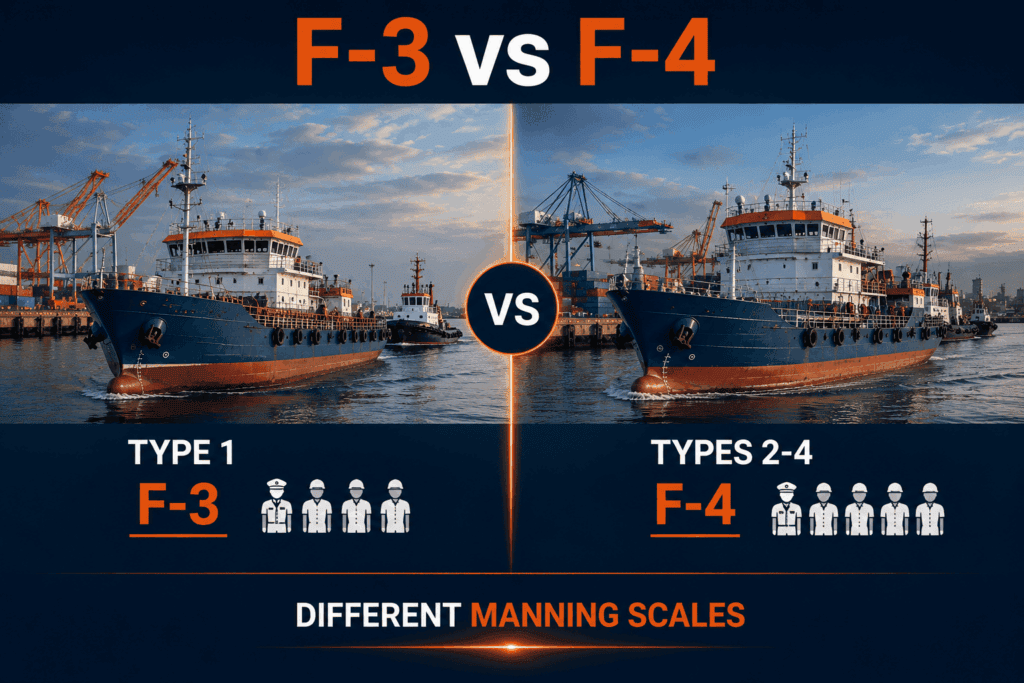
Since both annexures cover the exact same activity, harbour operations, and share the same five Gross Tonnage bands, the difference between them comes down entirely to crew number and certificate threshold at each tier.
| GT Band | F-3 Total Crew (Type 1) | F-4 Total Crew (Types 2 to 4) | F-3 Certificate Threshold | F-4 Certificate Threshold |
| Under 200 | 3 | 3 | Restricted Operator below 1600 GT | Restricted Operator below 500 GT |
| 200 to under 500 | 4 | 3 | Restricted Operator below 1600 GT | Restricted Operator below 500 GT |
| 500 to under 1600 | 4 | 6 | Restricted Operator below 1600 GT | Indian GMDSS CoC from 500 GT |
| 1600 to under 3000 | 5 | 6 | Indian GMDSS CoC from 1600 GT | Indian GMDSS CoC from 500 GT |
| 3000 to under 6000 | 8 | 8 | Indian GMDSS CoC from 1600 GT | Indian GMDSS CoC from 500 GT |
Two things stand out. Between 500 GT and 3000 GT, a Type 1 RSV in harbour needs fewer hands than a Type 2, 3, or 4 RSV doing the identical job, and Type 1 also gets to run on a Restricted Operator certificate up to a much higher tonnage before an Indian GMDSS CoC becomes mandatory.
Both scales converge to the same 8-person crew once a vessel reaches 3000 GT, which suggests that at the largest RSV sizes, the type classification stops changing the practical crewing burden even though it still governs construction standards. If you manage a mixed RSV fleet, this is the exact comparison your crewing team needs before assigning officers, since a certificate that satisfies Annexure F-3 will not automatically satisfy Annexure F-4 at the same tonnage.
What Special Conditions Apply to RSV Tankers, Cargo Vessels and Dredgers?
Annexure F-4 does not treat every RSV the same once cargo type enters the picture. The general notes that apply across Annexures F-3 to F-7 carry three conditions specific to tankers, cargo vessels, and dredgers.
What Are the Gross Tonnage Ceilings for Each RSV Category?
The GT limit for an RSV tanker is 3000 MT. The GT limit for an RSV cargo vessel is 6000 MT, and for an RSV dredger it runs up to 10,000 MT. This explains why Code F4-e stops at 6000 GT for most vessels, since that is the ceiling for RSV cargo classification, while an RSV tanker never actually reaches F4-e at all, since 3000 GT is already its cap under the RSV category. A dredger approaching or exceeding 6000 GT sits in a genuine grey area; this table does not spell out row by row, so it is worth confirming manning directly with your MMD before that job is fixed.
When Is an Additional Watchkeeping Officer Required Beyond 72 Hours?
As covered above under Code F4-e, any RSV of 3000 GT and above needs one additional 1st Class I/V Master when a voyage, or a dredging operation carried out in port, runs longer than 72 hours. This rule sits in the general notes rather than in the F-4 table itself, so it is easy to miss if you are only reading the code rows.
Can Dredge Grade Certificates Replace Standard RSV Certificates?
Yes. On dredgers, the Master, Mate, and NWKO-NCV certificates otherwise required across F4-a to F4-e may be substituted with Dredge Master Grade I, Dredge Master Grade II, and Dredge Mate Grade I, respectively. This lets an RSV dredger crew against certificates that actually match the vessel’s dredging role rather than forcing a conventional deck certificate onto a specialist operation.
What Counts as “Harbour Operations” for a River-Sea Vessel?
The general notes shared across Annexures F-3 to F-7 define ‘harbour operations’ as activity within notified port limits, with occasional operation permitted up to six nautical miles beyond port jurisdiction. That six nautical mile allowance matters in practice. It lets an RSV under Annexure F-4 make a short run just outside the formal port boundary for a sea trial, a bunkering call, or an anchorage shift without tripping into a different annexure such as F-5’s daylight voyage scale.
Once a passage becomes a genuine trip between two separate ports rather than an occasional extension of harbour work, the vessel needs to be reassessed against F-5, F-6, or F-7 depending on its type and the voyage length.
Do Fair Weather and SPM Restrictions Apply Under Annexure F-4?
Two restrictions recur across nearly every annexure in this circular, and Annexure F-4 carries both. For vessels under 200 GT, meaning Code F4-a, the prescribed minimum manning applies only to operation against fair-weather forecast and conditions, unless DGMA specifically authorises otherwise. A small RSV crewed to the bare F4-a minimum has less redundancy if weather turns, which is exactly why the concession disappears once a vessel exceeds 200 GT.
Vessels under 500 GT engaged in continuous service at a Single Point Mooring (SPM) facility within notified port limits must also carry at least one officer holding a valid STCW certificate of competency, on top of whatever Code F4-a or F4-b already requires. SPM work involves transferring liquid cargo at an exposed point, which carries more risk than ordinary inside-harbour handling even for a small vessel.
How Do Shipowners Get an Annexure F-4 Manning Scale Approved?
The process runs the same way it does for every other annexure in the circular. The shipowner or manager submits a safe manning proposal, together with the prescribed self-assessment checklist, to the concerned Mercantile Marine Department. The MMD checks that proposal against the Annexure F-4 minimum for the vessel’s confirmed RSV type and gross tonnage and against any additional manning. The company proposes for trading needs, maintenance, or rest-hour compliance before issuing the approved MSMD. Our pillar guide’s approval and dispensation section covers that full process, including how a temporary dispensation is handled if a crew member falls sick or becomes unavailable at short notice.
Once approved, the vessel must sail strictly to the crew numbers on that MSMD, and registered RPSL manning agencies build their placement and joining plans directly around it rather than against a generic F-4 table. A company that does not yet hold Recruitment and Placement Service Licence (RPSL) status needs that licence before it can place crew against an approved MSMD at all.
Legal Babu’s RPSL licence service walks through that registration process for companies setting up or renewing an RPSL licence. Officers standing watch on the bridge under Code F4-e also need a valid GMDSS qualification, and our directory of GMDSS training courses lists where that certificate can be obtained.
FAQs
What is Annexure F-4 of DGMA Circular No. 54 of 2025?
Annexure F-4 is the minimum safe manning scale for River-Sea Vessels engaged in harbour operations, covering every RSV type except Type 1. It sets deck department crew numbers and certificate requirements across five Gross Tonnage codes, F4-a through F4-e, from under 200 GT up to 6000 GT.
Which vessels does Annexure F-4 apply to?
Annexure F-4 applies to self-propelled River-Sea Vessels classified as Type 2, Type 3, or Type 4 while they are confined to harbour operations, meaning activity within notified port limits or up to six nautical miles beyond port jurisdiction on an occasional basis.
What is the difference between Annexure F-3 and Annexure F-4?
Both cover RSV harbour operations, but Annexure F-3 applies only to RSV Type 1, while Annexure F-4 applies to Types 2, 3, and 4. Between 500 GT and 3000 GT, Annexure F-4 requires more crew than Annexure F-3 for the same tonnage, and its Indian GMDSS CoC threshold starts earlier, at 500 GT rather than 1600 GT.
How many crew does a vessel need under Code F4-a?
Code F4-a, for RSVs under 200 GT, needs 3 nautical crew: 1 Master, 1 Chief Officer, and 1 rating covering the OS position with Basic STCW safety training. No separate OINW, AB, or Cook is required at this tier.
When does an RSV under Annexure F-4 need an Indian GMDSS CoC?
From 500 GT upward, meaning Codes F4-c, F4-d, and F4-e, at least one officer on board must hold a valid Indian GMDSS Certificate of Competency. Below 500 GT, a Restricted Operators certificate satisfies the requirement instead.
Does Annexure F-4 apply to RSV tankers above 3000 GT?
No. The GT limit for an RSV tanker is 3000 MT under the circular’s general notes for River-Sea Vessels, so a tanker never reaches the F4-e tier. Any vessel operating above that ceiling would need to be reassessed outside the RSV tanker category entirely.
Can a dredger use dredge-grade certificates instead of standard RSV certificates under F-4?
Yes. On dredgers, Master, Mate, and NWKO-NCV certificates may be substituted with Dredge Master Grade I, Dredge Master Grade II, and Dredge Mate Grade I respectively, matching certification to the dredging role rather than a conventional deck watch.
What happens if a voyage or dredging operation under F-4 exceeds 72 hours?
For an RSV of 3000 GT and above, meaning Code F4-e, one additional watchkeeping officer certificated to 1st Class I/V Master or above is required once the voyage, or a dredging operation carried out in port, runs beyond 72 hours.
Is Annexure F-4 the same as Annexure D for harbour operations?
No. Annexure D is the default harbour scale for ordinary self-propelled cargo and non-passenger vessels. River-Sea Vessels are pulled out of Annexure D entirely and crewed against Annexure F-3 or F-4 instead, depending on their RSV type, with different certificate tracks and different Gross Tonnage steps than Annexure D uses.
Who approves the Minimum Safe Manning Document for an RSV under Annexure F-4?
The concerned Mercantile Marine Department reviews the shipowner’s manning proposal against the Annexure F-4 minimum for the vessel’s confirmed RSV type and Gross Tonnage, then issues the MSMD. The vessel must sail strictly to that approved document once issued.