
Minimum safe manning requirements for harbour operations come from Annexure D of DGMA Circular No. 54 of 2025, and they set the lightest crew scale of any annexure in the circular. A vessel under 200 GT needs just 3 nautical crew, the smallest complement in the whole document. A vessel of 10,000 GT or above still needs only 8, far fewer than an international or near coastal ship of the same size.
If you manage a tug, a barge, a harbour craft, or any vessel confined to a port and its immediate approaches, this scale, not Annexure A, B, or C, decides what goes on your Minimum Safe Manning Document. This guide is part of our series on minimum safe manning requirements for Indian flag vessels, which maps the full circular annexure by annexure. It builds directly on what we’ve already covered for Annexure A on international voyages, Annexure B on near coastal voyages, and Annexure C on Indian coast operations. Every Indian flag vessel working a harbour trade needs to know exactly where it fits.
Why Does DGMA Circular No. 54 of 2025 Treat Harbour Operations Differently?
Every other cargo scale in the circular, Annexure A, Annexure B, and Annexure C, assumes a vessel is making a voyage, sometimes a long one, away from immediate shelter. Annexure D assumes the opposite. It’s built for vessels that rarely leave the protection of a port, so the risk profile, and therefore the required crew, drops accordingly. Our pillar guide’s overview of Annexures A to G places Annexure D in that wider context.
What Counts as Harbour Operation Under the Circular?
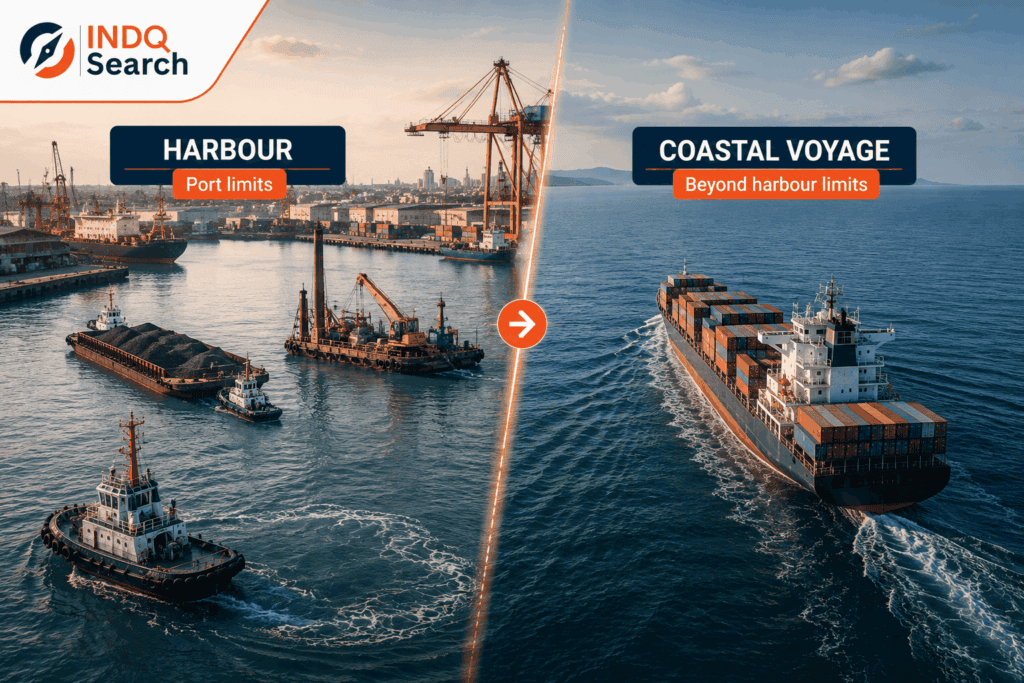
The circular defines harbour operation precisely: operations within notified port limits throughout the year, and operations in smooth or partially smooth waters near a port, in fair weather conditions. That covers tugs working a harbour, barges moving cargo within port limits, workboats, small bunker craft, and similar vessels that stay close to shore by design, not by exception.
What Falls Outside This Definition?
A vessel making a genuine sea passage, even a short coastal hop, falls outside Annexure D and needs to look at Annexure B or C instead. The distinction is about the nature of the operation, not the size of the vessel. A 150 GT tug working exclusively inside a harbour sits under Annexure D. The same 150 GT tug towing a barge along the open coast sits under Annexure B.
The legal basis behind Annexure D is unchanged from every other scale in the circular. IMO Resolution A.1047(27) sets the global framework, SOLAS Chapter V Regulation 14 makes a manning document mandatory, and the Merchant Shipping Act gives the Directorate General of Maritime Administration (DGMA), formerly the Directorate General of Shipping, the power to enforce it. What Annexure D changes is only the practical outcome, not the underlying legal chain.
What are the minimum safe manning requirements for harbour operations? (Annexure D)
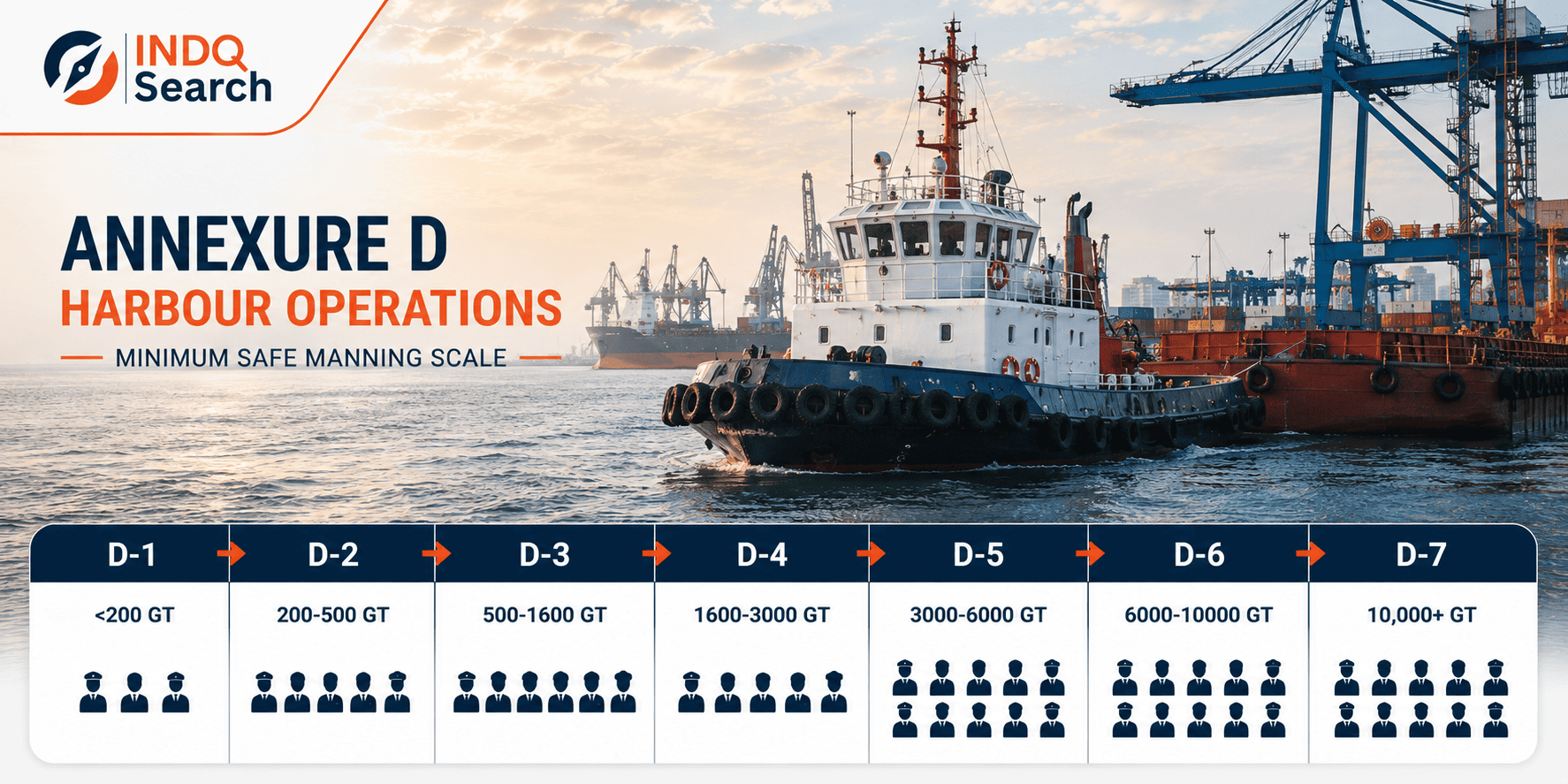
Annexure D covers self-propelled cargo and non-passenger vessels engaged in harbour operation. It runs across seven codes, D-1 through D-7, the finest tonnage breakdown of any annexure in the circular.
| Code | GT of Vessel | Master | Chief Officer | OINW | AB | OS | Cook |
| D-1 | Below 200 | 1st Class IV Master / 2nd Class IV Master, 12 months’ experience: 1 | 2nd Class IV Master: 1 | Not required | Not required | Rating, Basic STCW safety training: 1 | Not required |
| D-2 | 200 to below 500 | 1st Class IV Master / Master NCV (500 GT): 1 | 2nd Class IV Master / Mate NCV: 1 | Not required | Not required | Rating, Basic STCW safety training: 2 | Basic STCW safety training + CoC as Cook: 1 |
| D-3 | 500 to below 1600 | Mate NCV / NWKO (NCV), 1 year experience: 1 | NWKO (NCV) / 1st Class I/V Master / 2nd Class I/V Master, 1 year experience: 1 | Not required | Able Seafarer Deck II/5: 1 | Rating, Basic STCW safety training: 2 | Basic STCW safety training + CoC as Cook: 1 |
| D-4 | 1600 to below 3000 | Master NCV / Mate NCV, 1 year experience: 1 | NWKO (NCV) / 1st Class I/V Master, 1 year experience: 1 | Not required | Able Seafarer Deck II/5: 1 | Rating, Basic STCW safety training: 2 | Basic STCW safety training + CoC as Cook: 1 |
| D-5 | 3000 to below 6000 | Master NCV: 1 | NWKO, 1 year experience: 1 | NWKO NCV: 1 | Able Seafarer Deck II/5: 2 | Rating, Basic STCW safety training: 2 | Basic STCW safety training + CoC as Cook: 1 |
| D-6 | 6000 to below 10,000 | Master FG / Master NCV: 1 | Mate FG / Mate NCV: 1 | NWKO NCV: 1 | Able Seafarer Deck II/5: 2 | Rating, Basic STCW safety training: 2 | Basic STCW safety training + CoC as Cook: 1 |
| D-7 | 10,000 and above | Master FG: 1 | Mate FG: 1 | NWKO NCV: 1 | Able Seafarer Deck II/5: 2 | Rating, Basic STCW safety training: 2 | Basic STCW safety training + CoC as Cook: 1 |
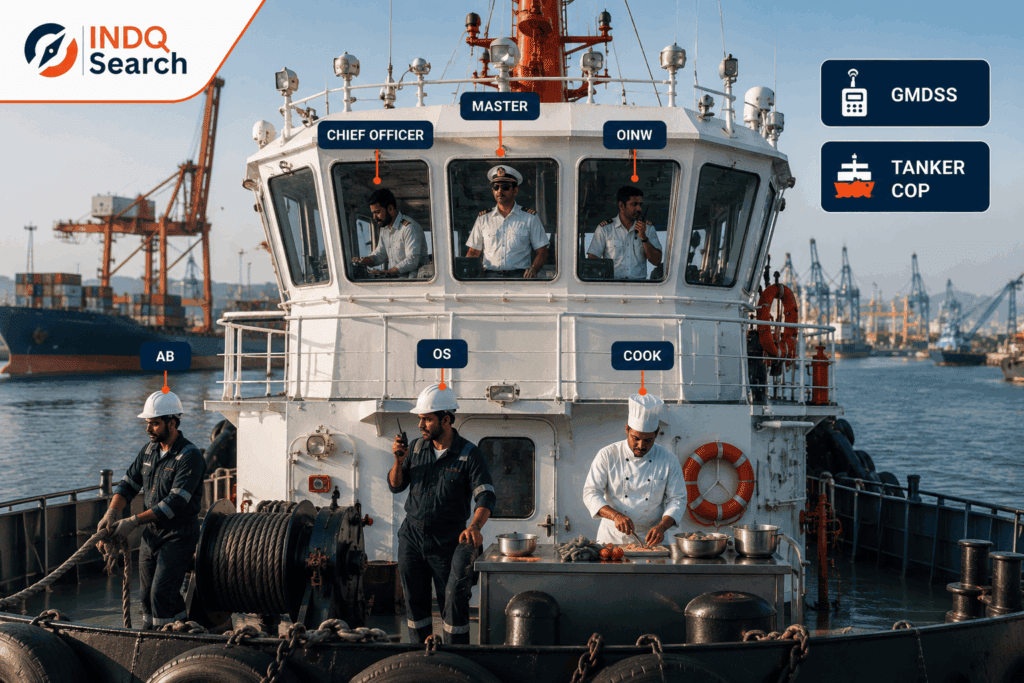
At least one officer on vessels below 500 GT needs a Restricted Operator Certificate, and vessels 500 GT and above need a full Indian GMDSS Certificate of Competency. Tankers need a valid Certificate of Proficiency in Tanker Operation on top of the base crew shown here.
What Do the Footnote Symbols in the Annexure D Table Mean?
Only one marker appears repeatedly across this table, a single asterisk on the OINW column at Codes D-5, D-6, and D-7. It ties to a footnote covering dredgers and vessels engaged in port operations exceeding 72 hours, which need one additional NWKO (NCV) beyond the number shown. Every other number in the table applies without a footnote modifier, which makes Annexure D notably simpler to read than Annexure C’s table, which carries six separate footnote symbols.
What Changes in Crew Numbers Between Code D-1 and Code D-7?
The smallest harbour vessels run the leanest crew anywhere in the circular. A 150 GT harbour tug, Code D-1, sails with just 3 nautical crew: a Master, a Chief Officer, and one OS. There is no AB, no dedicated OINW, and no cook requirement at this size.
By Code D-2, 200 to 500 GT, a cook joins the crew and OS numbers double, bringing the total to 5. Codes D-3 and D-4 add a dedicated AB rating, taking the total to 6, and introduce experience-based qualifications, a Mate NCV or NWKO with a year of sea time, rather than accepting a fresh certificate alone.
The real structural shift happens at Code D-5, 3000 to 6000 GT, where a dedicated OINW position finally appears for the first time on this scale, and the total reaches 8. That number holds steady through Codes D-6 and D-7, all the way up to 10,000 GT and beyond. In other words, a 12,000 GT harbour vessel under Annexure D needs the same 8 nautical crew as a 3,500 GT one. Size stops driving crew count once the officer structure is complete, which is not true on Annexure A, B, or C, where the largest vessels always carry more hands than the mid-tier ones.
What Certificates Appear on the Harbour Operations Scale?
Annexure D uses a wider mix of certificate types than any other scale in the circular, because it spans everything from a small harbour launch to a 10,000 GT vessel confined to port limits.
What Are Class IV Master Certificates?
Codes D-1 and D-2 accept 1st Class IV Master and 2nd Class IV Master certificates, a tier that sits below even the Near Coastal Voyage certificate used elsewhere in the circular. These are qualifications built specifically for small craft working close to shore, and they let operators crew a small harbour vessel without sending an officer through NCV or Foreign-Going training first. This is the only annexure among A, B, C, and D where this certificate class appears at all.
When Do NCV and FG Certificates Apply Instead?
NCV Certificates on Annexure D
From Code D-3 onward, NCV certificates take over as the baseline, matching the pattern seen on Annexure B and Annexure C. A Master NCV or Mate NCV, often with a year or two of documented sea time, fills the top two officer positions right through to Code D-5.
FG Certificates on Annexure D
Code D-6, 6000 to below 10,000 GT, is the one genuine exception in the circular’s certificate progression. It offers Master FG or Master NCV, and Mate FG or Mate NCV, as alternatives, rather than mandating one over the other. Only at Code D-7, 10,000 GT and above, does the scale require Foreign-Going certificates outright. Officers working toward that FG standard typically train through a Second Mate FG course, while ratings on any code can build their base qualification through a GP Rating course. Our directory of DG-approved maritime training institutes lists where to take either course. Officers due for renewal can check the process in our CoC revalidation guide.
Why Does Annexure D Delay Its Third Officer Position Longer Than Other Scales?
This is the opposite pattern from what we found on Annexure C. Annexure C introduces its third officer, the OINW, at just 200 GT. Annexure B waits until 500 GT. Annexure D waits far longer than either, all the way to 3000 GT, at Code D-5.
The logic tracks the actual work. A harbour vessel below 3000 GT is, by definition, confined to sheltered water and short transits within port limits, so a two-officer bridge team covers the watchkeeping load comfortably. Once a harbour vessel crosses 3000 GT, it typically handles more complex cargo operations, larger tows, or longer in-port duty cycles, which is exactly when the circular adds that third officer back in.
What Is the Special Manning Rule for Vessels Working an SPM Facility?
SPM, or Single Point Mooring, is an offshore buoy anchored near a port that lets large tankers load or discharge crude oil and other liquid cargo without docking at a jetty. India has several SPM installations, including the facility at New Mangalore Port, and vessels servicing these installations fall inside the harbour operation definition even though the SPM itself sits some distance offshore.
The circular adds one specific rule here. Vessels under 500 GT engaged in continuous service at an SPM facility within notified port limits must carry at least one officer holding a valid STCW certificate of competency, the same international training convention our guide to maritime conventions for Indian seafarers explains in full. This sits on top of the base Annexure D crew for that vessel’s GT code. It exists because SPM work, transferring liquid cargo at an exposed offshore point, carries more risk than a typical inside-harbour task, even for a small support craft.
What Extra Manning Applies to Dredgers Under Annexure D?
Dredgers get two distinct concessions under this annexure. First, Master, Mate, and NWKO-NCV certificates can be substituted with Dredge Master Grade I, Dredge Master Grade II, and Dredge Mate Grade I respectively, a substitution pattern repeated across every annexure in the circular. Second, any dredger engaged in port operations exceeding 72 hours needs one additional NWKO (NCV) beyond the base number shown in the table, the same 72-hour trigger that applies to any vessel under this annexure running an extended port operation.
Dredging work sits at the center of why Annexure D exists at all. Ports need continuous channel maintenance to stay navigable, and that work happens almost entirely within notified limits, which is precisely the operating pattern this annexure was built to cover.
Why Do Shore Access Rules Matter More for Harbour Crew?
Crew on a harbour vessel spend far more of their working life inside port limits than crew on an international or near coastal ship. That makes two documents more relevant to Annexure D crew day to day than to almost anyone else on the wider circular.
The first is the Shore Leave Pass, which controls how and when a seafarer can step off the vessel and into the port city. Our guide to DGMA Circular 38 of 2026 on revised shore leave and crew change rules covers exactly what’s changed. The second is the Biometric Seafarer’s Identity Document, or BSID, which port security checks routinely for anyone moving in and out of a terminal area.
Crew joining a harbour vessel should confirm their BSID is current before sign-on, and our guide to how to get a BSID card walks through the application process. Neither document changes the Annexure D manning numbers, but both affect whether a fully-manned harbour crew can actually move freely enough to do the job.
How Is the MSMD Issued for a Vessel Under Annexure D?
The approval process follows the same path as every other annexure, and our pillar guide covers the full MSMD approval workflow in detail. The shipowner or manager submits a manning proposal, with a self-assessment checklist, online to the concerned Mercantile Marine Department.
For a harbour vessel specifically, the MMD checks two things closely: that the vessel genuinely qualifies as operating within the harbour definition, and that the proposed crew matches the correct Annexure D code for its tonnage. Registered RPSL manning agencies crew harbour vessels against this approved document, and crew joining should hold current medical clearance through a DGMA approved doctor, per the requirements covered in our guide to mandatory medical tests for seafarers.
Can a Shipping Company Get a Dispensation From the Harbour Operations Manning Scale?
Only for genuine exigencies, and the process runs exactly as it does across the rest of the circular. Our pillar guide explains the full two-stage dispensation process, covering sudden illness, injury, or unavailability of a crew member.
For a harbour vessel, the company applies to the Nautical Wing with full case details, including the applicable Maritime Union of India wage scale for the rank concerned. Once in-principle approval is granted, it remits the maximum basic wage for that rank. Harbour vessels tend to have an advantage here that sea-going ships don’t: crew changes are usually easier to arrange quickly since the vessel rarely leaves port, which means dispensation requests on this annexure are, in practice, rarer than on the others.
If the underlying exigency is a genuine medical or family emergency, it’s also worth checking whether the affected seafarer qualifies for support under one of the SWFS welfare schemes alongside any manning dispensation the company arranges.
How Does the Harbour Operations Scale Compare With Other Annexures?
Annexure D stands apart from every cargo scale we’ve covered so far, on certificate range, tonnage granularity, and crew size alike.
| Scale | Annexure | Voyage Type | Entry Master Qualification | GT Bands | Smallest-Code Crew Total |
| International voyages | A | Worldwide trade, beyond near-coastal limits | Master (FG) | 4 (A-1 to A-4) | 6 |
| Near coastal voyages | B | Defined near-coastal zone | Master NCV (500 GT) or Mate NCV | 5 (B-1 to B-5) | 5 |
| Indian coast, incl. A&N and Lakshadweep | C | Indian coastline and island territories | Master NCV (500 GT) or Mate NCV | 6 (C-1 to C-6) | 4 |
| Harbour operations | D | Within notified port limits, fair weather | 1st or 2nd Class IV Master | 7 (D-1 to D-7) | 3 |
The pattern across the whole circular is consistent: the further a vessel operates from a sheltered port, the higher its entry-level certificate and the larger its minimum crew, even at the smallest tonnage band. Annexure D sits at one end of that spectrum, Annexure A at the other, and Annexure B and Annexure C fall in between.
What Happens If a Harbour Vessel Sails Below Its Approved Manning Scale?
The same rule applies here as everywhere else in the circular: a vessel must be crewed strictly to its approved MSMD. What makes this worth restating for Annexure D specifically is the fair-weather condition tied to the harbour definition itself.
If a vessel under 200 GT, Code D-1, operates outside fair-weather conditions without specific authorisation from the Directorate, it isn’t just short on crew, it’s operating outside the basis its entire manning scale was approved on. Inspectors reviewing a harbour vessel typically check three things. Crew numbers against the code. Certificate levels against the code. And whether the vessel’s actual operating pattern still genuinely fits the harbour definition it was approved under, rather than having drifted into open coastal work over time.
FAQs
What is Annexure D of DGMA Circular No. 54 of 2025?
Annexure D sets minimum safe manning for self-propelled cargo and non-passenger vessels engaged in harbour operation, meaning work within notified port limits or in smooth and partially smooth waters near a port in fair weather, across Codes D-1 to D-7.
How many crew does a vessel under 200 GT need under Code D-1?
Code D-1 requires a 1st Class or 2nd Class IV Master, a 2nd Class IV Master as Chief Officer, and one OS rating, a total of 3 nautical crew, the smallest complement in the entire circular.
What certificate does the Master need under Annexure D?
Certificates range from 1st or 2nd Class IV Master on the smallest vessels, to Master NCV from roughly 500 GT, to Master FG or NCV alternatives at 6000 to 10,000 GT, to Master FG only above 10,000 GT.
What counts as harbour operation under this circular?
Operation within notified port limits throughout the year, and operation in smooth or partially smooth waters near a port under fair-weather conditions. A vessel making an open sea passage does not qualify, even if it’s small.
What is the special rule for vessels working at an SPM facility?
Vessels under 500 GT in continuous service at a Single Point Mooring facility within notified port limits must carry at least one officer holding a valid STCW certificate of competency, on top of the base Annexure D crew.
Why does Annexure D add its third officer later than other scales?
Its OINW position only appears from Code D-5, 3000 GT, because vessels below that size operate in sheltered water on short transits, which a two-officer bridge team can safely cover.
Do dredgers get any manning concessions under Annexure D?
Yes. Dredgers can substitute Master, Mate, and NWKO-NCV certificates with Dredge Master and Dredge Mate grades, and need one additional NWKO (NCV) for port operations exceeding 72 hours.
What GMDSS certificate does an Annexure D vessel need?
Vessels below 500 GT need at least one officer with a Restricted Operator Certificate. Vessels 500 GT and above need at least one officer with a valid Indian GMDSS Certificate of Competency.
Is Annexure D manning the same regardless of vessel size above 10,000 GT?
Yes. Code D-7 covers every vessel 10,000 GT and above with the same 8-person nautical crew, since the officer and rating structure is already complete by that point on the scale.
Who approves the MSMD for a vessel under Annexure D?
The concerned Mercantile Marine Department reviews the shipowner’s proposal against the correct Annexure D code for the vessel’s tonnage and confirms the vessel genuinely meets the harbour operation definition before issuing the MSMD.