
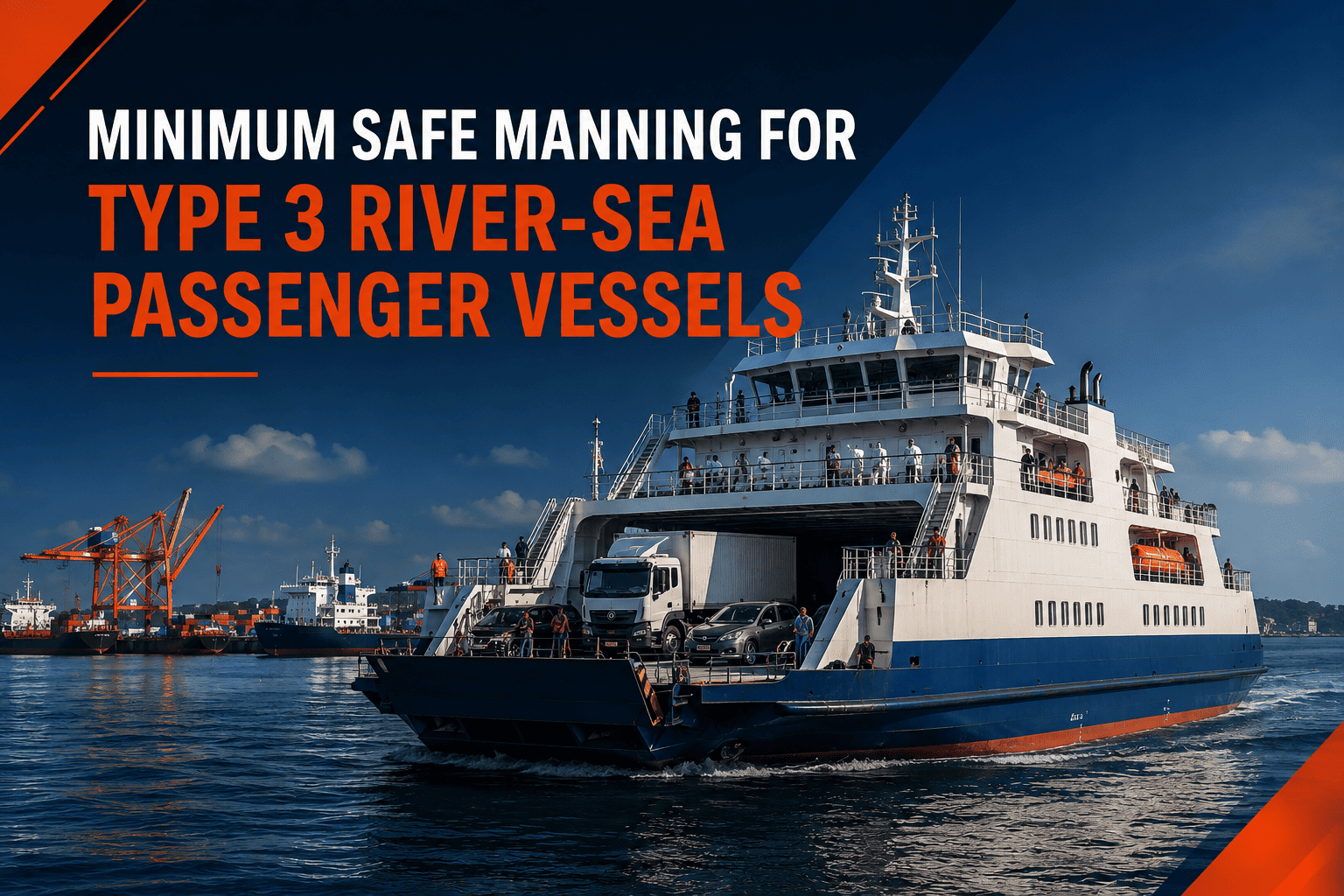
Minimum safe manning for Type 3 River-Sea passenger vessels comes from Annexure G-5 of DGMA Circular No. 54 of 2025, and it covers passenger vessels classed as Type 3 RSVs, including Ro-Ro and Ro-Pax configurations, whether they are carrying foot passengers only or vehicles as well. A vessel under 500 GT needs 7 nautical crew.
A vessel at 6000 GT and above needs 11, with foreign-going certificates required at the master and mate levels for the first time on this scale. If you manage a Type 3 river-sea ferry or a Ro-Pax vessel on that classification, Annexure G-5 decides what goes on its Minimum Safe Manning Document (MSMD), not Annexure F-6’s general cargo scale for the same vessel type and not Annexure G-6, which is reserved for Type 4 RSV passenger vessels instead.
This guide continues our series on minimum safe manning requirements for Indian flag vessels, which maps every annexure in DGMA Circular No. 54 of 2025. It sits inside the Annexure G subcluster covering passenger ships, Ro-Ro and Ro-Pax vessels, and special trade passenger vessels, following our guides to Annexure G-1 for passenger ships on international voyages and Annexure G-3 for passenger ships within 20 nautical miles of the Indian coast, and it is also the first guide in this series to connect back to the River-Sea Vessel classification covered in our Annexure F-6 guide for coastal voyages under 48 hours, since Annexure G-5 crews the same Type 3 RSV hull once it is carrying passengers.
What Vessels Does Annexure G-5 Cover?
Annexure G governs passenger ships, Ro-Ro and Ro-Pax vessels, and special trade passenger vessels across the whole circular, and within that group, two annexures are reserved specifically for river-sea vessels rather than seagoing ones. Annexure G-5 covers Type 3 RSVs carrying passengers, including Ro-Ro and Ro-Pax configurations. Annexure G-6 covers the equivalent Type 4 vessels, capped at carrying between 12 and 400 passengers. The type classification itself, Type 3 in this case, comes from the RSV Notification issued under DGMA Order No. 18 of 2013, which governs construction and operating range rather than manning and defines Type 3 as a vessel running voyages between Indian ports where duration does not exceed 24 hours.
How Does This Differ From Annexure G-1 and Annexure G-3?
Annexure G-1 and Annexure G-3 both cover seagoing passenger vessels, not river-sea vessels, split by how far and how long the voyage runs: international for G-1 and within 20 nautical miles of the Indian coast for G-3. Annexure G-5 sits in a different branch of the same overall Annexure G structure, built around the RSV type classification instead of a voyage zone. A Type 3 RSV carrying passengers never uses G-1 or G-3, regardless of how close to shore it happens to be operating, because its own vessel classification routes it to G-5 instead.
Why Does Annexure G-5 Include Ro-Ro and Ro-Pax Configurations?
Because a Type 3 RSV built to carry vehicles alongside passengers still falls under the same type classification and the same manning table as one carrying foot passengers only. The circular does not split Ro-Ro and Ro-Pax variants into a separate scale, so a river-sea ferry loading cars and trucks at a terminal is crewed to the identical Annexure G-5 numbers as a passenger-only vessel of the same gross tonnage.
What is the complete Annexure G-5 minimum safe manning for Type 3 river-sea passenger vessels?
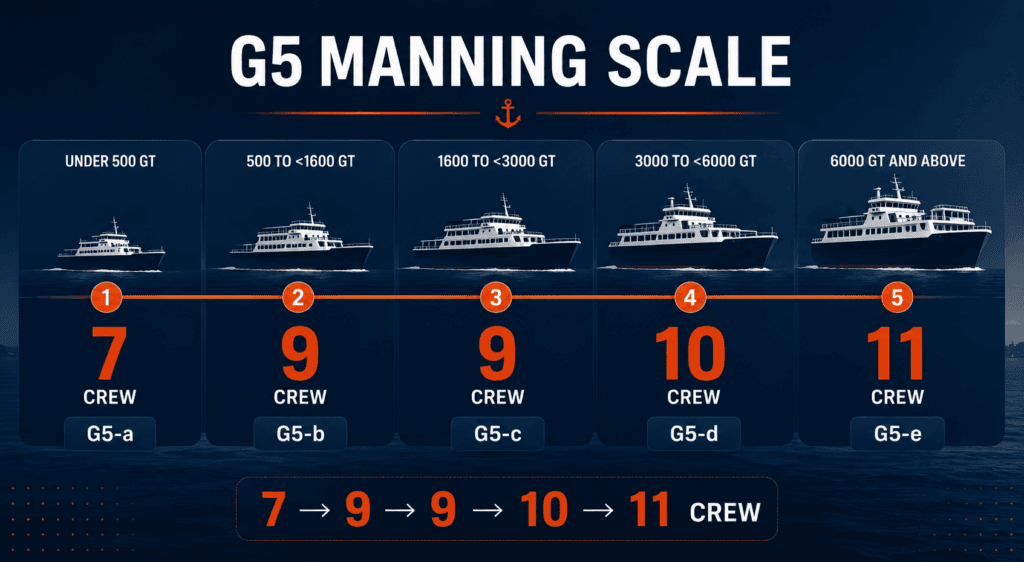
Annexure G-5 runs across five gross tonnage bands, spanning under 500 GT up to 6000 GT and above. The table below is the nautical, meaning deck, department scale only. Engine room manning for River-Sea passenger vessels is prescribed separately and is not part of this circular. Worth flagging before the table: the circular itself does not print a reference code for the top row, the way it does for G5-a through G5-d for every band below it. Following the same lettering used everywhere else on this scale, this guide refers to it as G5-e.
| Code | GT of Vessel | Master | No. | Chief Officer | No. | OINW | No. | AB | No. | OS | No. | Cook | No. |
| G5-a | Under 500 | Master NCV (500 GT) or NWKO NCV with 1 year experience | 1 | NWKO NCV | 1 | Not required | – | Able Seafarer Deck (II/5) or rating forming part of a navigational watch (II/4) | 2 | Rating with Basic STCW safety training | 2 | Basic STCW safety training and CoC as Cook, as applicable | 1 |
| G5-b | 500 to under 1600 | Master NCV or NWKO NCV with 1 year experience | 1 | NWKO NCV | 1 | Not required | – | (as above) | 3 | (as above) | 3 | (as above) | 1 |
| G5-c | 1600 to under 3000 | Master NCV or Mate NCV with 1 year experience | 1 | NWKO NCV | 1 | Not required | – | (as above) | 3 | (as above) | 3 | (as above) | 1 |
| G5-d | 3000 to under 6000 | Master NCV | 1 | Mate NCV | 1 | NWKO NCV | 1 | (as above) | 3 | (as above) | 3 | (as above) | 1 |
| G5-e | 6000 and above | Master FG | 1 | Mate FG | 1 | 2nd Mate FG or NWKO NCV | 2 | (as above) | 3 | (as above) | 3 | (as above) | 1 |
Add up each row, and the total nautical crew runs 7, 9, 9, 10, and 11 across Codes G5-a to G5-e. Two rules apply across the whole table without exception, covered in the sections that follow: a fixed GMDSS certificate requirement, and a fair-weather limit that only ever applies to part of the smallest code.
How Does Crew Size Change Across the G-5 Gross Tonnage Bands?
What Applies Below 1600 GT (Codes G5-a and G5-b)?
Code G5-a needs 7 nautical crew: a master, a chief officer, 2 AB ratings, 2 OS ratings, and a cook, with no OINW at this size. Code G5-b holds the same rank structure but adds a third AB and a third OS, taking the total crew to 9, the biggest single jump anywhere on this scale in absolute terms.
What changes at 1600 to 3000 GT (Code G5-c)?
Crew size holds at 9 through Code G5-c, matching Code G5-b exactly on headcount. What moves instead is the master’s certificate floor, which steps up from an NWKO NCV holder with 1 year of experience to a mate NCV holder with the same experience requirement, a marginally senior qualification for the same crew count.
What Happens at 3000 GT When does the OINW requirement begin (Code G5-d)?
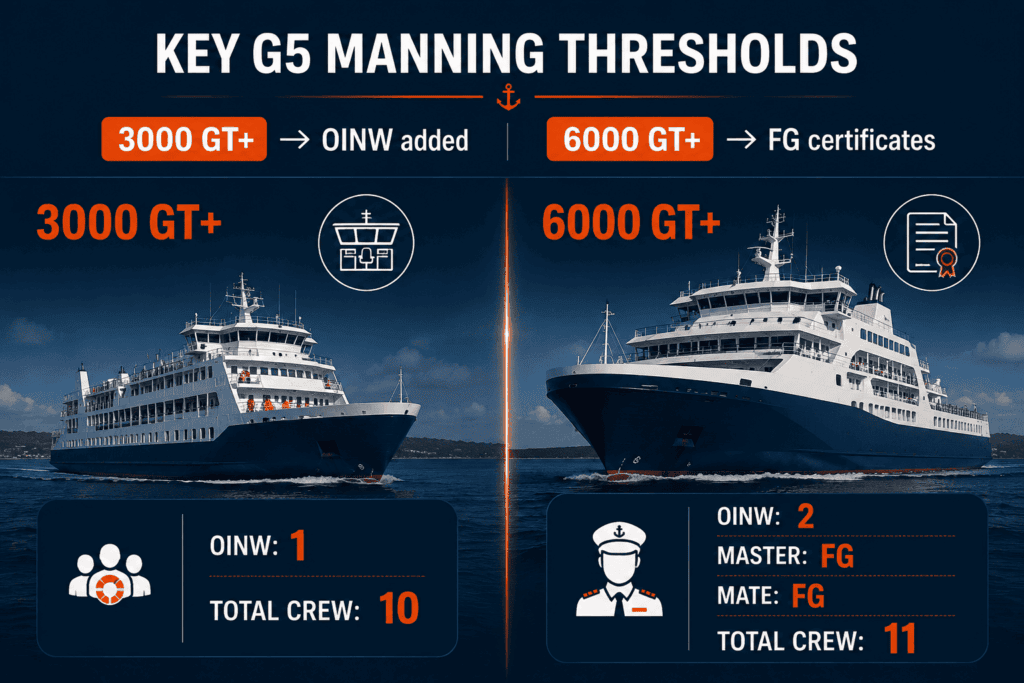
Code G5-d adds the first numbered OINW position on this scale, filled by an NWKO NCV holder, taking the total crew to 10. Every code below this one runs its bridge team on just a master and chief officer. From 3000 GT upward, a dedicated watchkeeping officer joins as a fixed requirement rather than an optional extra.
What Applies at 6000 GT and Above (Code G5-e)?
Code G5-e reaches 11 nautical crew, the ceiling for this scale, with the OINW position doubling to 2, filled by a 2nd Mate FG or an NWKO NCV holder.
Why Foreign-Going Certificates Become Mandatory at the Top Tier
Code G5-e is also where Master and Chief Officer certificates jump from NCV to foreign-going. Every code from G5-a to G5-d accepts NCV certification throughout, but a 6000 GT-plus RSV passenger vessel needs Master FG and Mate FG instead, the same kind of jump seen at the top tier of Annexure G-3’s coastal passenger scale and Annexure C’s cargo scale for the Indian coast. Size, more than voyage type, is what pushes a vessel from NCV certification into foreign-going territory across this circular.
Why Does Annexure G-5 Have No Separate Code Below 500 GT?
This is the detail that sets Annexure G-5 apart from nearly every other scale covered in this series so far. Annexures A through F, and G-1 and G-3 within the passenger group, all start with a code for vessels under 200 GT. Annexure G-5 does not. Its smallest code, G5-a, covers the entire range from the smallest RSV passenger vessel up to 500 GT in one band.
A Type 3 RSV built to carry passengers and, in many cases, vehicles as well, simply does not appear to come in a build small enough to warrant its own sub-200 GT tier the way a small harbour tug or a bare cargo hull does. That gap does leave one loose thread worth flagging: the circular’s general fair-weather restriction is written for vessels under 200 GT specifically, a threshold that sits inside Code G5-a’s range without having its own row. In practice, that means the restriction still applies to any G5-a vessel that happens to be under 200 GT, even though the code covering it stretches all the way up to 500.
What Certificate of Competency Rules Apply Under Annexure G-5?
Annexure G-5 carries a single certificate rule that applies to every code without exception. At least one officer on board must hold a valid Indian GMDSS Certificate of Competency, from G5-a through G5-e, with no restricted operator alternative at any tonnage. This matches the approach taken across the rest of Annexure G rather than the tiered certificate rules seen on some of the cargo-focused RSV scales, and it reflects the same underlying logic: a vessel carrying passengers needs full distress and safety communication capability regardless of how small the hull is.
How Does Annexure G-5 Compare With Annexure F-6 for the Same RSV Type?
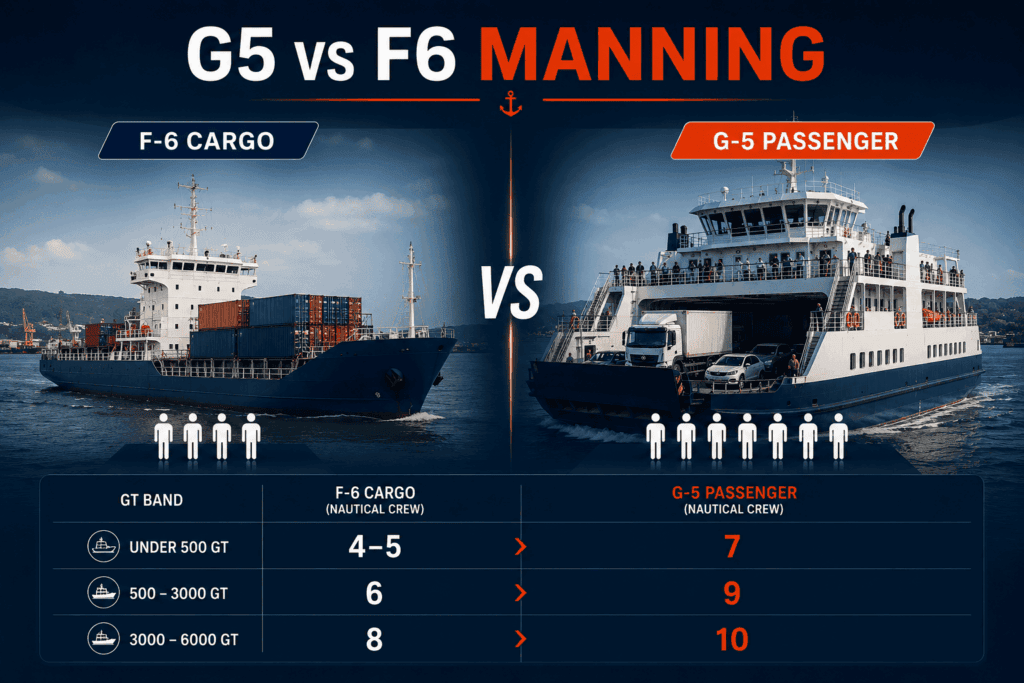
Annexure F-6 crews Type 3 and Type 4 River-Sea Vessels on coastal voyages under 48 hours for general cargo and non-passenger work. Annexure G-5 crews the same type 3 RSV hull once it is fitted out to carry passengers. Lining the two scales up by gross tonnage shows exactly what carrying passengers adds.
| GT Band | F-6 Total Crew (Type 3 RSV, Cargo) | G-5 Total Crew (Type 3 RSV, Passenger) |
| Under 200 to under 500 | 4 to 5 | 7 |
| 500 to under 1600 | 6 | 9 |
| 1600 to under 3000 | 6 | 9 |
| 3000 to under 6000 | 8 | 10 |
| 6000 and above | Not separately banded under F-6 | 11 |
At the smallest size, a passenger-carrying Type 3 RSV needs 2 to 3 more crew than the same size cargo hull. At 500 to 3000 GT, the gap holds at 3 extra crew. By 3000 to 6000 GT, the gap narrows to 2. Annexure F-6 also does not band separately above 6000 GT, since that sits at or beyond the GT ceiling generally used for RSV cargo classification, while Annexure G-5 continues on to its own top tier at that size, since a passenger vessel’s gross tonnage is not capped the same way.
The overall pattern is consistent with what carrying passengers costs across every other annexure in this circular. It adds ratings for evacuation and safety duties well before it adds officers, and the two scales only converge in relative terms once both reach their largest sizes.
Do Fair Weather Restrictions Apply Under Annexure G-5?
Yes, but only to the smallest vessels within Code G5-a. Vessels under 200 GT may operate only against fair-weather forecasts and conditions, unless DGMA specifically authorises otherwise. Since Code G5-a itself runs all the way up to 500 GT, this restriction effectively applies only to the lower slice of that band, and it lifts once a vessel reaches 200 GT, well before it reaches Code G5-a’s own upper limit.
How Do Shipowners Get an Annexure G-5 Manning Scale Approved?
The process runs the same way it does for every other annexure in the circular. The shipowner or manager submits a safe manning proposal, together with the prescribed self-assessment checklist, to the concerned Mercantile Marine Department. The MMD checks that proposal against the Annexure G-5 minimum for the vessel’s confirmed Type 3 RSV classification and gross tonnage before issuing the approved MSMD.
Once approved, the vessel must sail strictly to the crew numbers on that MSMD, and registered RPSL manning agencies build their placement and joining plans directly around them. A company that does not yet hold Recruitment and Placement Service Licence (RPSL) status needs that licence before it can place crew against an approved MSMD at all, and reviewing how an RPSL licence is registered is worth doing before a company takes on its first River-Sea passenger vessel crewing contract.
Officers standing watch under Annexure G-5 also need a valid GMDSS qualification at every tier, given the annexure’s single, non-negotiable certificate rule, and a directory of GMDSS training courses can point new officers to where that certificate is obtained. For the full text of Annexure G-5 alongside every other scale in the circular.
FAQs
What is Annexure G-5 of DGMA Circular No. 54 of 2025?
Annexure G-5 is the minimum safe manning scale for Type 3 River-Sea Vessels carrying passengers, including Ro-Ro and Ro-Pax configurations. It sets deck department crew numbers across five Gross Tonnage bands, from under 500 GT up to 6000 GT and above.
Which vessels does Annexure G-5 apply to?
Annexure G-5 applies to River-Sea Vessels classed as Type 3, whether carrying foot passengers only or fitted for Ro-Ro or Ro-Pax operation. Type 4 RSV passenger vessels are covered separately under Annexure G-6.
How many crew does a vessel need under Code G5-a?
Code G5-a, for Type 3 RSV passenger vessels under 500 GT, needs 7 nautical crew: 1 Master, 1 Chief Officer, 2 AB ratings, 2 OS ratings, and 1 Cook. No OINW is required at this tier.
Why does Annexure G-5 not have a separate code below 500 GT?
Unlike most other annexures in the circular, Annexure G-5 starts its smallest code at under 500 GT rather than under 200 GT. Type 3 RSV passenger vessels, particularly Ro-Ro and Ro-Pax configurations, do not appear to be built small enough for the circular to need a separate sub-200 GT tier.
When does an OINW become a required position under Annexure G-5?
From Code G5-d onward, meaning 3000 GT and above. Every code below that, G5-a through G5-c, runs its bridge team on just a Master and Chief Officer, with no separate OINW position.
When does Annexure G-5 require Foreign-Going certificates instead of NCV?
Only at Code G5-e, for vessels of 6000 GT and above. Every other code on the scale, G5-a through G5-d, accepts NCV certificates at Master and Chief Officer level.
What is the difference between Annexure G-5 and Annexure F-6?
Annexure F-6 covers Type 3 and Type 4 River-Sea Vessels on coastal voyages under 48 hours for general cargo work. Annexure G-5 covers Type 3 RSVs specifically once they are fitted to carry passengers. At every comparable Gross Tonnage, Annexure G-5 requires more crew, mainly extra AB and OS ratings for passenger safety duties.
What is the difference between Annexure G-5 and Annexure G-6?
Annexure G-5 covers Type 3 River-Sea passenger vessels. Annexure G-6 covers the equivalent Type 4 vessels, which are capped at carrying between 12 and 400 passengers, a limit that does not appear anywhere in Annexure G-5.
Does Annexure G-5 accept a Restricted Operator certificate at any tonnage?
No. Annexure G-5 requires at least one officer to hold a valid Indian GMDSS Certificate of Competency at every code, from G5-a through G5-e, with no lighter Restricted Operator alternative at any Gross Tonnage.
Who approves the Minimum Safe Manning Document for a Type 3 RSV passenger vessel under Annexure G-5?
The concerned Mercantile Marine Department reviews the shipowner’s manning proposal against the Annexure G-5 minimum for the vessel’s confirmed Type 3 RSV classification and Gross Tonnage, then issues the MSMD. The vessel must sail strictly to that approved document once issued.