
Minimum safe manning for passenger ships on international voyages comes from Annexure G-1 of DGMA Circular No. 54 of 2025, and it sets a heavier deck crew than any cargo ship of the same size carries. A passenger vessel under 200 GT needs 7 nautical crew. A vessel of 3000 GT and above needs 11, with every rank certificated to Foreign-Going standard from the smallest tier upward.
If you manage a passenger ship, a Ro-Ro or Ro-Pax vessel, or a special trade passenger ship trading internationally, Annexure G-1 is the table that decides its Minimum Safe Manning Document (MSMD), not Annexure A’s cargo vessel scale for international voyages, which excludes passenger vessels by name. The circular draws that line explicitly. Annexures A through F apply to self-propelled cargo and non-passenger vessels only. The moment passengers enter the picture, the manning scale shifts to a different part of the circular entirely, and Annexure G-1 is where that shift starts for a vessel on genuine international trade.
This guide opens a new subcluster in our series on minimum safe manning requirements for Indian flag vessels, which maps every annexure in the circular. Annexures A through F have their own guides already, covering everything from international cargo voyages down to river-sea vessel harbour work. Annexure G-1 begins a separate seven-part group, G1 through G7, built specifically around passenger ships, Ro-Ro and Ro-Pax vessels, special trade passenger vessels, RSV passenger vessels, and high-speed craft.
What Makes Annexure G Different From Annexures A to F?
The circular states this distinction plainly in its opening provisions. Annexures A through F apply to every type of self-propelled vessel registered under the Merchant Shipping Act, with one specific exception carved out by name: passenger vessels. That exception covers general cargo ships, tankers, offshore support vessels, tugs, dredgers, Indian coastal vessels, and river-sea vessels, none of which carry fare-paying passengers as their primary function.
Why Are Passenger Ships Covered Separately From Cargo Vessels?
A cargo vessel’s crew exists to run the ship and handle freight. A passenger vessel’s crew carries that same navigational burden and adds passenger safety duties on top of it, evacuation drills, muster station management, and the kind of hands-on-deck headcount needed to move people safely in an emergency rather than move cargo. That difference in function is exactly why the circular routes passenger vessels to their own set of annexures instead of folding them into the existing cargo scales with a footnote.
What Vessel Types Does Annexure G-1 Cover?
Annexure G sits under one heading covering three related categories: passenger ships, Ro-Ro and Ro-Pax vessels, and special trade passenger ships. A Ro-Ro or Ro-Pax vessel carries wheeled cargo that drives on and off under its own power, combined with passenger accommodation on a Ro-Pax hull, while a special trade passenger ship is built to carry large numbers of passengers in less conventional accommodation, typically on shorter, high-density routes. Annexure G-1 applies to all three categories the moment any of them trades internationally, without a separate table for each.
What Is the Complete Annexure G-1 Minimum safe manning for passenger ships on international voyages?
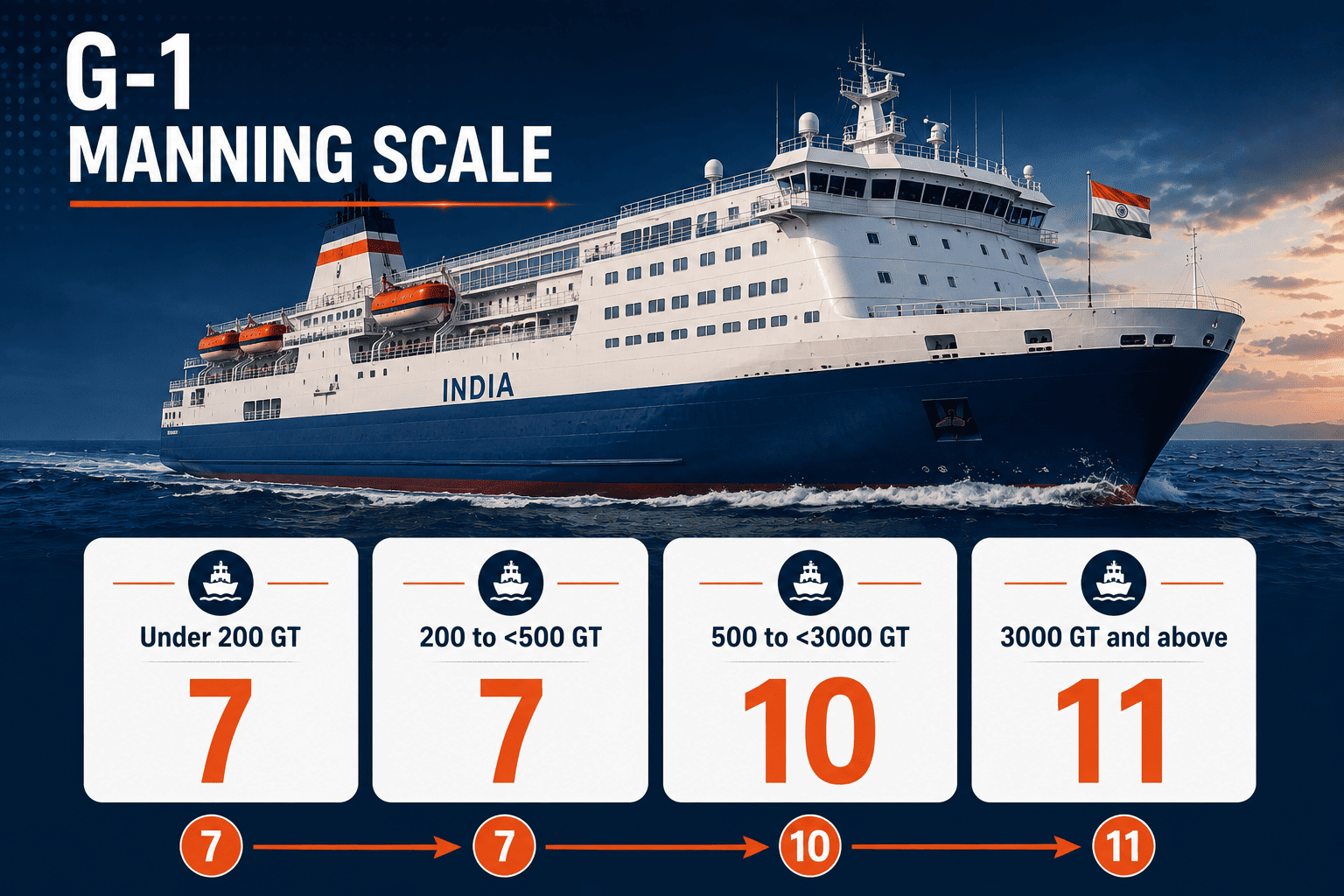
Annexure G-1 runs across four gross tonnage bands, from under 200 GT up to 3000 GT and above. The table below sets out the nautical, meaning deck department, scale only. Engine room manning for passenger vessels is prescribed separately and does not appear in this circular.
| Reference Code | GT of Vessel | Master | No. | Chief Officer | No. | OINW | No. | AB | No. | OS | No. | Cook | No. |
| G1-a | Under 200 | Master (FG) | 1 | 2nd Mate (FG) | 1 | Not required | – | Able Seafarer Deck (II/5) or rating forming part of a navigational watch (II/4) | 2 | Rating with Basic STCW safety training | 2 | Basic STCW safety training and CoC as Cook, as applicable | 1 |
| G2-b | 200 to under 500 | Master (FG) | 1 | Mate (FG) | 1 | Not required | – | (as above) | 2 | (as above) | 2 | (as above) | 1 |
| G3-c | 500 to under 3000 | Master (FG) | 1 | Mate (FG) | 1 | 2nd Mate (FG) | 1 | (as above) | 3 | (as above) | 3 | (as above) | 1 |
| G4-d | 3000 and above | Master (FG) | 1 | Mate (FG) | 1 | 2nd Mate (FG) | 2 | (as above) | 3 | (as above) | 3 | (as above) | 1 |
Add up each row, and the total nautical crew runs 7, 7, 10, and 11 across Codes G1-a to G4-d. Two rules apply across the whole table without exception. Every rank, from Master to 2nd Mate, carries a Foreign-Going (FG) certificate at every tonnage band, and either one dedicated radio officer with a valid Indian GMDSS certificate of competency or two deck officers who each hold one must be on board regardless of vessel size.
How Does Crew Size Change Across the G-1 Gross Tonnage Bands?
Unlike several of the cargo scales elsewhere in the circular, Annexure G-1 does not climb one crew member at a time through its lower tiers. It holds flat, then jumps sharply once a vessel crosses 500 GT.
What Applies Below 500 GT (Codes G1-a and G2-b)?
Both Code G1-a and Code G2-b need 7 nautical crew: a master, a deck officer at 2nd mate or mate level, 2 AB ratings, 2 OS ratings, and a cook. No numbered OINW position appears at either tier. What changes between the two codes is the deck officer’s rank alone, stepping from 2nd mate (FG) at G1-a to a full mate (FG) at G2-b, with the rest of the crew list identical.
What Changes at 500 to Under 3000 GT (Code G3-c)?
The crew jumps to 10 at Code G3-c, a 3-person increase from Code G2-b. This is the first tier where a numbered OINW position appears, filled by a 2nd mate (FG), and both the AB and OS counts rise from 2 to 3 each. A mid-sized international passenger vessel needs a materially larger bridge and deck team than the smaller tiers, reflecting the higher passenger loads these vessels typically carry at this GT range.
What Applies at 3000 GT and Above (Code G4-d)?
Code G4-d adds one more crew member, taking the total to 11, and it is the only code on this scale to require 2 people in the OINW position rather than 1. Master, Mate, AB, OS, and Cook numbers all hold steady from Code G3-c, so the entire increase at the top tier sits in a single rank, the OINW watchkeeping position.
Why Do the Reference Codes Run G1, G2, G3, G4 Instead of G1-a Through G1-d?
This is worth flagging because it breaks the pattern used almost everywhere else in the circular. Every other annexure, from A through F7, numbers its tonnage bands with a single annexure number and a lettered suffix, A-1 through A-4, F5-a through F5-e, and so on. Annexure G-1’s own table does something different. Its four rows are labelled G1-a, G2-b, G3-c, and G4-d, incrementing the leading number alongside the letter at every row, even though all four rows sit inside the single annexure titled “G-1: International Voyages.”
The practical effect is the same either way: four gross tonnage bands under one international voyage scale, so this is a labelling quirk rather than a substantive difference. It is worth knowing if you are cross-referencing the printed circular directly, since a search for “G1-b” or “G1-c” inside the source document will not return a result. The correct codes to look for are G1-a, G2-b, G3-c, and G4-d, exactly as the circular itself prints them.
What Certificate and GMDSS Rules Apply Under Annexure G-1?
Annexure G-1 carries the simplest certificate structure of any scale covered so far in this series, precisely because it does not vary by tonnage.
Why Does Every Rank Require a Foreign-Going Certificate?
Every officer position on Annexure G-1, Master, Mate, 2nd Mate, and the OINW role at the top two tiers, requires an FG certificate at every single Gross Tonnage band. There is no lighter certificate track available anywhere on this scale, unlike Annexures B, C, and E1 elsewhere in the circular, which allow NCV-certificated officers at lower tonnage before stepping up to FG only at the highest tier.
Does Annexure G-1 Ever Accept an NCV Certificate?
No. Because Annexure G-1 governs international voyages specifically, and an NCV certificate is only valid within India’s near coastal zone, there is no tonnage band where an NCV-qualified officer could lawfully serve on a G-1 vessel. This places Annexure G-1 alongside Annexure A and Annexure E-2 as one of only a handful of scales in the entire circular that require FG certification outright, with zero exceptions at any vessel size.
How Does Annexure G-1 Compare With Annexure A for International Voyages?
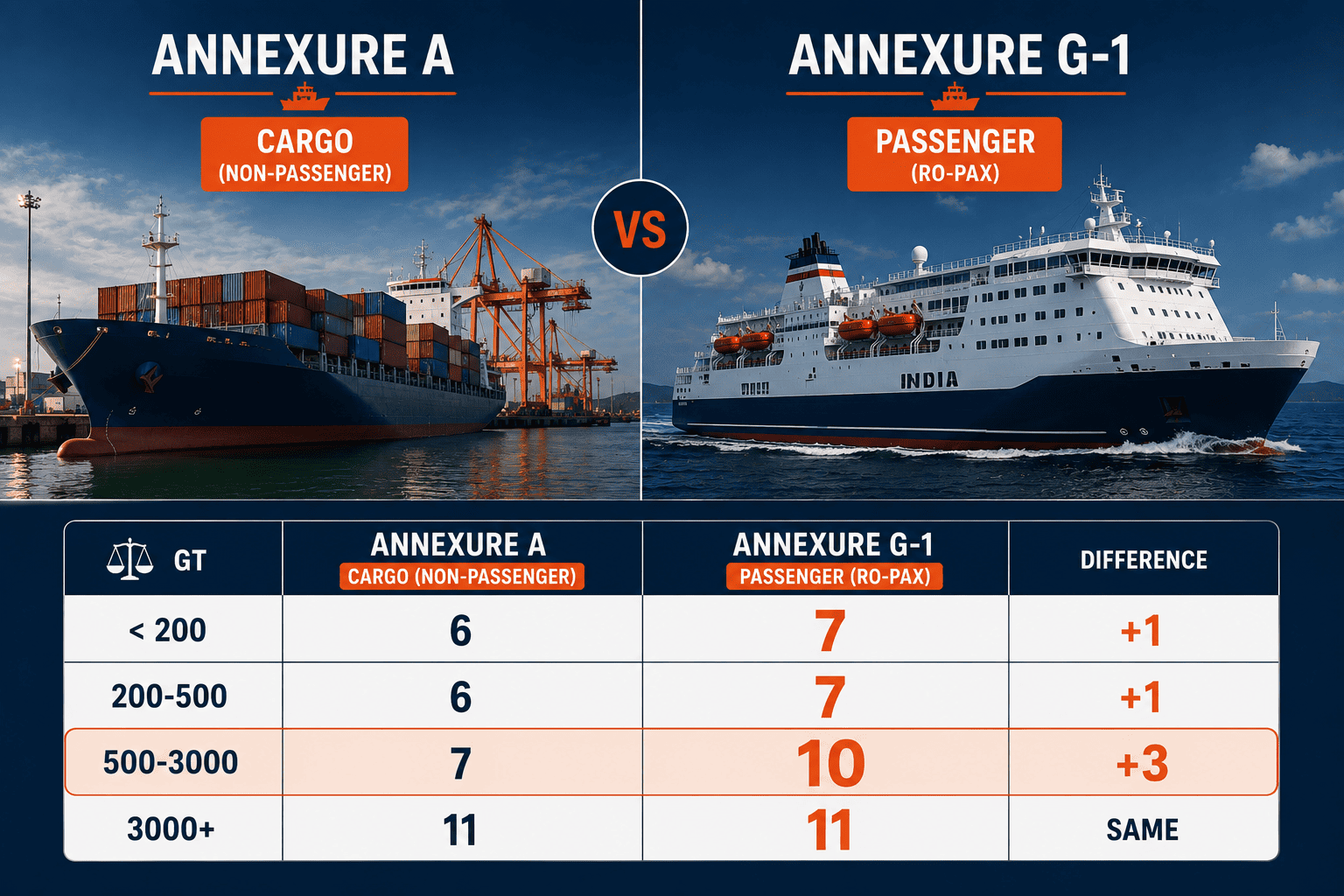
Both annexures cover exactly the same four gross tonnage bands and the same international trading area, which makes a direct comparison unusually clean. Annexure A sets the scale for general cargo and non-passenger vessels, while Annexure G-1 covers passenger ships, Ro-Ro, Ro-Pax, and special trade passenger vessels on the identical route type.
| GT Band | Annexure A Total Crew (Cargo) | Annexure G-1 Total Crew (Passenger) | Difference |
| Under 200 | 6 | 7 | +1 |
| 200 to under 500 | 6 | 7 | +1 |
| 500 to under 3000 | 7 | 10 | +3 |
| 3000 and above | 11 | 11 | Same |
Why Does a Passenger Ship Need More Ratings Than a Cargo Ship of the Same Size?
The gap is widest in the middle of the scale, not at the smallest tier, and it closes entirely at the top. Below 500 GT, a passenger vessel needs just 1 extra crew member over its cargo equivalent, but that gap triples to 3 extra crew once a vessel crosses into the 500 to 3000 GT band, almost entirely in AB and OS ratings rather than officers. That pattern lines up with what the additional muster and evacuation duties on a passenger vessel actually demand.
A small international passenger craft carries relatively few passengers to begin with, so the crew gap over an equivalent cargo vessel stays modest. A mid-sized passenger ship carries meaningfully more people, and the extra rating headcount tracks that jump in passenger load rather than rising in a straight line with tonnage the way officer ranks do.
At 3000 GT and above, the two scales converge on an identical total of 11, though the composition still differs slightly, since Annexure G-1 puts 2 people in the OINW position at this tier where Annexure A splits its extra headcount differently across AB and OS. This is the same pattern seen elsewhere in the wider circular, where a specialised scale and its cargo equivalent carry different crew counts through the middle tonnage bands and converge once a vessel is large enough that a full bridge and deck complement are required either way.
What Fair-Weather Restriction Applies Under Annexure G-1?
Passenger vessels under 200 GT, meaning Code G1-a, may operate only against fair-weather forecasts and conditions, unless the Directorate specifically authorises otherwise. This mirrors the fair-weather concession found at the smallest tonnage tier of nearly every other annexure in the circular, though Annexure G-1’s own note names passenger vessels specifically rather than using the generic phrasing found elsewhere. A small international passenger craft crewed to Code G1-a’s bare minimum carries less redundancy if weather turns mid-passage, which is precisely why that concession disappears the moment a vessel exceeds 200 GT.
Where Does Annexure G-1 Fit Within the Full Passenger Vessel Framework?
Annexure G-1 is the first and, by trading area, the widest-ranging scale in a seven-part group. G-2 covers NCV and short international voyages, effectively the passenger-vessel equivalent of stepping down from Annexure A to Annexure B on the cargo side. G-3 covers operations on the Indian coast within 20 nautical miles, and G-4 covers operation between two Indian ports in fair weather, within 5 nautical miles of the coast, a much tighter operating envelope than G-1’s unrestricted international scope.
Two further annexures apply specifically to River-Sea passenger vessels rather than seagoing ones: G-5 for Type 3 River-Sea passenger vessels, including Ro-Ro and Ro-Pax configurations, and G-6 for the equivalent Type 4 vessels, capped at carrying between 12 and 400 passengers. A final annexure, G-7, departs from the gross tonnage banding used everywhere else in the circular and sets one fixed crew for Category A high-speed craft operating out of Port Blair and the Indian offshore region, restricted to daylight hours.
Every code across this G-series carries a heavier rating complement than the equivalent cargo scale at the same tonnage, the same pattern this guide’s comparison table shows for G-1 against Annexure A, since passenger vessels need more hands for evacuation and passenger safety duties on top of ordinary navigation and deck work.
How Do Shipowners Get an Annexure G-1 Manning Scale Approved?
The approval process follows the same structure used across every annexure in the circular. The shipowner or manager submits a safe manning proposal, together with the prescribed self-assessment checklist, to the concerned Mercantile Marine Department (MMD). The MMD checks that proposal against the Annexure G-1 minimum for the vessel’s confirmed gross tonnage and against any additional crew the company proposes to meet operational, trading, or rest-hour needs before issuing the approved MSMD. Our pillar guide’s approval and dispensation section covers that full process in more depth, including how a temporary dispensation is handled if a crew member falls sick or becomes unavailable at short notice.
Once approved, the vessel must sail strictly to the crew numbers on that MSMD, and companies handling crew placement need current registration under the Recruitment and Placement Service Licence (RPSL) system before they can place officers or ratings against it. Setting up or renewing that registration is a standard company compliance step, and a structured walkthrough of the RPSL licensing process is worth reviewing before the vessel’s first FG crew joins.
Since every rank on Annexure G-1 needs an FG certificate, officers moving up from an NCV background typically train through a Second Mate FG course, while ratings build toward AB and OS positions through a GP Rating course. Officers already holding FG certification who are due for renewal can check the process in our CoC revalidation guide, and the GMDSS qualification required on every G-1 vessel is available through courses listed in our directory of DGMA-approved maritime training institutes.
Crew joining a passenger vessel on international trade should also confirm current fitness through a DGMA approved doctor, a step our guide to mandatory medical tests for seafarers covers in detail, and hold a valid BSID card for the port movement that international joining and sign-off naturally involves.
Given how tightly Codes G1-a and G2-b already run, with just 7 crew covering both navigation and passenger safety duties, losing even one crew member close to sailing is worth planning around early, and checking whether the affected seafarer qualifies for support under one of the SWFS welfare schemes is worth doing at the same time rather than after the fact. The rest-hour and watchkeeping considerations that come with running a fuller passenger crew are covered in more depth in our guide to maritime conventions for Indian seafarers.
What Happens If a Passenger Ship Sails Below Its Approved G-1 Manning Scale?
The baseline rule carries over from every other annexure in this circular: a vessel must be crewed strictly to the numbers on its approved MSMD, and sailing short is treated as a compliance failure during Flag State and Port State inspections, not a matter left to owner discretion.
Two points matter specifically on a passenger scale. First, since Annexure G-1’s crew numbers already sit meaningfully above the equivalent cargo scale through the middle tonnage bands, a missing rating removes proportionally more of the vessel’s passenger safety capacity than the same absence would on a cargo ship carrying no passengers at all. Second, because every rank on this scale requires FG certification with no NCV fallback, a shortfall cannot be temporarily patched with an NCV-qualified substitute the way it sometimes can on a coastal cargo scale. Any gap has to be resolved with another FG-certificated officer or rating, or through the formal dispensation process, before the vessel sails.
FAQs
What is Annexure G-1 of DGMA Circular No. 54 of 2025?
Annexure G-1 sets the minimum safe manning scale for passenger ships, Ro-Ro and Ro-Pax vessels, and special trade passenger vessels on international voyages, across four Gross Tonnage codes, G1-a, G2-b, G3-c, and G4-d.
Which vessel types does Annexure G-1 apply to?
Annexure G-1 applies to passenger ships, Ro-Ro vessels, Ro-Pax vessels, and special trade passenger ships whenever any of them trades on genuine international voyages. Cargo and non-passenger vessels on the same route type instead fall under Annexure A.
What is the difference between Annexure A and Annexure G-1?
Both cover international voyages across the same four Gross Tonnage bands, but Annexure A applies to cargo and non-passenger vessels while Annexure G-1 applies to passenger vessels. Below 3000 GT, Annexure G-1 requires more crew than Annexure A for an identical tonnage, converging on the same total of 11 only once a vessel reaches 3000 GT and above.
How many crew does a vessel need under Code G1-a?
Code G1-a, for passenger vessels under 200 GT, needs 7 nautical crew: 1 Master (FG), 1 2nd Mate (FG), 2 AB ratings, 2 OS ratings, and 1 Cook.
Does Annexure G-1 ever accept an NCV certificate instead of FG?
No. Every officer rank on Annexure G-1 requires a Foreign-Going certificate at every Gross Tonnage band, with no NCV option at any tier, since the annexure covers international voyages exclusively.
When does a G-1 vessel need a dedicated Radio Officer?
Annexure G-1 does not require a dedicated Radio Officer outright. The requirement is satisfied by either one dedicated Radio Officer holding a valid Indian GMDSS Certificate of Competency, or two deck officers who each hold one.
Why do the reference codes on Annexure G-1 read G1, G2, G3, and G4 instead of G1-a through G1-d?
This reflects how DGMA labelled the table in the circular itself. All four rows fall under the single annexure titled “G-1: International Voyages,” but each row’s reference code increments its leading number alongside its letter, a labelling pattern unique to this annexure in the circular.
What fair-weather restriction applies under Annexure G-1?
Passenger vessels under 200 GT, Code G1-a, may operate only against fair-weather forecast and conditions, unless DGMA specifically authorises otherwise.
Does Annexure G-1 apply to Ro-Ro and Ro-Pax vessels the same way it applies to ordinary passenger ships?
Yes. Annexure G-1 covers passenger ships, Ro-Ro vessels, Ro-Pax vessels, and special trade passenger vessels under one shared scale whenever any of them is on an international voyage. There is no separate table for Ro-Ro or Ro-Pax configurations at this stage of the circular.
Who approves the MSMD for a passenger ship under Annexure G-1?
The concerned Mercantile Marine Department reviews the shipowner’s manning proposal against the Annexure G-1 minimum for the vessel’s confirmed Gross Tonnage, then issues the MSMD once satisfied. The vessel must sail strictly to that approved document once issued.