
Minimum safe manning for passenger ships on NCV and short international voyages comes from Annexure G-2 of DGMA Circular No. 54 of 2025, and it is the only passenger vessel scale in the circular where the certificate requirement can change mid-voyage without the crew number changing at all. A passenger vessel under 200 GT needs 7 nautical crew here, the same 7 it would need under Annexure G-1. What changes is whether those 7 can hold NCV certificates or need foreign-going ones instead.
If you manage a passenger ship, Ro-Ro or Ro-Pax vessel, or special trade passenger ship trading on India’s near coastal routes, or occasionally stepping outside them on a short international run, Annexure G-2 is the table that decides its Minimum Safe Manning Document (MSMD), not Annexure G-1’s pure international scale, which requires foreign-going certification outright at every tonnage. Annexure G-2 works differently. It lets a vessel crew on NCV certificates for most of its trading pattern and then requires those same officers to be substituted with FG-certificated equivalents the moment a specific voyage takes the vessel outside the NCV region, even if nothing about the vessel’s size or crew number changes.
This guide continues our series on minimum safe manning requirements for Indian flag vessels, which maps every annexure in DGMA Circular No. 54 of 2025. It follows directly on from our guide to Annexure G-1 for passenger ships on international voyages, the first post in this passenger vessel subcluster, and the comparison between the two annexures turns out to be one of the more useful things a shipowner running mixed trading patterns can know.
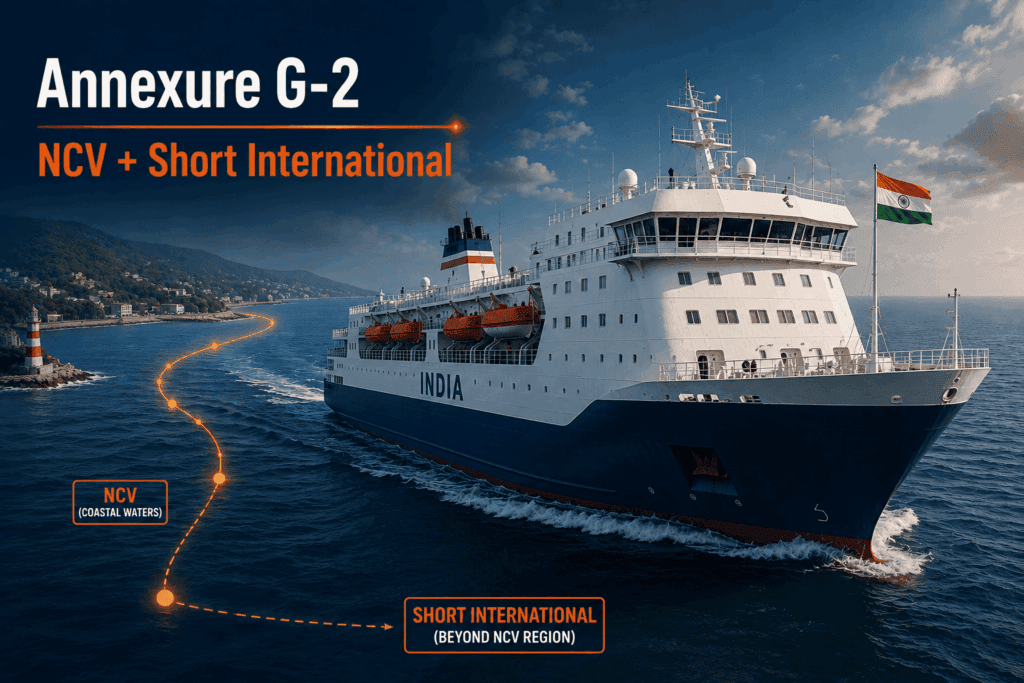
What Makes Annexure G-2 Different From Annexure G-1?
Both annexures cover the same vessel types: passenger ships, Ro-Ro and Ro-Pax vessels, and special trade passenger vessels, and both apply to voyages that leave Indian waters. The difference is not what kind of ship is covered. It is which certificate the vessel’s officers are allowed to hold.
Why Does One Annexure Cover Both NCV and Short International Voyages?
Annexure G-2’s own title bundles these two voyage types together for a practical reason: they share an identical crew table. A passenger vessel trading within the NCV region crews with NCV certificates. The same vessel, making an occasional short international voyage that steps outside that region, needs the same headcount but with FG certificates in place of the NCV ones. Rather than publish two separate tables that would be identical except for one column, the circular handles both cases inside a single annexure, with the certificate substitution spelt out in a footnote rather than a separate row.
What Is the “NCV Region” That Note 2 Refers To?
The circular does not spell out the exact geographic boundary of the NCV region inside Annexure G-2 itself. It is the same near coastal zone referenced by the NCV certificate system elsewhere in the circular, the boundary within which a Near Coastal Voyage certificate remains valid. What matters for Annexure G-2 in practice is simpler than pinning down a precise coordinate: the moment a voyage plan takes a G-2 vessel outside that zone, note 2 applies, regardless of how far outside it the vessel actually travels.
Confirming whether a specific route falls inside or outside the NCV region is a question for the vessel’s approved voyage plan and the concerned Mercantile Marine Department, not something this annexure answers with a fixed nautical-mile figure.
What Is the Complete Annexure G-2 Minimum safe manning for passenger ships on NCV and short international voyages?
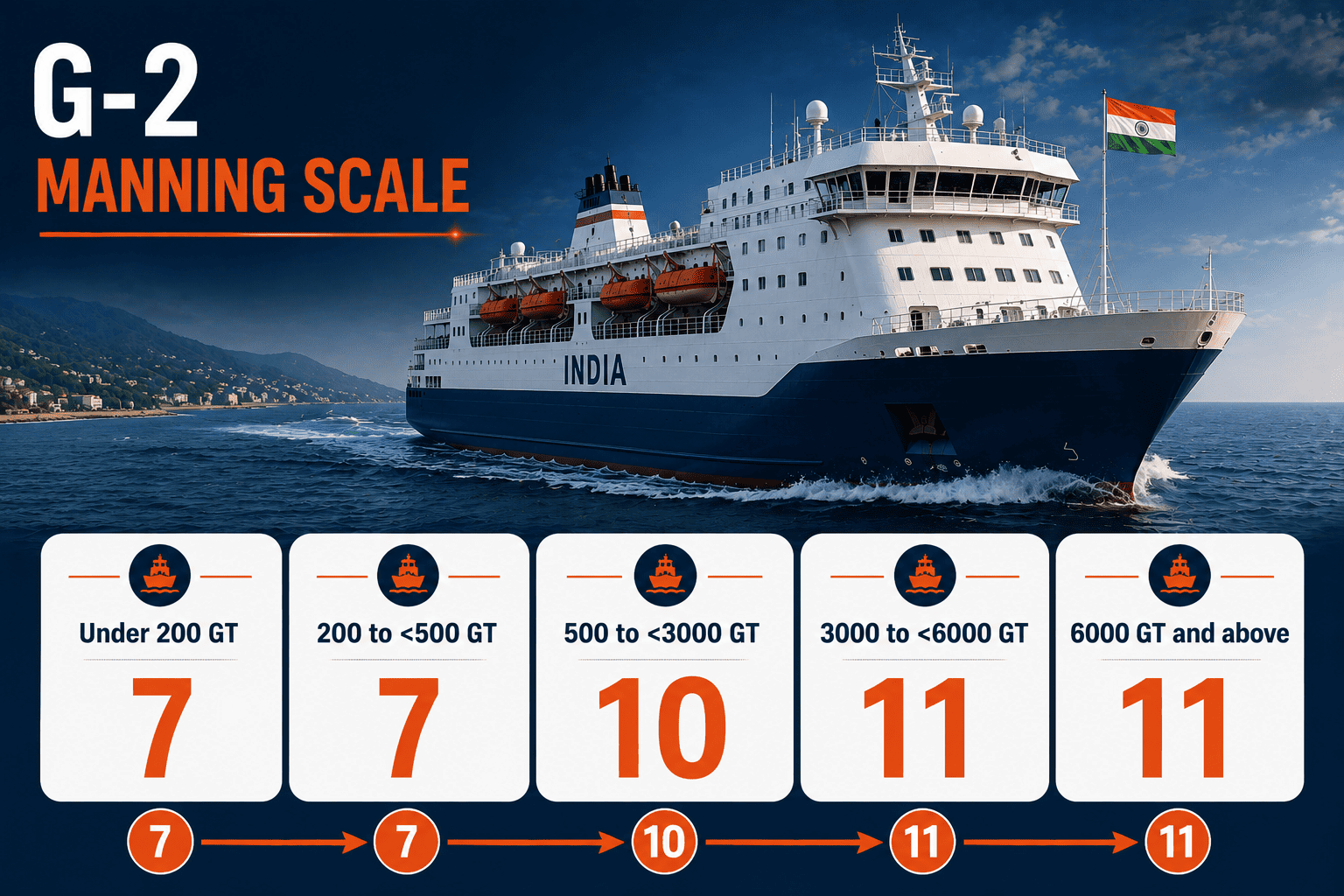
Annexure G-2 runs across five Gross Tonnage bands, from under 200 GT up to 6000 GT and above, one more band than Annexure G-1 carries. The table below sets out the nautical, meaning deck department, scale only. Engine room manning for passenger vessels is prescribed separately.
| Reference Code | GT of Vessel | Master | No. | Chief Officer | No. | OINW | No. | AB | No. | OS | No. | Cook | No. |
| G2-a | Under 200 | Master NCV (500 GT) or Mate NCV with 6 months experience | 1 | NWKO NCV | 1 | Not required | – | Able Seafarer Deck (II/5) or rating forming part of a navigational watch (II/4) | 2 | Rating with Basic STCW safety training | 2 | Basic STCW safety training and CoC as Cook, as applicable | 1 |
| G2-b | 200 to under 500 | Master NCV (500 GT) or Mate NCV with 6 months experience | 1 | Mate NCV | 1 | Not required | – | (as above) | 2 | (as above) | 2 | (as above) | 1 |
| G2-c | 500 to under 3000 | Master NCV | 1 | Mate NCV | 1 | NWKO NCV | 1 | (as above) | 3 | (as above) | 3 | (as above) | 1 |
| G2-d | 3000 to under 6000 | Master NCV | 1 | Mate NCV | 1 | NWKO NCV | 2 | (as above) | 3 | (as above) | 3 | (as above) | 1 |
| G2-e | 6000 and above | Master (FG) | 1 | Mate (FG) | 1 | NWKO NCV | 2 | (as above) | 3 | (as above) | 3 | (as above) | 1 |
Add up each row, and the total nautical crew runs 7, 7, 10, 11, and 11 across Codes G2-a to G2-e. One certificate rule applies to the whole table without exception: either one dedicated radio officer holding a valid Indian GMDSS certificate of competency or two deck officers who each hold one must be aboard regardless of tonnage.
How Does Crew Size Change Across the G-2 Gross Tonnage Bands?
What Applies Below 500 GT (Codes G2-a and G2-b)?
Both Code G2-a and Code G2-b need 7 nautical crew: a master, a chief officer, 2 AB ratings, 2 OS ratings, and a cook. No numbered OINW position appears at either tier. The only change between the two codes sits at the chief officer position, stepping from an NWKO NCV holder at G2-a to a full mate NCV at G2-b.
What Changes at 500 to Under 6000 GT (Codes G2-c and G2-d)?
The crew jumps to 10 at Code G2-c, a 3-person increase, and this is the first tier where a numbered OINW position, filled by an NWKO NCV holder, appears. The crew rises again to 11 at Code G2-d, purely because the OINW requirement doubles from 1 to 2. Master, Chief Officer, AB, OS, and Cook numbers hold steady across both codes.
What Applies at 6000 GT and Above (Code G2-e)?
Code G2-e holds the same crew total as Code G2-d, 11, with every rank and number identical. What changes is certification alone. The Master and Chief Officer step up from NCV to Foreign-Going at this tier, while the OINW position stays on an NCV certificate even at the top of the scale. This is the tonnage-based FG trigger built into the table itself, separate from the voyage-based FG trigger that note 2 adds on top of it.
When Does Note 2 Force an NCV Vessel to Crew With FG Certificates Instead?
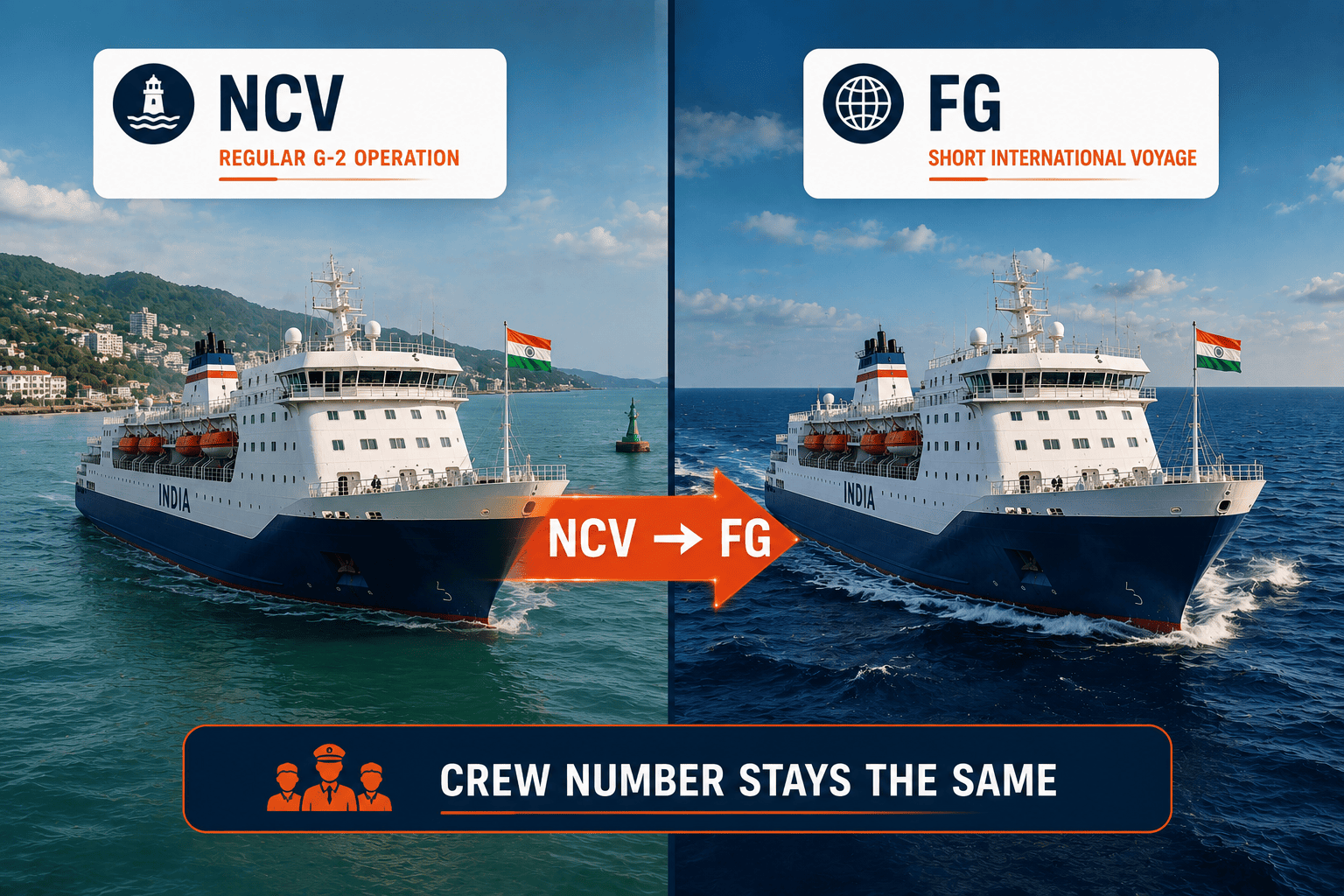
This is the detail that gives Annexure G-2 its name, and it applies independently of the gross tonnage step described above.
What Happens to the Crew Number When do certificates switch to FG?
Nothing. A Code G2-a vessel making a genuine short international voyage that takes it outside the NCV region still needs 7 nautical crew, the identical headcount it needs for ordinary NCV trade inside the region. What note 2 requires is that every NCV Certificate of Competency holder on that voyage be substituted with an officer holding the appropriate Foreign-Going certificate for the equivalent rank. A vessel does not add or remove crew members to comply with note 2. It swaps out certificates, rank for rank, for the duration of that voyage.
How Is This Different From the Tonnage-Based FG Step at Code G2-e?
Code G2-e’s FG requirement is permanent and tied to the vessel’s size. Once a passenger vessel reaches 6000 GT, its master and chief officer need FG certificates on every voyage, inside the NCV region or outside it, because the table itself fixes that certificate at that tonnage. Note 2’s FG requirement is temporary and tied to the voyage.
A Code G2-a vessel under 200 GT does not need FG-certificated officers for its regular NCV trade, only for the specific voyage that steps outside the NCV region, and it can revert to NCV-certificated crew once it returns to NCV trading. A shipping company running a small passenger vessel that occasionally makes a short international hop needs to plan for both realities: the standard NCV crew list for most of the year and an FG-certificated bench of officers ready to cover the occasional voyage that falls under note 2.
How Does Annexure G-2 Compare With Annexure G-1 for Passenger Ships?
Since both annexures cover the same vessel types, the comparison below lines up every Gross Tonnage band the two scales share.
| GT Band | Annexure G-1 Total Crew | Annexure G-2 Total Crew | G-1 Certificate | G-2 Certificate |
| Under 200 | 7 | 7 | FG at every rank | NCV, or FG under note 2 |
| 200 to under 500 | 7 | 7 | FG at every rank | NCV, or FG under note 2 |
| 500 to under 3000 | 10 | 10 | FG at every rank | NCV, or FG under note 2 |
| 3000 and above | 11 | 11 (splits into 3000 to under 6000 and 6000 and above on G-2) | FG at every rank | NCV below 6000 GT, FG from 6000 GT, or FG under note 2 |
The headline finding here is that crew numbers are identical between the two annexures at every comparable tonnage. Annexure G-1 and Annexure G-2 do not disagree on how many people a passenger vessel needs. They disagree only on which certificate those people are allowed to hold, and that disagreement is driven entirely by where the vessel is actually sailing, not by anything about the ship itself. A shipowner who already has an approved Annexure G-1 crew list, in terms of headcount, has effectively already confirmed the Annexure G-2 headcount too. The only remaining question is certification.
How Does Annexure G-2 Compare With Annexure B for Near Coastal Voyages?
Annexure B sets the equivalent NCV-based scale for cargo and non-passenger vessels, and it shares the exact same five Gross Tonnage bands as Annexure G-2, which makes the comparison unusually direct.
| GT Band | Annexure B Total Crew (Cargo) | Annexure G-2 Total Crew (Passenger) | Difference |
| Under 200 | 5 | 7 | +2 |
| 200 to under 500 | 6 | 7 | +1 |
| 500 to under 3000 | 7 | 10 | +3 |
| 3000 to under 6000 | 7 | 11 | +4 |
| 6000 and above | 9 | 11 | +2 |
Why Do Both Scales Step Up to FG Only at 6000 GT?
This is a genuine point of alignment worth noting. Annexure B steps its master and mate from NCV to FG only at Code B-5, 6000 GT and above. Annexure G-2 does exactly the same at Code G2-e, also 6000 GT and above. Both scales treat 6000 GT as the point where a vessel’s size alone justifies FG certification regardless of trading pattern.
What Annexure B does not carry is anything resembling a note. 2. A cargo vessel under Annexure B making an occasional voyage outside the NCV region has no equivalent footnote requiring a wholesale certificate swap for that one voyage. That obligation is specific to Annexure G-2, and it reflects the same passenger-safety logic seen across this entire G-series: a passenger vessel’s certification, not just its headcount, has to track the actual risk profile of a specific voyage more tightly than a cargo vessel’s does.
What GMDSS and Fair-Weather Rules Apply Under Annexure G-2?
Every code on Annexure G-2 carries the same GMDSS requirement found on Annexure G-1: either one dedicated Radio Officer holding a valid Indian GMDSS Certificate of Competency, or two deck officers who each hold one. There is no lighter Restricted Operator alternative anywhere on this scale, at any tonnage.
Vessels under 200 GT, meaning Code G2-a, may operate only against fair-weather forecasts and conditions, unless DGMA specifically authorises otherwise. This is the same concession and the same limitation found at the smallest tonnage tier of nearly every annexure in the circular. A small passenger vessel crewed to Code G2-a’s minimum has less redundancy if weather turns, which is exactly why that allowance disappears once a vessel exceeds 200 GT.
Where Does Annexure G-2 Fit Within the Full Passenger Vessel Framework?
Annexure G-2 is the second of seven scales covering passenger ships, Ro-Ro and Ro-Pax vessels, and special trade passenger vessels. G-1 covers international voyages requiring FG certification outright. G-2, this guide, covers NCV trade and the short international voyages that occasionally step outside it. G-3 covers operations on the Indian coast within 20 nautical miles, a tighter operating envelope than G-2’s near-coastal scope, and G-4 covers operations between two Indian ports in fair weather, within 5 nautical miles of the coast, tighter still.
Two further annexures apply specifically to River-Sea passenger vessels: G-5 for Type 3 River-Sea passenger vessels, including Ro-Ro and Ro-Pax configurations, and G-6 for the equivalent Type 4 vessels, capped at carrying between 12 and 400 passengers. The final annexure, G-7, departs from gross tonnage banding entirely and sets one fixed crew for Category A high-speed craft operating out of Port Blair and the Indian offshore region, restricted to daylight hours.
Reading G-1 and G-2 together gives a fairly complete picture of how DGMA handles the international end of passenger vessel trading: one annexure for vessels that never touch NCV waters and one for vessels that mostly do but occasionally step outside them.
How Do Shipowners Get an Annexure G-2 Manning Scale Approved?
The approval process runs through the same steps used across every annexure in the circular, with one extra confirmation specific to G-2’s dual certificate structure.
- Confirm the vessel’s gross tonnage and the correct code, G2-a through G2-e.
- Confirm whether the vessel’s trading pattern stays inside the NCV region or includes short international voyages that step outside it.
- Where note 2 applies, confirm that FG-certificated officers are available to crew the specific voyage in question, in place of the vessel’s usual NCV-certificated complement.
- Submit the safe manning proposal, together with the prescribed self-assessment checklist, to the concerned Mercantile Marine Department.
The MMD checks the proposal against the Annexure G-2 minimum for the vessel’s confirmed tonnage, and against any additional crew the company proposes for trading needs or rest-hour compliance, before issuing the approved MSMD. Our pillar guide’s approval and dispensation section covers that process in full, including how a temporary dispensation is handled if a crew member falls sick or becomes unavailable close to sailing.
Once approved, the vessel must sail strictly to the crew numbers on that MSMD, and companies handling crew placement need current Recruitment and Placement Service Licence (RPSL) registration before they can place officers or ratings against it. A step-by-step overview of that RPSL registration process is worth reviewing before a company takes on its first G-2 vessel, particularly one that will need both NCV and FG-certificated officers on its books.
Ratings working toward AB and OS positions typically start with a GP Rating course, while officers who need to hold FG certification ready for note 2 voyages, on top of their usual NCV qualification, often build that step-up through a Second Mate FG course. Officers due for renewal on either track can check the process in our CoC revalidation guide, and the broader training landscape behind these certificates sits in our directory of DGMA-approved maritime training institutes.
Crew joining a G-2 vessel should also confirm current fitness through a DGMA approved doctor, a step covered in our guide to mandatory medical tests for seafarers, and hold a valid BSID card for the port movement that joining and sign-off involve. Given how often Codes G2-a and G2-b run close to their 7-crew minimum, losing a crew member unexpectedly, particularly one holding the FG qualification needed for a scheduled short international leg, is worth planning around early, and checking eligibility for one of the SWFS welfare schemes is worth doing at the same time rather than after the fact.
What Happens If a Passenger Ship Sails Below Its Approved G-2 Manning Scale or Crosses Outside the NCV Region Uncertified?
The baseline compliance rule is unchanged from every other annexure: a vessel must be crewed strictly to the numbers on its approved MSMD, and sailing short is a compliance failure, not a matter of owner discretion.
Annexure G-2 adds a second failure mode that does not exist on most other scales in this circular. A vessel can be correctly crewed by headcount and still be non-compliant if it makes a short international voyage outside the NCV region while its officers still hold only NCV certificates, since note 2 requires the FG substitution for that specific voyage regardless of how many people are on board. Both failure modes get checked during flag state and port state inspections, and a company that tracks only crew number, without also tracking which specific voyages trigger note 2, risks a compliant-looking crew list that is still out of step with the certificate the voyage actually requires.
FAQs
What is Annexure G-2 of DGMA Circular No. 54 of 2025?
Annexure G-2 sets the minimum safe manning scale for passenger ships, Ro-Ro and Ro-Pax vessels, and special trade passenger vessels on NCV and short international voyages across five Gross Tonnage codes, G2-a through G2-e.
Which vessels does Annexure G-2 apply to?
Annexure G-2 applies to passenger ships, Ro-Ro vessels, Ro-Pax vessels, and special trade passenger vessels trading within the NCV region, including those that occasionally make a short international voyage outside it.
What is the difference between Annexure G-1 and Annexure G-2?
Both cover the same crew numbers at comparable gross tonnage bands. Annexure G-1 requires foreign-going certification at every tier for genuine international voyages. Annexure G-2 allows NCV certification within the NCV region, stepping up to FG certification only at 6000 GT and above or temporarily for any specific voyage that steps outside the NCV region under note 2.
How many crew does a vessel need under Code G2-a?
Code G2-a, for vessels under 200 GT, needs 7 nautical crew: 1 master NCV or equivalent, 1 NWKO NCV, 2 AB ratings, 2 OS ratings, and 1 cook.
What does note 2 of Annexure G-2 actually require?
For a short international voyage outside the NCV region, note 2 requires every NCV Certificate of Competency holder on board to be substituted with an officer holding the equivalent Foreign-Going certificate for that same rank for that voyage. The crew number does not change.
Does Annexure G-2 ever require FG certification permanently, not just for a single voyage?
Yes. Code G2-e, for vessels of 6000 GT and above, requires Master (FG) and Mate (FG) certification permanently, regardless of whether the vessel is trading inside or outside the NCV region.
When does a G-2 vessel need a dedicated radio officer?
Annexure G-2 does not require a dedicated Radio Officer outright. The requirement is satisfied by either one dedicated radio officer holding a valid Indian GMDSS Certificate of Competency or two deck officers who each hold one.
Does Annexure G-2 define the exact boundary of the NCV region?
No. The circular does not set a fixed nautical-mile boundary for the NCV region inside Annexure G-2 itself. It is the same near-coastal zone referenced by the NCV certificate system elsewhere in the circular, and confirming whether a specific route falls inside or outside it is a matter for the vessel’s approved voyage plan.
What fair-weather restriction applies under Annexure G-2?
Vessels under 200 GT, Code G2-a, may operate only against fair-weather forecasts and conditions, unless DGMA specifically authorises otherwise.
Who approves the MSMD for a passenger ship under Annexure G-2?
The concerned Mercantile Marine Department reviews the shipowner’s manning proposal against the Annexure G-2 minimum for the vessel’s confirmed gross tonnage and against whether any planned voyages trigger the note 2 certificate substitution, then issues the MSMD once satisfied.