
Safe manning for river-sea vessels on daylight voyages comes from Annexure F-5 of DGMA Circular No. 54 of 2025, and it applies the moment an RSV Type 2, 3, or 4 leaves harbour limits for a genuine daylight run between two nearby ports. A vessel under 200 GT needs 4 nautical crew. A vessel from 3000 GT to under 6000 GT needs 8, with a dedicated watchkeeping officer added to the bridge team.
If you manage an RSV that regularly hops between two ports in a single day, or you handle its Minimum Safe Manning Document (MSMD) approval, Annexure F-5 is the table that applies, not Annexure F-4’s harbour scale and not the longer coastal scale under Annexure F-6. Gross tonnage decides the code inside F-5. The voyage itself, a daylight passage between nearby ports, decides whether F-5 applies at all.
This guide continues our series on minimum safe manning requirements for Indian flag vessels, which maps every annexure in DGMA Circular No. 54 of 2025. It builds directly on Annexure F-3 for Type 1 RSVs and Annexure F-4 for Types 2 to 4 in harbour, the two guides immediately before this one in the RSV sub-cluster, and it pairs with the pillar guide’s River-Sea Vessels section for the full five-annexure picture.
What Is a Daylight Voyage Between Nearby Ports Under Annexure F-5?
Annexure F-5 sits between two other RSV scales, and the easiest way to place it is by asking what the vessel is actually doing right now, not how big it is.
A River-Sea Vessel confined to port limits, or making an occasional trip up to six nautical miles beyond port jurisdiction, sails under Annexure F-4. The moment that same vessel makes a genuine passage from one port to a nearby port, in daylight hours, it steps up to Annexure F-5. If the voyage stretches past daylight into a longer coastal passage of up to 48 hours, the vessel needs Annexure F-6 instead, which this series will cover next.
Which RSV Types Does Annexure F-5 Cover?
Annexure F-5’s own title spells this out precisely: RSV Types 2, 3, and 4. Type 1 RSVs never reach F-5. They already have a single scale of their own under Annexure F-3 that covers essentially all of their permitted operation, including harbour work, since a Type 1 vessel’s operating envelope stays close to shore by classification.
For the full breakdown of how Types 1 through 4 are classified, including construction and freeboard standards, our Annexure F-3 guide walks through that in detail. That classification itself sits outside DGMA Circular No. 54 of 2025. It comes from a separate RSV notification, and the safe manning circular simply attaches a crew scale to whichever type a vessel already carries on its own certificate.
How Is Annexure F-5 Different From Annexure F-4 and Annexure F-6?
All three annexures, F-4, F-5, and F-6, cover the same RSV Types, 2 through 4. What changes between them is the nature of the voyage, not the vessel.
Annexure F-4 covers harbour work and short extensions of it. Annexure F-5 covers a genuine port-to-port hop that stays inside daylight hours. Annexure F-6 covers a longer coastal voyage, still restricted to Types 3 and 4, running up to 48 hours. Type 2 RSVs stop at F-5. They never appear in F-6 or in Annexure F-7’s unrestricted scale, which is reserved for Type 4 alone.
Getting the annexure wrong is not a minor paperwork slip. A Type 3 RSV crewed to Annexure F-4’s harbour minimum and then sent on a daylight run between ports would be short of crew and short on GMDSS certification at several Gross Tonnage bands, exactly the gap a flag state or port state inspector checks the MSMD against.
What is the Complete Annexure F-5 for safe manning for river-sea vessels on daylight voyages?
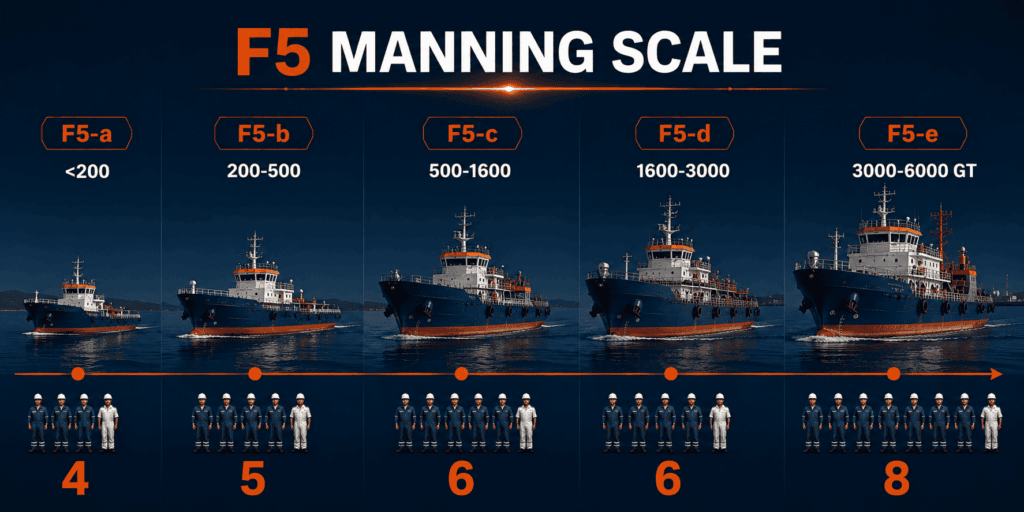
Annexure F-5 runs across five codes, F5-a through F5-e, spanning under 200 GT up to 6000 GT. The table below is the nautical, meaning deck department, scale only. Engine room manning for RSVs is prescribed separately.
| Code | GT of Vessel | Master | No. | Chief Officer | No. | OINW | No. | AB | No. | OS | No. | Cook | No. |
| F5-a | Under 200 | NWKO (NCV) or 1st Class IV Master with 1 year experience | 1 | 2nd Class IV Master | 1 | Not required | – | Able Seafarer Deck (II/5) or rating forming part of a navigational watch (II/4) | 1 | Rating with Basic STCW safety training | 1 | Not required | – |
| F5-b | 200 to under 500 | Master (NCV) or NWKO (NCV) with 1 year experience | 1 | 2nd Class IV Master | 1 | Not required | – | (as above) | 1 | (as above) | 1 | Basic STCW safety training and CoC as Cook, as applicable | 1 |
| F5-c | 500 to under 1600 | Master NCV or NWKO (NCV) with 1 year experience | 1 | NWKO-NCV, 1st Class IV Master, or 2nd Class IV Master with 1 year experience | 1 | Not required | – | (as above) | 1 | (as above) | 2 | (as above) | 1 |
| F5-d | 1600 to under 3000 | Master NCV or Mate NCV with 1 year experience | 1 | NWKO-NCV or 1st Class IV Master | 1 | Not required | – | (as above) | 1 | (as above) | 2 | (as above) | 1 |
| F5-e | 3000 to under 6000 (see GT ceiling note below) | Master NCV | 1 | Mate (NCV) or NWKO (NCV) with 1 year experience | 1 | NWKO (NCV), general note 5 applies | 1 | (as above) | 2 | (as above) | 2 | (as above) | 1 |
Add up each row and total nautical crew runs 4, 5, 6, 6, and 8 across Codes F5-a to F5-e. Two rules apply across the whole table regardless of code. Tankers need a valid Certificate of Proficiency in Tanker Operation on top of the base crew shown here, and every code carries its own radio qualification requirement, covered in the certificate section below.
How Does Crew Size Change Across the F-5 Gross Tonnage Bands?
The scale does not rise in equal steps. It climbs by one at the smallest tiers, holds flat through the middle, then jumps at the top.
What Applies Below 500 GT (Codes F5-a and F5-b)?
Code F5-a needs 4 nautical crew: a master, a chief officer, one AB, and one OS. Code F5-b adds a cook, bringing the total to 5, while the master, chief officer, AB, and OS positions stay at one each. Neither code carries a numbered OINW position. This is already a heavier crew than the equivalent harbour codes under Annexure F-4, which need only 3 crew at the same tonnage, since F5-a adds a numbered AB that F4-a does not require at all.
What Changes Between 500 GT and 3000 GT (Codes F5-c and F5-d)?
Crew size steps up to 6 at Code F5-c and holds there through Code F5-d. What actually changes is the OS count, which rises from one to two, while master, chief officer, AB, and cook stay flat at one each across both codes. Certificate seniority moves up between the two codes as well. F5-d’s chief officer needs NWKO-NCV or a full 1st Class IV Master, dropping the shorter-experience Mate-level options that F5-c still allows.
What Applies From 3000 GT to 6000 GT (Code F5-e)?
Code F5-e adds 2 more crew, taking the total to 8, and this is the first tier on the F-5 scale where an OINW position appears as a numbered requirement. An NWKO (NCV) officer joins specifically to cover navigational watchkeeping duty that the smaller F-5 codes handle without a dedicated officer, and the AB count also rises from one to two at this tier.
How Does General Note 5 Affect Code F5-e?
DGMA’s general notes for River-Sea Vessels add one further condition here. For an RSV of 3000 GT and above, one additional 1st Class I/V Master is required whenever a voyage, or a dredging operation carried out in port, runs beyond 72 hours. A Code F5-e vessel that normally sails with its base crew of 8 needs to plan for that extra officer the moment a job is scheduled to run past three days.
What Certificate and GMDSS Rules Apply Under Annexure F-5?
Annexure F-5 carries its own radio qualification notes, and they sit at a noticeably lower Gross Tonnage than the equivalent thresholds on Annexure F-3 or Annexure F-4. This is one detail worth checking carefully if your fleet runs RSVs across more than one operation type, since it is easy to assume the ROC and GMDSS thresholds line up the same way on every F-series annexure. They do not.
When Does a Radio Operator Certificate Meet the Requirement?
For vessels below 200 GT, meaning Code F5-a only, at least one officer on board must hold a valid Radio Operator Certificate. This is worth naming precisely, since it is a distinct qualification from the Restricted Operator Certificate that Annexure F-3 and Annexure F-4 accept at their own smallest tiers.
When Does the Vessel Need a Full Indian GMDSS CoC?
From 200 GT upward, meaning Codes F5-b through F5-e, at least one officer must hold a valid Indian GMDSS Certificate of Competency. That 200 GT threshold is considerably stricter than Annexure F-4’s 500 GT cutoff for the same requirement, and stricter again than Annexure F-3’s 1600 GT cutoff for Type 1 RSVs. A vessel that satisfies its radio requirement comfortably in harbour under F-4 may need to upgrade before it can lawfully make the same daylight hop under F-5.
How Does Annexure F-5 Compare With Annexure F-4 for the Same RSV Types?
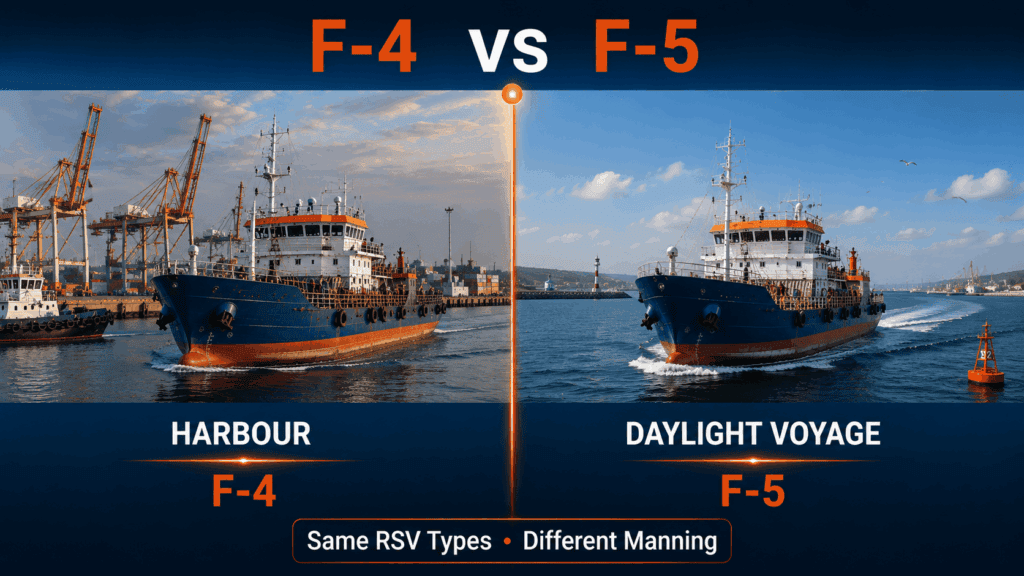
Since both annexures cover the identical RSV Types, 2 through 4, and share the same five Gross Tonnage bands, comparing them side by side shows exactly what changes once a vessel leaves the harbour for a daylight passage.
| GT Band | F-4 Total Crew (Harbour) | F-5 Total Crew (Daylight Voyage) | F-4 Certificate Threshold | F-5 Certificate Threshold |
| Under 200 | 3 | 4 | Restricted Operator below 500 GT | Radio Operator below 200 GT |
| 200 to under 500 | 3 | 5 | Restricted Operator below 500 GT | Indian GMDSS CoC from 200 GT |
| 500 to under 1600 | 6 | 6 | Indian GMDSS CoC from 500 GT | Indian GMDSS CoC from 200 GT |
| 1600 to under 3000 | 6 | 6 | Indian GMDSS CoC from 500 GT | Indian GMDSS CoC from 200 GT |
| 3000 to under 6000 | 8 | 8 | Indian GMDSS CoC from 500 GT | Indian GMDSS CoC from 200 GT |
Two things stand out here. Below 500 GT, a daylight-voyage RSV under Annexure F-5 needs more crew and a stricter radio qualification than the identical vessel confined to harbour under Annexure F-4, even though both scales are covering vessels of the exact same size and type. Once a vessel reaches 500 GT, the two scales converge on the same crew total and the same GMDSS requirement, which suggests the extra manning burden of leaving harbour limits matters most at the smallest end of the fleet, where a harbour crew genuinely is not built for open-water passage work.
What GT Limits and Extra Manning Rules Apply to RSV Tankers, Cargo Vessels and Dredgers?
Annexure F-5 does not treat every RSV the same once cargo type enters the picture. The general notes shared across Annexures F-3 to F-7 carry the same conditions here that apply on every RSV harbour or voyage scale.
What Are the Gross Tonnage Ceilings for Each RSV Category?
The GT limit for an RSV tanker is 3000 MT. The GT limit for an RSV cargo vessel is 6000 MT, and for an RSV dredger it runs up to 10,000 MT. This is why Code F5-e stops at 6000 GT for most vessels, since that matches the ceiling for RSV cargo classification, while an RSV tanker never actually reaches F5-e at all, its own 3000 GT cap already sitting one tier lower on the table.
Can Dredge Grade Certificates Replace Standard RSV Certificates?
Yes. On dredgers, the Master, Mate, and NWKO-NCV certificates otherwise required across F5-a to F5-e may be substituted with Dredge Master Grade I, Dredge Master Grade II, and Dredge Mate Grade I, respectively. This lets a dredger operating on a daylight run between two nearby ports crew against certificates that actually match its dredging role.
Do Fair Weather and SPM Restrictions Apply Under Annexure F-5?
Two restrictions that recur across nearly every annexure in this circular also apply here. For vessels under 200 GT, meaning Code F5-a, the prescribed minimum manning applies only to operation against fair-weather forecast and conditions, unless DGMA specifically authorises otherwise. A small RSV crewed to F5-a’s bare minimum has less redundancy if weather turns mid-passage, which is exactly why that concession disappears once a vessel exceeds 200 GT.
Vessels under 500 GT engaged in continuous service at a Single Point Mooring (SPM) facility within notified port limits must also carry at least one officer holding a valid STCW certificate of competency, on top of whatever Code F5-a or F5-b already requires. This condition sits in the general notes rather than in the F-5 table itself, so it is easy to overlook if a vessel splits its time between SPM duty and genuine port-to-port runs.
Where Does Annexure F-5 Fit in the Full RSV Manning Framework?
DGMA Circular No. 54 of 2025 does not set a fixed nautical-mile definition for “nearby ports” inside Annexure F-5 itself. Unlike Annexure F-4’s harbour definition, which spells out a six nautical mile allowance beyond port jurisdiction, F-5’s own text leaves the practical boundary between a daylight port-to-port hop and a longer coastal passage to the vessel’s approved voyage plan and Type classification. That is worth flagging honestly rather than guessing at a figure the circular does not state.
What the framework does make clear is the progression. Annexure F-3 covers Type 1 RSVs across essentially every situation. Annexure F-4 covers Types 2 to 4 confined to harbour. Annexure F-5, this guide, covers the same Types 2 to 4 once they make a genuine daylight run between nearby ports. Type 3 and Type 4 RSVs step up again to Annexure F-6 for coastal voyages of up to 48 hours, and Type 4 alone continues to Annexure F-7 for unrestricted operation. Each step up the chain widens both the operating envelope and, as the comparison table above shows, the crew and certificate requirements that come with it.
How Do Shipowners Get an Annexure F-5 Manning Scale Approved?
The process runs the same way it does for every other annexure in the circular. Before applying, it helps to confirm three things:
- The vessel’s confirmed RSV Type, since Annexure F-5 excludes Type 1 entirely.
- The correct Gross Tonnage code, F5-a through F5-e, for that vessel.
- Whether the intended voyage genuinely stays within daylight hours between nearby ports, or whether it actually needs Annexure F-6 instead.
The shipowner or manager then submits a safe manning proposal, with the prescribed self-assessment checklist, online to the concerned Mercantile Marine Department. The MMD checks that proposal against the Annexure F-5 minimum for the vessel’s confirmed type and tonnage, and against any additional manning the company proposes for trading needs or rest-hour compliance. Our pillar guide’s approval and dispensation section covers that full process, including how a temporary dispensation is handled if a crew member falls sick or becomes unavailable at short notice.
Once approved, the vessel must sail strictly to the crew numbers on that MSMD, and registered RPSL manning agencies build their placement and joining plans directly around them. A company that does not yet hold Recruitment and Placement Service Licence (RPSL) status needs that licence before it can place crew against an approved MSMD at all, and PSL licence service walks through that registration process for companies setting up or renewing one.
Crew joining an F-5 vessel should also hold current medical clearance from a DGMA approved doctor, per our guide to mandatory medical tests for seafarers, and a current BSID card for the port-side movement that a daylight port-to-port hop naturally involves. Given how tight Codes F5-a and F5-b already run, with just 4 and 5 crew respectively, losing even one crew member mid-rotation is worth planning around early, and it is also worth checking whether the underlying issue qualifies the seafarer for support under one of the SWFS welfare schemes at the same time.
Officers building toward the certificates this table requires can find course listings in our directory of DGMA-approved maritime training institutes, ratings build their base qualification through a GP Rating course, and the STCW standards behind these certificate tracks are covered in our guide to maritime conventions for Indian seafarers. Officers due for renewal can check the process in our CoC revalidation guide.
What Happens If a Daylight-Voyage RSV Sails Below Its Approved F-5 Manning Scale?
The baseline rule is unchanged from every other annexure in this circular: a vessel must be crewed strictly to the numbers on its approved MSMD, and sailing short is a compliance failure, not a matter of owner discretion.
Two points matter specifically for Annexure F-5. First, since the smaller F-5 codes already run tighter than their F-4 harbour equivalents, a single missing officer removes proportionally more of the required bridge team than the same absence would on a harbour-confined sister vessel. Second, a Type 2 RSV that starts running voyages longer than a daylight hop, or a Type 3 or 4 RSV that starts running voyages beyond 48 hours, has moved outside the operation Annexure F-5 was approved for and needs to be reassessed against Annexure F-6 or F-7 rather than simply continuing to sail under its existing F-5 MSMD.
FAQs
What is Annexure F-5 of DGMA Circular No. 54 of 2025?
Annexure F-5 sets the minimum safe manning scale for River-Sea Vessel Types 2, 3, and 4 engaged in daylight voyages between nearby ports, across Codes F5-a to F5-e.
Which RSV types does Annexure F-5 apply to?
Annexure F-5 applies to RSV Types 2, 3, and 4. Type 1 RSVs are covered separately under Annexure F-3, which spans essentially all of their permitted operations.
What is the difference between Annexure F-4 and Annexure F-5?
Both cover RSV Types 2 to 4, but Annexure F-4 applies while the vessel is confined to harbour operation, while Annexure F-5 applies once the vessel makes a genuine daylight voyage between nearby ports. Below 500 GT, Annexure F-5 requires more crew and a stricter radio certificate than Annexure F-4 for the identical vessel.
How many crew does a vessel need under Code F5-a?
Code F5-a, for RSVs under 200 GT, needs 4 nautical crew: 1 Master, 1 Chief Officer, 1 AB, and 1 rating covering the OS position with Basic STCW safety training.
When does an RSV under Annexure F-5 need an Indian GMDSS CoC?
From 200 GT upward, meaning Codes F5-b through F5-e, at least one officer on board must hold a valid Indian GMDSS Certificate of Competency. Below 200 GT, a Radio Operator Certificate satisfies the requirement instead.
Does Annexure F-5 ever require a Foreign-Going certificate?
No. The scale runs entirely on NCV and Class IV certificates across all five codes, and never rises to a Foreign-Going requirement at any Gross Tonnage tier.
What extra crew is required for RSVs over 3000 GT on long voyages?
For an RSV of 3000 GT and above under Code F5-e, one additional 1st Class I/V Master is required whenever the voyage, or a dredging operation carried out in port, runs beyond 72 hours.
What are the GT limits for River-Sea Vessels under Annexure F-5?
The general notes shared across Annexures F-3 to F-7 set the limit at 3000 GT for RSV tankers, 6000 GT for RSV cargo vessels, and 10,000 GT for RSV dredgers.
Does Annexure F-5 define how far apart “nearby ports” can be?
No. DGMA Circular No. 54 of 2025 does not give a fixed nautical-mile figure for “nearby ports” under Annexure F-5. The practical boundary sits with the vessel’s approved voyage plan and RSV Type classification.
Who approves the MSMD for an RSV under Annexure F-5?
The concerned Mercantile Marine Department reviews the shipowner’s manning proposal against the correct Annexure F-5 code for the vessel’s confirmed RSV Type and Gross Tonnage, then issues the MSMD once satisfied.