
The minimum safe manning scale for near coastal voyages sets the nautical crew every Indian ship must carry under DGMA Circular No. 54 of 2025, Annexure B. A vessel under 200 GT needs a Master NCV or Mate NCV, one NWKO, and a small ratings team. A ship at 6000 GT or above needs a full foreign-going bridge team instead of NCV officers.
Every Indian flag vessel trading within India’s near coastal zone needs a crew list that matches this exact scale before its Minimum Safe Manning Document is approved. This guide breaks down Annexure B rank by rank so ship managers, cadets on the NCV track, and crewing teams know precisely what a compliant near-coastal crew looks like. It builds on our complete guide to minimum safe manning requirements for Indian flag vessels, which covers every annexure in the circular. It also pairs with our breakdown of Annexure A for international voyages, the scale that applies once a near-coastal ship crosses into international trade.
Why Does DGMA Circular No. 54 of 2025 Matter for Near Coastal Voyages?
Near coastal trade used to sit across several older manning orders, each covering a slightly different tonnage band or vessel type. DGMA Circular No. 54 of 2025, issued on 8 December 2025 by the Directorate General of Shipping, folded all of that into one document. Our guide to the full circular covers how that consolidation happened across every annexure.
The legal basis stays the same as it does for every other scale in the circular. IMO Resolution A.1047(27), Principles of Minimum Safe Manning, sets the global framework. SOLAS Chapter V, Regulation 14, makes safe manning mandatory for every flag administration. What makes near coastal voyages distinct is the certification track. Annexure B is built around NCV, or Near Coastal Voyage, certificates. These cost less and train faster than Foreign-Going (FG) certificates, right up until a ship’s tonnage forces a step up.
What Is the Minimum Safe Manning Scale for Near Coastal Voyages? (Annexure B)
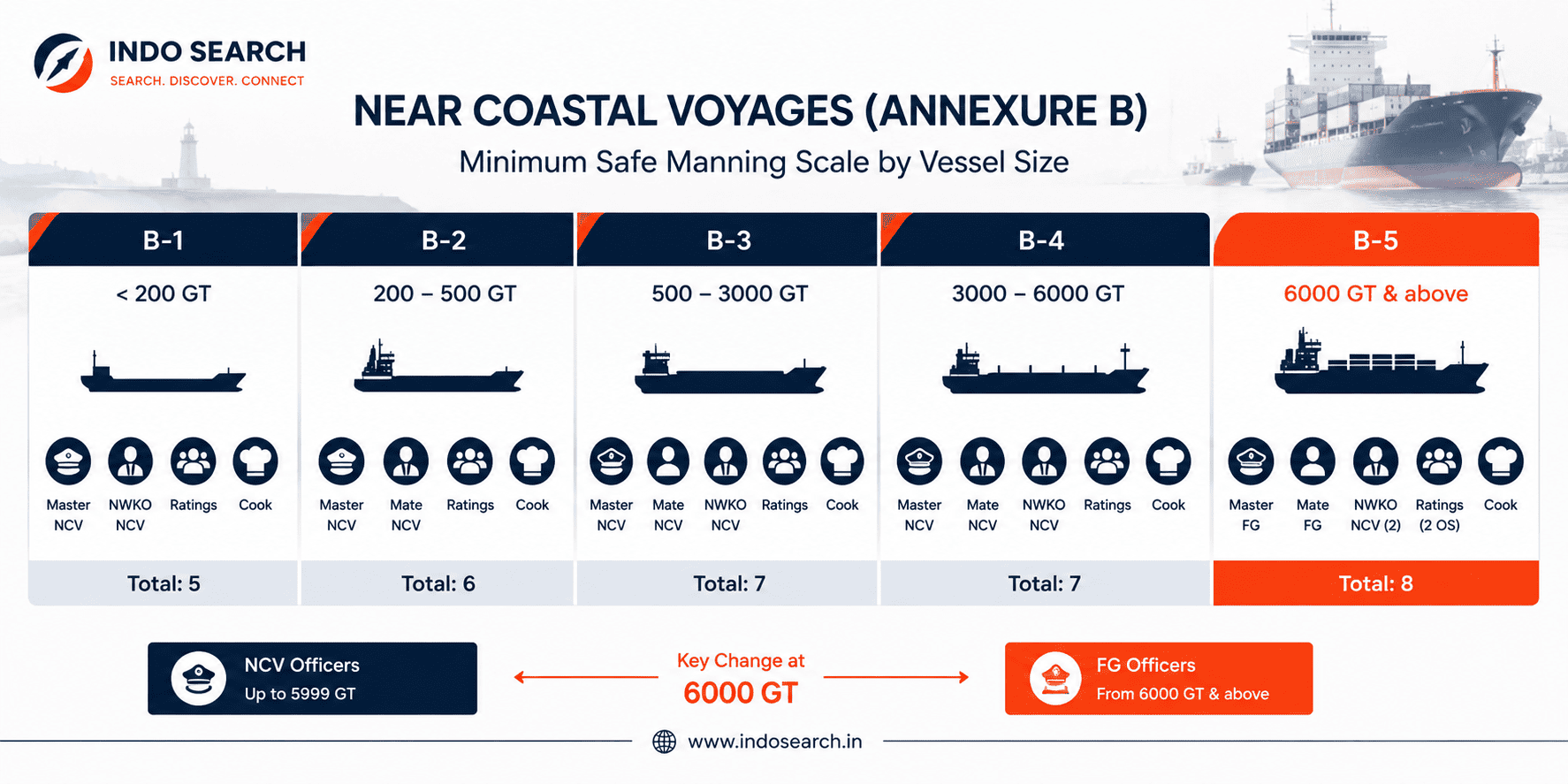
Annexure B covers self-propelled cargo and non-passenger vessels trading within India’s near coastal zone, with crew numbers scaling to gross tonnage (GT) across five codes, B-1 through B-5. The table below is the nautical, or deck, scale only. Engine room manning sits outside this circular.
| Code | GT of Vessel | Master | Chief Officer | OINW / NWKO | AB | OS | Cook |
| B-1 | Below 200 | Master NCV (500 GT) / Mate NCV: 1 | NWKO NCV: 1 | Not required | Able Seafarer Deck II/5: 2 | Not required | Basic STCW safety training + CoC as Cook: 1 |
| B-2 | 200 to below 500 | Master NCV (500 GT) / Mate NCV, 6 months’ experience: 1 | Mate NCV / NWKO NCV, 12 months’ experience: 1 | Not required | Able Seafarer Deck II/5: 2 | Rating, Basic STCW safety training: 1 | Basic STCW safety training + CoC as Cook: 1 |
| B-3 | 500 to below 3000 | Master NCV: 1 | Mate NCV: 1 | NWKO NCV: 1 | Able Seafarer Deck II/5: 2 | Rating, Basic STCW safety training: 1 | Basic STCW safety training + CoC as Cook: 1 |
| B-4 | 3000 to below 6000 | Master NCV: 1 | Mate NCV: 1 | NWKO NCV: 1 | Able Seafarer Deck II/5: 2 | Rating, Basic STCW safety training: 1 | Basic STCW safety training + CoC as Cook: 1 |
| B-5 | 6000 and above | Master FG: 1 | Mate FG: 1 | NWKO NCV: 2 | Able Seafarer Deck II/5: 2 | Rating, Basic STCW safety training: 2 | Basic STCW safety training + CoC as Cook: 1 |
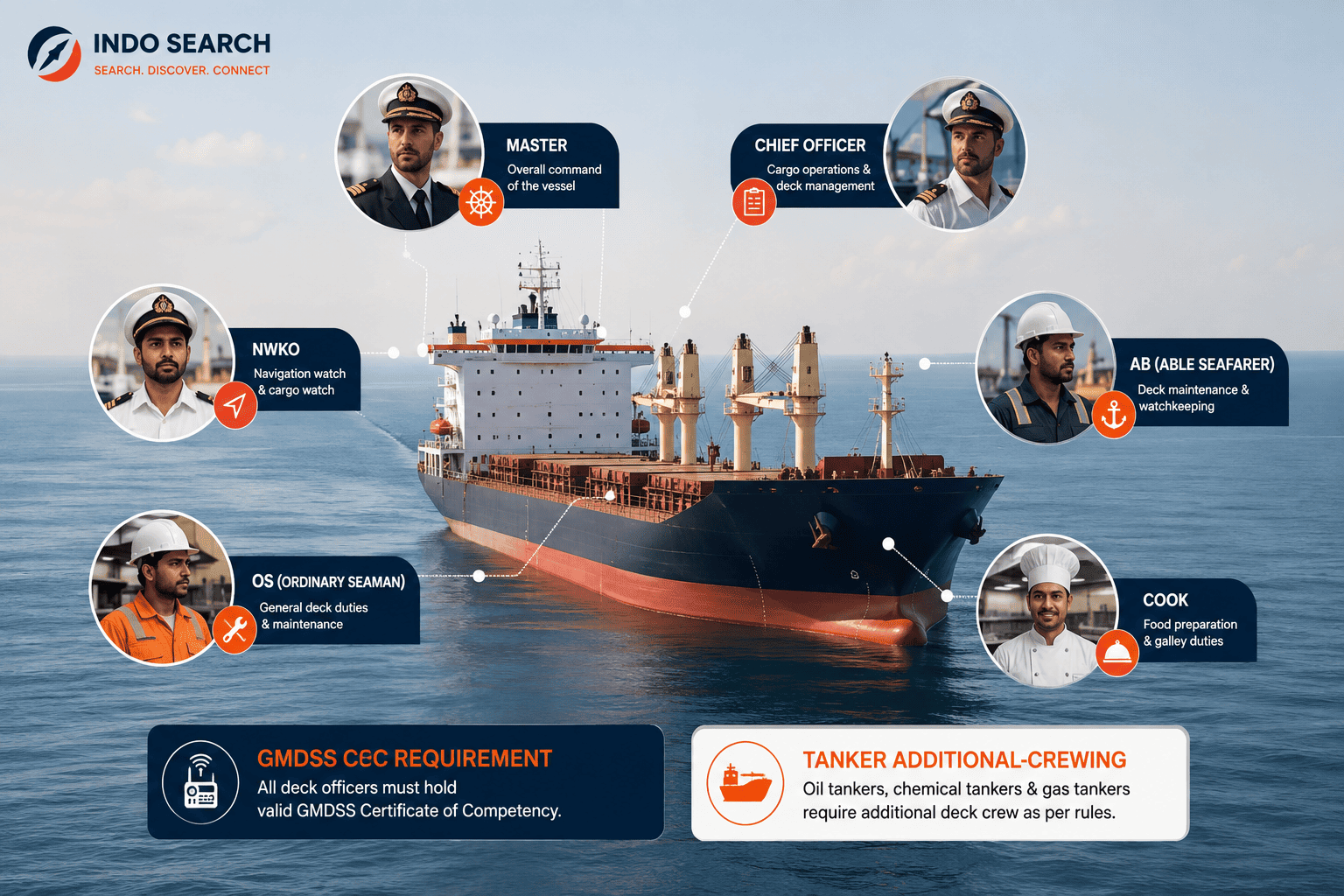
Four rules apply across the table. One dedicated Radio Officer with a valid GMDSS CoC, or two deck officers who each hold one, must be on board every vessel under this annexure. Oil, chemical, and gas tankers need one additional crew member in every rank marked with a hash symbol in the original circular, on top of a valid Certificate of Proficiency in Tanker Operation. Vessels under 500 GT running MSV, OSV, PSV, or SPS operations, along with tugs, only need one NWKO NCV at Code B-5 instead of two. Vessels under 200 GT can rely on this scale only for fair-weather operation, unless the Directorate specifically authorises otherwise, a rule the pillar guide explains in full.
What Changes in Crew Numbers Between Code B-1 and Code B-5?
The scale grows in two ways at once: more people, and higher certificates. Vessels under 500 GT, Codes B-1 and B-2, run with a Master NCV or Mate NCV and a single NWKO. Code B-2 goes one step further. It asks that officer to show real sea time, 6 months for the Master and 12 months for the Mate or NWKO, rather than a fresh certificate alone.
Once a vessel reaches 500 GT, an NWKO becomes a dedicated requirement rather than a shared role, and the crew holds steady in size through Codes B-3 and B-4. The real jump happens at Code B-5, 6000 GT and above, where the Master and Mate must both step up from NCV to FG certificates, and the NWKO and OS numbers double.
A 450 GT coastal general cargo ship, Code B-2, can trade under Annexure B with just 5 nautical crew: Master NCV, Mate/NWKO NCV, 2 AB, 1 OS, and 1 Cook. A bulk carrier at 6000 GT, Code B-5, needs 9, with FG certificates now required at master and mate levels, even though the vessel never leaves India’s near coastal zone.
What Extra Certificates Does the Near Coastal Crew Need?
Certification on Annexure B runs almost entirely on the NCV track. A Master NCV (500 GT) or Mate NCV can command a vessel up to 6000 GT, which keeps training costs and time down compared with the Foreign-Going route required under Annexure A for international voyages. Ratings still need basic STCW safety training, and the cook needs STCW safety training plus a Certificate of Proficiency as Cook where applicable, the same baseline as every other annexure in the circular.
Deck ratings working toward AB and OS positions on near coastal vessels typically start with a GP Rating course. Officers renewing an NCV or FG Certificate of Competency can check the process in our CoC revalidation guide. At least one officer on board must also hold a valid Indian GMDSS Certificate of Competency, satisfied either through a dedicated Radio Officer or two GMDSS-qualified deck officers.
What Is the Special Manning Rule for Tugs Under Annexure B?
Annexure B carries one exception that does not appear anywhere else in the circular. A tug below 500 GT can extend its NCV manning to cover voyages into the Persian Gulf and the Singapore Straits, subject to acceptance by the respective foreign maritime administrations.
In practice, this lets a smaller Indian-flagged tug take on regional towage or offshore support work in two of the busiest shipping corridors in the world. It can do this without upgrading its entire bridge team to foreign-going certificates first. It is a narrow exception, tied specifically to tugs under 500 GT, and it still sits inside the fair-weather restriction that applies to any vessel under 200 GT on this scale. Owners running tugs on these routes should confirm current acceptance terms with the relevant foreign administration before relying on this extension, since acceptance is not automatic.
How Is the MSMD Issued for a Near Coastal Vessel?
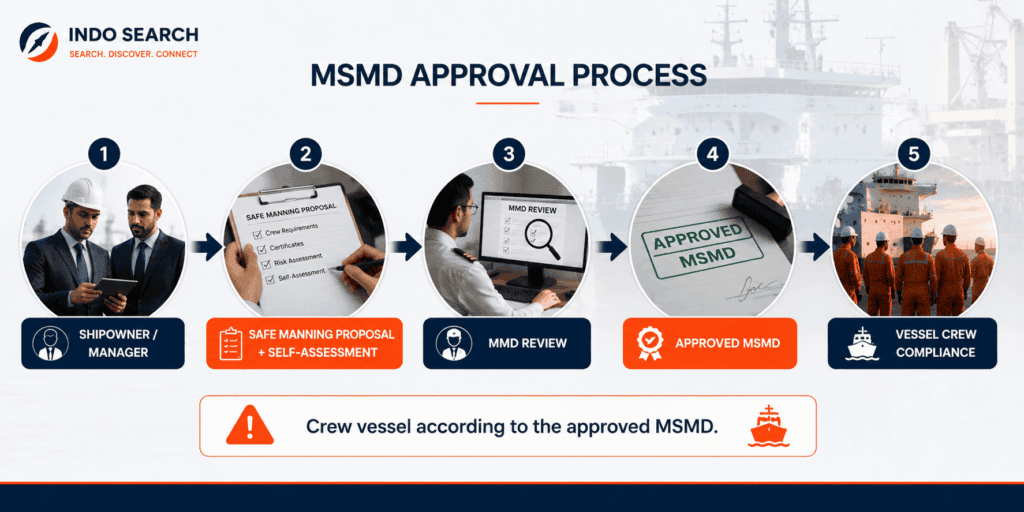
The process matches every other annexure in the circular, and our pillar guide covers the full MSMD approval workflow in more detail. For a near coastal vessel specifically, the shipowner or manager submits a safe manning proposal, with a self-assessment checklist, online to the concerned Mercantile Marine Department (MMD).
The MMD checks the proposal against the Annexure B scale for that vessel’s GT code, plus any additional crew the company proposes for trading patterns, maintenance, or rest-hour compliance. Once the MSMD is approved, the ship must be crewed strictly according to that document, and registered RPSL manning agencies build their near coastal placement plans directly around it.
One detail trips up new ship managers on this annexure specifically: a vessel’s MSMD is tied to its certification track. If a near coastal ship later takes on international charter work, its NCV-certified officers no longer meet the requirement, and the MSMD needs reassessment under Annexure A before that voyage, not after.
Can a Shipping Company Get a Dispensation From the Near Coastal Manning Scale?
Only in narrow, exceptional cases, and the process is identical to every other annexure in the circular. Our pillar guide explains the full two-stage dispensation process, covering sudden illness, injury, or unavailability of a crew member.
For a near coastal vessel, the company applies to the Nautical Wing with full case details, including the applicable Maritime Union of India wage scale for the rank concerned. Once in-principle approval is granted, the company remits the maximum basic wage for that rank to the Directorate before the dispensation takes effect. The Directorate treats these as rare exceptions across all annexures, not a routine way to sail short-handed on a near coastal run.
How Does the Near Coastal Scale Compare With International and Indian Coast Scales?
Annexure B sits between two other cargo scales in the circular, and the difference comes down to certificate standard and how quickly that standard steps up.
| Scale | Annexure | Voyage Type | Entry Master Qualification | Certificate Standard at Top Tier |
| International voyages | A | Worldwide trade, beyond near-coastal limits | Master (FG) | FG throughout, no NCV option |
| Near coastal voyages | B | Defined near-coastal zone | Master NCV (500 GT) or Mate NCV | Steps up to FG above 6000 GT |
| Indian coast, incl. A&N and Lakshadweep | C | Indian coastline and island territories | Master NCV (500 GT) or Mate NCV | Steps up to FG above 6000 GT |
The clearest way to see the difference is to compare codes at the same tonnage. A 4000 GT vessel under Annexure A needs a Master FG from the very first GT band. The same 4000 GT vessel under Annexure B still runs on Master NCV, Code B-4, and only needs an FG-certified Master once it crosses 6000 GT. Annexure C follows a near-identical pattern to Annexure B, which is why the two scales are easy to confuse if you only glance at the tonnage bands without checking the actual voyage type.
What Happens If a Near Coastal Vessel Sails Below Its Approved Manning Scale?
The rule is the same one that runs through the entire circular. Every ship must be manned strictly in accordance with the scale specified in its approved MSMD, and a near-coastal vessel is no exception.
Port State and Flag State inspectors check MSMD compliance during routine surveys, and a shortfall, whether in headcount or in certificate grade, counts as a compliance failure. This matters more on Annexure B than it might first appear. A ship trading with NCV-certified officers, when its actual voyage now needs FG certificates instead, has a real gap. That gap, not a missing body on the crew list, is usually what an inspector finds first.
FAQs
What is the minimum safe manning scale for near coastal voyages?
It is the fixed number and rank of nautical crew, from Master to Cook, that an Indian ship must carry on near coastal voyages, set out in Annexure B of DGMA Circular No. 54 of 2025.
Which circular governs the near coastal manning scale?
DGMA Circular No. 54 of 2025, issued on 8 December 2025 by the Directorate General of Shipping, now the Directorate General of Maritime Administration (DGMA), sets Annexure B alongside every other manning scale for Indian ships.
How many crew does a vessel under 200 GT need under Code B-1?
Code B-1 requires a Master NCV or Mate NCV, one NWKO NCV, 2 AB ratings, and 1 Cook, a total of 5 nautical crew, plus GMDSS qualification on at least one officer.
What certificate does the Master need under Annexure B?
A Master NCV (500 GT) or Mate NCV up to 6000 GT, stepping up to a Master (FG) certificate only once the vessel reaches 6000 GT or above, under Code B-5.
What is the difference between Annexure A and Annexure B?
Annexure A covers international voyages and requires FG certificates at every tonnage level. Annexure B covers near coastal voyages and allows NCV certificates until a vessel reaches 6000 GT.
Can a tug use Annexure B manning outside Indian waters?
Yes, in one specific case. A tug below 500 GT can extend its NCV manning to the Persian Gulf and Singapore Straits, subject to acceptance by the relevant foreign maritime administration.
Does every vessel under Annexure B need a dedicated Radio Officer?
Not necessarily. The requirement is satisfied by either one dedicated Radio Officer with a GMDSS CoC or two deck officers who each hold a valid Indian GMDSS Certificate of Competency.
What happens if a near coastal vessel takes on international charter work?
Its MSMD needs reassessment under Annexure A before that voyage. NCV-certified officers who meet Annexure B do not automatically satisfy the FG requirement under Annexure A.
Do tankers need extra crew under Annexure B?
Yes. Tankers carry one additional crew member in each rank marked with a hash symbol in the circular, on top of the base Annexure B numbers, and need a valid Certificate of Proficiency in Tanker Operation.
Who approves the MSMD for a near coastal vessel?
The concerned Mercantile Marine Department (MMD) reviews the shipowner’s manning proposal against the Annexure B scale and any additional crew proposed for operational or rest-hour reasons, then issues the MSMD.